Last updated: 5 September 2026
TL;DR: A bonus scheme works when it rewards something the whole team influences, is calculated transparently, and never rewards clinical decisions. Get the wording right: a scheme that becomes contractual is hard to withdraw, and regular performance-linked payments have to be reflected in holiday pay for the first 4 weeks of leave.

Pay pressure is real and salary is not the only lever. A bonus scheme looks like an elegant answer: reward the good year, share the upside, keep the wage bill flexible. Done carelessly it does the opposite, rewarding the wrong behaviour and creating a grievance every quarter. This guide covers how to design one that holds.
Three reasons, usually. To compete for staff without permanently raising fixed costs, to share a genuinely good year with the people who produced it, and to focus attention on something the practice wants to improve.
Only the second of those is reliably achieved. A bonus scheme is a weak recruitment signal, because candidates discount money they might not receive, and it is a blunt tool for changing behaviour in a clinical setting. As a way of sharing a good year, though, it works well and is genuinely appreciated.
Be honest about which of the three you are actually doing. Schemes fail most often because they are sold internally as one thing and designed as another, and the team notices the mismatch by the second payment round.
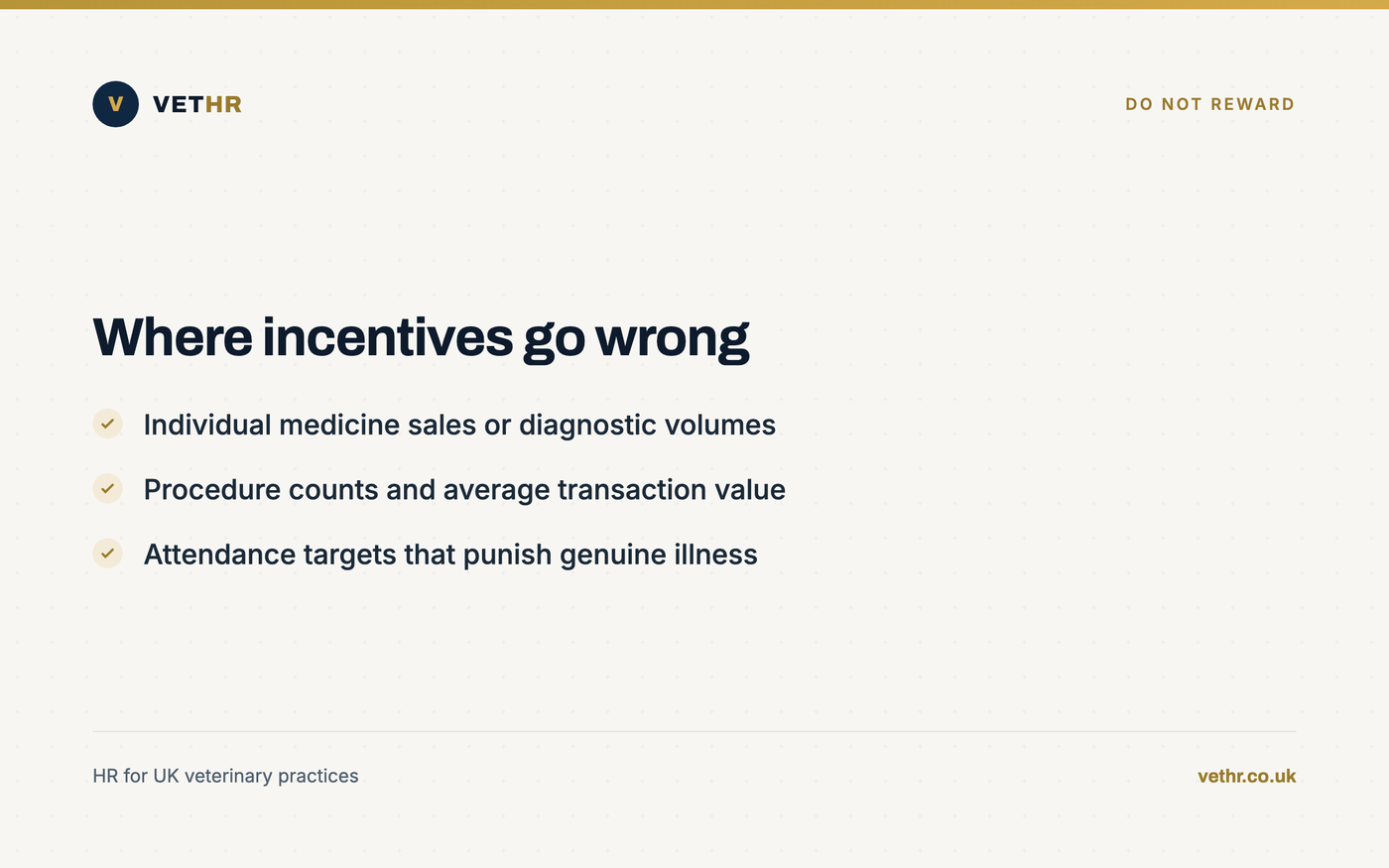
Anything that touches clinical judgement. A bonus scheme linked to individual sales of medicines, diagnostic volumes, procedure counts or average transaction value puts a financial interest between a vet and the recommendation they make, and that tension is visible to clients as well as staff.
The reputational exposure is real. Public debate about the cost of veterinary care has made clients more alert than they were, and a practice that has to explain an incentive structure is already losing the argument, whatever the clinical reality.
There is an internal cost too. A bonus scheme that pays consulting vets on activity pays nothing to the nurse who prepped, the receptionist who filled the diary or the person who cleaned the theatre at eight in the evening, and small teams see straight through that.
Outcomes the whole team influences and nobody can distort. In a practice of 5 to 50 people, the strongest measures are usually practice-level and few in number: two or three, not eight.
Avoid absence-linked bonuses in particular. They reward people for coming in unwell, which in a practice handling immunocompromised patients and shared equipment is a poor trade, and they create discrimination risk where absence relates to disability or pregnancy.
Decide deliberately, and write it down. A genuinely discretionary bonus scheme leaves the practice free to pay nothing in a poor year. A contractual one gives certainty to staff and becomes a term you cannot remove without agreement.
The trap sits between the two. A scheme described as discretionary but paid at the same rate every year for four years can become contractual through custom and practice, and attempting to withdraw it at that point is a change to terms rather than an exercise of discretion.
If you want real discretion, exercise it visibly: vary the amount, state the reasons each year, and confirm in writing that no entitlement arises for the future. If you want certainty, put the formula in the contract and stand behind it. Our contract service handles both forms of wording.
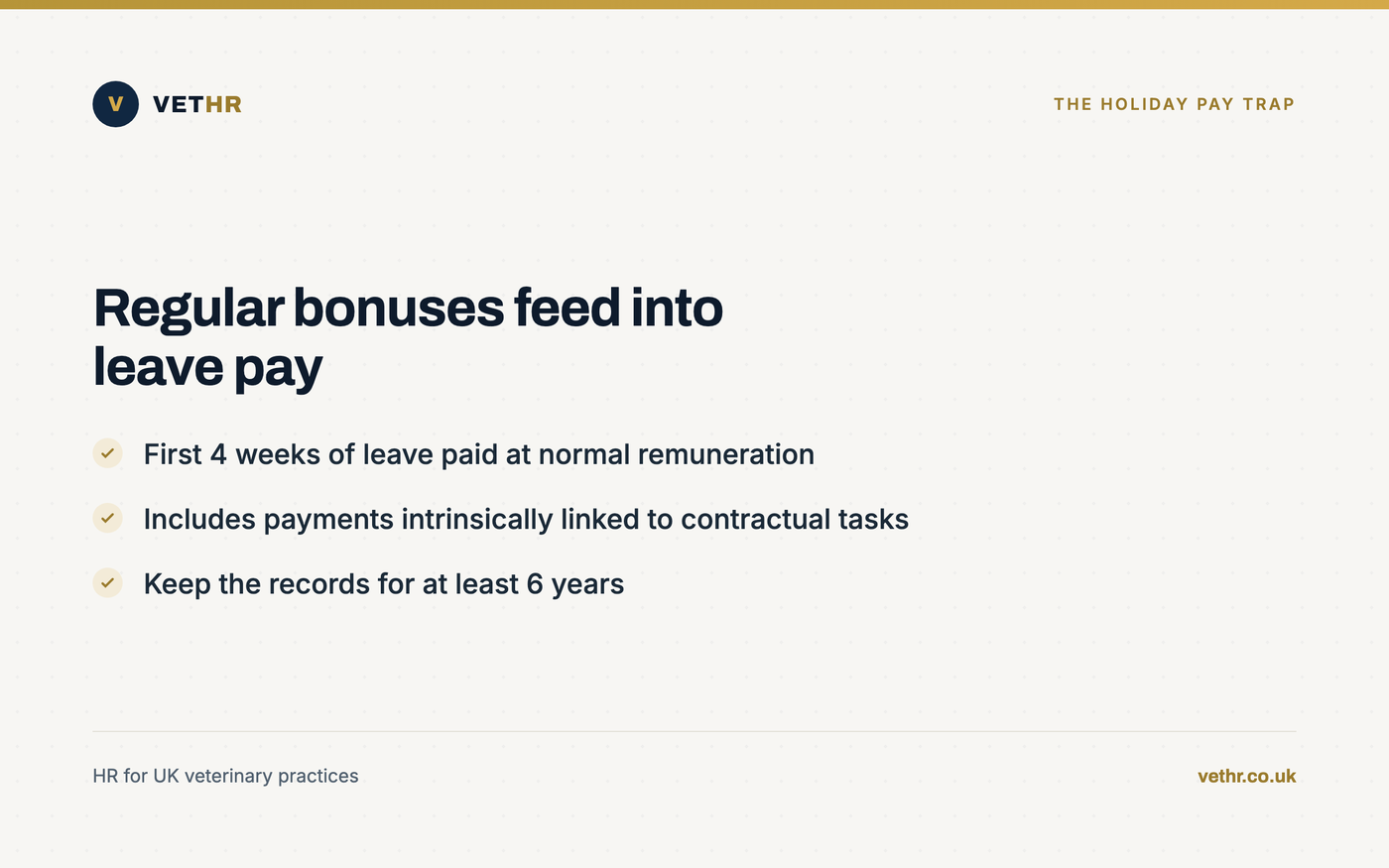
It can increase it, and this is the detail most practices miss. GOV.UK guidance on holiday pay states that the first 4 weeks of leave must be paid at normal remuneration, which includes payments, including commission payments, intrinsically linked to the performance of tasks which a worker is contractually obliged to carry out.
The same guidance covers payments relating to professional or personal status such as length of service, seniority or professional qualifications, and other payments such as overtime that have been regularly paid in the preceding 52 weeks. On bonuses specifically it notes that whether they are included depends on the nature of the bonus.
The practical consequence: a regular, performance-linked bonus scheme is likely to feed into holiday pay, while a genuine one-off discretionary payment is less likely to. Work that out before you launch, and record how the calculation is done. Since 6 April 2026 employers must keep records of annual leave and holiday pay for at least 6 years.
Our holiday calculation system handles the reference period maths, which is where the errors otherwise happen.
It can, provided you are willing to be open about the numbers. Profit share without transparency is just an unexplained payment, and staff will assume the calculation is unfavourable to them because they have no way to check it.
A workable shape for an independent practice: a stated percentage of profit above an agreed threshold, distributed by a rule everyone knows in advance, with a short annual explanation of the result. Distribution by contracted hours rather than by role or seniority is the simplest defensible rule.
Be clear about who is included from the start: part-time staff pro rata, new starters after a stated qualifying period, and leavers who worked most of the year. Deciding those questions after the profit figure is known is how a good year turns into a bad conversation.
In writing, before the measurement period starts, with the formula included. A bonus scheme announced halfway through a year is a gift rather than an incentive, and a formula revealed only at payment time reads as a decision dressed up as a calculation.
Cover four things in the announcement: the period being measured, the measures and thresholds, how any payment is divided, and when it will be paid. Then say plainly whether the scheme is discretionary and whether it creates any expectation for future years.
Review it annually alongside pay. Circumstances change, and a bonus scheme built around a target that stopped being relevant two years ago quietly teaches the team that the numbers do not mean anything. If a measure no longer fits, change it openly at the start of a period rather than adjusting it at the end.
And explain the result in the years when nothing is paid. That conversation is uncomfortable and it is the one that determines whether anybody believes the scheme next time.
Thinking about a bonus this year? A free 30-minute HR health check will pressure-test the design before you announce it. Book your HR health check.
Only carefully. A payment made consistently over several years can become contractual through custom and practice even where the paperwork calls it discretionary, in which case removing it is a change to terms requiring consultation and agreement. Take advice before announcing a withdrawal.
Pro rata by contracted hours is the normal and defensible approach, and part-time workers must not be treated less favourably than comparable full-time colleagues without objective justification. Whatever you decide, apply it consistently and state it in the scheme rules before the period begins.
This needs care, because unfavourable treatment because of maternity leave is unlawful. Practices commonly pay a full share of a practice-wide bonus scheme and treat maternity leave as qualifying service. Take advice on the specific wording rather than deciding case by case.
For retention, generally not. A pay rise is certain, pensionable and appears every month, while a bonus is uncertain and quickly discounted. Bonuses are best used to share genuine upside on top of competitive salaries, rather than as a substitute for reviewing pay properly each year.
Do it regardless of what you pay. The RCVS 2024 survey found that among vets intending to leave the profession, 47% cited not feeling rewarded or valued in a non-financial sense. That is a recognition problem, and no bonus scheme fixes it.
The best schemes we see in veterinary practice are simple, practice-wide and openly explained: a share of a good year, calculated by a rule everyone knew in advance, paid to everybody from the cleaner to the clinical director. The worst are individual, activity-linked and negotiated privately.
If you are considering one, design it alongside your annual salary review rather than instead of it. Our HR consultancy will pressure-test the design and the wording, and the free HR health check takes 30 minutes.
The Vet HR Team provides HR consultancy and white-labelled staff systems exclusively to UK veterinary practices. We are not tax advisers, and payroll treatment should be confirmed with your accountant.
Contracts, rotas, holiday, a difficult conversation. Tell us what you are dealing with and we will come back within one working day. Nothing to sign up to.
Got it. We will come back to you within one working day. If you do not see a reply, please check your spam folder.
