Last updated: 2 September 2026
TL;DR: Once a worker tells you in writing that she is pregnant or a new mother, you must carry out an individual pregnancy risk assessment and make any changes needed. If a risk cannot be removed, the law sets a strict order: adjust conditions or hours, then offer suitable alternative work on the same terms, then suspend on full pay. Veterinary work triggers several of the named hazards at once.
An RVN tells you she is pregnant. Congratulations are the easy part. What follows is a legal duty with a defined sequence, and veterinary practice happens to contain several of the exact hazards the regulations were written about. This guide covers the pregnancy risk assessment a UK practice must carry out, and how to do it without making anyone feel sidelined.
When you are told in writing. The Health and Safety Executive puts it plainly: once your worker has informed you in writing, you must complete an individual risk assessment and make any necessary changes to support them. The duty covers pregnant workers, those who have given birth in the last 6 months and those who are breastfeeding.
Two words in that sentence matter. Individual, because a general practice risk assessment does not discharge the duty. And must, because this is not a courtesy extended to valued staff. It is a legal requirement with a clear trigger.
In practice, most people tell their practice manager verbally first. Respond warmly, then ask for it in writing, explain why, and start the pregnancy risk assessment the same week. Waiting until the twelve-week scan is a common and avoidable mistake, because the earliest weeks are when several of the risks matter most.
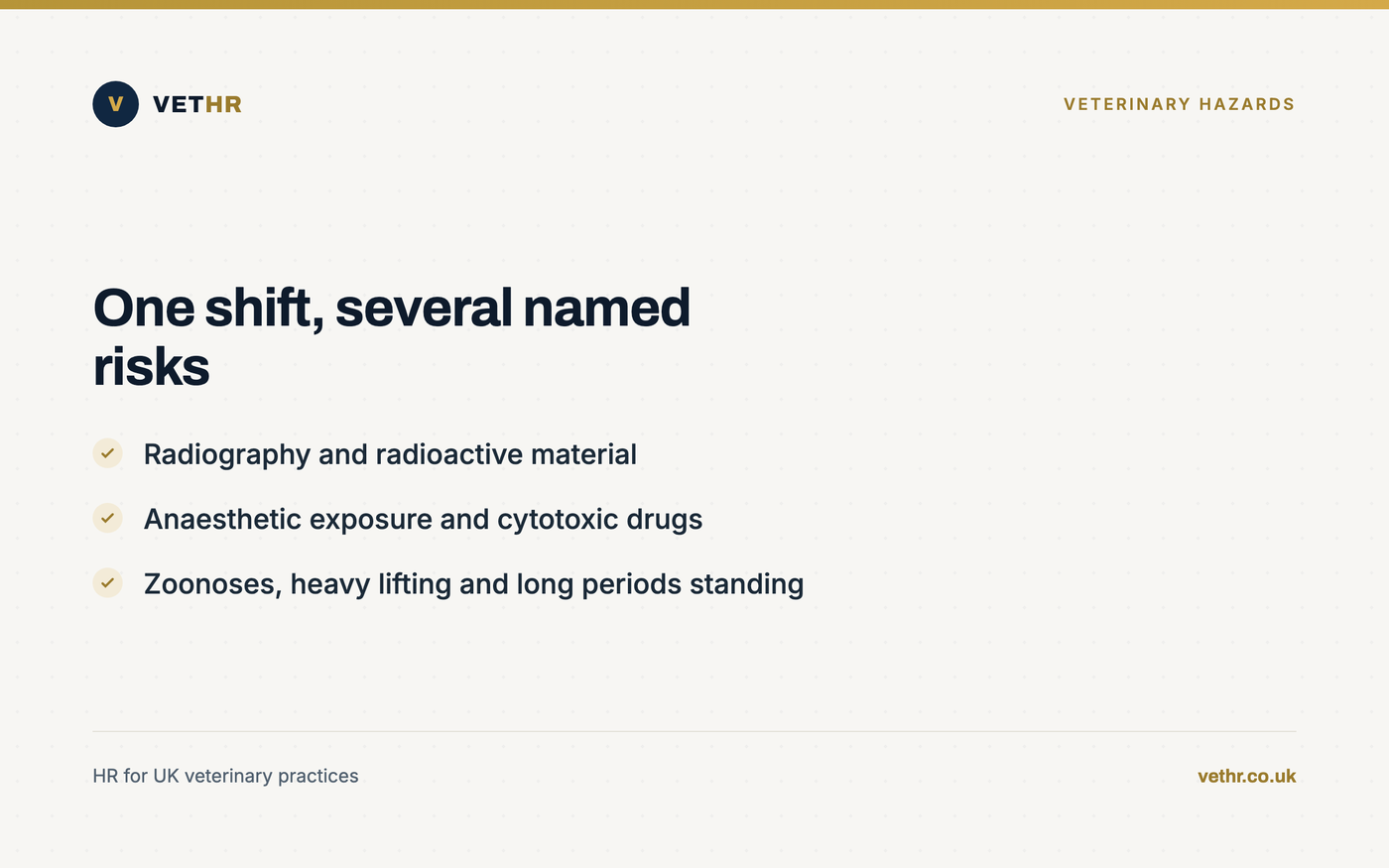
More than in almost any comparable small workplace. The HSE’s list of common risks for new and expectant mothers includes lifting or carrying heavy loads, sitting or standing for long periods, radioactive material, infectious diseases and antimitotic or cytotoxic drugs. A veterinary practice can present every one of those in a single shift.
Translated into practice terms, the pregnancy risk assessment needs to look hard at these:
The pregnancy risk assessment should be specific to her role, not to the job title. A referral surgeon, a farm vet and a receptionist face genuinely different exposures, and a template that treats them identically is evidence of nothing.
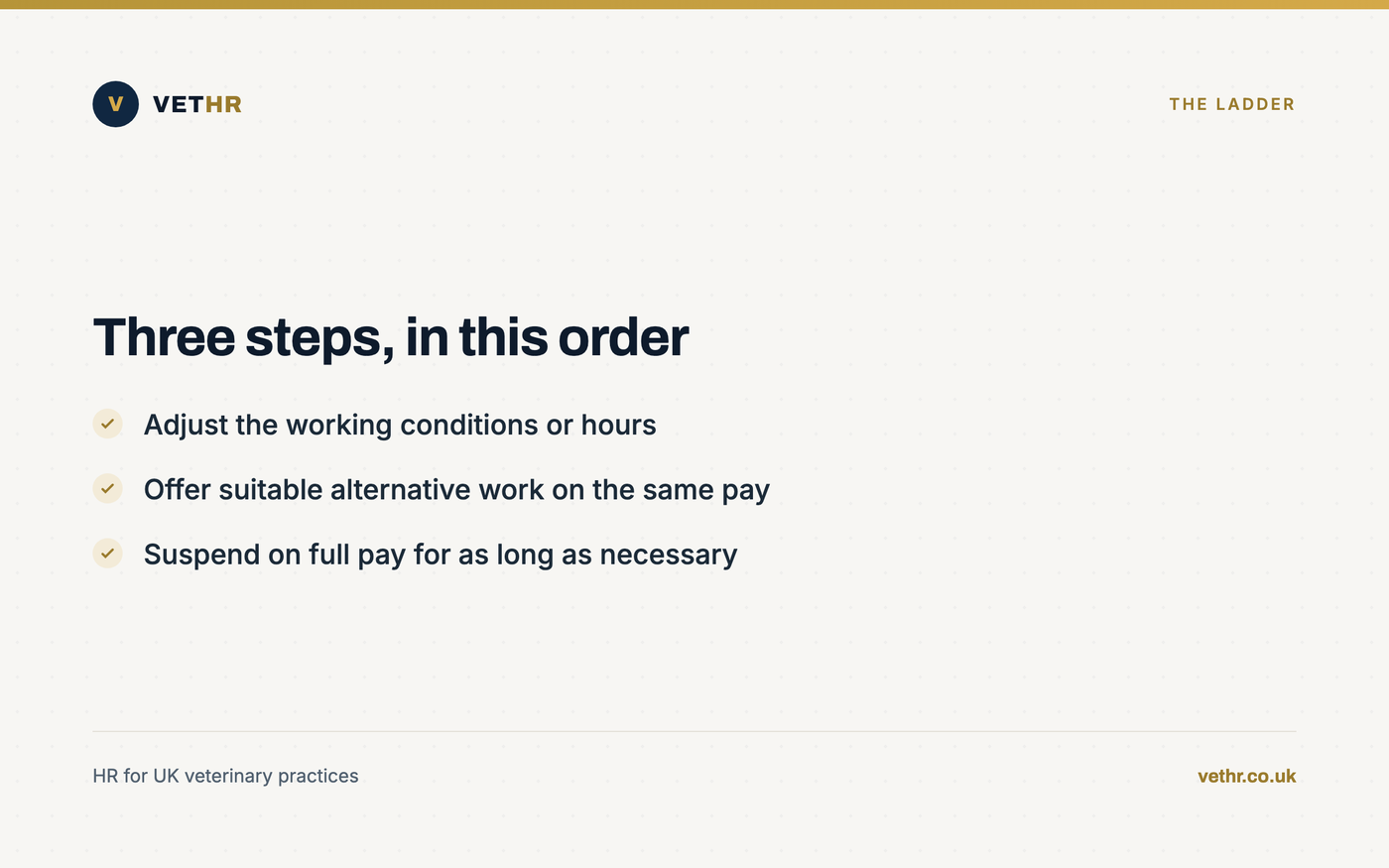
There is a strict order, and skipping a step is where employers get into difficulty. The HSE sets out three stages: adjust the working conditions or hours to avoid the risk; provide suitable alternative work on the same terms and conditions including pay; then suspend on paid leave for as long as necessary.
That third step is a suspension on full pay under the Management of Health and Safety at Work Regulations. It is not sick leave, it is not unpaid, and it is not maternity leave brought forward. Practices sometimes reach for one of those three by mistake, and each of them creates a claim.
Work through the ladder in order and record in the pregnancy risk assessment what you considered at each stage. If radiography can be reassigned, that is step one. If it cannot, and there is meaningful alternative work at the same pay, that is step two. Only when both genuinely fail does step three arrive.
Usually more than the clinical adjustments do. Removing one person from radiography, out of hours and heavy restraint redistributes those tasks across a team that was already at capacity, and the redistribution is where resentment grows if it is handled silently.
Be explicit with the team about what is changing and why, within the limits of her privacy and only once she is content for it to be shared. Colleagues cover willingly when they understand the reason and can see it is temporary and fairly shared.
Model the change in the rota rather than improvising it week to week. A rota system that shows who is available for which duties makes the redistribution visible and stops the same two people absorbing all of it. Our guide to maternity leave in a veterinary practice covers what comes next.
As a joint problem-solving exercise, not an announcement of restrictions. The person knows her job better than anyone, and she will usually have thought about the risks long before she told you. Start by asking what she is already worried about.
Avoid two extremes. Doing nothing because she says she feels fine is a breach of duty, and her reassurance does not transfer the risk. Removing her from all clinical work on day one is over-correction of the pregnancy risk assessment, and it is often experienced as being written off professionally.
Agree a review date. A pregnancy risk assessment is not a single document filed and forgotten. Capacity, mobility and fatigue change through pregnancy, and the assessment should be revisited as they do, along with a separate review before return to work and while breastfeeding.
One page, dated, signed by both of you, and specific enough that a stranger could follow the reasoning. A pregnancy risk assessment that lists hazards without recording what you decided is only half a document, and it is the decisions that will matter if the assessment is ever examined.
Keep it with the personnel file rather than in the health and safety folder alone, because the questions that arise later are usually employment questions rather than safety ones. Our guide to digital staff records covers where these documents should live.
One further point on privacy. The pregnancy risk assessment contains health information, so limit access to those who need it and agree with her what the wider team will be told.
Have someone in your team who has just told you? A free 30-minute HR health check will get the assessment and the paperwork right. Book your HR health check.
Yes. The duty sits with the employer and cannot be waived by the employee. Her preference is important input into what adjustments look like, and it should be recorded, but it does not remove the requirement to assess the risks and act on them.
HSE lists radioactive material among the risks to assess, and radiation work in a practice is also governed by your local rules and radiation protection adviser. The safest and most common approach is to reassign holding and positioning duties entirely, and to record that decision in the assessment.
Yes, where the first two steps genuinely cannot resolve the risk. HSE states the worker should be suspended on paid leave with full pay in line with the Management of Health and Safety at Work Regulations. It is a last resort, which is exactly why the earlier steps deserve real effort.
It does. The HSE guidance covers new and expectant mothers, including those who have given birth within the last 6 months and those who are breastfeeding. A return to work review is therefore part of the process rather than an optional extra.
Duties to workers on your premises are broader than duties to employees alone, so do not assume the question disappears because someone is not on your payroll. Ask, assess and adjust, and take advice where the working relationship is genuinely unclear.
Handled well, this is one of the moments that decides whether someone comes back after maternity leave. A prompt, specific pregnancy risk assessment says the practice takes her safety seriously and still values her professionally. Silence, or a blanket removal from clinical work, says the opposite.
Our policy library includes the assessment templates and the family leave policies that sit around them, and our HR consultancy will run the process with you. The free HR health check is the fastest way to find out what you already have.
The Vet HR Team provides HR consultancy and white-labelled staff systems exclusively to UK veterinary practices. Radiation safety decisions should also be checked with your radiation protection adviser.
Read next: First Aid at Work in a Veterinary Practice, The COSHH Assessment Your Veterinary Practice Probably Needs to Redo and Needlestick Injuries in a Veterinary Practice.
Contracts, rotas, holiday, a difficult conversation. Tell us what you are dealing with and we will come back within one working day. Nothing to sign up to.
Got it. We will come back to you within one working day. If you do not see a reply, please check your spam folder.
