Last updated: 28 August 2026
TL;DR: A training cost agreement is a written arrangement setting out what the practice pays for, what the employee commits to, and what is repayable if they leave soon after. To be recoverable it must be agreed in writing before the spend, taper over time, and reflect a genuine estimate of the practice’s loss rather than a punishment.

A practice funds a certificate for a promising vet. Eighteen months and several thousand pounds later, they resign. Nobody wants to be the practice that stops paying for development, and nobody wants to be the practice that funds a competitor’s hire. A training cost agreement is how you hold both positions at once.
A written agreement, signed before the money is spent, that sets out three things: what the practice will fund, what the employee commits to in return, and what proportion becomes repayable if they leave within a defined period. A training cost agreement is a separate document from the contract, referenced by it.
The distinction that matters is between an investment and a loan. A training cost agreement is neither exactly. It is a conditional investment: the practice funds development, and the condition is that the practice gets a reasonable period of benefit from it before the person moves on.
Framed that way, most veterinary staff find it entirely reasonable. Framed as “you owe us money if you leave”, the same clause reads as a trap and causes exactly the resentment that makes people leave.
Only with the right paperwork. GOV.UK is clear that an employer can only make deductions from pay where it is required by law, the worker agrees in writing, or the contract says they can. A verbal understanding at the time of booking a course does not qualify.
So the sequence is not negotiable. Written agreement first, signed by both parties, then the spend. A training cost agreement produced after someone has resigned protects nothing, and attempting to deduct without it turns a recruitment problem into an unlawful deduction from wages claim.
There is a second limit. A repayment clause that operates as a punishment rather than a genuine estimate of what the practice has lost risks being unenforceable as a penalty. Demanding the full course fee back on the day after a two-year certificate completes is the sort of term that invites that argument.
Practical protection also has limits: if the final salary payment does not cover the sum, you are left pursuing a debt from a former employee. Most practices decide, correctly, that recovery is a deterrent and a partial recoupment rather than a full remedy.
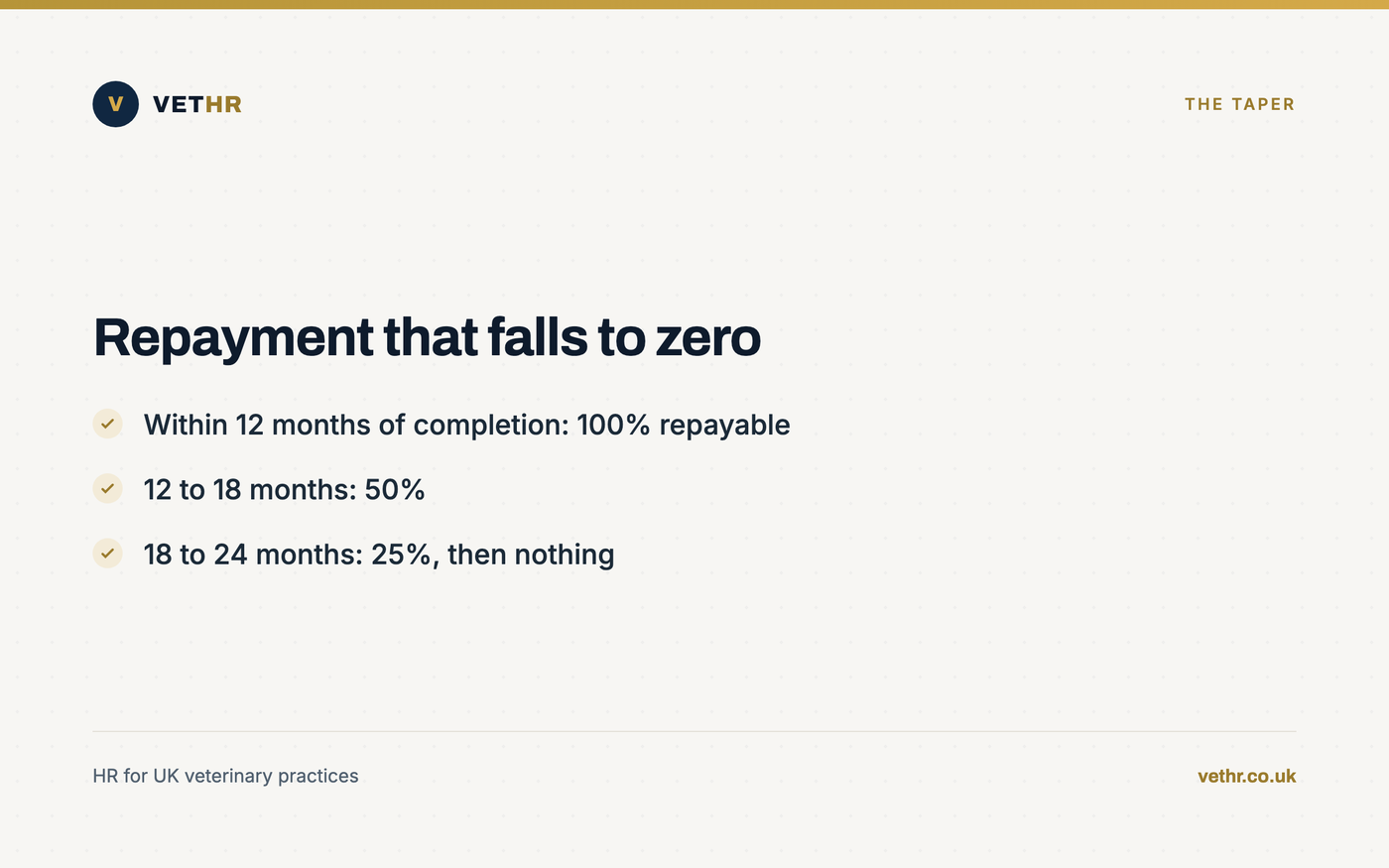
Down to zero over a period that matches the value of the training. The longer the practice has had the benefit, the less should be repayable. A flat “repay everything within two years” is both unfair and legally fragile. A sliding scale is easier to justify and easier to explain.
A workable structure for a course completed in month zero:
Scale the period to the spend. A £400 one-day course does not justify a two-year tie. A funded certificate costing several thousand pounds plus study leave reasonably does. The proportionality of your training cost agreement is the thing most likely to be questioned, so set it deliberately.
Everything the practice is spending, itemised, plus the conditions attached. Vagueness is what makes a training cost agreement fail. If study leave, exam fees and travel are part of the investment, say so in figures before the course starts.
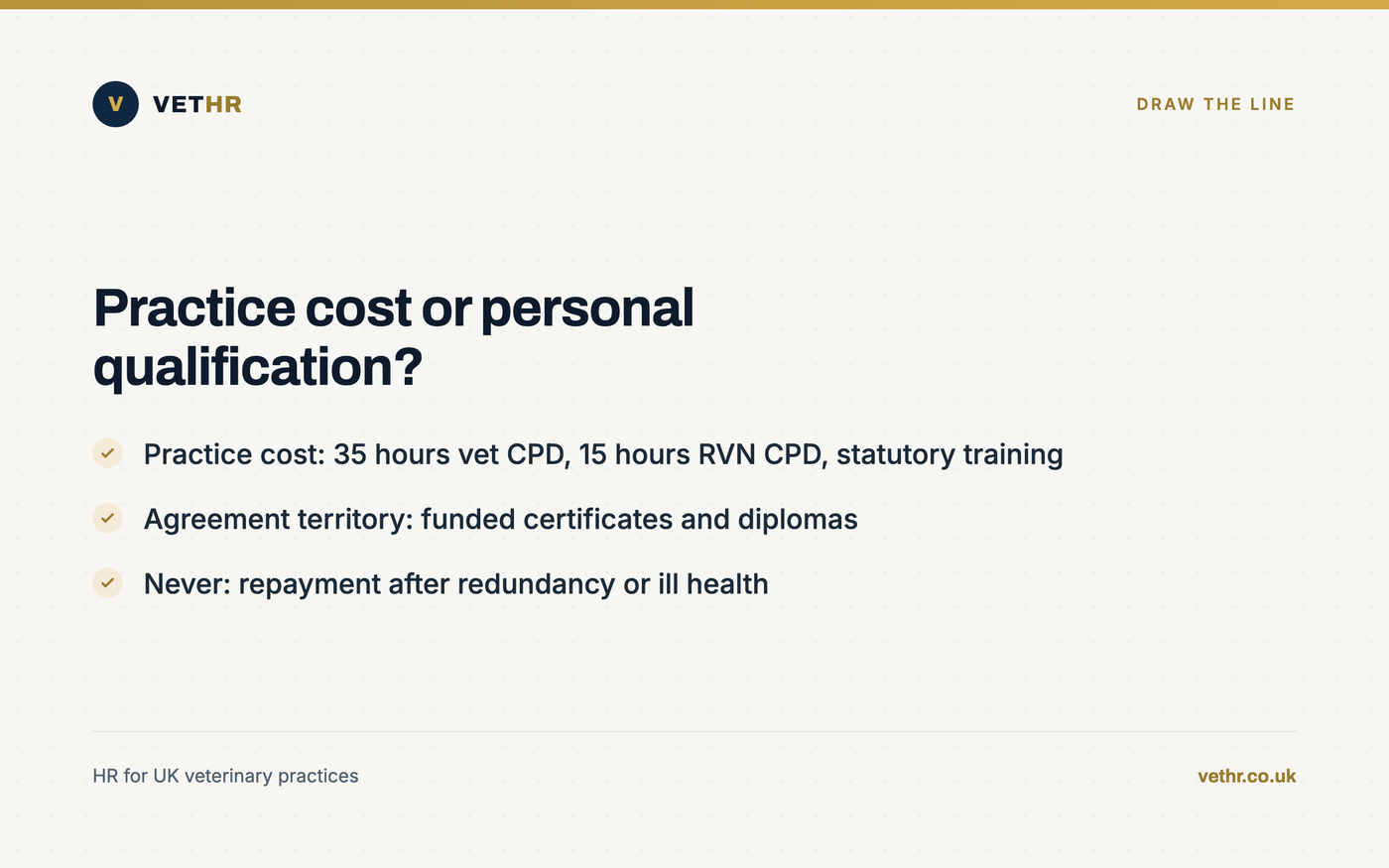
The exclusions list is what makes a training cost agreement fair rather than punitive. Nobody should repay a certificate because the practice made them redundant, and a clause that would require it makes every other clause look worse.
Keep the two apart. The RCVS requires 35 hours of CPD a year for veterinary surgeons and 15 hours for registered veterinary nurses, plus reflection. That is a professional obligation, not a discretionary perk, and it should not sit inside a repayment arrangement.
Draw the line at the point where training becomes a qualification the individual carries to any employer. Mandatory annual CPD, in-house training and statutory health and safety training are practice costs. A funded certificate, an advanced practitioner route or a specialist diploma is where a training cost agreement belongs.
Getting that line wrong is a recruitment problem as much as a legal one. A practice that asks an RVN to sign a repayment agreement for routine CPD looks mean, and word travels quickly in a regional veterinary community.
Badly drafted clawback does. A well drafted training cost agreement usually increases the amount of training a practice is willing to fund, which improves retention. The variable is not whether the agreement exists but whether it is proportionate and explained.
Think about what the alternative looks like. Practices that have been burnt once often stop funding development altogether, which is the outcome nobody wanted: no certificates, no advanced skills, and a team that leaves for employers who will pay for them.
Explain the agreement in the same conversation as the opportunity, not by email afterwards. “We will fund this, here is what it costs us, here is the period we are asking for in return” is a fair exchange between adults. Our guide to veterinary staff retention covers what else actually moves the needle.
By pricing the cover, not just the salary. A day of study leave for a sole charge vet is rarely a day of lost salary. It is a day of freelance vet cover, or a day of reduced consulting capacity, and that number belongs in the itemised list alongside the course fee.
Practices routinely undercount this. A certificate with 12 study days, each requiring cover, can carry a rota cost comparable to the tuition. Including it makes the training cost agreement honest in both directions: the employee sees the true scale of the investment, and the practice is not quietly absorbing a cost it never named.
Book the study days into the rota at the start of the course rather than month by month. Fixed dates mean cover can be arranged early and cheaply, and they stop study leave becoming the thing that gets cancelled every time the practice is busy. A rota system that holds future commitments makes this straightforward.
One caution. If study leave repeatedly gets cancelled and the person fails as a result, a repayment claim will look very poor indeed. Protect the days you promised.
Funding a certificate this year? A free 30-minute HR health check will show whether your paperwork would let you recover a penny of it. Book your HR health check.
Only up to the amount actually owed under a signed agreement, and only where the written authority to deduct exists. GOV.UK permits deductions where the worker agrees in writing or the contract allows it. Beyond that, any remaining balance is a civil debt, recoverable only by agreement or through the courts.
Decide before it happens and write it down. Most practices treat a genuine attempt as satisfying the agreement, with repayment triggered only by non-attendance or withdrawal without good reason. Penalising an honest failure discourages the next person from attempting anything difficult.
Treat apprenticeship funding separately, because government-funded training operates under its own rules and the costs are largely not yours to recover. Any additional spend outside the apprenticeship, such as extra courses or equipment, can be covered by a separate agreement if it is genuinely additional.
Long enough to recover the value, and no longer. For most veterinary certificates a 24-month taper is defensible. Beyond that, the argument that the practice has not yet had reasonable benefit becomes harder to make, and the clause starts to look like a restraint rather than a recovery.
Separate, and referenced by the contract. Training funded years into employment needs its own dated document with its own figures. A single clause in a contract signed on day one cannot describe a course nobody had thought of at the time.
Practices that develop people keep people. The purpose of a training cost agreement is not to trap anyone; it is to make the practice comfortable enough to keep saying yes. When the paperwork is fair and explained properly, the number of certificates funded goes up, not down.
If you are about to commit to a certificate, get the document right first. Our contract and policy service drafts these for veterinary practices, our policy library keeps them current, and the free HR health check will tell you what you currently have.
The Vet HR Team provides HR consultancy and white-labelled staff systems exclusively to UK veterinary practices. We are not a law firm, and recovery of a specific sum is a matter for legal advice.
Read next: Getting a Sponsor Licence.
Contracts, rotas, holiday, a difficult conversation. Tell us what you are dealing with and we will come back within one working day. Nothing to sign up to.
Got it. We will come back to you within one working day. If you do not see a reply, please check your spam folder.
