Last updated: 14 June 2026
TL;DR: A whistleblowing policy tells your team how to raise a concern about wrongdoing safely: what counts as a protected disclosure, who to tell, and what happens next. In a veterinary practice the stakes include patient safety, medicines and professional duties, so the route matters. This guide covers the law, the difference between a grievance and a disclosure, what a small practice’s policy must include, and how to handle a concern about a senior person.
Most practices have a grievance procedure. Far fewer have a whistleblowing policy, and the two do different jobs. This guide explains what whistleblowing legally is, why clinical settings raise the stakes, and what a proportionate policy for a small practice looks like.
Whistleblowing is a worker reporting certain types of wrongdoing that affect others, not just themselves. The law calls this a protected disclosure. It covers concerns such as a criminal offence, danger to health and safety, environmental damage or a cover up, and the disclosure must be in the public interest.
GOV.UK guidance on whistleblowing for employees lists the concerns that count: a criminal offence such as fraud, danger to someone’s health and safety, risk or actual damage to the environment, a miscarriage of justice, a company breaking the law, a belief that someone is covering up wrongdoing, and sexual harassment. The same guidance is clear that the disclosure must be in the public interest, meaning it must affect others, for example the general public.
Protection is wide. Acas guidance on whistleblowing at work explains that employees, workers, agency workers and apprentices are all protected under the Public Interest Disclosure Act 1998, and that protection applies from the beginning of employment. A team member does not need years of service before the law stands behind them.
GOV.UK also notes that an employer may have a whistleblowing policy that tells workers what to expect if they report a concern internally. That one sentence is the whole argument for writing yours. If you do not describe the route, every person who spots something serious has to invent their own.
Because clinical work concentrates exactly the concerns whistleblowing law exists for. Controlled drugs, anaesthesia, radiation, animal welfare and public health all sit inside an ordinary working day. Vets and nurses also carry professional duties to raise concerns, so a practice without a clear internal route leaves people to improvise.
Run down the GOV.UK list with a clinical eye. Controlled drugs that are not stored or recorded properly. An anaesthetic monitoring step skipped on busy days. Radiation safety rules quietly ignored. A colleague working hours that make them unsafe. Each of these fits the qualifying categories, and each is more likely to be seen first by an RVN or a receptionist than by the owner.
There is a professional layer too. Vets and registered veterinary nurses answer to a professional regulator as well as an employer, and concerns about animal welfare or unsafe practice carry professional weight for them. When a clinician is weighing up whether to speak, they are often thinking about their professional position, not just their job. A clear internal route respects that.
And practices are small. The person who sees the problem usually knows the person causing it, shares a lunch room with them, and may be managed by them. Without a policy, the personal cost of speaking is the whole story. With one, the practice has already said: we want to hear this, here is how, and here is what happens next.
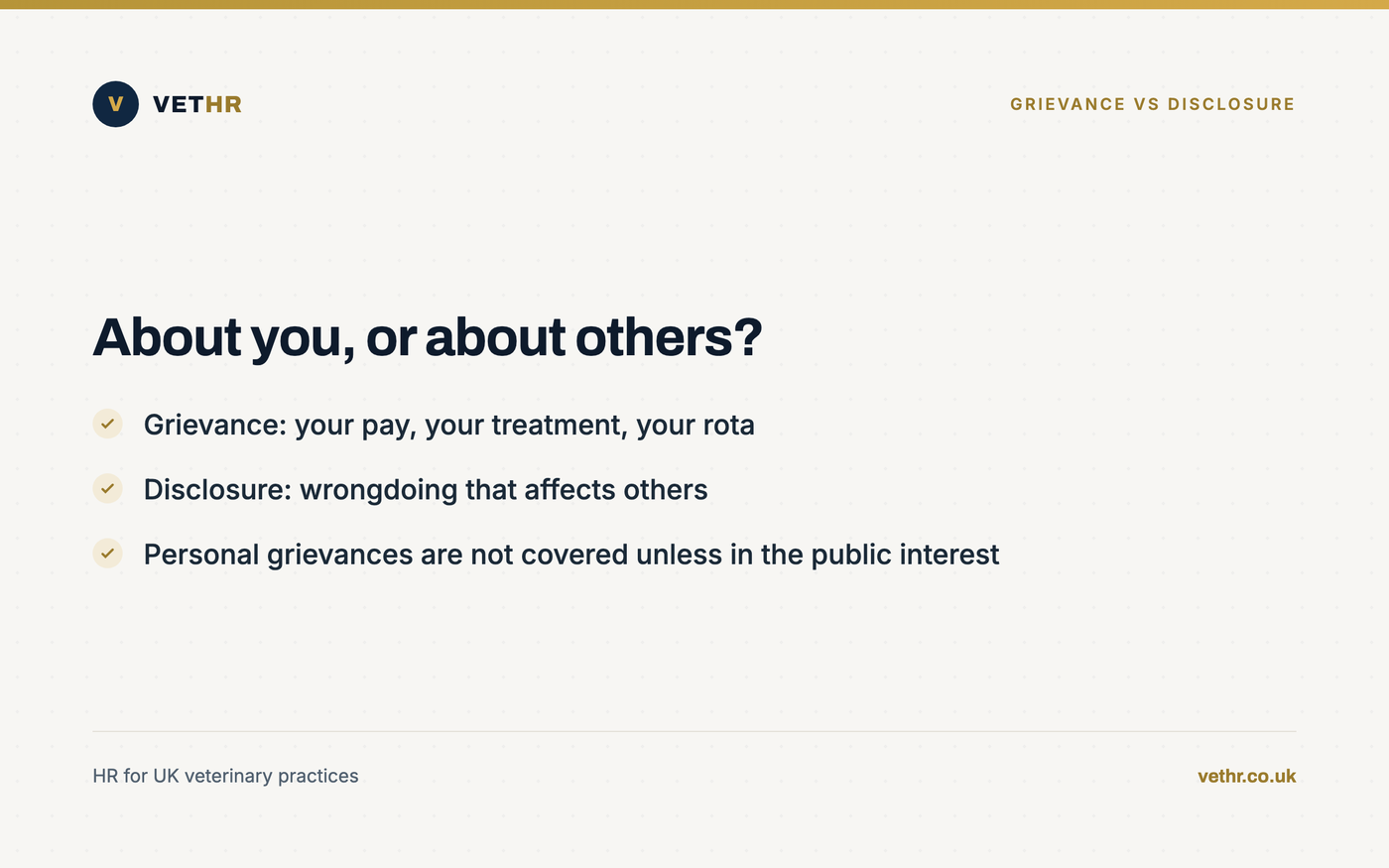
A grievance is about you: your pay, your treatment, your working relationships. A protected disclosure is about wrongdoing that affects others, such as patients, clients or the public. GOV.UK is explicit that personal grievances are not covered by whistleblowing law unless the particular case is in the public interest.
The distinction is easier with examples. “My rota gives me every Saturday” is a grievance. “The controlled drugs register is being filled in days later, from memory” is a disclosure. “I am spoken to badly in front of clients” is a grievance. “Out of date stock is being relabelled and used” is a disclosure. One is about fair treatment of a person. The other is about wrongdoing with wider consequences.
Routing matters because the procedures do different work. A grievance process aims to resolve a situation for an individual and usually ends in a meeting and an outcome. A disclosure needs the underlying problem investigated and fixed, with the person who raised it protected while that happens. Push a disclosure through the grievance route and you can close the meeting while leaving the wrongdoing untouched.
Some concerns are genuinely both, and GOV.UK acknowledges that a personal case can be covered where it is in the public interest. Do not make the person choose the right doorway. Take the concern, decide the route yourself, and if part of it is personal, run that part through the process in our guide to handling a grievance in a veterinary practice.
Not sure your paperwork would cope if someone raised a serious concern tomorrow? Book a free HR health check. In 30 minutes we will look at what you have, what is missing for a practice your size, and what to fix first. Straight answers, nothing sold for the sake of it.
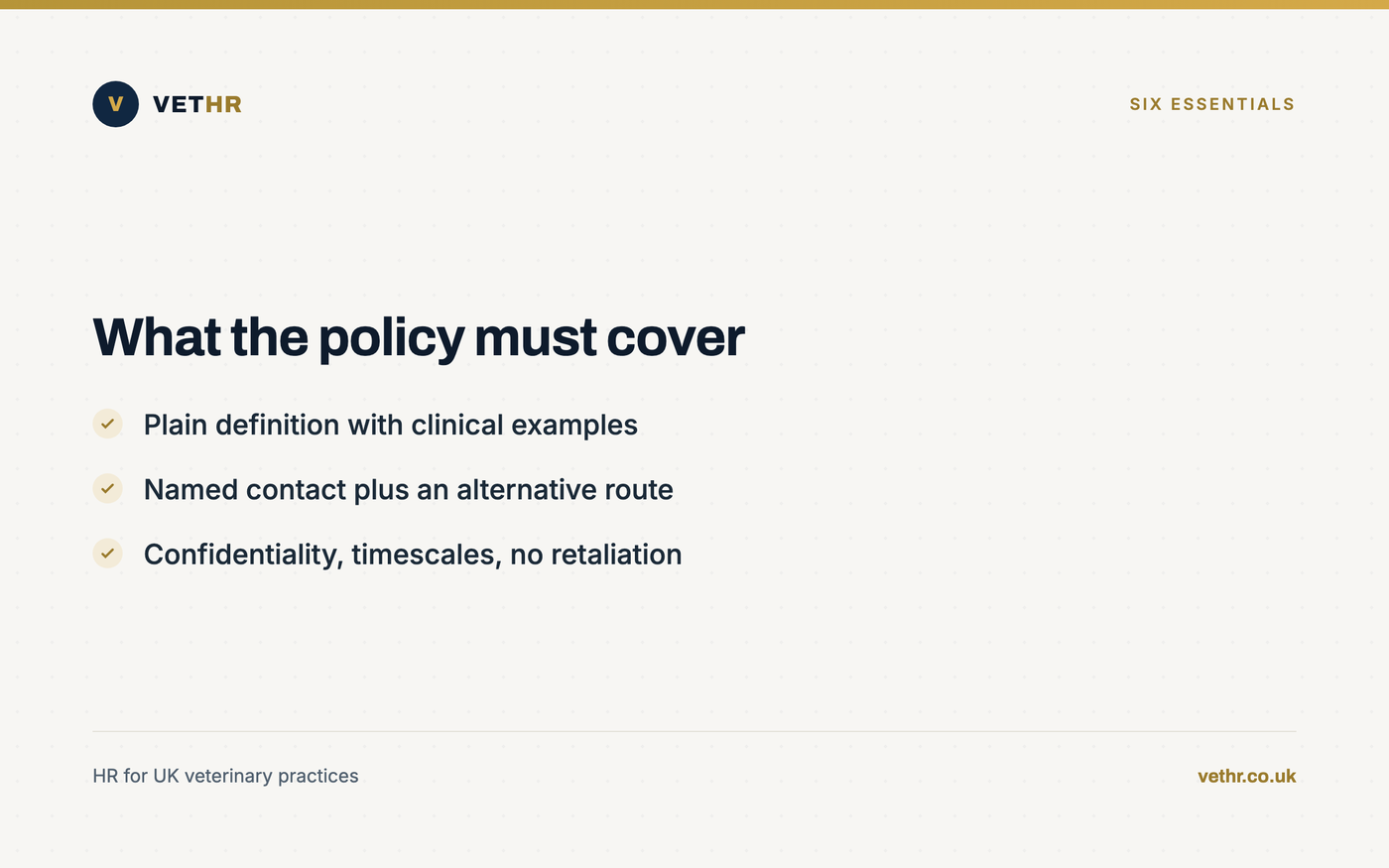
Six things: what whistleblowing is and is not, who to tell inside the practice, an alternative route when the concern involves the usual contact, how confidentiality is handled, what the practice will do and when, and a clear statement that nobody who raises a genuine concern will suffer for it.
Two pages is enough. A whistleblowing policy nobody can find, or nobody can face reading, protects nobody. Keep it plain, host it where the rest of your policies live, and let staff reach it from a phone. Our policies system keeps every practice policy current, findable and acknowledged per person and per version.
It also helps to separate the everyday from the exceptional. Most concerns start life as small observations: a near miss, a broken process, a worrying shortcut. A simple incident reporting route such as our See It Report It system catches those early, in the open, before they harden into something a whistleblowing policy has to handle.
By law and by behaviour. The Public Interest Disclosure Act 1998 protects whistleblowers from unfair dismissal and from detriment, which Acas describes as being treated worse than before. In practice, protection means confidentiality where possible, no change to rotas or duties because of the disclosure, and a named person watching for exactly that.
The Acas examples of detriment are worth reading against a rota: bullying or harassment, being denied training, being overlooked for promotion, having hours reduced. In a practice, detriment can also look like the colder shift pattern, the missing surgical slots or the sudden silence in the prep room. None of it needs to be deliberate to do damage.
So make protection a task, not a sentiment. Keep the circle of people who know small. Record what was decided and why. Have the named contact check in with the person a few weeks later and ask directly whether anything has changed for them. If it has, treat that as seriously as the original concern.
Be honest about confidentiality. GOV.UK notes that someone raising a concern should say straight away if they do not want anyone to know it was them. The practice equivalent is to ask that question up front, then be truthful: in a team of ten, complete anonymity may be impossible, but control over who is told, and when, is not.
Your policy must name a route that does not run through the person concerned. GOV.UK confirms a worker can raise a concern with a prescribed person or body instead of their employer, so a good policy says who the alternative contact is before anyone ever needs to use it.
Inside the practice, the bypass is usually a second director, a senior person outside the line involved, or an external HR partner. This is one place an outside contact earns its keep: a concern about the principal vet cannot sensibly be heard by the principal vet, and an external route turns an impossible conversation into a possible one.
Outside routes exist whether or not your policy mentions them. GOV.UK guidance on who to tell and what to expect sets out the alternatives: a prescribed person or body relevant to the wrongdoing, or a legal adviser. Its example is that a concern about a care home can be made to the Care Quality Commission. The lesson for an owner is simple: staff already have routes around you. A policy that admits this openly is not inviting trouble. It is building the trust that makes the internal route the natural first choice.
If you are the subject, step out. Hand the matter to the named alternative, do not sit in on the conversations, and never question the motives of the person who raised it. How the practice treats its most uncomfortable concern is the clearest signal the rest of the team will ever receive.
Whistleblowing law protects workers whether or not their employer has a policy. GOV.UK describes a whistleblowing policy as something an employer may have that tells workers what to expect when they report a concern. So the protections are automatic. The policy is how a practice manages them well rather than badly, and it is the difference between a described route and an improvised one.
A grievance concerns your own employment: pay, treatment, relationships. A disclosure concerns wrongdoing that affects others, such as danger to health and safety or a criminal offence. GOV.UK states that personal grievances are not covered by whistleblowing law unless the particular case is in the public interest, which is why the two need separate routes.
Yes. GOV.UK confirms a worker can report a concern to a prescribed person or body instead of their employer, provided it is relevant to the wrongdoing, or take legal advice. A sensible policy acknowledges this rather than pretending the internal route is the only one, because a policy that hides the law convinces nobody.
Acas describes detriment as being treated worse than before or having your situation made worse, with examples including bullying, harassment, being denied training, being overlooked for promotion and having hours reduced. In a small practice it can be quieter than that: a changed rota, withdrawn duties, a shift in tone. All of it is worth taking seriously.
Agency workers are protected, along with employees, workers and apprentices, according to Acas guidance on whistleblowing at work. Genuinely self-employed people are generally not. The practical answer for a practice is simpler: treat any serious concern the same way regardless of who raises it, because the wrongdoing matters more than the employment status of the person who saw it.
A whistleblowing policy is not an admission that something is wrong. It is the practice saying, before it is ever needed, that serious concerns will be heard, looked into and never punished. The law already protects the person who speaks up. The policy decides whether they speak to you first, or to someone outside.
Start by writing the route down. Keep it with the rest of your policies in a hosted, acknowledged policy library, give the everyday concerns a home in See It Report It, and if you want a second pair of eyes on the whole picture, book a free HR health check and we will tell you plainly where the gaps are.
The Vet HR Team provides HR consultancy and white-labelled staff systems exclusively to UK veterinary practices.
Contracts, rotas, holiday, a difficult conversation. Tell us what you are dealing with and we will come back within one working day. Nothing to sign up to.
Got it. We will come back to you within one working day. If you do not see a reply, please check your spam folder.
