Last updated: 14 June 2026
TL;DR: Neonatal care leave gives parents up to 12 weeks of extra leave when their baby spends 7 or more full consecutive days in neonatal care. It applies to babies born on or after 6 April 2025. The leave is a day one right; statutory pay needs 26 weeks of service. It sits on top of maternity and paternity leave. Here is how eligibility, pay, notice and cover planning work in a small veterinary practice.

When a colleague’s baby arrives early or unwell, the practice wants to do the right thing and usually improvises. Since April 2025 there has been a statutory answer. Neonatal care leave is newer than most staff handbooks, which means most handbooks do not mention it. This guide sets out the rules and the planning, so the week it matters is not the week you start reading.
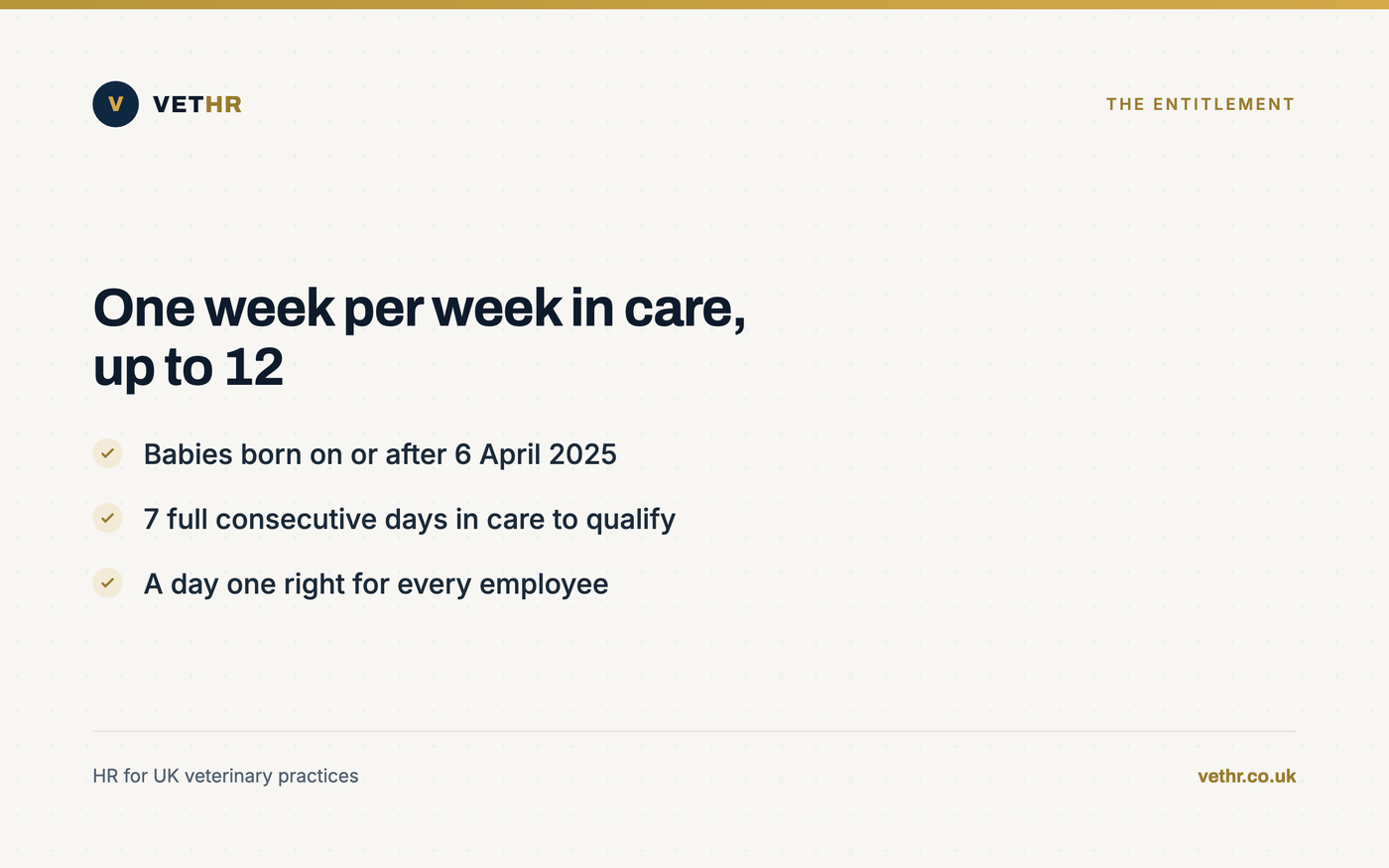
Neonatal care leave is a statutory right for parents whose baby spends 7 or more full and continuous days in neonatal care. It gives one week of leave for every full week the baby is in care, up to 12 weeks, and it applies to babies born on or after 6 April 2025, per GOV.UK guidance on neonatal care leave and pay.
Neonatal care means care that starts within the first 28 days after birth. GOV.UK counts hospital care, medical care after discharge under consultant oversight, and palliative or end-of-life care. The right applies to employees in England, Scotland and Wales, per the GOV.UK eligibility page.
For a practice owner, the headline is simple: a parental absence you had planned around can now grow by up to 12 weeks, lawfully and at short notice. In a team of ten, that is not a footnote in the handbook. It is a rota event, and the practices that cope are the ones that already know the rules.
Any employee who is the baby’s parent, or the partner of the baby’s mother, with caring responsibility for the baby, qualifies for the leave from day one: GOV.UK confirms it does not matter how long they have worked for you. Statutory neonatal care pay is separate and needs 26 weeks of continuous service plus a minimum earnings level.
The eligibility page also covers adoption and surrogacy: adoptive parents can qualify once the baby is placed or an official adoption notification is obtained, and intended parents through surrogacy can qualify where they expect a parental order within 6 months of the birth. In vet practice terms, this covers vets, RVNs, receptionists and practice managers alike, as long as they are employees.
For the pay, GOV.UK requires 26 weeks of continuous employment up to the end of a qualifying week, continued employment up to the week before the pay starts, and average earnings at or above the lower earnings limit, measured over an 8-week period. The lower earnings limit is £129 a week for the 2026 to 2027 tax year, per GOV.UK rates and thresholds for employers.
The practical consequence: a long-serving nurse will usually qualify for both leave and pay, while someone who joined two months ago qualifies for the leave but possibly not the pay. Know which case you are dealing with before you talk numbers with anyone.
One week of leave for every 7 full and continuous days the baby spends in neonatal care, capped at 12 weeks, per GOV.UK. For eligible employees, statutory neonatal care pay is £194.32 a week or 90 percent of average weekly earnings, whichever is lower, for the 2026 to 2027 tax year, per GOV.UK rates and thresholds and Acas guidance.
That weekly figure is the same standard rate as statutory paternity pay and the later weeks of statutory maternity pay, so your payroll will find it familiar. The unfamiliar part is the trigger: the entitlement builds week by week while the baby is in care, so nobody knows on day one how long the absence will be.
Everything else about employment continues as normal. GOV.UK confirms the employee keeps their right to pay rises, keeps building up holiday, and keeps the right to return to work. Record the absence under its own label so holiday accrual and any pay top-ups are calculated correctly.
Tier 1 is neonatal care leave taken while the baby is in neonatal care or up to one week after it ends; notice is due on the day the leave starts and can be given by phone, voicemail or text. Tier 2 is leave taken later; it needs written notice of 15 or 28 days and must be one continuous block, per GOV.UK.
In tier 1, leave can be taken in separate blocks of at least one week at a time. In tier 2, the written notice is 15 days for one week of leave and 28 days for two weeks or more. All of it must be used within 68 weeks of the baby’s birth, per GOV.UK.
The notice for the pay works differently from the notice for the leave: an employee can give written notice for the pay up to 28 days after their leave starts. GOV.UK lists what they must provide: their name, the baby’s date of birth, the dates of neonatal care, the start date and the number of weeks requested.
The design is deliberate. A parent in a neonatal unit cannot fill in forms, so tier 1 asks for a text message, not paperwork. Match that in your own process: accept the text, confirm in writing yourself, and chase the formalities later. Nobody should be doing HR admin from a hospital corridor.
It is additional, not overlapping. GOV.UK states that neonatal care leave and pay come on top of other parental pay and leave entitlements, and that an employee already on maternity or adoption leave takes the neonatal weeks at the end of that entitlement. Nothing is lost by being on another type of leave first.
In practice the two parents often use it differently. A mother already on maternity leave adds her neonatal weeks to the end, stretching a 9-month absence towards a year. Her partner, back at work while the baby is still in hospital, may use tier 1 leave immediately, one week at a time, announced by text on the morning it starts.
For planning, that means one absence gets longer at the far end and another becomes unpredictable right now. Both are lawful, both are protected, and both are easier to manage if the practice knew about the rules before the baby arrived.
If your handbook predates April 2025, this right is missing from it, and probably not only this one. Book a free HR health check and in 30 minutes we will check your family leave policies, your handbook and your rota setup against the current rules, and tell you plainly what needs fixing.
Plan on the trigger, not the certainty. The moment you learn a team member’s baby is in neonatal care, assume tier 1 neonatal care leave may start with a same-day message, and build the rota with that in mind. Tier 2 leave comes with 15 or 28 days of written notice, so treat it like any other bookable absence.
For a 10-person team the usual tools apply: shift swaps, moving ops lists, and freelance vet cover for longer gaps. The difference from holiday is emotional as much as operational. Handled well, the message the whole team hears is that nobody has to worry about the rota from a hospital corridor. Handled badly, everyone remembers.
A live, shared rota does most of the administrative work. When the text arrives at 7am, the manager updates one screen, the team sees it, and the day reshapes itself without a phone tree. That is what our practice rota system exists for: publish once, update once, everyone sees the same version.
Keep the money side clean too. Statutory neonatal care pay runs at a fixed weekly rate while normal pay stops, so payroll needs the leave dates promptly and accurately. One label for the absence, one record of the weeks taken, no reconstructing dates from memory in month three.
A neonatal care leave policy needs one page: who qualifies, the one-week-per-week entitlement up to 12 weeks, the two tiers and their notice rules, the pay and who gets it, how it stacks with maternity and paternity leave, who to contact, and how the absence is recorded. Written in plain English, with a link to the current GOV.UK guidance rather than a restatement of it.
Then make it findable. A policy that exists only in a PDF from 2023 does not help anyone, and by definition it will not contain this right. A hosted, acknowledged policy library keeps one live version and records who has read it. That is exactly what our policies system does for veterinary teams.
Add one line of guidance for managers: respond to the first message with sympathy before process. The policy exists so the manager does not have to improvise the rules. The manager exists so the parent never has to read the policy from the hospital. More quick answers live on our FAQ page.
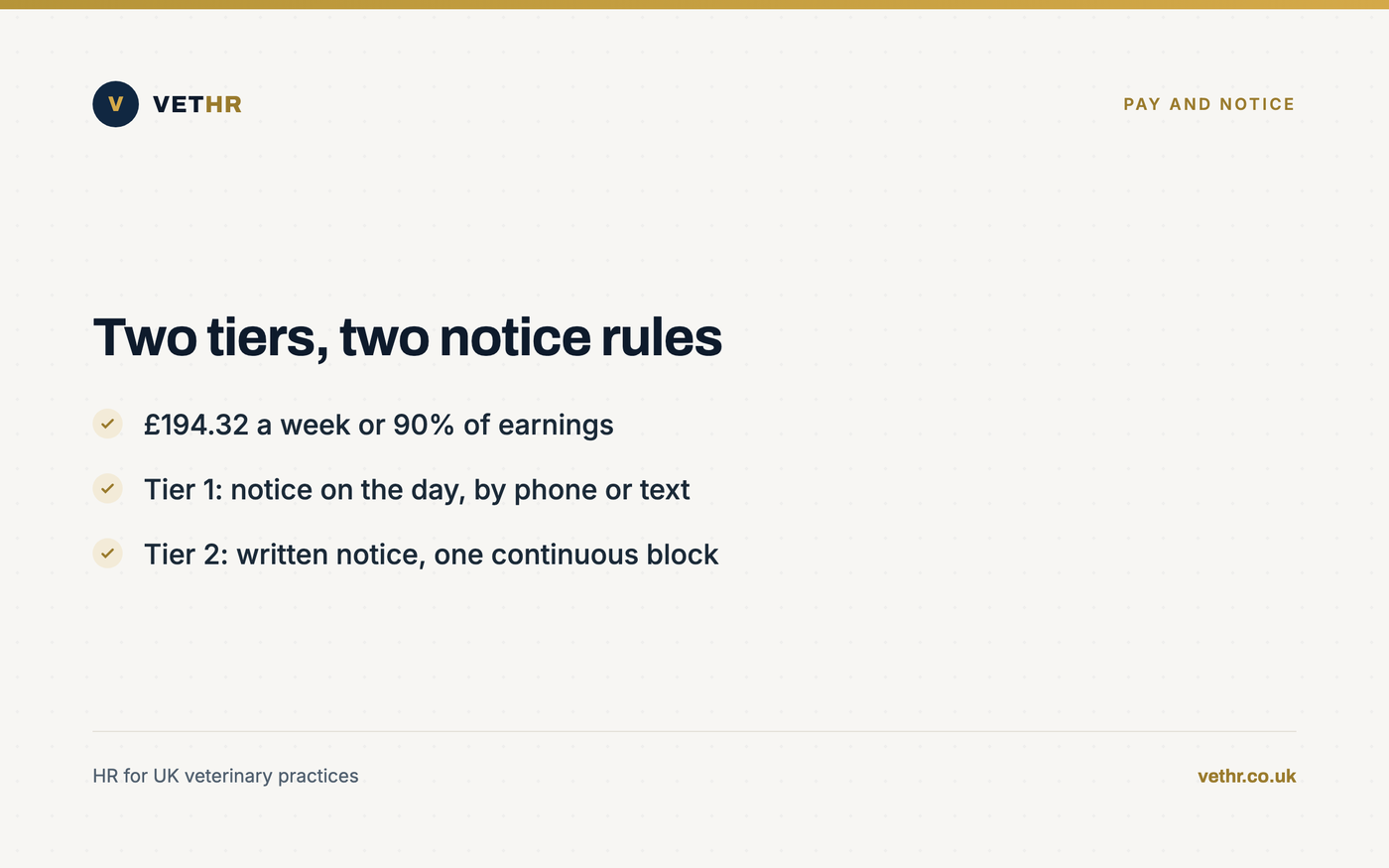
The leave itself is a right for every eligible employee from day one. Statutory neonatal care pay is separate: it needs 26 weeks of continuous service and average earnings at or above the lower earnings limit, and it pays £194.32 a week or 90 percent of average weekly earnings, whichever is lower, per GOV.UK and Acas.
It applies to babies born on or after 6 April 2025, per the GOV.UK eligibility guidance. If a team member’s baby was born before that date, the statutory right does not apply, although you can always agree compassionate arrangements of your own.
Seven or more full and continuous days, with the care starting within the first 28 days after birth, per GOV.UK. The entitlement then builds at one week of neonatal care leave for each full week of care, up to the 12-week maximum.
Yes. The right covers the baby’s parents and the partner of the baby’s mother, provided they have caring responsibility for the baby, per GOV.UK. Adoptive parents and intended parents through surrogacy can also qualify. Partners often use tier 1 leave while the baby is still in hospital.
No. It is additional to other parental entitlements, per GOV.UK. An employee already on maternity or adoption leave takes the neonatal weeks at the end of that leave, and all of it must be used within 68 weeks of the baby’s birth.
Neonatal care leave is the kind of right a good practice would want to offer anyway; the law has simply written down the terms. Up to 12 extra weeks, from day one, paid for those with 26 weeks of service, triggered by a text message on the hardest morning of someone’s year. The rules are not difficult. Being unprepared for them is.
Get it into your handbook before you need it. Put a one-page policy in your policy library, make sure your rota can absorb a same-day absence, or book a free HR health check and we will check your family leave setup against the current rules.
The Vet HR Team provides HR consultancy and white-labelled staff systems exclusively to UK veterinary practices.
Read next: Shared Parental Leave in a Veterinary Practice.
Contracts, rotas, holiday, a difficult conversation. Tell us what you are dealing with and we will come back within one working day. Nothing to sign up to.
Got it. We will come back to you within one working day. If you do not see a reply, please check your spam folder.
