Last updated: 14 June 2026
TL;DR: Carer’s leave gives every employee up to one week of unpaid leave every 12 months to care for a dependant with a long-term care need. It is a day one right, it can be taken in half days, and you cannot refuse a request, only postpone it under strict rules. This guide covers who qualifies, notice periods, postponement, rota planning and record keeping for a small veterinary practice.
Somewhere in most practices there is an RVN quietly looking after a parent, or a receptionist supporting a partner through a long illness. Carer’s leave is the statutory right built for them, and it has been in force long enough that a handbook which never mentions it is overdue an update. Here are the seven rules that matter, and how to run them in a team of ten.
Carer’s leave is a statutory right to unpaid time off work to give or arrange care for a dependant with a long-term care need. It applies to every employee from their first day of work, whatever their hours or length of service, according to GOV.UK guidance on carer’s leave. That includes the Saturday receptionist and the vet who started last month.
The dependant does not have to be a relative. Acas guidance lists a husband, wife, civil partner or partner, a child, a parent, someone who lives in the employee’s household (not tenants or lodgers), or anyone who relies on them for care, such as an elderly neighbour.
The care need must be long term. Per GOV.UK, that means one of three things: an illness or injury expected to need care for more than 3 months, a disability as defined in the Equality Act 2010, or care needs connected to old age. This is much wider than childcare, and it covers the caring most people never mention at work.
The practice angle: you will rarely see a request coming, because most carers do not talk about it until they have to. The right exists whether or not you knew about the caring responsibility, so the sensible move is to have the process ready before the first request lands.
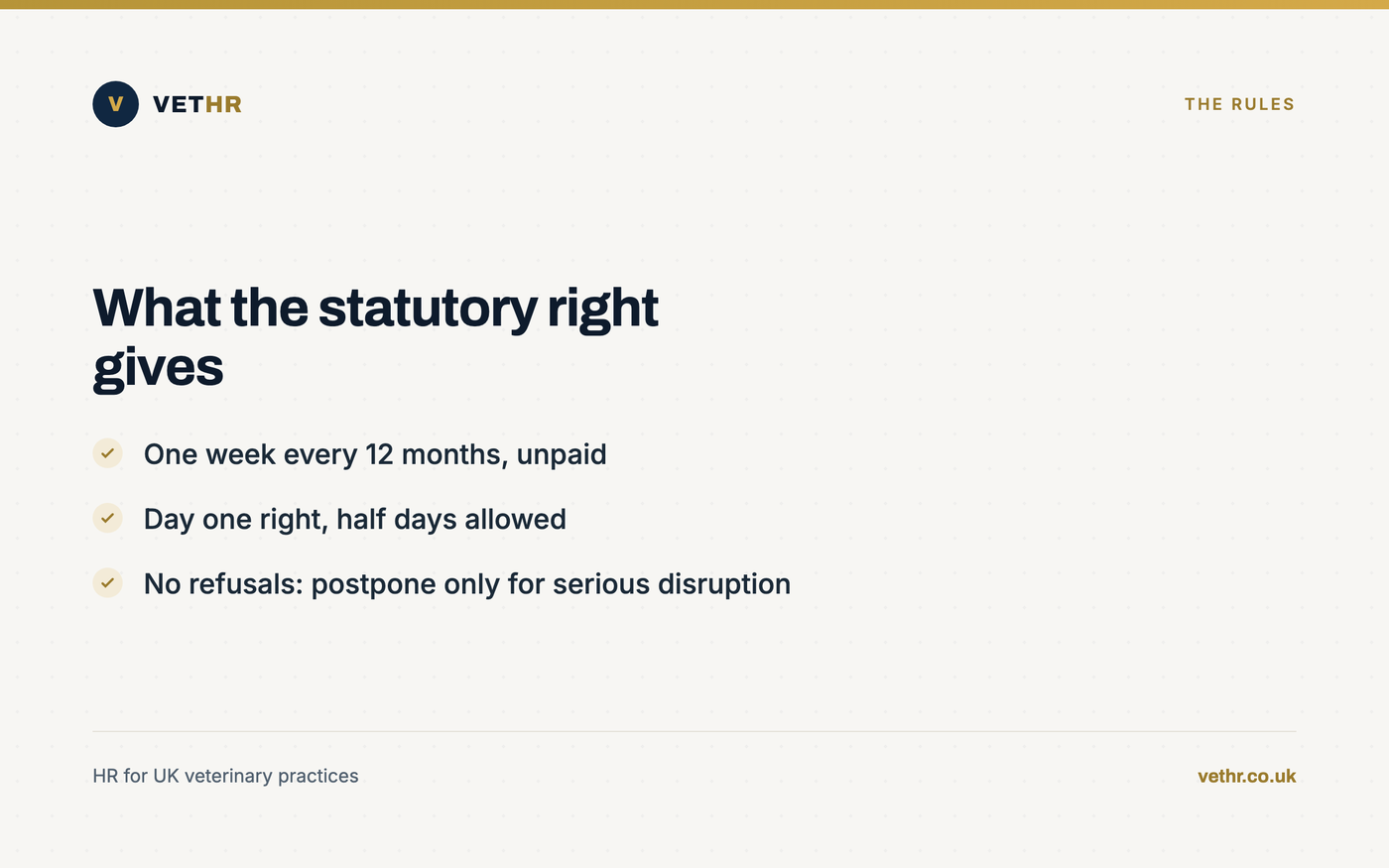
The entitlement is up to one week of carer’s leave every 12 months, and the statutory right is unpaid, although you can choose to pay for it. A week means the employee’s usual working week, so someone who works 3 days a week can take 3 days, per GOV.UK.
The leave is flexible. GOV.UK confirms it can be taken as a whole week, as individual days, or as half days spread through the year, and a half day is the minimum. An employee caring for more than one person does not get more: multiple dependants share the single entitlement.
On pay, Acas notes that an employer might choose to pay for this type of leave but does not have to. If you decide to enhance the right and pay some or all of it, write that down and apply it to everyone. An unwritten enhancement applied to favourites is a dispute in waiting.
Employment rights carry on as normal during the absence: GOV.UK confirms holiday accrual and the right to return to the job are protected. That is one more reason to record the leave under its own label, so annual leave balances stay accurate. Our holiday calculations system keeps those balances right automatically.
At least 3 days notice for a half day or a single day, and notice at least twice the length of the leave for anything longer, so 4 days notice for 2 days off. Notice is counted in full days and does not have to be in writing, per GOV.UK.
Acas sets out the same sliding scale, rising to 12 days notice for someone requesting a full 6-day working week. Even at the top of the scale, the windows are short. A request can land on Monday for leave that starts on Thursday, inside a rota you published a fortnight ago.
The verbal notice point deserves attention. A request mentioned in the corridor between consults counts, because the law does not require writing. You cannot add hurdles the law does not set, but you can make the easy route a recorded one: a named person to tell, and a system that logs the request the same day.
You cannot refuse a carer’s leave request. You can only postpone it, and only where the absence would seriously disrupt the running of the practice. If you postpone, you must explain why in writing within 7 days, and agree a new date within one month of the requested one, per GOV.UK and Acas.
Serious disruption is a high bar, and in a 10-person practice it does occasionally exist: the only vet rostered on a full surgery day, with no freelance vet cover to be found. Even then, postponing is a delay with paperwork attached, not a veto. Treat it as the rare exception.
Remember what the leave is usually for: accompanying someone to planned treatment, or covering a care arrangement that cannot move. A postponed appointment for the employee is often a cancelled one for the dependant. Postpone only when you genuinely cannot staff the day, and say so honestly in the written explanation.
Consistency matters as much as legality. If requests from the head nurse sail through while the weekend receptionist gets postponed, you have built a pattern a tribunal would enjoy reading about. Same rules, same evidence, every time.
Not sure your absence rules would stand up to a difficult fortnight? Book a free HR health check. In 30 minutes we will look at your leave policies, your records and your rota, and tell you plainly which gaps matter for a practice your size.
Carer’s leave is planned time off, up to a week a year, for the foreseeable care of someone with a long-term need. Time off for dependants is emergency leave: a reasonable amount of unpaid time to deal with the unexpected, with no set limit on how often it can be used, per GOV.UK guidance on time off for dependants.
GOV.UK is explicit that emergency time off does not cover situations known about beforehand, and gives the example of taking a child to a booked hospital appointment. The planned appointment belongs under carer’s leave. The childcare that collapses at 7am, or the parent who falls that morning, belongs under time off for dependants.
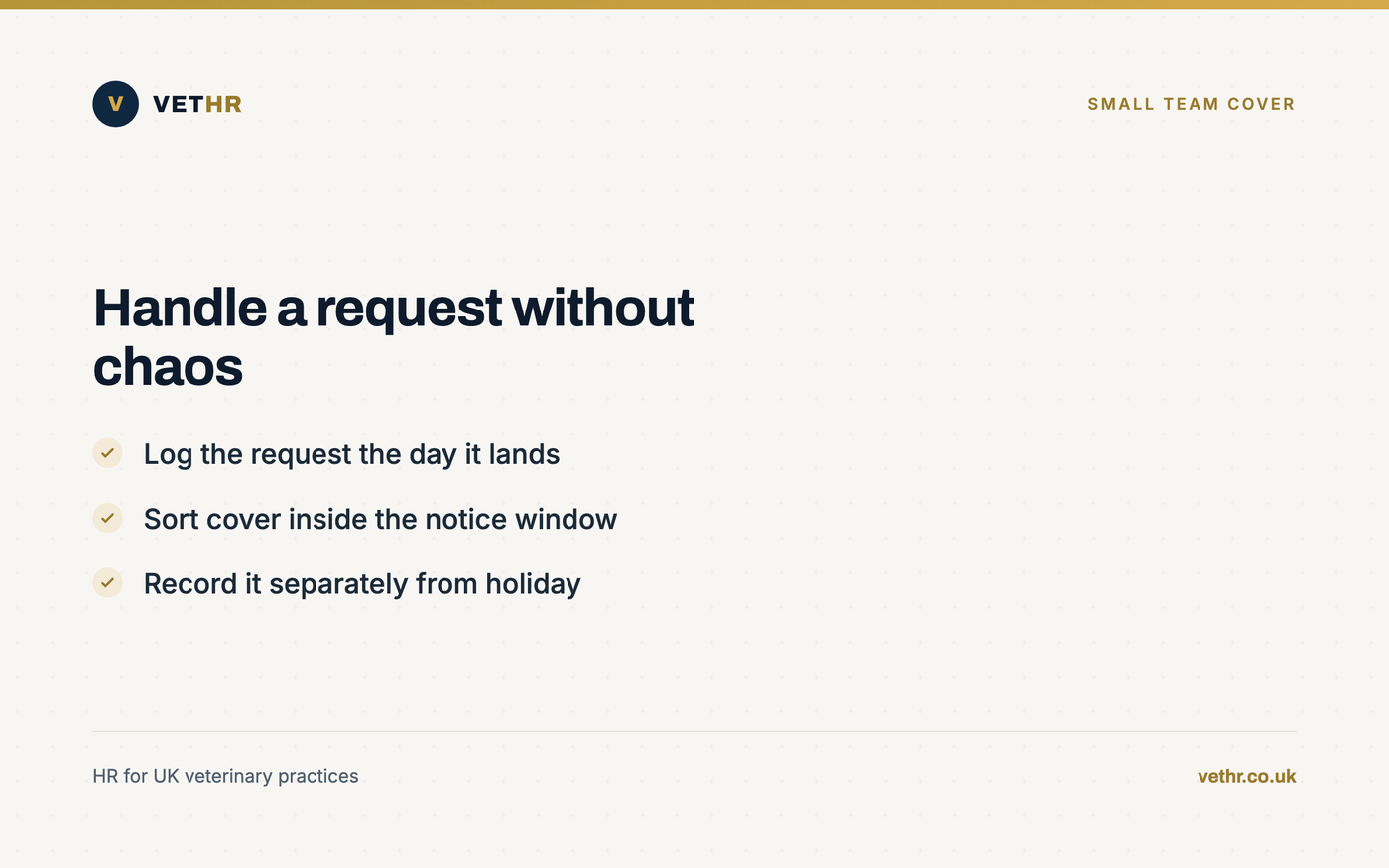
Keep the two under separate labels in your records. One has a fixed annual entitlement to track; the other does not. Blur them and you will either shortchange someone’s entitlement or quietly hand out extra weeks, and you will not know which until it is awkward.
Treat it like any other planned absence: log the request the day it arrives, mark it on the rota immediately, and sort cover inside the notice window. In a team of ten, the difference between a calm week and a chaotic one is usually what happens in the first 24 hours after the request.
Half days are your friend here. A nurse accompanying a parent to a morning appointment can take a half day and still work the afternoon list, which is far easier to absorb than a full day off. Since GOV.UK allows half days as the minimum unit, build your rota process to offer them.
For longer absences, the usual tools apply: shift swaps, moving an ops list, or booking freelance vet cover for a full week away. A live rota everyone can see makes each of those quicker. That is exactly what our practice rota system is for: one published rota, updated once, visible to the whole team.
One thing not to do: nudge people towards using paid holiday instead so the absence costs you nothing to administer. Some staff will genuinely prefer paid holiday because the statutory leave is unpaid, and that is their choice to make. Offer both routes, record whichever they choose, and never make the unpaid route feel like a black mark.
A good carer’s leave policy fits on one page: who counts as a dependant, the one-week entitlement, the fact the statutory leave is unpaid, the notice rules, how to make a request, the narrow grounds for postponement, and how the leave is recorded. Plain English, no recited legislation.
Put it in the staff handbook or, better, a hosted policy library where staff can find it from a phone and acknowledge they have read it. Our policies system records a dated acknowledgement per person, per version, which is the record you want if a decision is ever questioned.
Point the policy at the current GOV.UK page rather than restating every rule, and review it whenever the guidance changes. A short policy people can find beats a long one nobody opens.
No, the statutory right is unpaid. Acas notes an employer might choose to pay for it but does not have to, so check what your own policy promises. Employment rights such as holiday accrual and the right to return to the same job are protected during the absence, per GOV.UK.
No. Under GOV.UK guidance an employer cannot refuse, only postpone, and only where the absence would seriously disrupt the business. A postponement must be explained in writing within 7 days, and a new date agreed within one month of the original request.
Yes. GOV.UK confirms the leave can be taken as a whole week, individual days or half days, and Acas identifies a half day as the minimum unit. For a rota-based practice, half days are usually the easiest form to absorb, so offer them openly.
No. GOV.UK confirms the entitlement stays at one week every 12 months regardless of how many dependants an employee cares for. All dependants share the same single week of leave.
No. The right applies from the first day of work, per both GOV.UK and Acas, with no minimum service and no minimum hours. A new graduate vet in their second week has exactly the same entitlement as your longest-serving nurse.
Carer’s leave is one of the easier rights to get right: one unpaid week a year, short notice windows, no refusals, postponement only with written reasons. The practices that struggle are the ones that hear the request in a corridor, write nothing down, and improvise. The ones that cope have a one-page policy, a live rota and a habit of logging requests the day they land.
If that second practice does not sound like yours yet, start small. Put a proper policy in your policy library, get absences visible on a shared practice rota, or book a free HR health check and we will tell you plainly what to fix first.
The Vet HR Team provides HR consultancy and white-labelled staff systems exclusively to UK veterinary practices.
Read next: Shared Parental Leave in a Veterinary Practice.
Contracts, rotas, holiday, a difficult conversation. Tell us what you are dealing with and we will come back within one working day. Nothing to sign up to.
Got it. We will come back to you within one working day. If you do not see a reply, please check your spam folder.
