Last updated: 27 June 2026
TL;DR: Managing underperformance in a veterinary practice is a capability issue, not misconduct, so the fair route is supportive, not punitive. Spot the real cause, raise it informally first, then set clear measurable objectives with training and review dates. Only if improvement does not come, after a fair formal capability process, does dismissal become a last resort. Done properly, capability is a potentially fair reason for dismissal.
Few things drain a practice manager faster than one team member who is quietly not coping. The instinct is often to escalate or to ignore. Neither is fair, and neither is safe. This is a calm walkthrough of the capability route: how to help someone improve, and how to act fairly if they cannot.
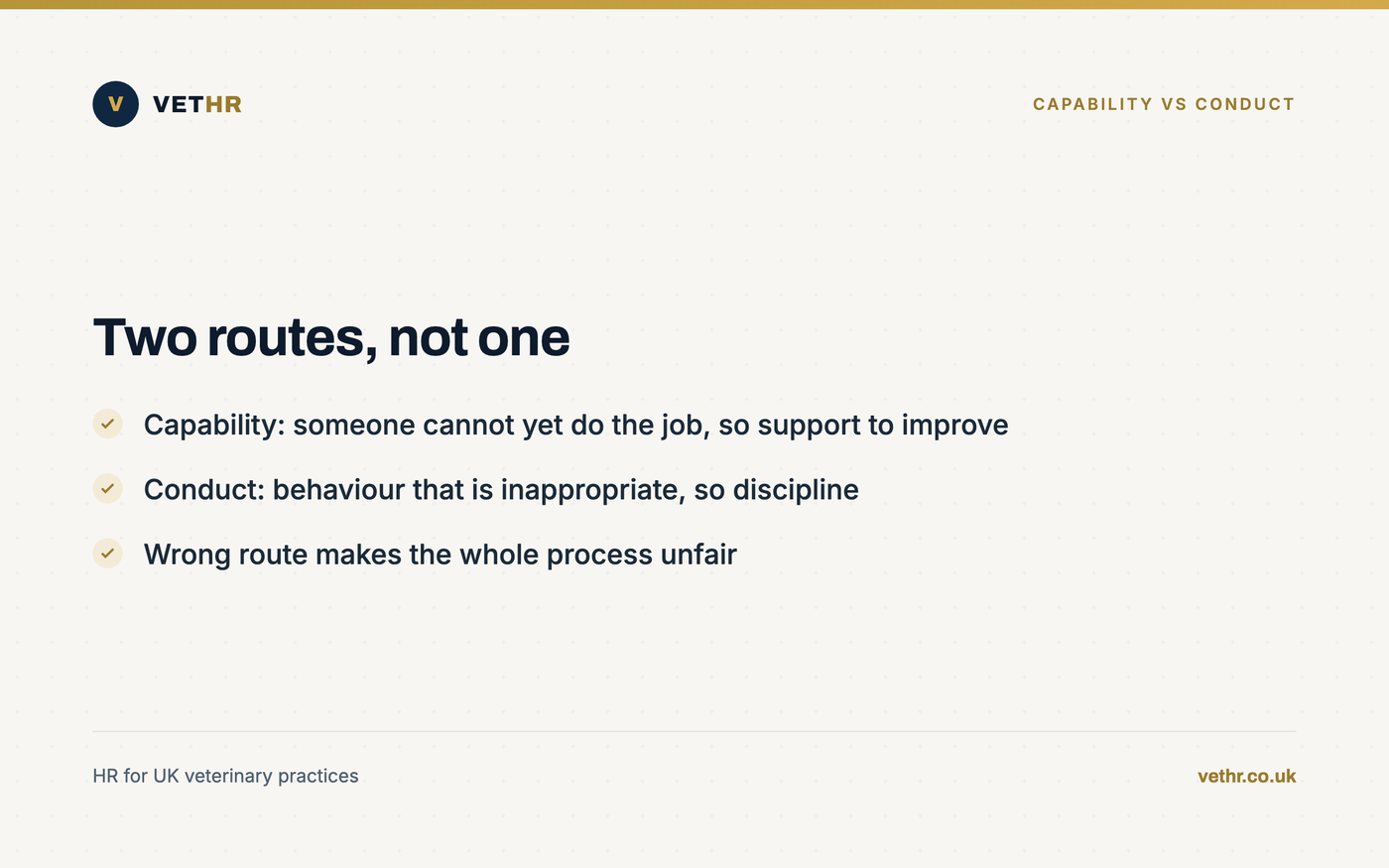
Managing underperformance in a veterinary practice means handling someone who cannot yet meet the standard of the job, through a fair capability process rather than discipline. Capability is about ability, not behaviour. Acas defines capability as “someone’s ability to do their job” and conduct as “someone’s behaviour at work”, and the two routes are deliberately different.
That distinction matters because it changes everything you do next. A nurse who keeps missing drug calculations is a capability question: can we help them get there. A nurse who falsifies a record is misconduct. According to Acas, the capability route should “support employees to improve first”, with dismissal as “a last resort”, which is the opposite of how a disciplinary often feels, per Acas guidance on dismissals for capability or conduct.
Getting this right is not only fairness for one person. It protects the whole team. The same underperformance left unmanaged becomes the rota gap, the redone work and the resentment that pushes good colleagues toward the door. The RCVS Surveys of the Professions 2024 found that 56 percent of vets considering leaving cited poor work-life balance, the leading reason, according to the RCVS. Carrying someone else’s shortfall is how that balance breaks.
So the goal of the capability route is simple. Give the person a genuine, supported chance to reach the standard. Keep a clear record while you do it. And if the standard is still not met after that fair chance, you have the evidence to act properly. This article walks each stage, in order.
You find the real cause of poor performance by asking before you assume. Underperformance has many roots: unclear expectations, a gap in training, a health issue, a personal crisis, or the wrong role fit. The first job is not to judge the work but to understand why the work is falling short, because the right response depends entirely on the answer.
Some causes are not capability at all, and treating them as such is unfair and risky. A drop in performance can flag a health condition or a disability, which carries its own legal duties and may require reasonable adjustments rather than a capability process. The same is true of pregnancy, caring responsibilities or burnout. Naming the cause early stops you walking into the wrong procedure.
This is also where many practices realise the standard was never clear. If a new graduate vet was never told how many consults an hour is expected, or an RVN never had the inventory process explained, the gap is yours, not theirs. Underperformance against an unspoken standard is not underperformance. It is a missing handover.
Practically, gather the evidence before the conversation. What specifically is falling short, with dates and examples, not a vague sense that someone is “not pulling their weight”. Acas advises employers to “carry out any necessary investigations, to establish the facts of the case” as a core principle, in its Code of Practice. Facts make the next step fair and the conversation calm.
Yes, almost always. Acas is clear that employers should “take steps to try and help someone to improve, before starting a formal disciplinary procedure”. An honest, private, two-way conversation often resolves the problem on its own, and it is the quickest route. Jumping straight to a formal process when a quiet word would have worked is rarely fair or proportionate.
Run it as a conversation, not a verdict. Describe what you have seen, give specific examples, then ask. The person may already know they are struggling and be relieved someone has noticed. They may also tell you something you did not know: a system they were never shown, a rota pattern that is crushing them, a worry at home. You cannot fix a cause you have not heard.
Agree something concrete before you finish. What good looks like, what support you will provide, and when you will check in. Acas notes that employers should “keep a record of any conversations they have with employees about performance”, even informal ones. A short dated note, shared so both of you agree what was said, is enough. It is not bureaucracy; it is fairness with a memory.
Give the informal stage real time to work. People do not turn around a habit in a week, and an unrealistic check-in date undermines the whole point. If improvement comes, say so and mean it, because being noticed when you get it right is what makes the noticing of a problem feel fair in the first place.
Getting this wrong at the start is where practices come unstuck. A free HR health check gives you 30 minutes to talk through the situation, decide whether it is a capability or a conduct route, and map a fair process before you say anything to the employee. No jargon, nothing sold for the sake of it, just a clear next step.
If an informal approach does not work, the next step is a performance improvement plan. Acas says a plan should set out “specific objectives for the employee, a reasonable timeline to meet them, any further support or training they need”. A good plan is a deal, not a warning: here is the standard, here is the help, here is the time, here is when we review.
Make the objectives measurable and fair. “Be more organised” cannot be passed or failed. “Complete patient records within the same shift, with no outstanding entries at handover” can. Objectives should reflect the person’s usual workload and role, not a standard you have quietly raised because you are frustrated. Stretch is fine; a trap is not.
The support column is the one practices skip, and it is the one that matters most legally. Acas states that employers “must provide adequate resources for an employee to do their job”, which “might include giving them training”. A plan that demands improvement but offers no help is not a fair plan, and it will not stand up later.
Talk the person through the plan so they genuinely understand it, and keep a copy you both agree on. The reviews are where the work happens: each one is a chance to acknowledge progress, unblock a problem, or be honest that the gap is not closing. None of it should be a surprise at the end, because surprise is the enemy of a fair process.
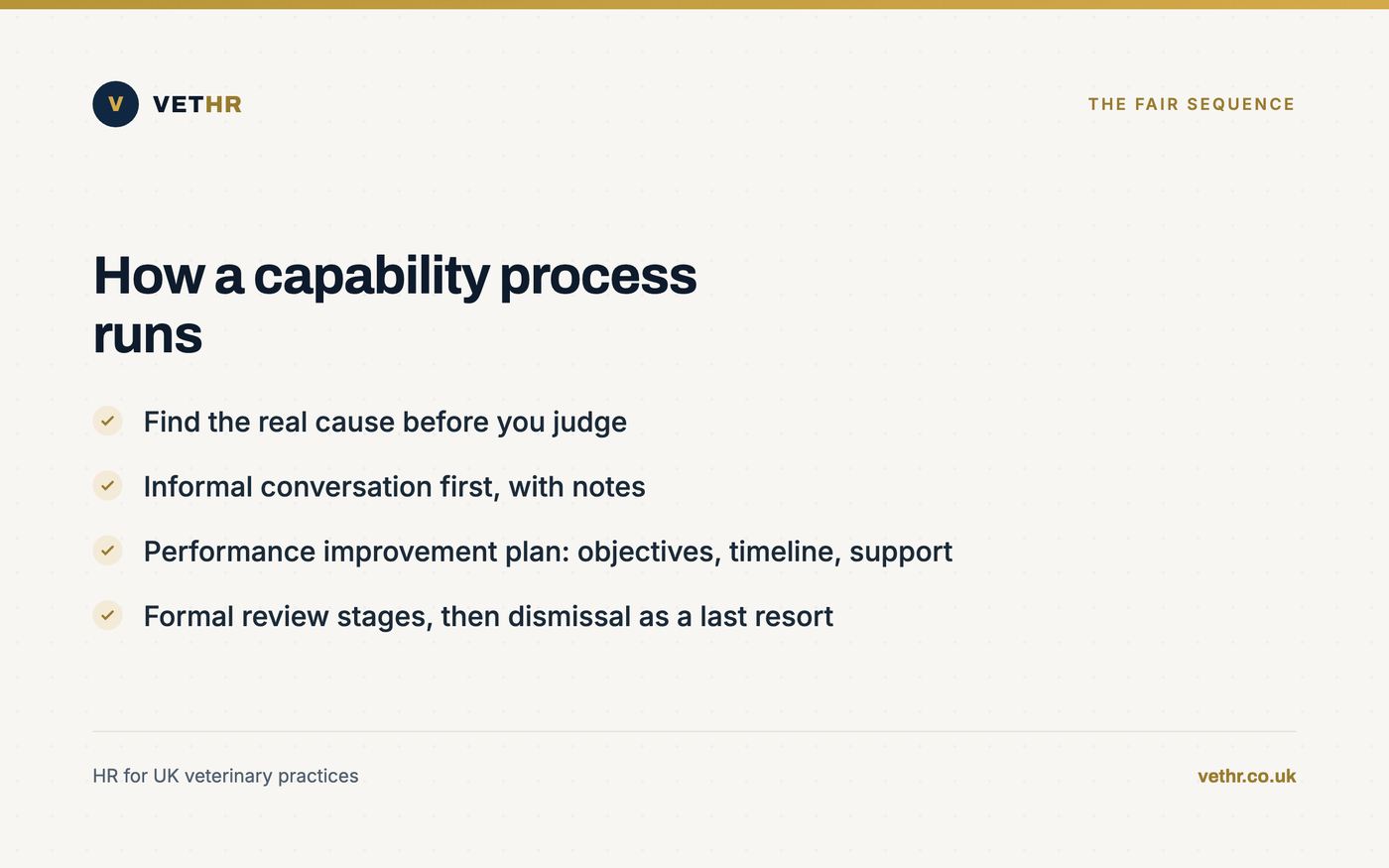
A formal capability procedure is the structured stage you reach if support and a plan have not closed the gap. It mirrors a fair disciplinary process: a clear letter setting out the concern, a meeting where the employee can respond and be accompanied, a decision, a chance to improve, and the right to appeal. The Acas Code of Practice applies here, because “disciplinary situations include misconduct and/or poor performance”.
Each stage should be evidenced and proportionate. Write to the employee with the specific performance concerns and the evidence, and invite them to a meeting with enough notice to prepare. They have the statutory right to be accompanied by a colleague or trade union representative. Hold the meeting as a genuine discussion, not a reading of a verdict already written.
Capability procedures usually move through stages rather than jumping to the end. A first formal review and a written improvement objective, then a further stage if the standard is still not met, each with its own review period and support. This is also where the Code bites financially: tribunals can “adjust any awards made in relevant cases by up to 25 per cent for unreasonable failure to comply”, so skipped steps cost real money.
Consistency is the quiet test running through all of it. Acas asks employers to “act consistently”, meaning a healthcare assistant and a vet facing the same shortfall should travel the same fair route. In a small practice where everyone knows everyone, that even-handedness is exactly what stops a fair process being seen as a personal one.
Throughout, keep the records you have been building. Dates, objectives, the support offered, what was said at each review, and the employee’s responses. If this ever reaches a tribunal, the question is whether you acted reasonably and followed a fair procedure. A clean, honest paper trail is how you answer that with a yes.
Dismissal for capability can be fair when, after genuine support and a fair process, the employee still cannot meet the standard and no other suitable option remains. Capability is one of the potentially fair reasons for dismissal, but only if you also act reasonably. The reason alone is never enough; the procedure is what makes it fair.
Acas frames dismissal as “a last resort”, reached only after you have supported the person to improve first. Before deciding, ask whether anything else would work: more training, an adjusted role, redeployment to a position that fits their strengths, or reasonable adjustments if a health condition is in play. If there is genuinely “no other suitable role”, dismissal may be the fair outcome.
If you reach that point, do it properly. A final capability meeting, a decision based on the evidence and the failed reviews, the correct notice, and a right of appeal. An employer who “did not follow a fair procedure” risks an unfair dismissal claim “even if the reason for dismissal was valid”, which is why the calm groundwork in every earlier stage is what protects you here.
This is the moment to get a second pair of eyes on it. The cost of getting a dismissal wrong, in tribunal awards, time and morale, dwarfs the cost of a conversation beforehand. Vet HR is HR consultancy and documentation support, not a law firm, but a structured fair process is exactly what our HR consultancy and monthly support are built to give a practice.
Capability is about ability, when someone cannot yet do the job to standard. Misconduct is about behaviour, when someone does something inappropriate or unacceptable. Acas describes capability as “someone’s ability to do their job” and conduct as “someone’s behaviour at work”. The capability route is supportive and improvement-focused; the conduct route is disciplinary. Choosing the wrong one makes the whole process unfair.
Long enough to give a genuine chance to improve, with named review dates rather than an open-ended drift. Acas calls for “a reasonable timeline” tied to specific objectives and support. There is no fixed length, because it depends on the role and the gap, but a few weeks to a few months is common. The test is whether the time was fair and the support real.
Yes, if you have a fair reason and follow a fair procedure. Capability is a potentially fair reason for dismissal, but only after you have supported the person to improve, run a fair capability process and considered alternatives, with dismissal as a last resort. Skipping the process risks an unfair dismissal claim even when the underperformance is real, so the procedure matters as much as the reason.
You should. Acas advises employers to “keep a record of any conversations they have with employees about performance”, from the first informal chat onward. Records of objectives, support offered, review meetings and responses are what show you acted reasonably. If a case ever reaches a tribunal, a clear dated paper trail is your evidence that the process was fair.
Then it may not be a straightforward capability matter. A health condition or disability can carry legal duties, including making reasonable adjustments, and treating it as ordinary underperformance can be unfair and unlawful. The right step is to understand the cause first, take advice, and consider adjustments or support before any capability process. When in doubt, pause and get it checked.
Managing underperformance in a veterinary practice well is not about being soft or being tough. It is about being fair and being clear. Spot the cause, talk early, set honest objectives with real support, run a proper process if you need to, and keep dismissal as the last resort it should be. Do that, and you protect the individual, the team and the practice all at once.
If you are facing one of these situations now, you do not have to work it out alone. See how we structure fair processes and documentation in our policies and procedures, read how ongoing support works in monthly HR support, or simply book a free HR health check and we will help you map the right next step for your practice.
The Vet HR Team provides HR consultancy and white-labelled staff systems exclusively to UK veterinary practices.
—
Read next: Settlement Agreements in a Veterinary Practice.
Contracts, rotas, holiday, a difficult conversation. Tell us what you are dealing with and we will come back within one working day. Nothing to sign up to.
Got it. We will come back to you within one working day. If you do not see a reply, please check your spam folder.
