Last updated: 14 June 2026
TL;DR: Switching HR provider is a sequencing exercise, not a leap. Find the notice window and renewal date in your current agreement first, secure contracts, policies and staff records while your access is live, confirm what your licence lets you keep, then line the new provider up so cover begins the day the old agreement ends. Done in that order, there is no gap and no month of paying twice.

Most practices only think about switching HR provider after something has gone wrong: slow answers, generic advice that ignores how a clinic runs, or an invoice that has quietly grown. Whatever the reason, the move itself follows the same sequence. This guide covers the notice window, the documents, the handover and the money.
Whenever your current agreement allows. Most outsourced HR agreements run for a fixed term with a notice window, and many renew automatically for a further term if no notice is given by a set date. Read the agreement before you do anything else, diary the notice deadline, and work the rest of the switch backwards from it.
The agreement is rarely where you think it is. Look for the original proposal or order form, the terms of business attached to it, and any renewal letters or emails since. Note four things: the initial term, the renewal term, the length and form of notice required, and exactly who notice must be sent to.
Auto-renewal is the trap that catches practices. Plenty of outsourced HR agreements roll into a further fixed term unless notice lands inside a set window, sometimes well before the renewal date itself. Miss the window and you can be committed for another term before you have even started looking at alternatives.
If you cannot find the paperwork, ask the provider for a copy of the current terms and your renewal date in writing. It is a routine request, and the answer starts the clock on everything else in this guide. Put the notice deadline in the practice diary the day you learn it.
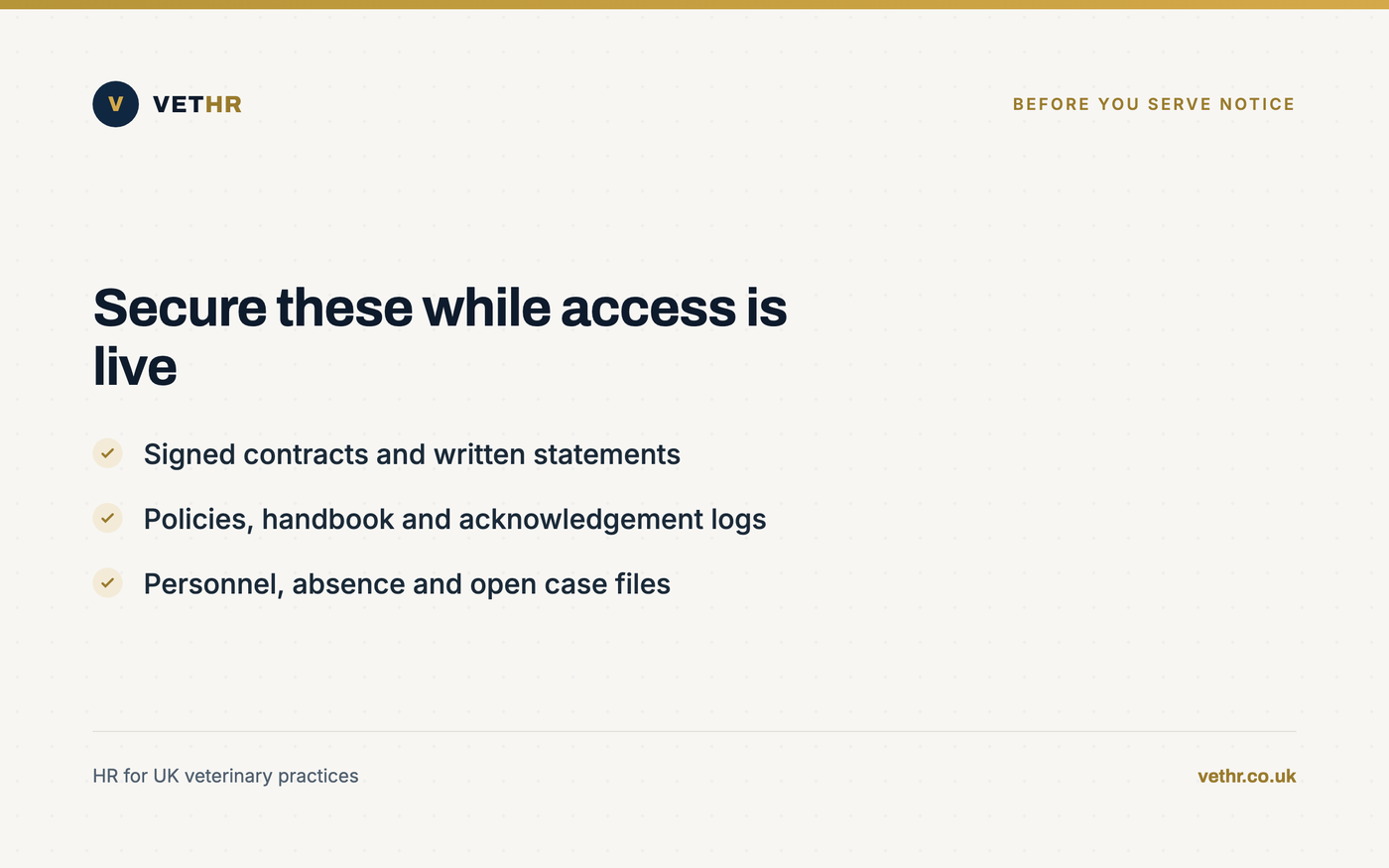
Copies of everything the practice relies on: every employment contract and written statement, every policy and the handbook, personnel files, absence and disciplinary records, and any acknowledgement logs. Export them while your access is live and the relationship is calm. Doing this before you serve notice is far easier than doing it after.
Then check what the licence actually lets you keep. Template documents a provider drafted may be their intellectual property, licensed to the practice only while the subscription runs. Documents issued to your staff, such as a signed contract or a disciplinary outcome letter, are records of your employment relationships. Read the terms, and where the line is unclear, ask in writing.
One reassurance while you audit: the employment relationship itself does not belong to any provider. Acas guidance on employment contracts describes the contract as a legal agreement between the employer and the worker, and that agreement is between the practice and the staff member. Providers change. The terms your team signed carry on regardless.
The employer’s legal duties sit with the practice, not the provider. Every employee and worker must receive a written statement of the main terms on day one, with a wider statement within 2 months, and payroll records must be kept for 3 years from the end of the tax year. Whoever supports you, those records are yours to hold.
Start with the written statement of employment particulars. Employees and workers must receive a principal statement of the main terms on the first day of employment, and a wider written statement within 2 months covering matters such as pensions and disciplinary and grievance procedures, according to GOV.UK guidance on the written statement of employment particulars. If particulars change, staff must be told in writing within one month.
Payroll has its own clock. HMRC guidance on keeping PAYE records says employers must keep records including payments, deductions, leave and sickness absences for 3 years from the end of the tax year they relate to, and HMRC can charge a penalty of up to £3,000 where records are not kept.
The point for a switch is simple. If your only copies of these documents live inside a provider’s portal, the practice has a dependency it should not have. Export everything now and keep your own archive, whoever you work with. That independence is also what makes switching HR provider painless if you ever need to do it again.
Not sure what you would be left holding if the relationship ended tomorrow? Book a free HR health check. In 30 minutes we will look at your contracts, policies and records, tell you what is missing or out of date, and give you a straight view of what a clean handover would need. No obligation, no hard sell.
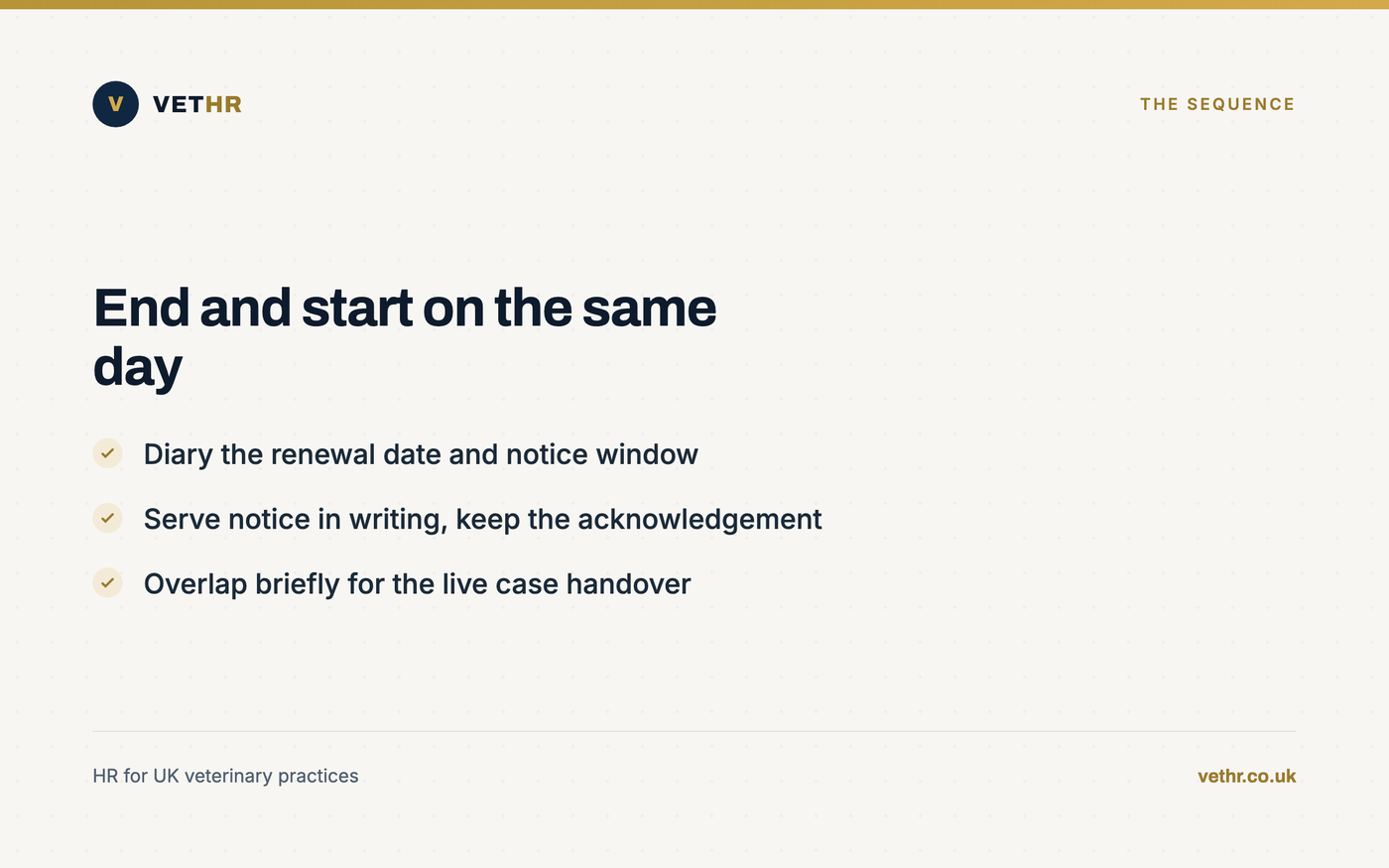
Work backwards from the day the old agreement ends. Choose the new provider while the old agreement is still running, agree a start date that meets your notice deadline, serve notice in writing, then run a short overlap for handover. The old service should stop on the same day the new one is fully live.
Live cases are where handovers go wrong most often. An open disciplinary, a grievance mid-process or a long-term absence needs a named handover: the file, the timeline so far, the next step and its deadline. Brief the new provider before the old access ends, and keep your own dated note of where each case stands.
Onboarding runs in parallel. A good new provider will want to review your contracts against the day-one and 2-month requirements above, read your policies, and meet the practice manager before go-live. Hand over the archive you exported in step two, and the handover becomes a review of documents you control rather than a rescue.
Align the new start date with the old end date. Double payment usually happens when a practice signs the new provider before checking the old notice window, then discovers months of unexpired term. Check the window first, time the notice so the two terms meet end to end, and treat any short overlap as a planned handover cost rather than an accident.
If you have already missed the notice window, do not sign a second agreement in frustration. Serve notice now for the next available end date, use the waiting months to export records and fix gaps, and start the new provider the day the old term expires. Paying twice for a planned handover month is a cost you chose. Paying twice for a year you did not notice is not.
Watch the small print on exit or offboarding fees too. If the agreement mentions them, ask for the figure in writing before you serve notice, so the comparison between staying and going is honest.
Choose for the sector first. A veterinary practice needs support that understands rotas, OOH, RVN registration and clinical pressure, not a generic helpline reading from a script. Compare candidates on veterinary specialism, response speed, what happens to your documents when you leave, and whether pricing is fixed in writing before you commit.
Ask each candidate the questions this process has just taught you: how long is the term, when can we leave, what do we keep, and what does the handover look like from your side. A provider confident in its service answers plainly. Then compare the main veterinary HR providers side by side before you decide.
Vet HR works exclusively with UK veterinary practices. Support runs as fixed-price consultancy projects or a monthly subscription, priced per practice and quoted in writing, and it starts with a free 30-minute HR health check rather than a signature. If you are weighing up a move, that is the easiest first step.
Whatever your agreement says, and nothing about it is standardised. Check the terms of business for the initial term, the renewal clause, the notice window and the required form of notice. These are commercial agreements between businesses, not employment contracts, so the document you signed is the only answer that matters.
No. Employment contracts are between the practice and each staff member, not the provider, so they continue unchanged through a switch. A new provider may recommend updates, and where any change affects the written statement particulars, GOV.UK guidance says staff must be told in writing within one month of the change.
Check the licence. Template documents a provider drafted may be their intellectual property, but records of your employment relationships, such as signed contracts, written statements and case files, exist so the practice can meet its own duties as the employer. Export copies while you have access, and ask the provider to confirm in writing what you keep.
They transfer with a named handover. For each open disciplinary, grievance or absence case, record the file, the timeline, the next step and its deadline, then brief the new provider before the old access ends. Never let a live case sit unowned across the switch date.
The handover work itself is quick; the notice window sets the real timetable. If your agreement requires notice well before the renewal date, the switch takes as long as that clause says. Check the window first, then plan the export, selection and handover steps to land on the end date.
Switching HR provider is not a leap of faith. It is four things and a calendar: the agreement that tells you when you can leave, the archive that makes you portable, the notice that starts the clock, and the handover that lands the new support on the day the old support stops.
If you are considering a move, compare the main veterinary HR providers, see how our consultancy support works, or book a free HR health check and we will tell you plainly whether a switch would actually fix the problem you have.
The Vet HR Team provides HR consultancy and white-labelled staff systems exclusively to UK veterinary practices.
Contracts, rotas, holiday, a difficult conversation. Tell us what you are dealing with and we will come back within one working day. Nothing to sign up to.
Got it. We will come back to you within one working day. If you do not see a reply, please check your spam folder.
