Last updated: 14 October 2026
TL;DR: You must allow an employee time off if they are called up for jury service. You do not have to pay them, and if you do not, they can claim some money back for lost earnings from the court. Service usually lasts up to 10 days but can run longer, and it can only be delayed once in a 12 month period.
A vet in a three vet practice brings in a jury summons for the first week of December. The rota is already built around Christmas, the branch has one nurse on a Tuesday, and nobody has ever dealt with this before. The legal position is simple. The rota problem is not, and the two get confused within about ten minutes.
Yes. GOV.UK guidance for employers states that you must allow an employee time off if they are called up to serve on a jury.
There is no discretion in that. Jury service is a public duty and a summons is a court order, not a request the practice can decline because the rota is tight.
Treating it as authorised absence from the moment the summons appears, and saying so in writing, takes the anxiety out of the conversation. Most people bring a summons in expecting an argument.
No. GOV.UK tells jurors that you will not be paid for doing jury service, but you can claim some money back if you lose earnings. There is no statutory duty on the employer to pay.
So there are two choices. Pay normally and ask the person not to claim for lost earnings, which is what most practices with any capacity choose to do. Or do not pay, in which case they claim through the court and the practice will need to confirm the hours and pay lost on the court’s form.
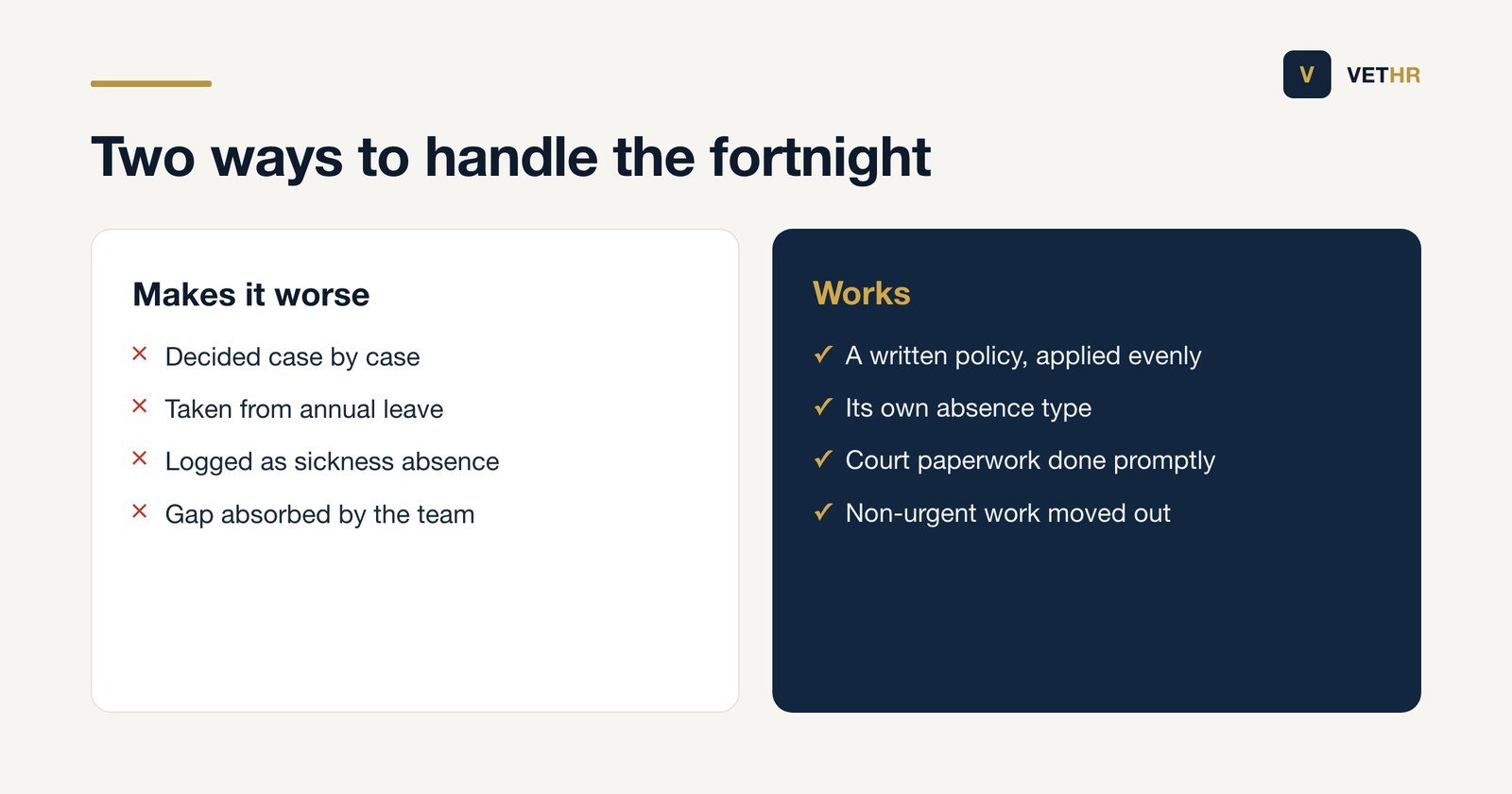
Decide which of those you do before the first summons arrives, and write it down. Deciding case by case is how one nurse gets full pay and the next one does not, and that comparison gets made in the staff room within a week.
Whatever you choose, deal with the court’s paperwork quickly. A delayed form means the person is out of pocket while waiting, and that is a bad look for a decision that was legally optional in the first place.
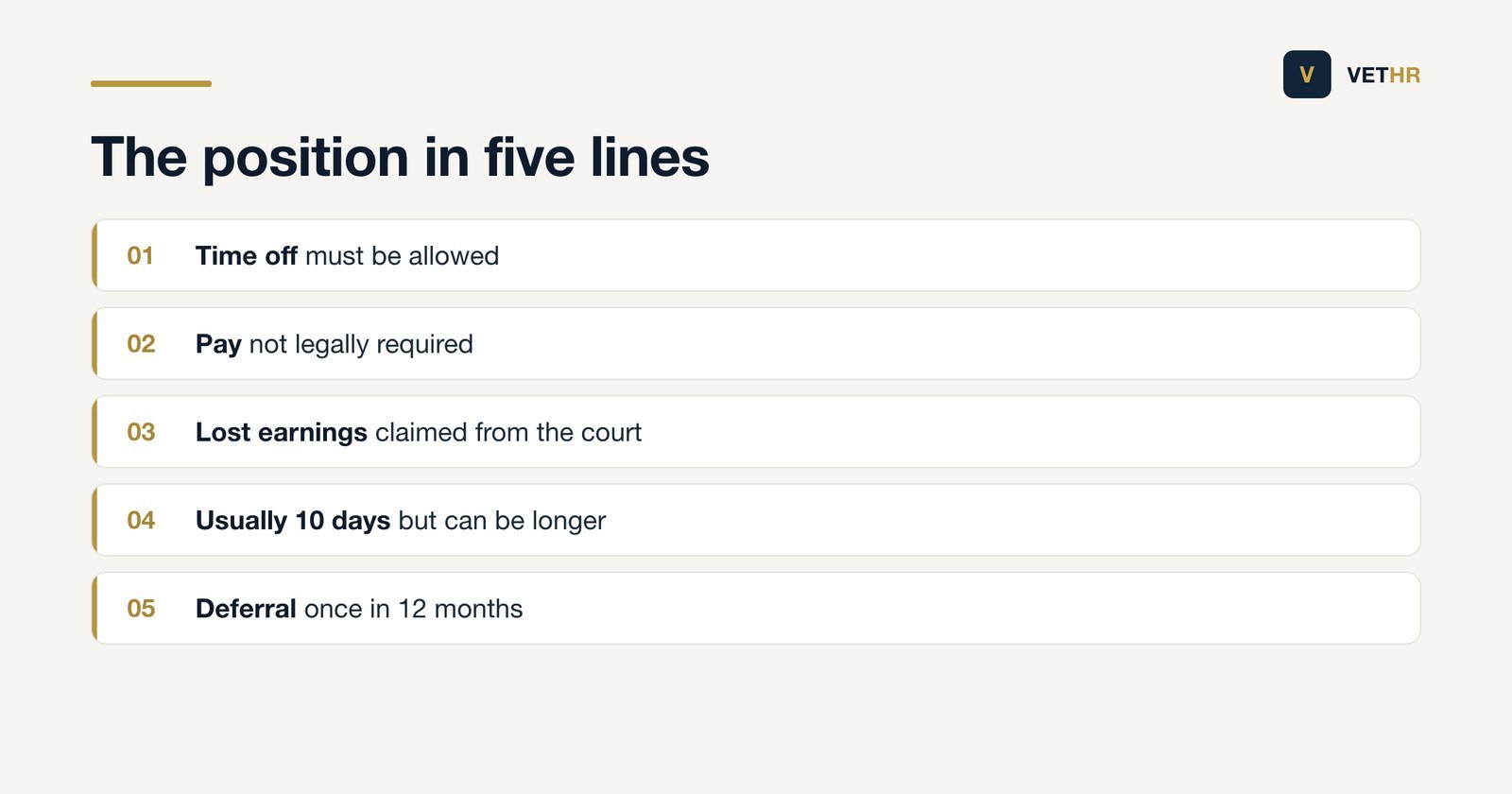
GOV.UK guidance says jury service usually lasts up to 10 days, but can be longer. A juror on a long trial can be away for weeks, and nobody knows at the start which they will be.
Plan for ten working days and have a contingency for more. The person will usually know after the first day or two whether they have been empanelled on something long.
They may also not be needed every day. Jurors are sometimes released early or not called at all, and some will want to come in for the rest of the afternoon. Let them if it is practical, but do not expect it, do not ask for it, and do not build the rota on the assumption that it will happen.
You can ask, once. GOV.UK guidance says employers can ask an employee to try to delay their jury service if their absence would seriously harm the business, and that a person can only delay jury service once in a 12 month period, having to say on the summons when they will be available.
Use that carefully. Seriously harm the business is a real test, and a single vet practice losing its only vet for a fortnight in December is a stronger case than a ten vet group losing one in February.
Put the request in writing to the employee, explain the reason, and leave the decision about whether to ask the court to them. It is their summons and their deferral to spend, and pressuring someone into using it is not a good use of a working relationship.
If they do defer, diarise the new window immediately. A deferral pushed to March is easy to forget and then arrives as a surprise twice.
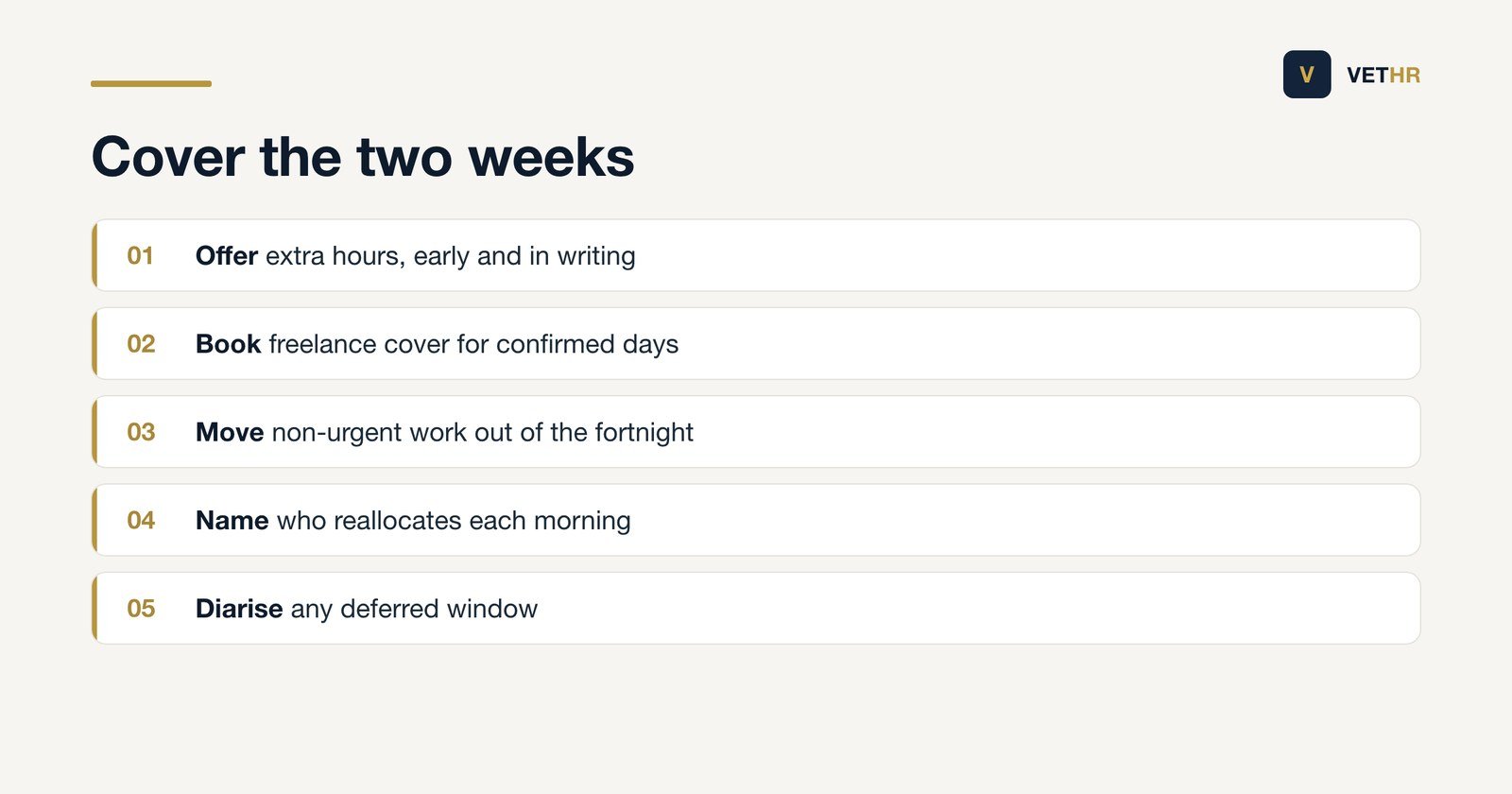
Treat it as two weeks of planned absence with an uncertain end. That is the same problem as a short notice sickness absence, and you probably already have the tools.
Moving non-urgent work is the one practices resist and the one that works. A fortnight of routine dentals rescheduled is far cheaper than a fortnight of everybody working through their breaks. Our notes on being short staffed and staffing levels in a veterinary practice cover the arithmetic.
Tell the team, with the person’s agreement, that a colleague is on jury service rather than letting people guess. Unexplained absences in a small practice generate their own stories, and the truth here is entirely uncontroversial.
Expect the person to come back a little flat. Some trials are difficult to sit through, and a juror cannot discuss what they have heard. A short, undemanding first day back is worth offering.
Five lines, in the leave section of the handbook, next to time off for dependants and unpaid parental leave.
Record it in the rota system as its own absence type, so it does not consume annual leave and does not appear in your sickness figures. Our rota and absence system handles it alongside every other leave category.
Jury service is the most common, but it is not the only one. Magistrates, local councillors, school governors, members of certain tribunals and some other public roles all carry an entitlement to reasonable time off.
Reasonable is the operative word for those, and it depends on the role and the practice. What matters is having a position rather than improvising when a nurse mentions she has become a school governor.
Add a line about public duties to the same policy. Our page on policies for veterinary practices covers the full leave set, and a free 30-minute HR health check will tell you which of them you are missing.
No. GOV.UK guidance is explicit that an employer must allow an employee time off if they are called up to serve on a jury. What you can do is ask the employee to seek a deferral where the absence would seriously harm the business.
No. Jurors are not paid for jury service but can claim some money back if they lose earnings. Many practices choose to pay anyway and ask the person not to claim. Decide your position in advance and apply it consistently.
Jury service usually lasts up to 10 days but can be longer. Plan for two working weeks, keep a contingency, and expect to know more after the first day or two once the person knows which trial they are on.
They can if they want to and it is practical, and some people prefer it. Do not build the rota on the assumption, because being released early is unpredictable and the court’s needs come first.
No. It is a separate category of authorised absence and should not come out of anyone’s holiday entitlement. Record it as its own absence type so it also stays out of your sickness reporting.
The legal answer to jury service takes one sentence: allow the time off, and pay only if you choose to. Everything difficult about it is the rota, and the rota is solved by moving non-urgent work rather than by absorbing the gap.
Write the five lines into your handbook now, while nobody has a summons. We build complete leave policies for independent practices through HR consultancy for veterinary practices and ongoing HR support on subscription.
The Vet HR Team provides HR consultancy and white-labelled staff systems exclusively to UK veterinary practices.
Contracts, rotas, holiday, a difficult conversation. Tell us what you are dealing with and we will come back within one working day. Nothing to sign up to.
Got it. We will come back to you within one working day. If you do not see a reply, please check your spam folder.
