Last updated: 27 June 2026
TL;DR: An HR retainer for veterinary practices is ongoing monthly support, while a one-off project is a fixed-price fix for a specific job such as a contracts and policies cleanup. Choose the project when you have a clear, finite problem. Choose the retainer when people questions keep arriving and you want someone on hand. Many practices start with one and add the other. This guide shows when each fits and how to decide without overbuying.
Most practice owners are not really choosing between two products. They are choosing how much HR they want to carry themselves. This is a calm, honest look at when a fixed-price fix is enough and when ongoing support earns its keep, so you buy the model that fits your practice rather than the bigger one.
It is an ongoing monthly arrangement that gives you continuous access to HR advice, document updates and case support for a set fee. Instead of buying help job by job, you have a specialist on hand all year. It suits practices where people questions arrive often enough that waiting to find help each time becomes the bottleneck.
A one-off project is the other shape. It is a fixed-price piece of work with a defined start and finish: a contracts rewrite, a policy refresh, a handbook build or a single tricky case handled end to end. You agree the scope, the price and the deliverable, the work is done, and you owe nothing further. No subscription, no commitment beyond the job.
The two are not rivals so much as different answers to different questions. A project fixes a thing. A retainer covers a need that keeps recurring. The whole decision comes down to which of those better describes your practice right now, and that is what the rest of this guide works through.
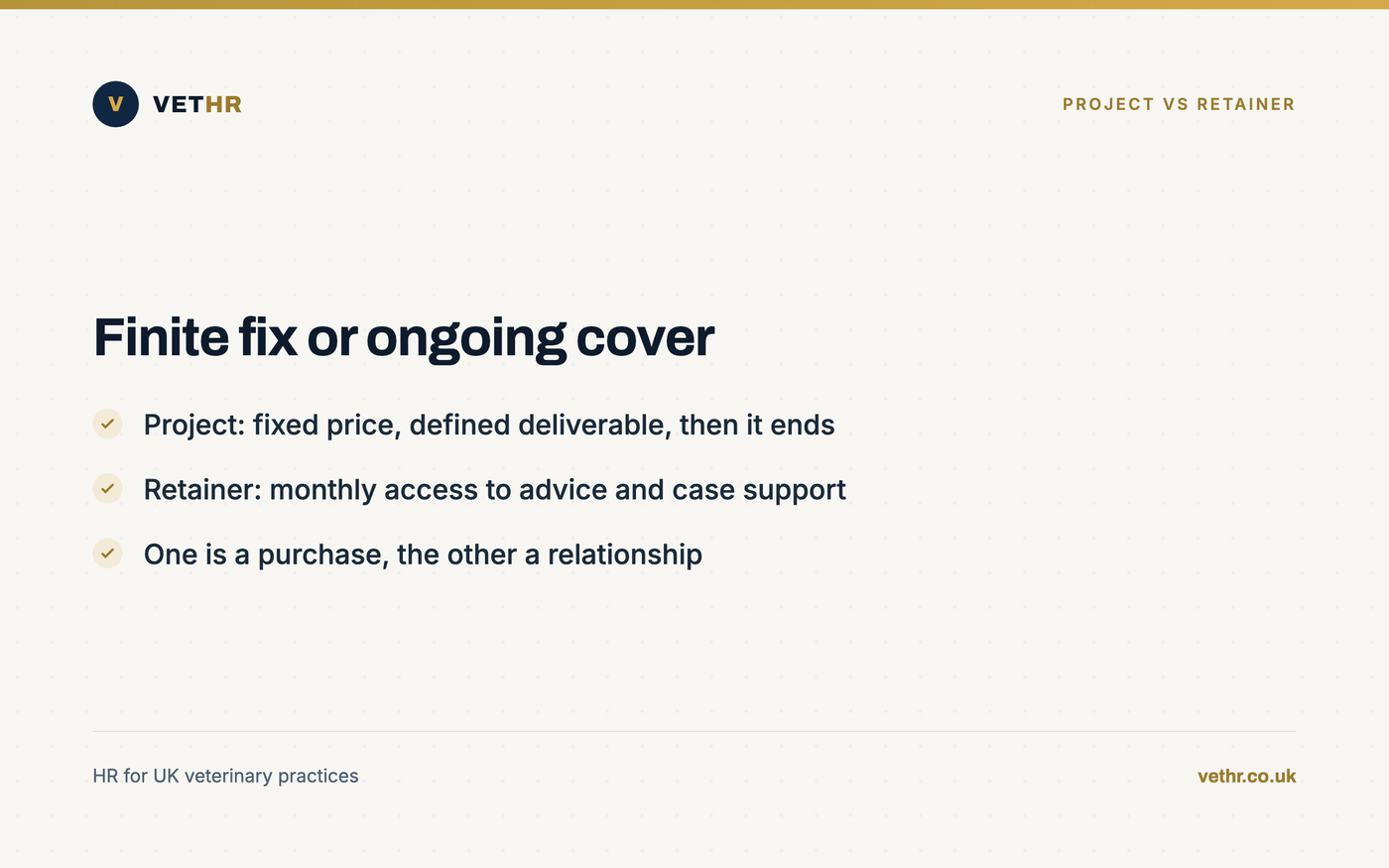
The real difference is finite versus ongoing. A one-off HR project solves a defined problem for a fixed price and then ends. A retainer is monthly HR support for vets that stays in place, covering advice and cases as they come up. One is a purchase, the other a relationship, and each carries a different kind of value.
A project gives you certainty. You know the scope, the deliverable and the cost before you start, which makes it easy to approve and easy to budget. The limit is equally clear: when the job is done, so is the support. If a question lands the following month, you are back to arranging help from scratch.
A retainer gives you continuity. The same specialist already knows your contracts, your team and your history, so advice arrives faster and fits your practice rather than a generic template. The trade is that you pay whether a busy month or a quiet one, which is exactly why fit matters more than headline price.
There is a compliance angle worth naming. Under GOV.UK guidance on the written statement of employment particulars, every employee and worker must receive a principal statement on or before their first day, with the wider written statement following within two months. A project gets your existing documents right once; a retainer keeps every new starter compliant as the team turns over.
A one-off HR project makes more sense when you have a clear, finite problem and a settled team. If your contracts are out of date, your handbook is missing or a single issue needs handling, a fixed-price fix solves it cleanly without committing you to ongoing fees. You buy the outcome, not a relationship you may not need.
The classic case is a documents cleanup. Many practices run for years on contracts inherited from a previous owner or pulled from a generic template, then realise they no longer match how the practice works or what the law now requires. A project rewrites them properly, once, to a standard you can rely on.
Getting a single case right is not a small thing. The Acas Code of Practice on disciplinary and grievance procedures states that tribunals can adjust any awards in relevant cases by up to 25 per cent for an unreasonable failure to follow the Code. A well-run one-off project on a live case is often worth far more than its fee for that reason alone. You can see how a fixed-price piece of work is scoped on our HR consultancy page.
A monthly HR retainer is worth it when people questions keep arriving and you want answers without arranging help each time. If you are hiring, managing performance, dealing with absence or simply fielding regular queries, ongoing HR support pays for itself in speed and confidence. The value is having someone who already knows your practice on the end of the phone.
Volume is the first signal. A single annual contract tweak does not justify a subscription. A steady drip of questions, a new starter most months, the odd absence issue and a performance conversation or two, does. At that point the cost of repeatedly sourcing one-off help quietly exceeds the cost of having support in place.
Currency is the second. Employment rules move, and documents drift out of date the moment they are signed and filed. An HR subscription for veterinary practices keeps contracts, policies and templates current as the law and your team change, so you are not discovering a gap at the worst possible moment, mid-case.
Retention adds weight to the case. In the RCVS Surveys of the Professions 2024, the share of vets intending to stay in the profession for five or more years fell to 75 percent, down from 79 percent in 2019, according to the RCVS. Fair processes and consistent management are part of what keeps good people, and that consistency is exactly what ongoing support is built to provide. Our monthly subscription is designed around that steady, recurring need.
Not sure whether you need a one-off fix or ongoing support? A 30-minute conversation usually settles it. Book a free HR health check and we will look at your contracts, your team and the kind of questions you are fielding, then tell you honestly which model fits. No pressure, nothing sold for the sake of it.
Cost is driven by scope for a project and by team size and support level for a retainer. A one-off fix is priced on the work involved, so a single contract differs from a full handbook build. A retainer reflects how many people you have and how much help you want. Any firm number quoted before someone has seen your practice should make you cautious.
For a project, the levers are clear. The size of the document set, whether everything is being rewritten or just updated, and how many live cases are involved all move the figure. The benefit is total predictability: you approve a fixed price for a defined deliverable and there are no surprises after the fact.
For an HR retainer for veterinary practices, the comparison that matters is not project versus subscription but support versus exposure. Weigh the monthly fee against the practice manager hours lost to people admin, the cost of getting a single case wrong, and the risk carried in documents you could not produce on request. For many growing practices, ongoing support is cheaper than the scramble it removes.
A note on how we price, since people ask. Vet HR quotes per practice in writing after a free health check, rather than publishing a one-size figure that would not fit your setup. You can take a fixed-price project, a monthly retainer, or start with one and move to the other. You will always see the number before you commit, with no surprise fees and nothing bundled in that you will not use.
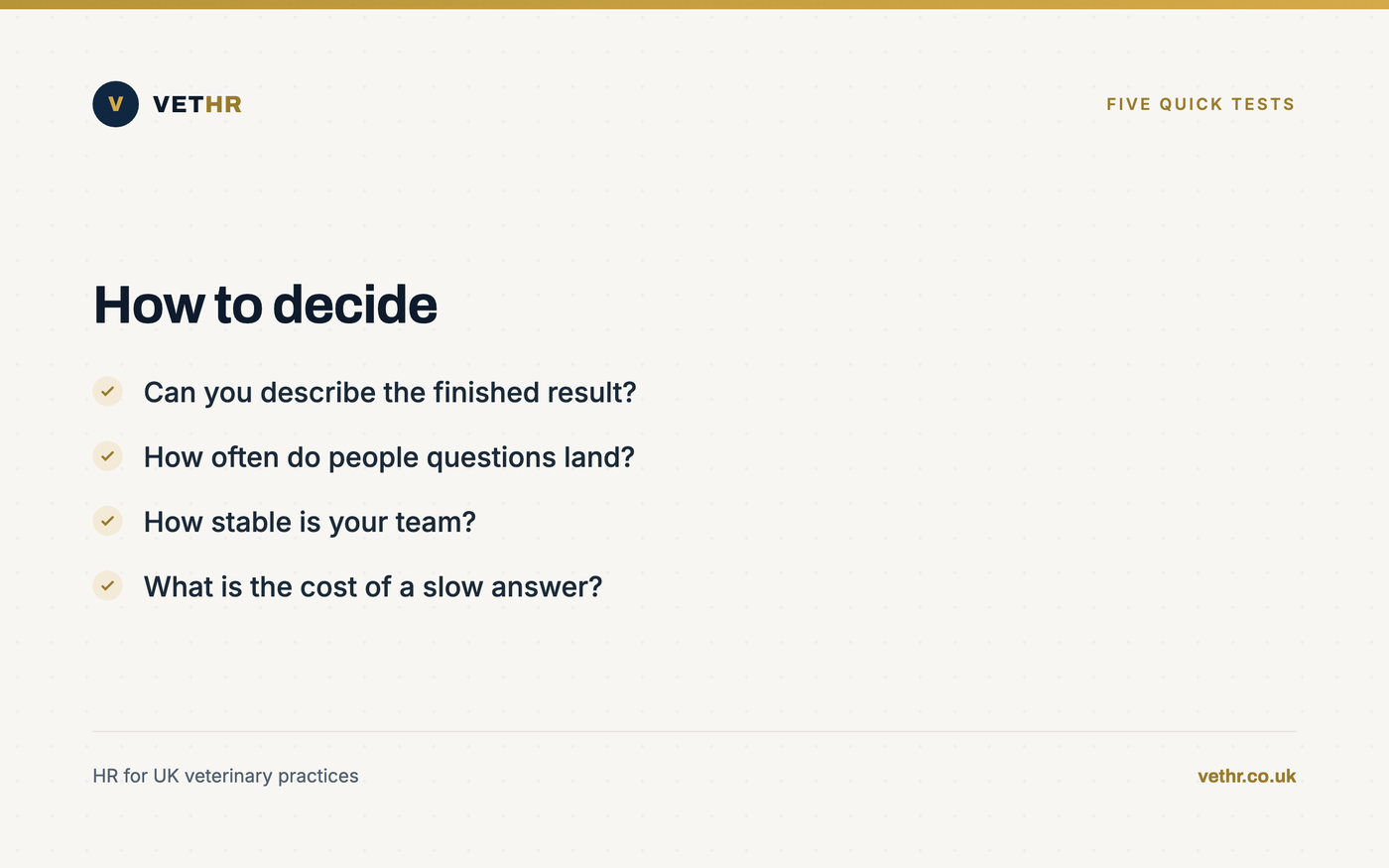
You decide by naming the problem honestly. If it is finite and you can describe the finished result, a one-off project is the cleaner buy. If the need is recurring and you cannot say when it ends, a retainer fits better. Run your practice through these five quick tests and the answer usually becomes obvious.
For many practices the honest answer is both, in sequence. Start with a one-off project to get the foundations right, the contracts, the policies and the handbook, then move onto a retainer to keep it all current and to have support when the next question lands. The project cleans the slate; the retainer stops it filling up again.
Whichever route you take, the building blocks are the same. A good fix or a good retainer both rest on solid veterinary employment contracts and the right staff systems for rotas, hours and records. Sort those once and everything downstream gets easier, whether you are buying a single project or ongoing cover.
Neither is better; they solve different problems. A one-off project fixes a finite job such as a contracts rewrite for a fixed price. An HR retainer for veterinary practices gives you ongoing support for recurring people questions. Choose the project for a clear, settled need and the retainer when questions keep arriving and speed matters.
Yes, and many practices do exactly that. A common path is a fixed-price project first to get contracts and policies right, then a monthly retainer to keep them current and to have advice on hand. Starting with the project means any later ongoing support builds on solid foundations rather than patching gaps.
It depends on team size and how much support you want, so there is no honest single price. We quote per practice in writing after a free health check. The useful comparison is the monthly fee against the admin hours, case risk and compliance exposure that ongoing support removes, which for many growing practices comes out in the retainer’s favour.
It typically includes access to HR advice, contract and policy updates kept current as rules change, support on cases such as absence, performance and grievances, and templates for everyday situations. The exact scope is agreed in writing so you know what is covered. The point is continuous cover rather than help bought job by job.
Not always. A small, stable practice with current documents and few people issues may be fine with the occasional one-off project. Ongoing support earns its place once hiring is regular, questions land most months, or no one in-house can fully own HR. The trigger is recurring need, not headcount alone.
There is no prize for buying the bigger package. A one-off project is the right answer when the problem is finite and you can picture the finished result. A monthly retainer is the right answer when the questions keep coming and you want someone who already knows your practice ready to help. Many owners are best served by one then the other.
Let the problem choose the model rather than the other way round. To weigh it up, read how a fixed-price piece of work is scoped in our HR consultancy, see what ongoing cover looks like with our monthly subscription, or simply book a free HR health check and we will give you a straight recommendation for your practice. Nothing sold that you do not need.
The Vet HR Team provides HR consultancy and white-labelled staff systems exclusively to UK veterinary practices.
Related reading: The contract clauses to check before a long HR retainer · The Kingfisher alternative
Contracts, rotas, holiday, a difficult conversation. Tell us what you are dealing with and we will come back within one working day. Nothing to sign up to.
Got it. We will come back to you within one working day. If you do not see a reply, please check your spam folder.
