Last updated: 15 September 2026
TL;DR: When you are short staffed, protect emergencies and inpatients first, move routine work second, and never close the gap by skipping breaks. Workers still get a 20-minute break after six hours and 11 hours between working days. Nurses can only take on Schedule 3 work under a vet’s direction. Then fix the pattern with rota headroom, a bank list and a written cover policy.
It is 7.45am. One vet has called in sick, a nurse is stuck on the motorway and the first consult is at 8.30. Every practice has mornings like this, and being short staffed for a day is survivable. What does the damage is making the day’s decisions in a panic, and then letting the same gap come back next month.
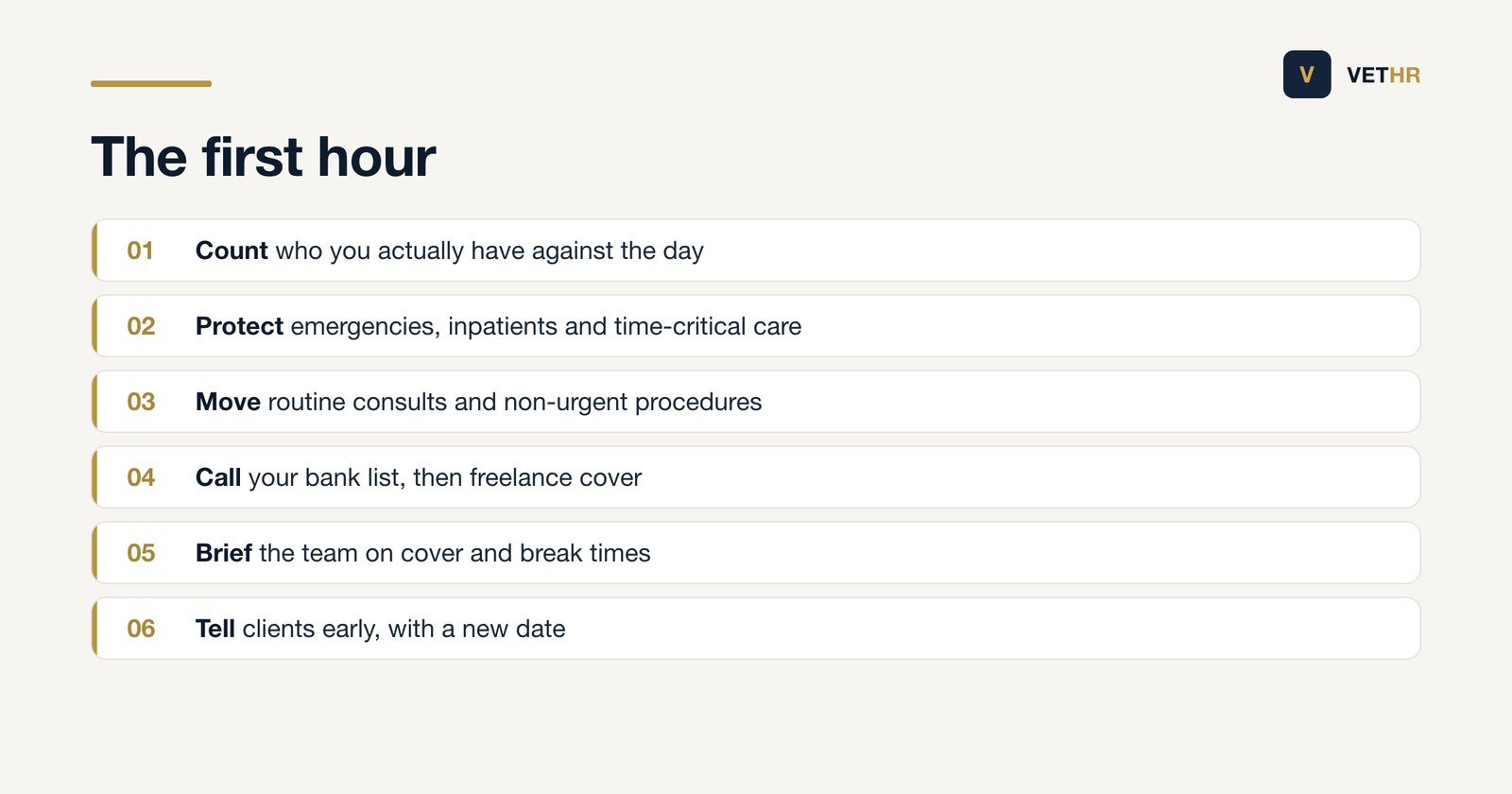
When you are short staffed, decide what the day must still deliver before you decide who does it. Emergencies, hospitalised patients and time-critical treatment come first. Routine consults, boosters and non-urgent procedures can usually move. Then call in cover, brief the team, tell clients early and plan every break before the doors open.
Step four goes faster when the list already exists. A practice that keeps a current bank list, with phone numbers and the days each person can usually work, fills a gap in two calls rather than twenty. Our guide to freelance vet cover explains how to keep good people coming back.
Step seven is the one everyone skips. A short note after each short staffed day is how you spot that it is always a Monday, always the same branch, or always the week after a bank holiday.
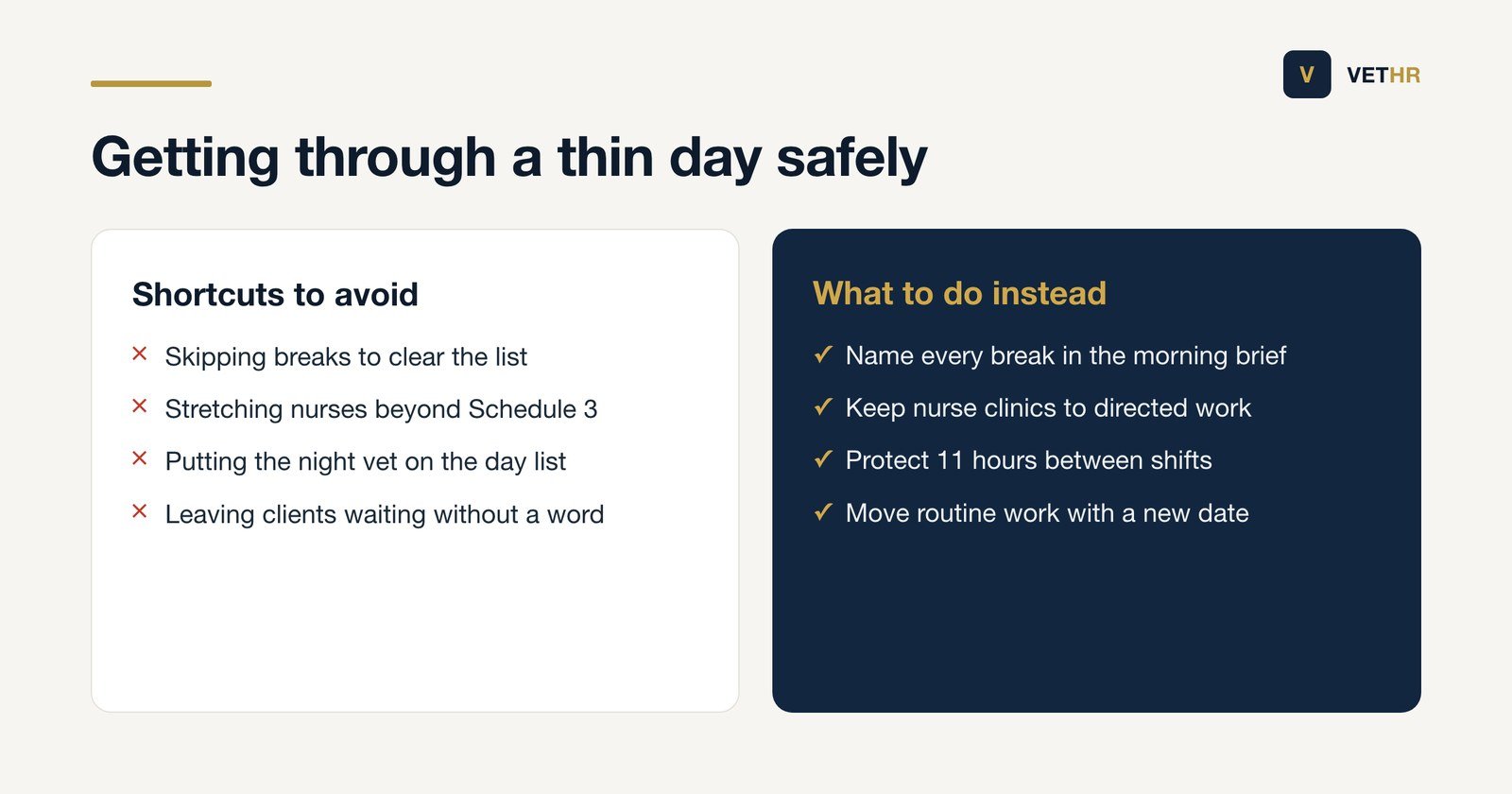
Registered veterinary nurses can give medical treatment and carry out minor surgery not involving entry into a body cavity, under the direction of their veterinary surgeon employer. Student nurses also need supervision. Being short staffed does not widen those limits, so build any extra nurse clinics around what Schedule 3 actually allows.
The RCVS guidance on delegation to veterinary nurses defines the terms. Direction means the vet instructs the nurse on the tasks but is not necessarily present. Supervision means a vet or registered nurse is on the premises and able to respond. For a student nurse carrying out minor surgery, supervision must be direct, continuous and personal.
Before directing a nurse, the vet must consider how difficult the procedure is, whether the nurse is qualified for the species, whether they have the experience to react if something goes wrong, and whether the vet will be available to answer a call for assistance. The nurse should also feel capable of doing it.
That last condition matters when you are short staffed. If the only vet is in theatre with a long surgery, they may not be available to answer a call, which limits what can safely be delegated while it runs.
Schedule 3 privileges apply to registered and student veterinary nurses only. An animal care assistant or receptionist cannot step into that gap, however experienced, so keep them on the work that frees nurses up: admissions, discharges, phones and stock.
A thin rota is not a reason to drop breaks. GOV.UK sets the minimum: one uninterrupted 20-minute rest break when working more than six hours, 11 hours of rest between working days, and either 24 hours off each week or 48 hours each fortnight. Plan breaks before the day starts.
The GOV.UK guidance on rest breaks gives a useful example: a worker who finishes at 8pm should not start again until 7am. That is the rule that bites when a vet covers a late evening and is then asked to open the next morning.
The break does not have to be paid, which depends on the contract, but it does have to happen. In a busy practice the only reliable way is to name break times in the morning brief and cover them, rather than hoping a quiet moment appears.
Weekly hours matter too. GOV.UK confirms nobody can work more than 48 hours a week on average, normally over 17 weeks, unless they choose to opt out, and anyone under 18 cannot work more than 8 hours a day or 40 hours a week. A run of short staffed weeks can push someone over the average without anyone noticing.
If an emergency swallows someone’s break, give them the time back the same day and record why. Our guides to working time rules and overtime for veterinary staff cover the detail.
The RCVS expects vets in practice to take steps to provide 24-hour emergency first aid and pain relief, but not to stay personally on duty. When the practice cannot provide it, clients must be directed to another appropriate service, and those arrangements should be made before an emergency arises and confirmed in writing.
The RCVS guidance on 24-hour emergency cover also says staffing, facilities and arrangements should be appropriate to the likely workload of the practice and reviewed on an ongoing basis. A practice that is short staffed every week should read that paragraph closely.
Vets are not expected to respond to emergencies within a set timeframe, but they should respond with reasonable promptness. Where the on-duty vet cannot attend every emergency in a reasonable time, the guidance says to try to inform the owner and document the reasons for the delay.
The most common unsafe fix is asking the night vet to cover the day as well. Protect their rest, and if the gap is in the evening, check that your out of hours arrangements can take the calls instead. Our guide to the out of hours rota covers the planning.
Short staffed more weeks than not? A free 30-minute HR health check will show where the rota runs out of room. Book your HR health check.
Tell them early, plainly and with a new date. A client who hears at 8am that a routine appointment has moved to Thursday usually accepts it; a client who waits forty minutes and then hears the same news rarely does. Keep the message about protecting care, and never say why a colleague is off.
On a short staffed day, the last line of every message should be what to do if the animal gets worse. That keeps the practice on the right side of its emergency obligations even while routine work is being moved.
A practice that is short staffed most weeks usually has a rota with no headroom rather than a run of bad luck. Annual leave, sickness, training days and vacancies are predictable in total even when individual days are not, and a rota built for full attendance fails the first time anyone is away.
The pattern feeds itself. Every thin day adds pressure to the people who did turn up, and pressure is one of the reasons people leave, which creates the next gap. Our guide to the stress risk assessment shows how to assess workload properly.
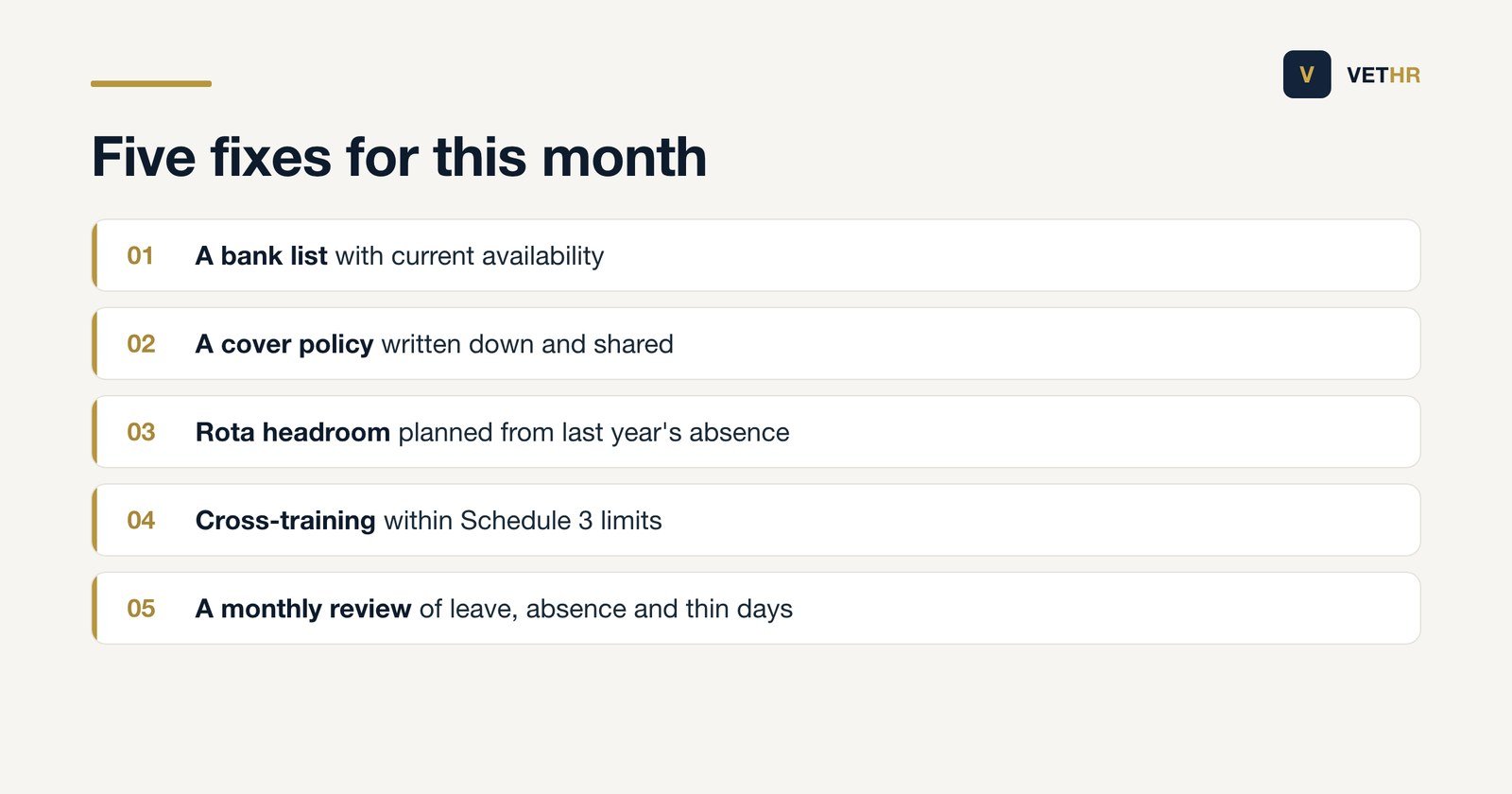
Five fixes remove most short staffed days: a current bank list, a written cover policy, headroom built into the rota, cross-training within Schedule 3 limits, and a monthly look at absence and leave data. None needs a new hire, and each one makes the next thin morning easier to run.
The cover policy is the one that pays back fastest. When the whole team knows the order of priorities, the 7.45am phone call becomes a routine rather than a crisis. Our guide to a veterinary rota policy shows what to include.
That depends on the contract, and on the working time limits. Extra shifts cannot breach the 11 hours of rest between working days or the weekly rest rules, and nobody can work more than 48 hours a week on average unless they have opted out.
Only for work a vet has directed that falls within Schedule 3, that the nurse is qualified and capable of doing, and where the directing vet is available to answer a call for assistance. Anything outside Schedule 3 still needs a veterinary surgeon.
The RCVS expects vets in practice to take steps to provide 24-hour emergency first aid and pain relief. Where the practice cannot, clients must be directed to another appropriate service, using arrangements made in advance and confirmed in writing.
At least one uninterrupted 20-minute break when working more than six hours, 11 hours of rest between working days, and 24 hours off each week or 48 hours each fortnight. Contracts can give more, and the break does not have to be paid unless the contract says so.
Enough to absorb planned leave and typical absence without cancelling routine work. Work it out from your own last twelve months of leave, sickness and training days, role by role, rather than from a rule of thumb.
Every practice is short staffed some days. The difference between a hard day and a dangerous one is a plan made in advance: what gets protected, what moves, what nurses can safely take on, and when everyone gets a break.
Our rota system shows leave clashes and gaps before they become a 7.45am phone call, and a free HR health check will tell you whether your rota has the headroom it needs.
The Vet HR Team provides HR consultancy and white-labelled staff systems exclusively to UK veterinary practices. This guide is general information, not legal advice.
Contracts, rotas, holiday, a difficult conversation. Tell us what you are dealing with and we will come back within one working day. Nothing to sign up to.
Got it. We will come back to you within one working day. If you do not see a reply, please check your spam folder.
