Last updated: 5 September 2026
TL;DR: Every needlestick injury should be reported internally the moment it happens. Only some are reportable under RIDDOR, and the test is narrower than most practices assume. The immediate medical decisions are time critical and belong to a clinician, not to a manager. What belongs to the practice is a procedure people can follow at 2am and a record that survives the shift.
This article covers the employer’s procedure and records. It is not clinical advice, and nothing here replaces prompt medical assessment of an individual injury.
A needlestick injury goes unreported not through carelessness, but through the ordinary pressure of a busy list.
A needlestick injury usually happens mid procedure, to somebody holding an animal, with a client in the room or a list running behind. The instinct is to squeeze it, carry on, and mention it later. Later becomes the end of the shift, and the end of the shift becomes never, and the entry that should have gone in the accident book does not exist.
That matters for two separate reasons. Clinically, post exposure decisions are time sensitive. Practically, if the person later develops a problem and there is no record, both they and the practice are in a much worse position than if it had taken two minutes on the day.
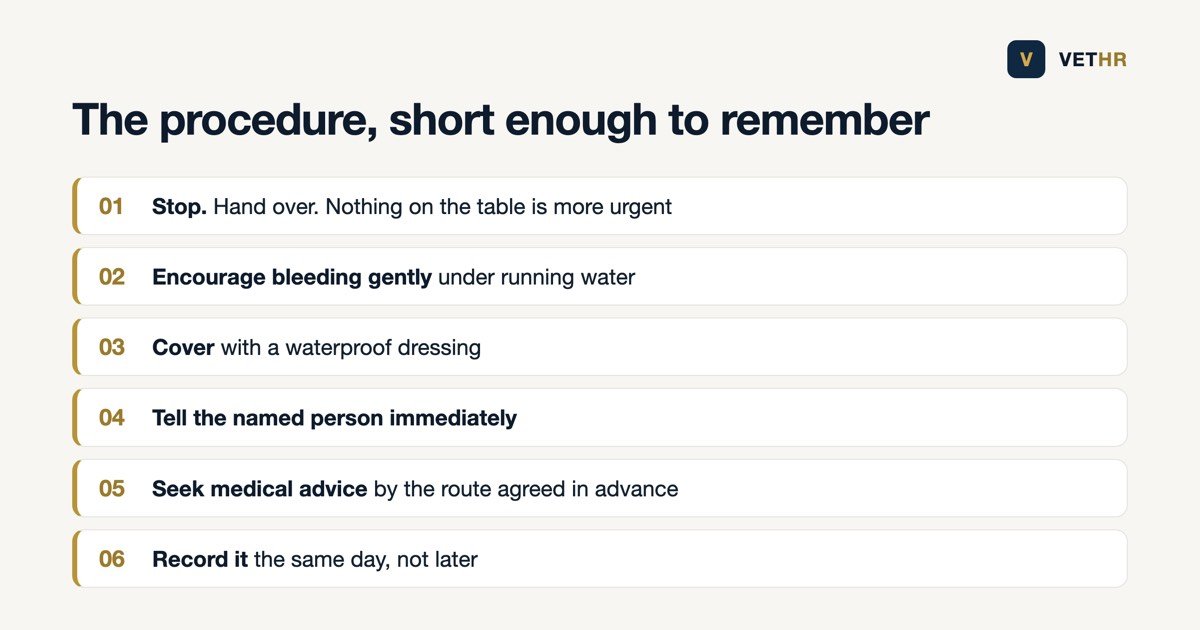
A needlestick injury procedure has to be short enough to pin up where sharps are used, and short enough to be remembered by somebody who has just injured themselves.
Step four is the one that decides whether the rest happens. A practice where reporting a needlestick injury feels like an admission of clumsiness will have very few of them on paper and no fewer in reality.
The single most useful thing a practice manager can do about a needlestick injury is decide, in advance and in writing, where somebody goes.
Occupational health provider, local A&E, NHS 111, or a named GP practice. In hours and out of hours, because they may be different. Names and numbers on the procedure itself, not in a folder.
Somebody who has just sustained a needlestick injury should not be working out who to call. Deciding it in advance costs one conversation and it is the difference between advice sought in twenty minutes and advice sought the following afternoon.
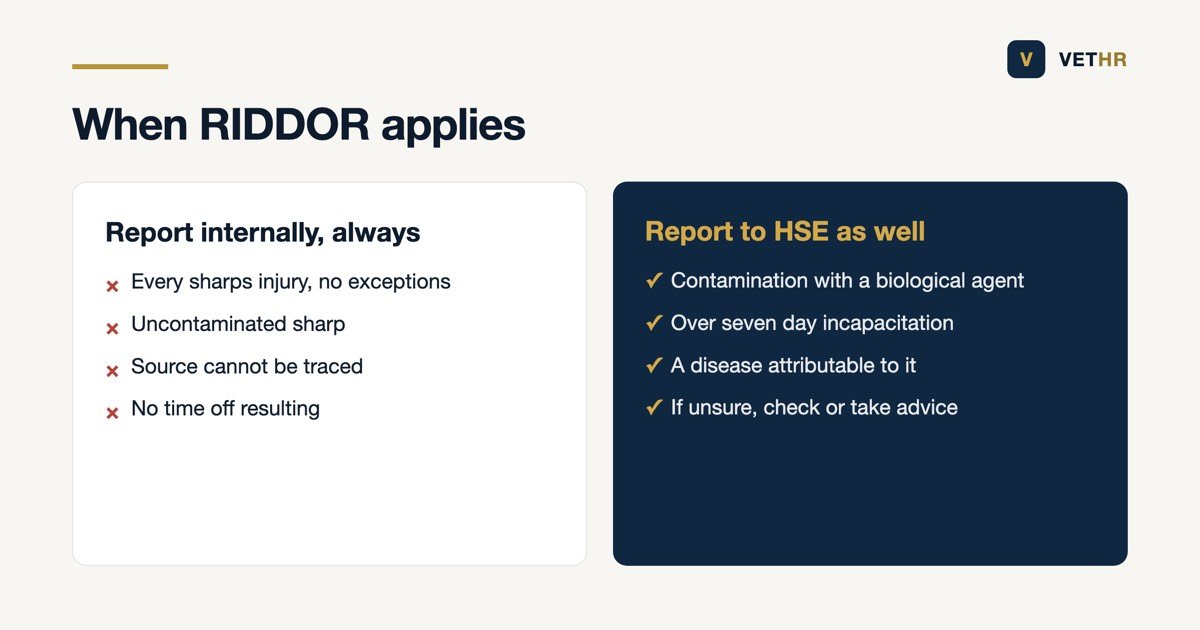
This is where practices get needlestick injury reporting wrong in both directions, either reporting nothing or assuming everything must be reported.
Report every needlestick injury internally. RIDDOR is narrower, and applies in these situations:
Where the sharp was uncontaminated, or the source cannot be traced, and there is no over seven day injury, it is generally not RIDDOR reportable. It still goes in your own records.
If you are unsure, check the HSE guidance on RIDDOR or take advice. Over reporting is not a problem. Failing to report is.
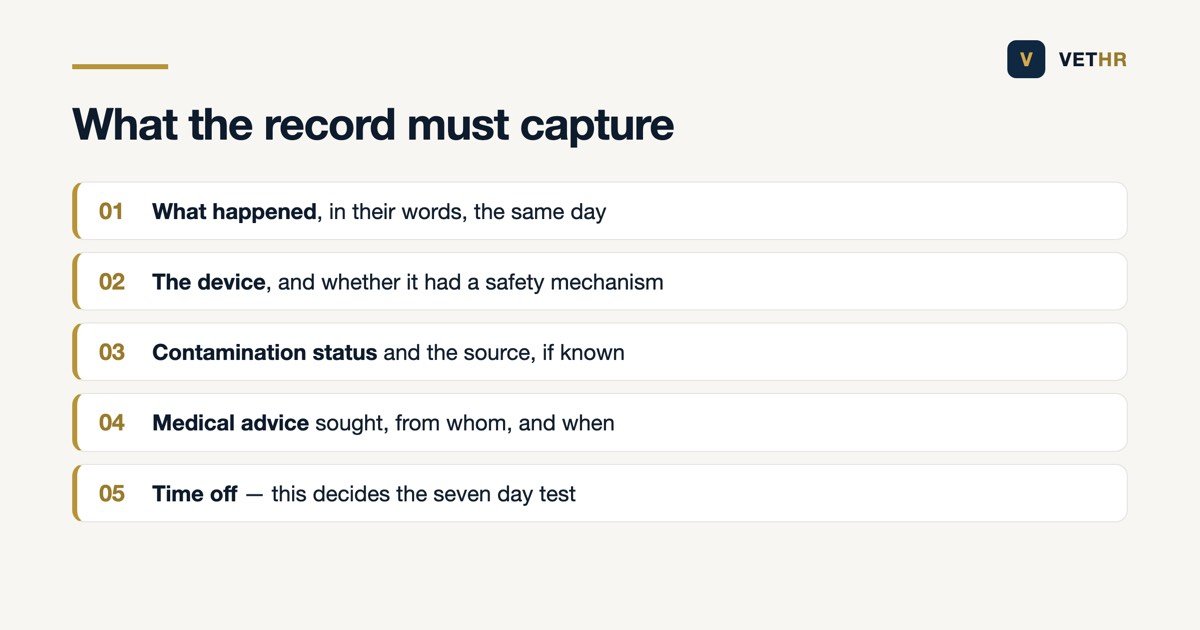
More than the words needlestick injury and a finger. The details that matter later are the ones nobody can reconstruct in six months.
Our free health and safety pack has the procedure and the injury record already laid out.
The reporting is done and the medical advice has been taken. Four things then get forgotten.
Sickness absence following a needlestick injury is ordinary sickness absence and should be handled the same way, with a return to work conversation like any other. Since 6 April 2026 statutory sick pay starts from the first qualifying day, which matters for the part time and bank staff who previously received nothing.
One needlestick injury is an event. Four in a year is information, and it will point at something specific: a particular procedure, a particular time of day, a bin that is too far from the table, or a list that runs so tight that nobody has a free hand.
Read the incident log as a set once a year rather than one entry at a time. The HSE publishes practical guidance on managing sharps risks that is worth an hour of a practice manager’s time even though it is written for healthcare.
The standard needlestick injury controls are well known: safer devices where they exist, never resheathing by hand, sharps bins within reach and not overfilled, and never passing a sharp hand to hand.
What is less often said is that most sharps injuries happen when somebody is rushing, restraining a difficult animal single handed, or working at the end of a long shift. Those are staffing and rota decisions rather than training failures, and no amount of retraining fixes a list that is booked tighter than it can safely run.
If your incident log shows a cluster at particular times or on particular days, that is a rota finding, and our guide to staffing levels is the place to take it.
Yes, record every needlestick injury internally. Accident book entries contain health information about an identifiable person, so keep them confidential and not on a page where the next person can read the previous entry.
Record the needlestick injury anyway and encourage them to seek advice. The record protects them as much as the practice, and a person who declines advice on the day sometimes changes their mind, at which point the contemporaneous note is what they need.
The Health and Safety (Sharp Instruments in Healthcare) Regulations 2013 are aimed at the healthcare sector, and whether and how they apply to a veterinary practice is worth checking for your own setting. What is not in doubt is that the general duties under the Health and Safety at Work etc Act and COSHH already require you to assess and control the risk.
Somebody who is usually on site and will act immediately, which in most practices is the head nurse or the practice manager rather than a partner who may be consulting. Name a deputy for when they are not there.
Exactly the same needlestick injury procedure, and it should be covered in their induction before their first shift. Students are more likely to hesitate before reporting, so say explicitly that reporting is expected and that nobody will be criticised for it.
A needlestick injury is a two minute administrative task and a genuinely frightening few days for the person it happened to. Practices tend to handle the second part well and the first part badly, and it is the first part that determines what happens if anything goes wrong.
Pin the procedure up, name the person, agree the medical route, and say out loud that reporting is expected. If you want the assessments and records structured properly, our free HR health check covers it.
Contracts, rotas, holiday, a difficult conversation. Tell us what you are dealing with and we will come back within one working day. Nothing to sign up to.
Got it. We will come back to you within one working day. If you do not see a reply, please check your spam folder.
