Last updated: 5 September 2026
TL;DR: Where a full time vet or RVN post has sat vacant for months, two people at three days each will often fill it. The thing that makes a job share work or fail is the handover, and the practices that get it right pay for an overlap rather than hoping the two people sort it out. It costs slightly more per hour than one person and considerably less than a vacancy.

Because the alternative is often nothing. A full time vet post advertised at a fair salary can sit open for months in parts of the country, while freelance cover quietly eats more than the salary would have cost.
Meanwhile there is a substantial pool of experienced vets and nurses who are not applying for full time roles and would apply for three days. Parents. People phasing towards retirement. People who left clinical work and would come back for part of a week. A job share reaches all of them, and none of them are visible in your applications for a full time post.
There is a retention argument too. Two people each doing three days also carry a load that one person doing five would find much harder to sustain, which matters in a profession with a known burnout problem.
Two routes, and they need handling differently.
The second route is the one practices miss. A request to drop to three days is frequently refused on the basis that the role needs five, when the honest answer is that the role needs five days of cover, which is a different thing.
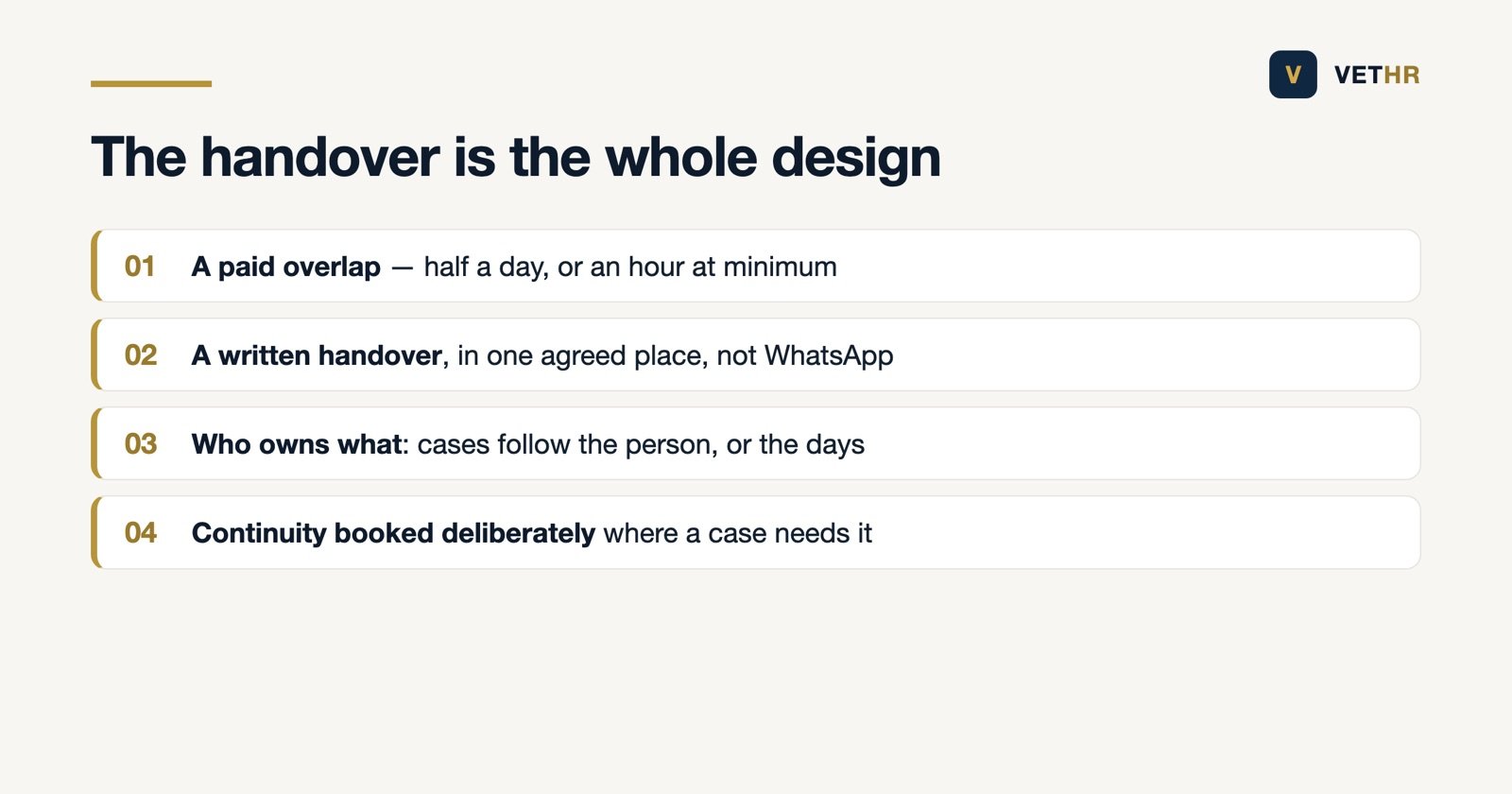
Everything else is administration. The handover is where it succeeds or falls apart, and in clinical work the stakes are higher than in most sectors because a dropped detail is a patient.
Three things to design deliberately:
Where a case genuinely needs continuity, say so explicitly and book the follow up on that person’s day. Clients accept this readily when it is explained and resent it when they discover it by accident.
Three patterns, each suiting a different practice.
Out of hours needs its own decision. Splitting it in proportion to days worked is the fairest starting point, but say it out loud and put it in the rota policy rather than letting it be negotiated every month.
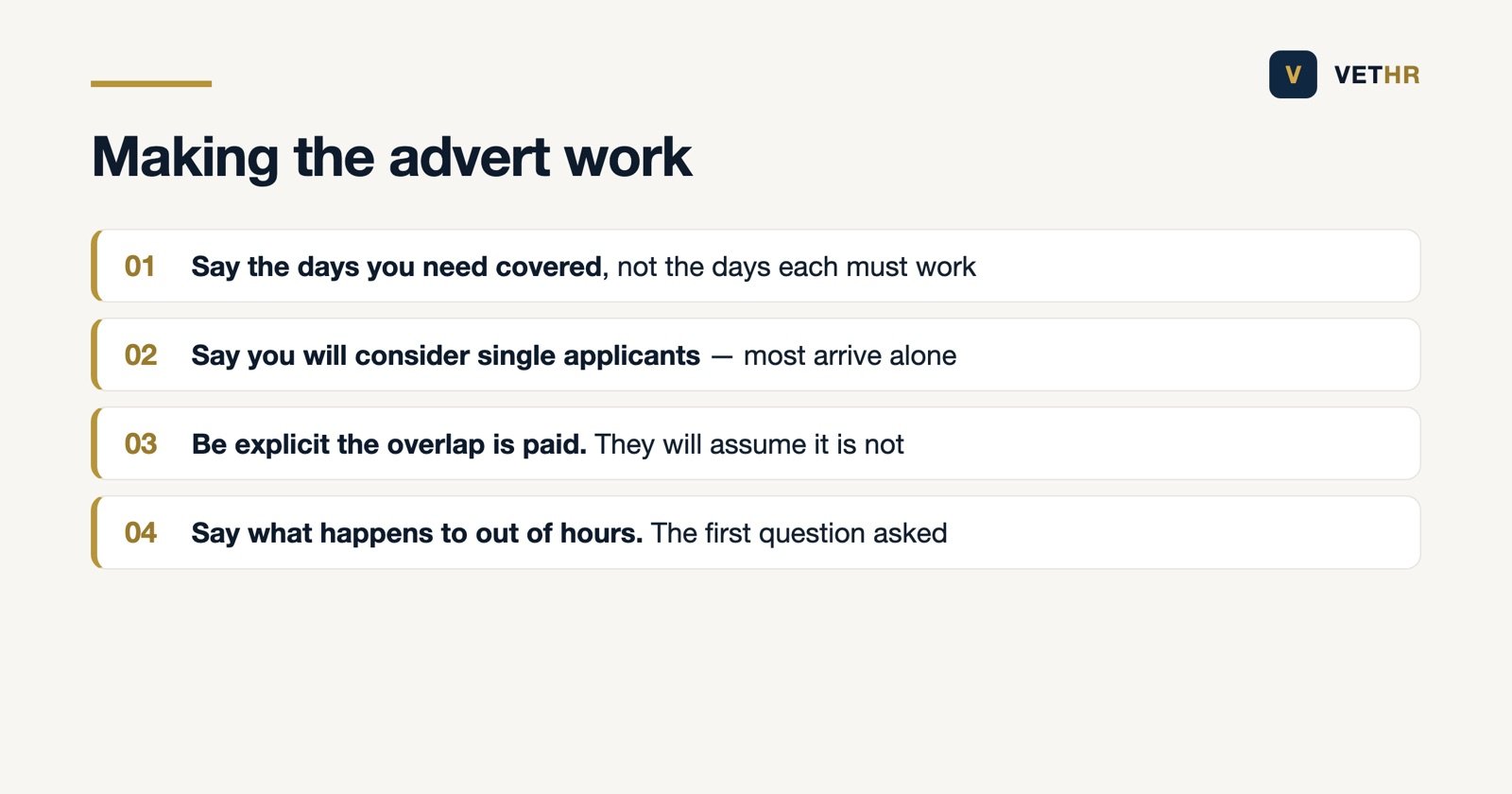
If you decide to open a role to a job share, the advert has to say so in a way people believe. “We would consider flexible working” reads as a polite no. “This role is open to a job share, and we will help two applicants pair up” reads as an invitation.
Where two people apply separately and both are good, you are allowed to introduce them and let them work out whether they want to pair. Practices worry this is awkward. It is not, and it is how many successful arrangements begin.
These arrangements almost never fail on day one. It fails around month three, when the handover discipline slips and the two people stop writing things down because they have started to assume they know what the other did.
Two things prevent it. Hold a three way review at six weeks and again at three months, with both people and the manager together, and ask one question: what is falling between you? And keep the written handover mandatory even when it feels unnecessary, because the week it feels unnecessary is the week somebody is on annual leave.
Gov.uk sets out the basic position on flexible working, of which a job share is one form.
A job share is two separate employment contracts, not one contract with two names on it. Each person has their own terms, their own holiday entitlement, their own probation and their own notice period.
Our free flexible working pack covers the request side, and the contract template the terms.
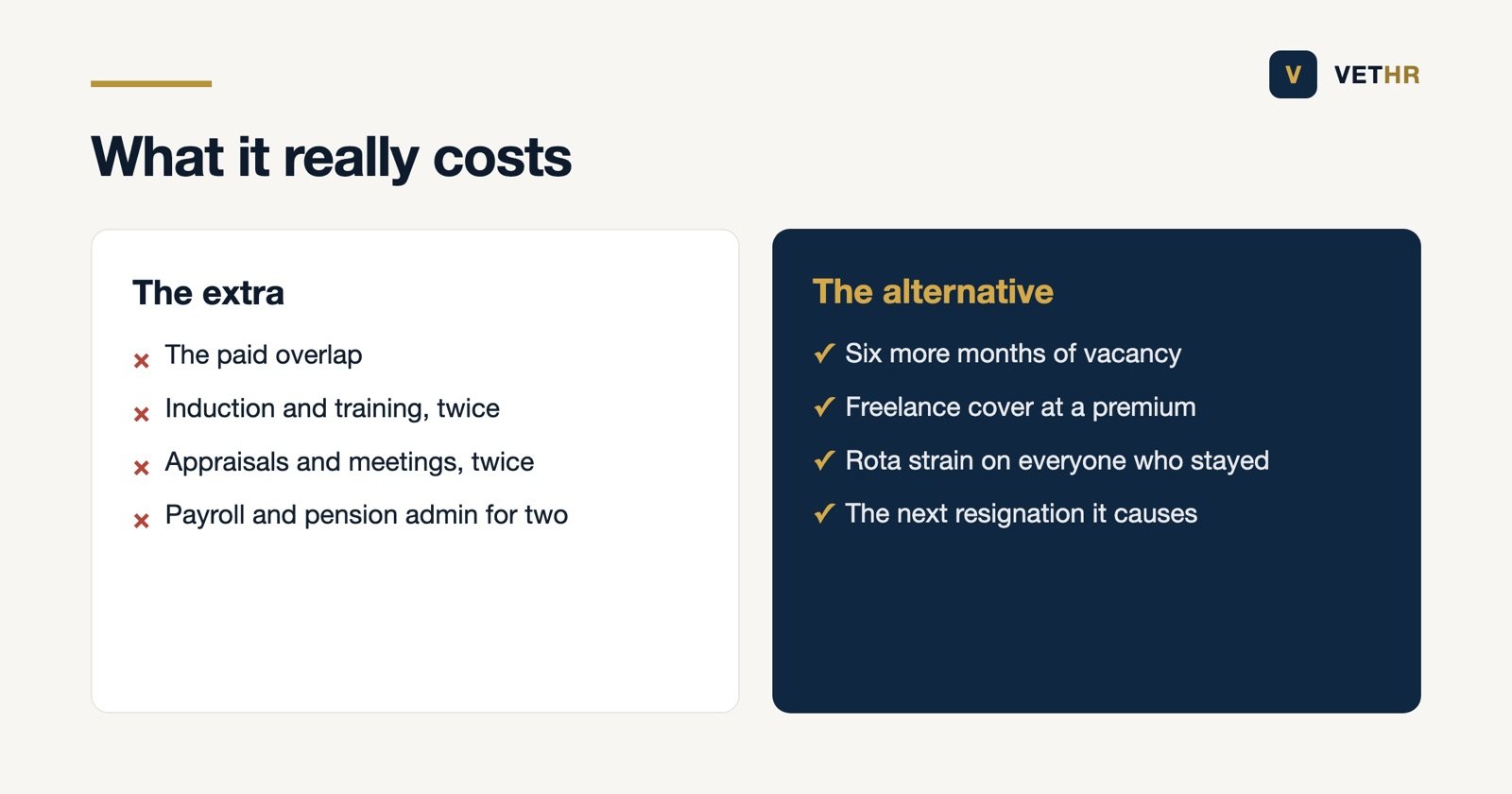
Slightly more per hour than one person, and worth understanding rather than guessing.
Set that against the actual alternative, which is not a full time employee. It is another six months of vacancy, freelance cover at a premium, and the rota strain on everybody who stayed. On that comparison a job share is inexpensive.
The other person’s employment continues on their existing terms. Recruit a replacement partner, and consult the remaining person about interim arrangements. You cannot require them to go full time, and asking them to cover the gap indefinitely is how you lose them too.
They need to cover the core of the role between them. Differences can be an advantage, as long as clients and colleagues know who does what and the rota reflects it. Where one has a skill the other lacks, book accordingly rather than pretending they are interchangeable.
A flexible working request can only be refused for one of the eight statutory business reasons, and you must consult before refusing. Refusing because a job share feels complicated is not one of them, and where the request relates to childcare or a disability there is discrimination risk on top.
Better than practices expect, provided it is explained rather than discovered. Tell clients there are two vets covering the role, name both, and book continuity where a case needs it. What clients dislike is being surprised, not the arrangement.
It is the hardest role to share, because so much of it is continuity and relationships. It can work where responsibilities are split by function rather than by day, for example one holding rota and people and the other holding finance and compliance.
Most practices dismiss a job share because it sounds like twice the management for the same output. In reality it is one extra handover to design, and in return you reach a pool of experienced people who will never apply for your full time advert.
If a post has been open more than three months, put “open to a job share” in the advert and see what arrives. If you want the contracts and the handover structured properly first, our free HR health check covers it. Acas has general guidance on flexible working.
Contracts, rotas, holiday, a difficult conversation. Tell us what you are dealing with and we will come back within one working day. Nothing to sign up to.
Got it. We will come back to you within one working day. If you do not see a reply, please check your spam folder.
