Last updated: 5 September 2026
TL;DR: A workplace investigation establishes facts, and nothing else. Write down the question you are answering before you speak to anyone, keep the investigator separate from whoever will chair a hearing, gather evidence before opinions, and finish with a report that says what is established, what is disputed and whether there is a case to answer. Most of the damage in these cases is procedural, not factual.
A workplace investigation exists to find out what happened. Not to build a case, not to decide an outcome, and not to have a quiet word that makes the problem go away.
That sounds obvious and it is the thing practices most often get wrong, usually with good intentions. Somebody senior forms a view early, and the workplace investigation becomes a search for evidence supporting it. A tribunal reads that in the paperwork immediately, and it is one of the few procedural errors that cannot be repaired later.
The other function is underrated: a proper investigation frequently establishes there is no case to answer. That is a good outcome. It ends the matter, it protects the person who was accused, and it protects the practice from acting on a misunderstanding.
Before anybody is spoken to, write one or two sentences setting out precisely what is being investigated, as a factual question rather than a conclusion.
Not “concerns about Sarah’s attitude”. Something like: “Whether, on 14 August, medication was administered to a patient without a recorded prescription check, and if so, in what circumstances.”
Then write what the workplace investigation is not looking at, which stops it sprawling into a general review of somebody’s performance. Investigations that begin with “let us find out what has been going on” take three times as long and read as a fishing expedition.
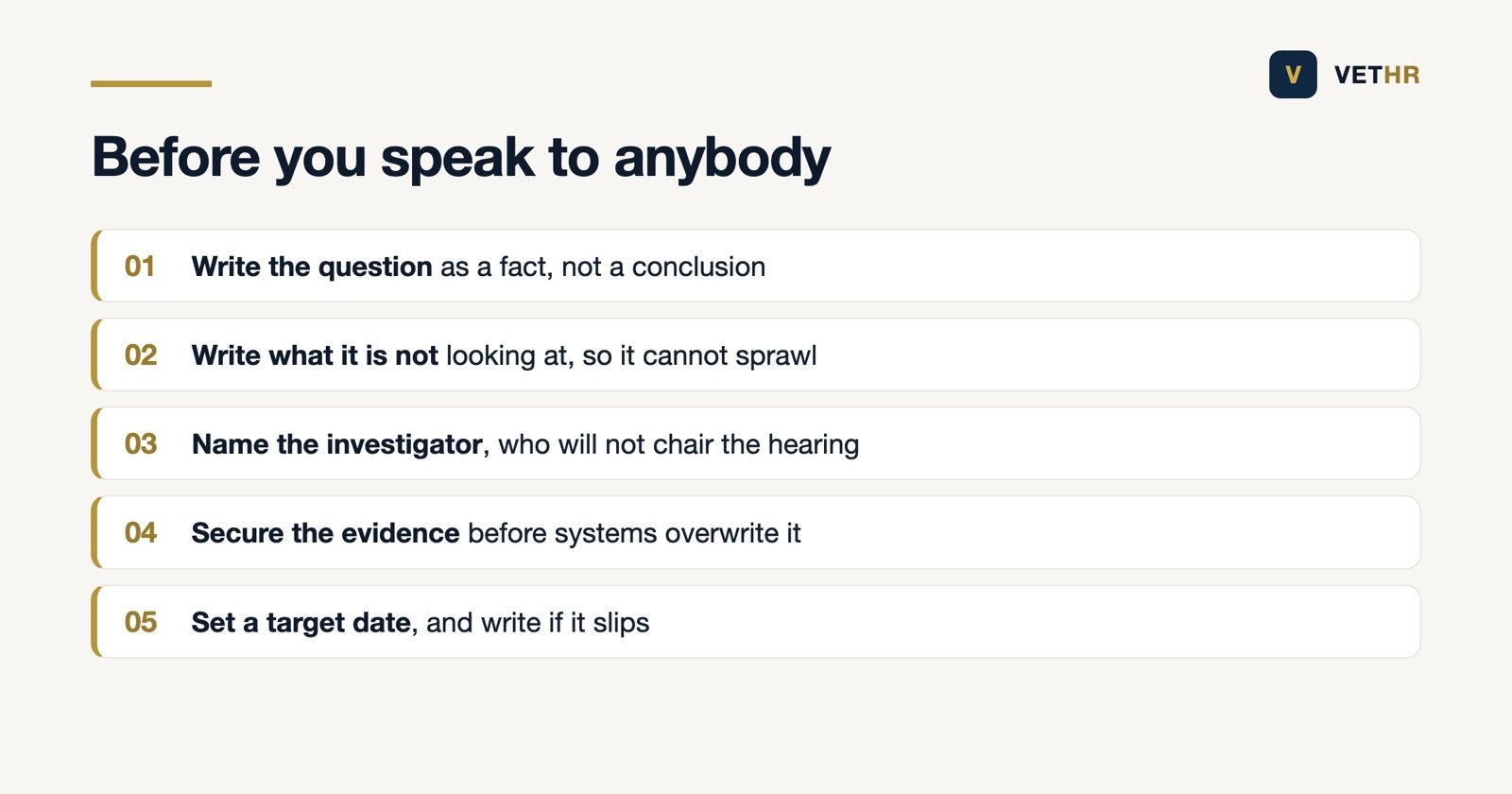
Somebody who will not be deciding the outcome. A workplace investigation and a decision are two different jobs. Three roles, three people wherever you can manage it: whoever investigates, whoever chairs any hearing, and whoever hears an appeal.
In a practice with two partners this is genuinely hard, and pretending otherwise helps nobody. Workable answers exist:
What does not work is one person investigating, deciding and hearing the appeal. That is the most common procedural failure in a small practice and the hardest to repair once the process has run.
Start a workplace investigation with documents. They do not change their story between Tuesday and Friday. People do, honestly and without meaning to, especially once they know a workplace investigation is under way.
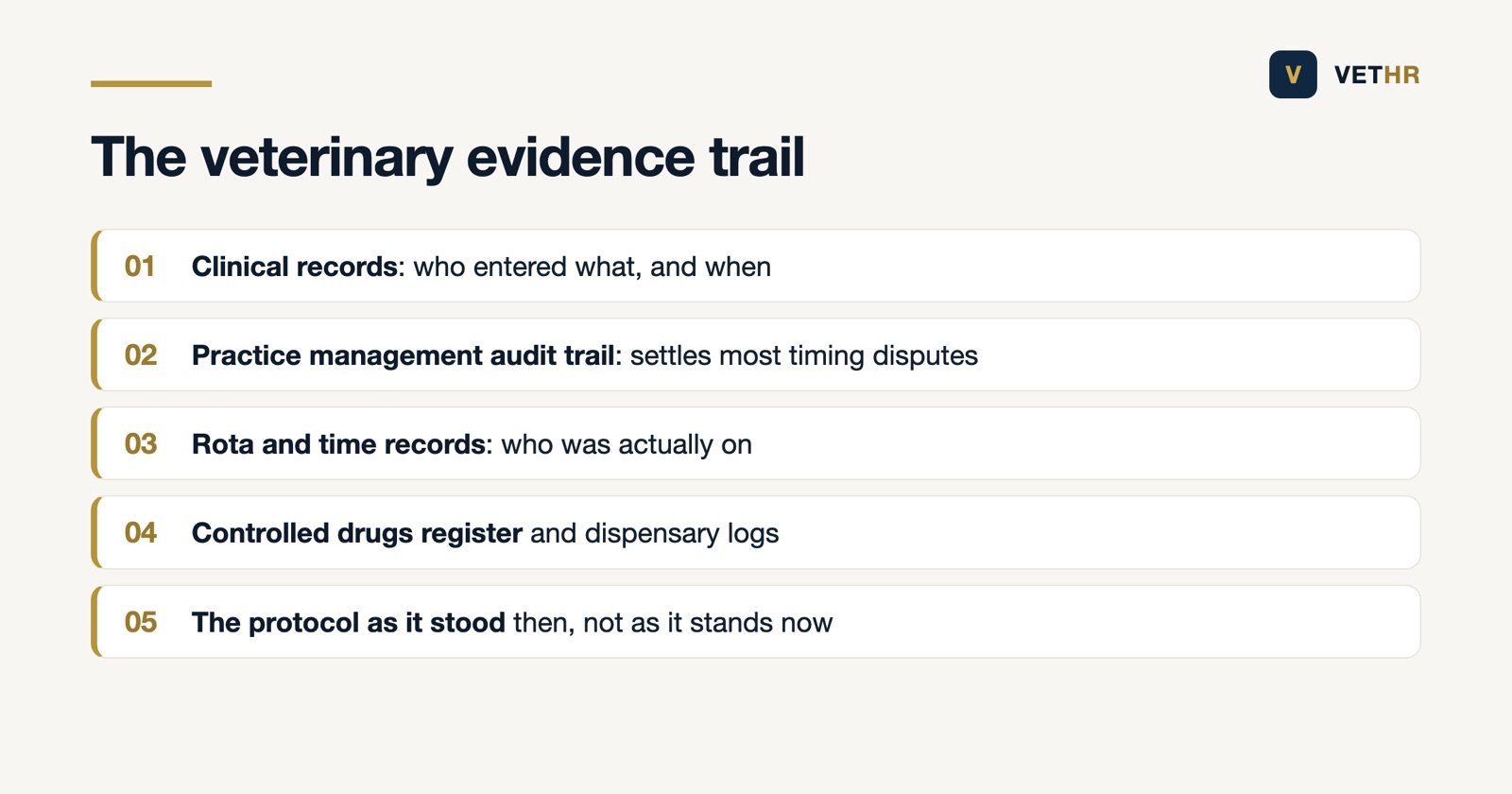
In a veterinary practice the documentary trail is usually richer than people expect:
Secure these early. Systems overwrite, rotas get rebuilt, and a record you did not take a copy of in week one is often gone by week three.
Take a note taker to every workplace investigation meeting. An investigator trying to ask questions and write simultaneously does both badly, and the record is what you will be judged on.
Open each meeting by saying the same four things: this is an investigation and not a disciplinary hearing, no decision has been made, notes are being taken and will be shared, and confidentiality is expected on both sides.
On companions, be straight. There is no statutory right to be accompanied at an investigation meeting, as distinct from a disciplinary or grievance hearing. Many practices allow it anyway, which is usually sensible and costs nothing. Whichever you decide, apply it to everyone the same way.
Ask open questions. Never put the allegation to a witness as though it is already established, because you will get agreement rather than evidence.
A workplace investigation ends in a written report, and it has five parts: what you were asked to look at, what you did, what you found as fact, what remains disputed or unclear, and a recommendation.
The recommendation is only ever one of these: no case to answer, an informal or training matter, a case to answer at a disciplinary hearing in respect of a stated allegation, or refer elsewhere. An investigator never recommends a sanction. Suggesting a final written warning in the report hands the employee an argument that the outcome was decided before the hearing.
Say plainly where the evidence is weak. A report that acknowledges uncertainty is far more credible than one that does not, and honesty about a thin allegation is often what stops a practice pursuing something it should drop.
Our free investigation and suspension pack contains the plan, the meeting record, the witness statement form and the report template.
Bullying, harassment and “atmosphere” complaints are the hardest kind of workplace investigation, because there is rarely a single event and almost never a document.
Three things make them manageable. Ask the complainant for specific instances with dates rather than a general characterisation, because “he is always dismissive” cannot be investigated and “on these four occasions he did this” can. Speak to people who were present at those instances rather than canvassing the team for impressions. And separate the question of whether something happened from the question of whether it amounted to harassment, which is a judgement for the person deciding, not for the investigator.
Where the behaviour came from a client rather than a colleague, a different duty applies from 30 October 2026, covered in our guide to third party harassment. Acas guidance on bullying and harassment is a useful reference for the internal case.
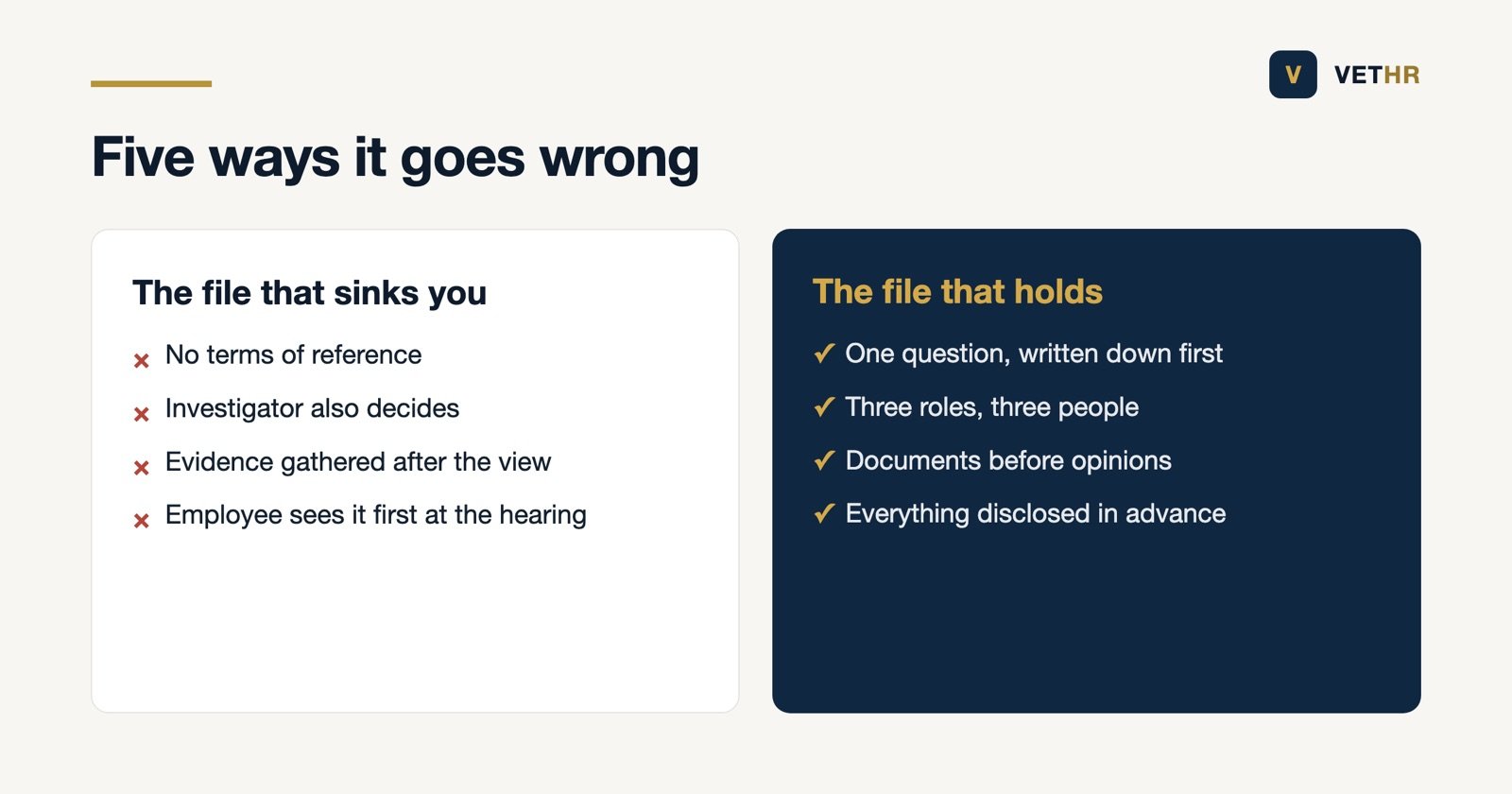
Every one of those is procedural, and every one is free to avoid if the workplace investigation is planned before it starts rather than assembled as it goes.
A workplace investigation should be as short as is consistent with doing it properly. There is no fixed limit, but a workplace investigation that drifts past a few weeks without explanation causes real harm, particularly if somebody is suspended.
Set a target date for the workplace investigation in the terms of reference. If it slips, write to the people involved with a new date and the reason. Silence is what turns a manageable process into a grievance about the process.
Two situations need advice before you go far.
Clinical standards. Where the matter concerns the clinical judgement of a registered professional, an internal conduct process and a professional standards question run on different rules. Treating a clinical disagreement as misconduct, or a genuine conduct issue as purely clinical, causes problems in both directions.
Anything that might be a protected disclosure. If a concern was raised about animal welfare, medicines handling or patient safety before the conduct issue surfaced, the sequence matters a great deal. Whistleblowing protection applies from day one with no service requirement.
The Acas step by step guide to disciplinary procedure sets out the general framework the investigation sits inside.
No, and you should not do it as a reflex. Suspension is not a neutral act. Consider whether there is a genuine risk in the person staying at work and whether a less drastic option manages it, and record your reasoning.
Generally yes, before any hearing, because they cannot answer a case they have not seen. Where a witness is genuinely afraid, take advice rather than promising an anonymity you may not be able to maintain.
You can usually conclude the workplace investigation anyway, and often should, particularly where animal welfare or another member of staff is involved. Take advice before deciding, because how you handle it affects references and any later claim.
Sometimes, and it depends on how they were obtained and how private the group was. Messages volunteered by a participant are on much safer ground than messages obtained by looking at somebody’s phone. Take advice before relying on them.
Say so clearly, in writing, to the person who was investigated. Tell them the matter is closed. People who are cleared quietly, with no confirmation, frequently leave anyway, which wastes the whole exercise.
Almost every case that goes badly for a practice goes badly on procedure rather than facts. The facts are usually roughly what everyone thought. What sinks it is a workplace investigation with no terms of reference, one person doing every role, and a report that recommends an outcome.
If you have something live now, our free HR health check covers it, and advice before the first meeting is worth considerably more than advice after the third.
Read next: Suspension in a Veterinary Practice.
Contracts, rotas, holiday, a difficult conversation. Tell us what you are dealing with and we will come back within one working day. Nothing to sign up to.
Got it. We will come back to you within one working day. If you do not see a reply, please check your spam folder.
