Last updated: 5 September 2026
TL;DR: Self rostering lets the team build the rota inside rules you set, rather than receiving one. It reliably improves how fair the rota feels, which is what most rota complaints are actually about. It fails when the rules are vague, when out of hours is left to volunteers, or when nobody owns the final version. Done properly it is a control you keep, not one you give away.
Self rostering is where staff choose their own shifts from the available slots, within constraints the practice sets, and the manager approves and fixes the result. The practice still defines what has to be covered. The team decides who covers what.
It is not the same as letting people pick whatever they like. Every workable version of self rostering has three fixed elements: the shifts that must be filled, the skill mix each shift requires, and a deadline after which the manager fills the gaps.
Because almost every rota complaint is a fairness complaint wearing a scheduling costume. People rarely object to working a weekend. They object to feeling that the weekend was allocated to them by someone who did not have to think about it.
It changes the emotional shape of that. When a nurse picks their own Saturday, the Saturday is theirs. When the same nurse is given a Saturday, it belongs to whoever gave it to them. The hours are identical and the experience is not.
There is a second, less discussed benefit. It exposes where a practice is genuinely short. When the team cannot fill a slot between them, that is not a scheduling failure, it is a staffing fact, and it becomes visible instead of being absorbed by whoever is easiest to ask.
Four failure modes, and all four are avoidable if you decide them before you start rather than after the first argument.
Notice that none of these are objections to self rostering. They are objections to running it without rules, which is a different thing.
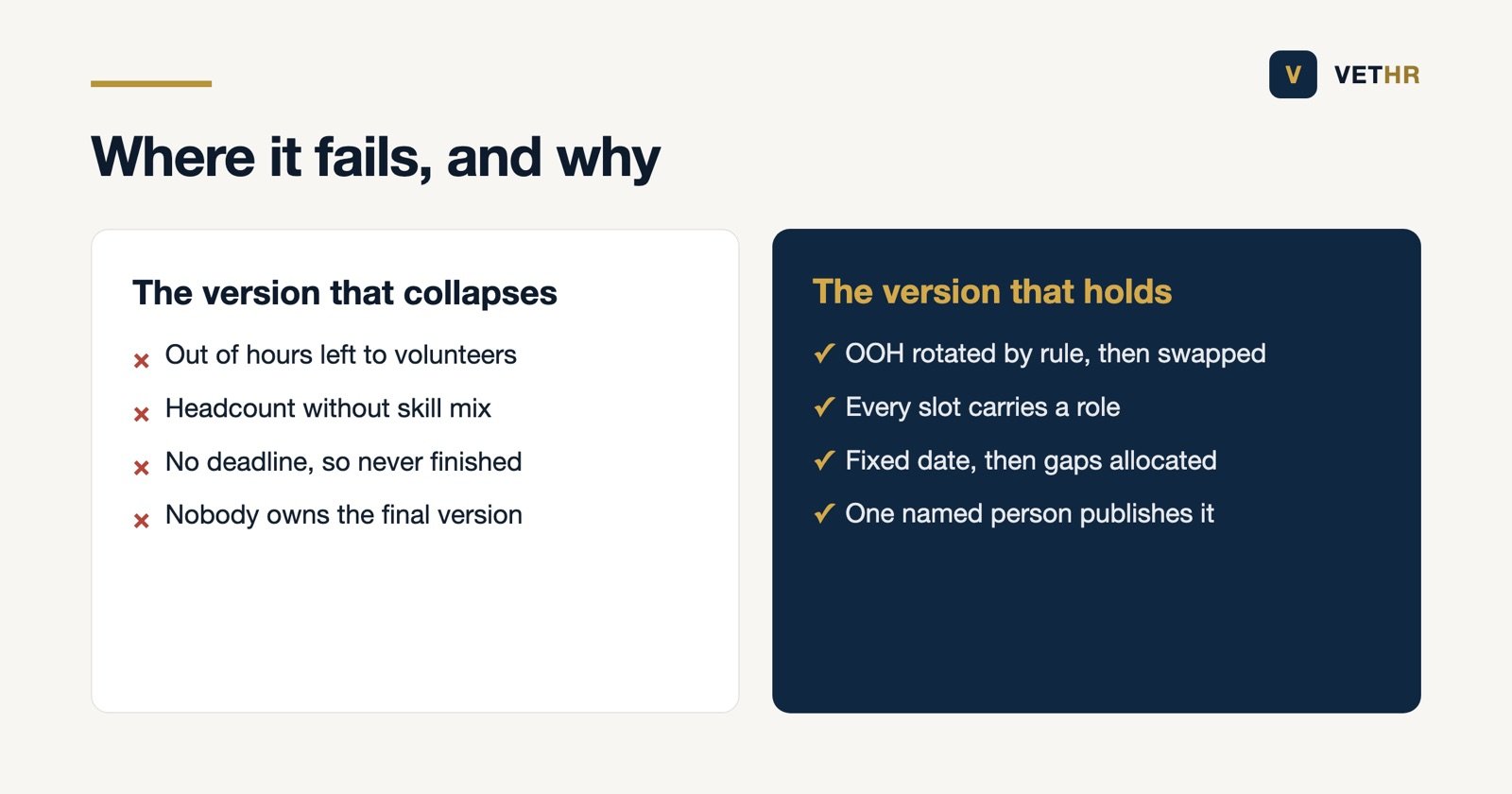
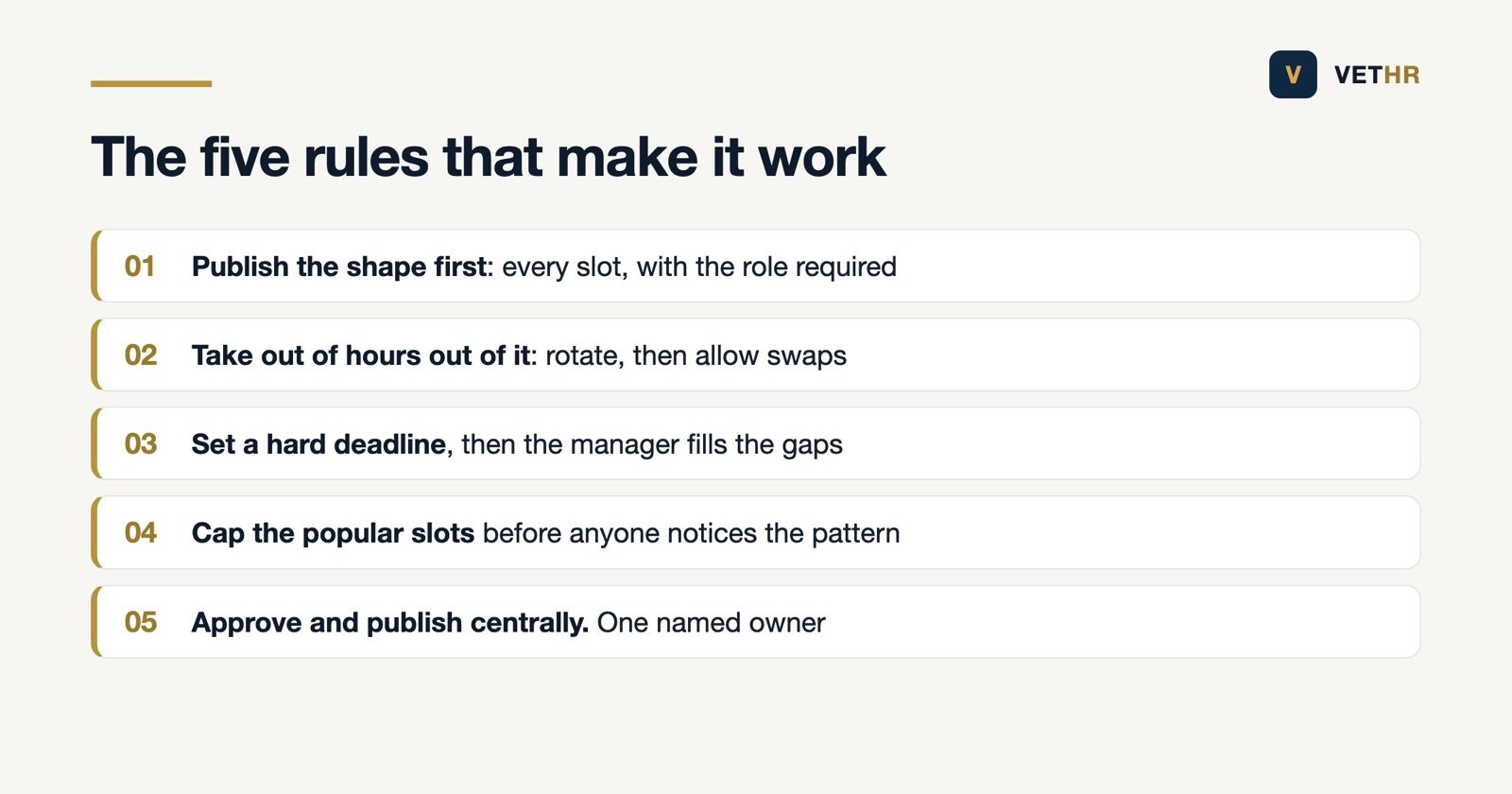
These belong in writing, which is what a veterinary rota policy is for. Without a policy it lasts about two cycles.
Flexible working is a statutory right to request from day one, and a request must be handled reasonably within the statutory timeframe. Self rostering does not replace that process and should not be offered as though it does.
What it can do is reduce how many formal requests you receive, because a lot of flexible working requests are really requests to stop being given the shift that does not fit around a school run. If people can choose around that themselves, they often never need to ask.
Where a formal request does come in, handle it formally. Acas sets out the process for flexible working, and answering “we do self rostering, so pick what you want” is not a response to a statutory request.
The work does not disappear, it moves. Three parts of the job get harder and one gets much easier.
That last point is the real prize. Under a manager built rota, every unpopular shift is a decision someone made about a person. Under self rostering, the leftovers are a fact about the week. Being able to say “these are the slots nobody picked” is a completely different conversation from “I have put you down for Saturday”.
Partially, and the honest answer depends on how much slack you have.
With four or five people there is very little choice to distribute. If two nurses can cover Saturday and one of them has to, it just makes them negotiate between themselves, which can be worse than a manager deciding. Small teams often do better with a published rotation than with free choice.
Around eight to ten people upwards it starts to earn its keep, because there is genuine flexibility to allocate. Multi site practices get the most from it, because someone will always prefer the branch nobody else wants.
If you are not sure whether you have the slack, the honest test is in our guide to veterinary practice staffing levels: remove one person from next week and see what happens.
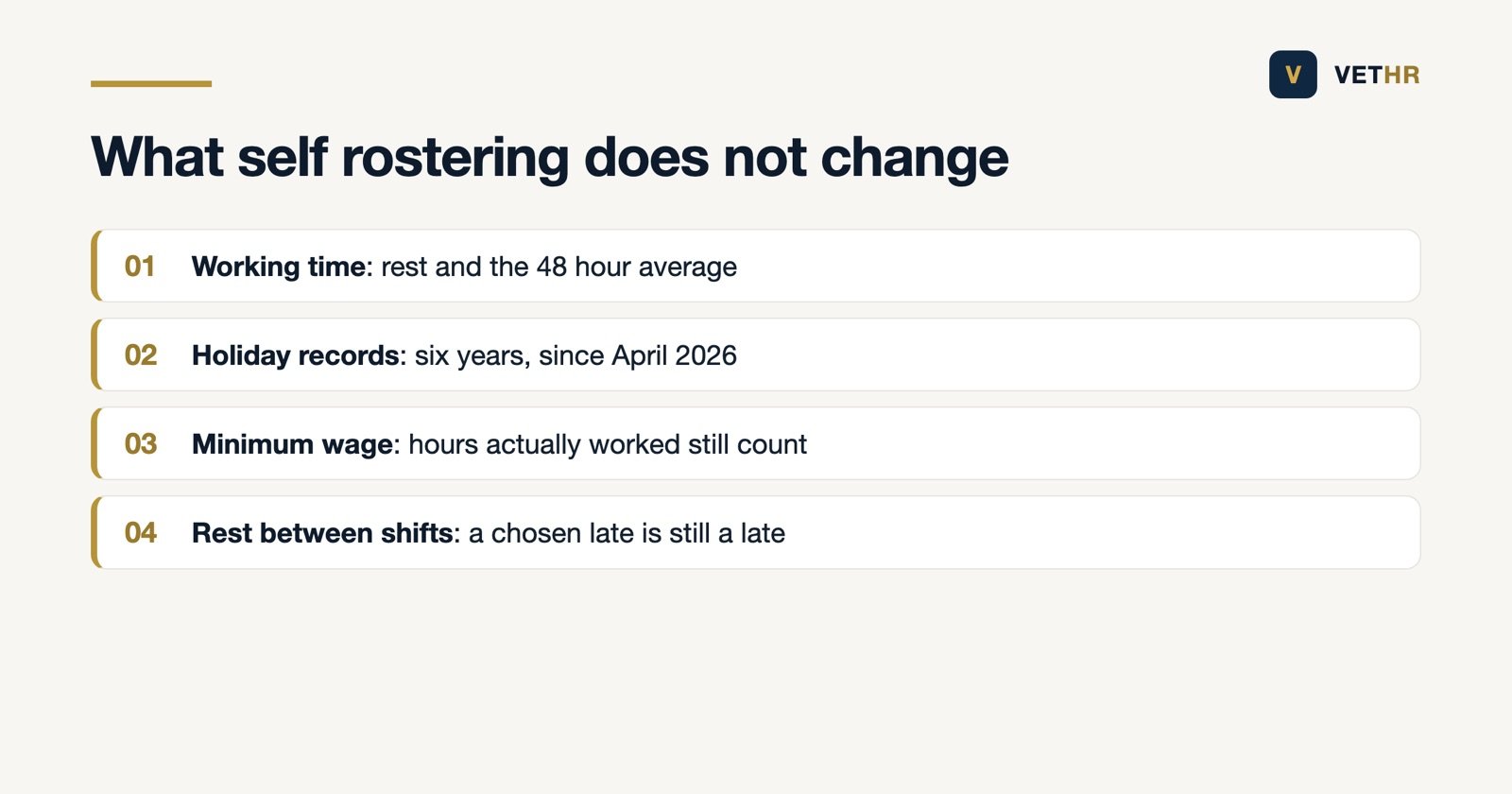
Letting staff choose their shifts does not move any duty from the practice to the individual. The employer remains responsible for all of it.
Build the checks into the process rather than trusting people to know the rules. A rota that flags a breach before it is published is worth more than a policy that says do not do it.
Run one cycle, not a permanent change. Announce it as a trial of four weeks, with the current system returning automatically unless everyone agrees otherwise. That removes the fear that a bad month becomes permanent.
Measure three things at the end: how many slots the team filled unaided, how many the manager had to allocate, and whether the out of hours count came out even. Those three numbers tell you whether self rostering suits your practice better than any amount of discussion will.
Not to trial it. A shared sheet with the slots listed and a deadline works for one cycle. It stops working around ten people, because the conflicts and the skill mix checks become manual and someone has to do them every time.
Decide the tie break before you start, and write it down. Rotation from last cycle is the fairest and the easiest to defend. First come first served rewards whoever checks their phone most, which is not a quality you want to reward.
You can let people swap OOH within an allocated rotation. Allocating OOH purely by choice is the single most common way self rostering goes wrong, because willingness is not evenly distributed and the willing get punished for it.
It should not. Keep it as a process described in the rota policy rather than a contractual term, so you can stop or adjust it without a contract variation.
Then you have learned something valuable rather than failed. Persistent unfilled slots are a staffing or a shape problem, and the process has just made it visible instead of letting it land quietly on the most obliging person.
It is not a way of spending less time on the rota. Set up properly it takes about the same time, and the time moves from allocating shifts to designing and policing rules. What changes is how the result feels to the people working it, and that is where retention actually lives.
Try one cycle with the five rules above. If you want the rules written down properly first, our free HR health check covers rota design, and you keep the written summary either way.
Contracts, rotas, holiday, a difficult conversation. Tell us what you are dealing with and we will come back within one working day. Nothing to sign up to.
Got it. We will come back to you within one working day. If you do not see a reply, please check your spam folder.
