Last updated: 5 September 2026
TL;DR: COSHH requires employers to plan, manage and monitor substances hazardous to health. All employers must carry out a risk assessment, and those with five or more employees must record the significant findings. Asbestos, lead and radioactive substances are excluded because they have their own regulations. Training and, where needed, health surveillance follow from the assessment.
Most practices have a COSHH assessment folder. Rather fewer have one that mentions anaesthetic gases, and almost none have revisited it since a new chemotherapy protocol or a change of disinfectant. The folder exists; the assessment behind it has quietly stopped describing the building.
The Control of Substances Hazardous to Health Regulations. HSE describes them as requiring employers to plan, manage and monitor the substances hazardous to health in the workplace, through a three stage approach of identify, assess and control.
A COSHH assessment is not optional. All employers must carry out a risk assessment, and those employing five or more people must also record the significant findings, which covers most veterinary practices.
The duty is to adequately control exposure, not merely to note that a hazard exists. A folder of safety data sheets is the raw material for a COSHH assessment, not the assessment itself, and that distinction is what inspections turn on.
HSE sets out how to work through it in its guidance on carrying out a COSHH risk assessment, which is written for any employer rather than for a specific sector, so the veterinary detail is yours to add.
Substances hazardous to health include chemicals, products containing chemicals, fumes, dusts, vapours, mists and biological agents, which is a wider net than most practices apply.
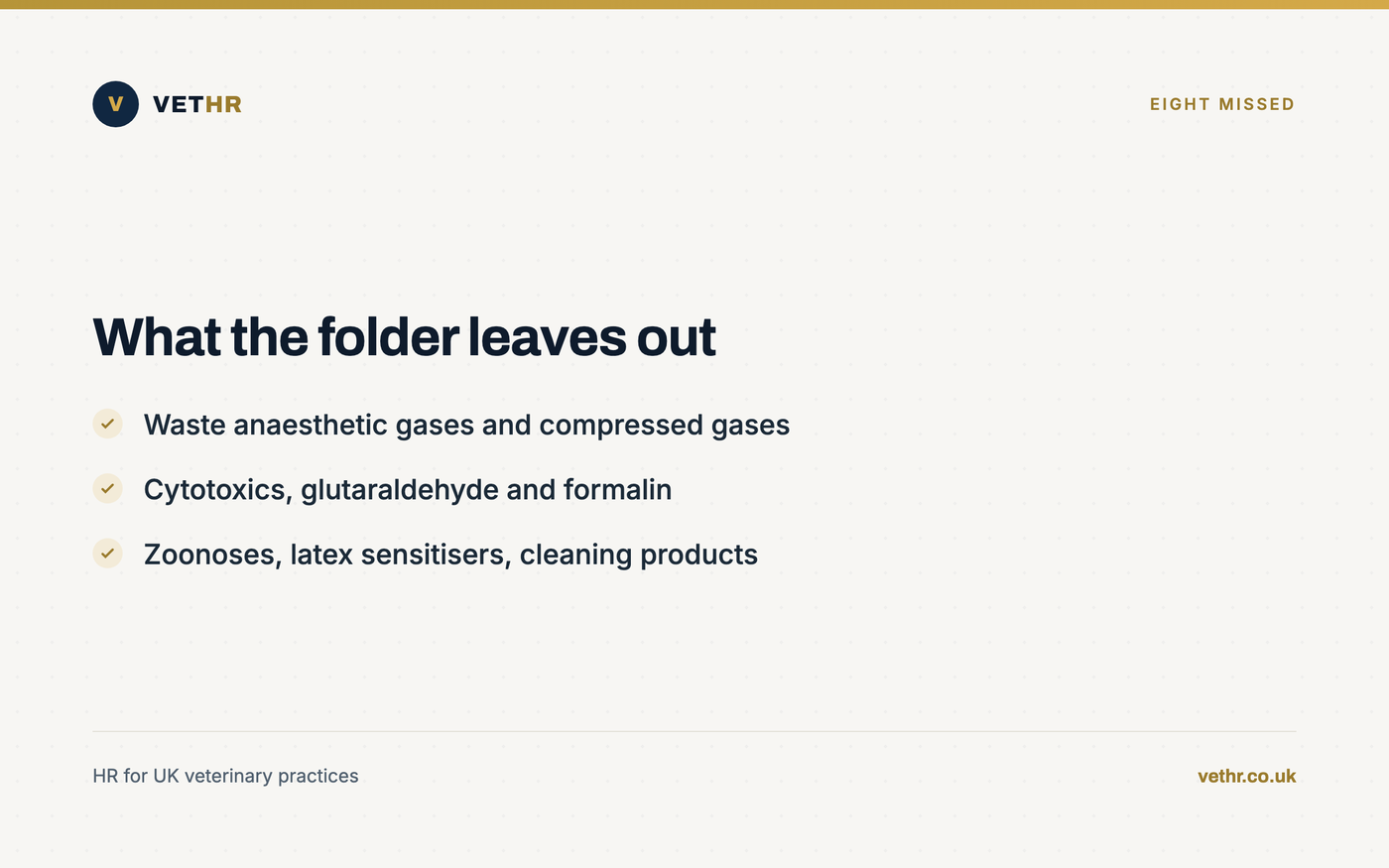
These eight come up repeatedly in a veterinary COSHH assessment, and most practice folders cover three or four of them. Each needs its own entry rather than a general line about chemicals.
Number seven is the one most likely to produce a live case. Skin problems from gloves and hand hygiene are common in nursing teams and are frequently treated as personal rather than occupational.
Number two deserves a separate written procedure covering pregnant and breastfeeding staff, which links directly to your pregnancy risk assessment.
Three categories sit outside a COSHH assessment because they have their own regulations. COSHH does not cover asbestos, lead or radioactive substances, because each is governed by separate legislation.
Radiation matters here. A practice with an x-ray suite is dealing with ionising radiation under its own regime, with its own appointed roles and monitoring, and it should never be folded into a COSHH file as though it were another chemical.
Asbestos is relevant if you occupy an older building. The duty to manage asbestos sits with whoever is responsible for maintenance of the premises, which may be the practice or may be a landlord.
Note the exclusions in your file rather than leaving them silent. A COSHH assessment that says nothing about radiation looks incomplete; one that says radiation is managed separately under its own arrangements looks deliberate.
By task, not by product. This is the single change that turns a folder of data sheets into a usable assessment, because risk comes from what someone does with a substance rather than from the bottle sitting on a shelf.
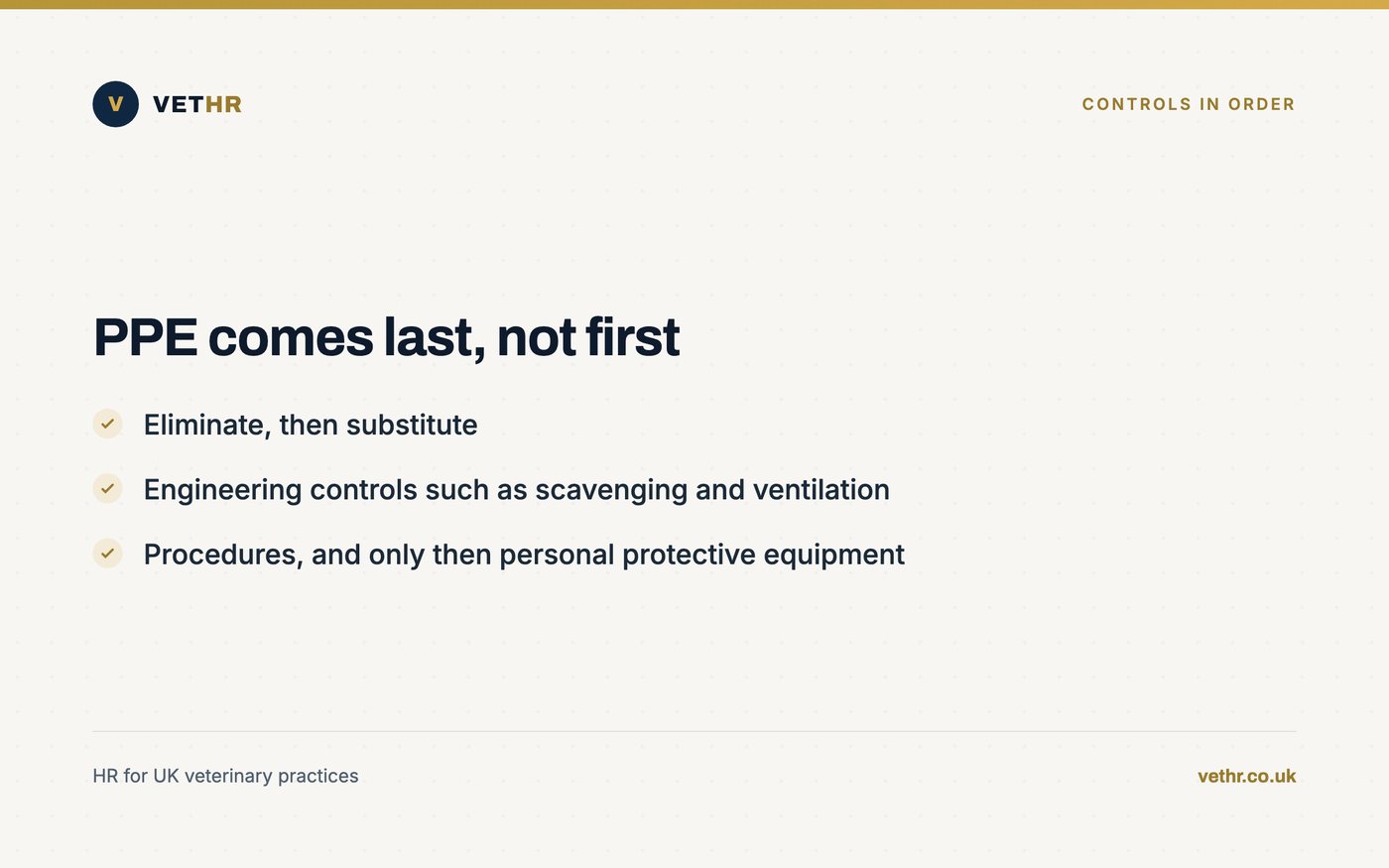
Step four is where practices go wrong by starting with gloves. PPE is the last line, and reaching for it first usually means an engineering control, such as functioning scavenging, has not been considered properly.
Walk the building while you do it. A COSHH assessment written at a desk from a stock list misses the decanting that happens in the corridor, the bottle stored above head height and the room where the ventilation has never worked properly.
Step seven is the one that lapses. Nobody revisits the assessment when a new disinfectant arrives, so keep a standing item at your health and safety review, as our guide to the HR compliance checklist covers.
Information, instruction and training on the hazards, the risks and the control measures. Employers must provide information about hazards, risks and control measures, plus instruction and training in how to use those controls.
Cover the COSHH assessment findings at induction and repeat them when anything changes. A student nurse arriving in September needs the anaesthetic gas and cytotoxic briefings in week one, not when the subject happens to arise.
Record who was trained and when. Training that cannot be evidenced is, from an inspection point of view, training that did not happen, which is why our digital staff records approach keeps it against the individual.
Include bank and part-time staff explicitly. They are in the building least often, use the same substances and are the most likely to have missed the briefing entirely, as our guide to casual workers notes.
COSHH folder untouched since the last inspection? A free 30-minute HR health check will show you what is missing. Book your HR health check.
When the COSHH assessment says so. HSE explains that as part of the risk assessment employers should find out whether health surveillance is required, and that its purpose is to identify indications of disease or adverse changes related to exposure as early as possible.
In veterinary practice the usual candidates are skin checks for staff in frequent wet work or glove use, and respiratory monitoring where sensitisers are involved. Both are cheap compared with an occupational dermatitis case.
Health surveillance produces health data, which is special category information, so store the outcome rather than the detail and limit access, as our guide to GDPR and staff records sets out.
Tell staff what surveillance is for before you arrange it. People assume any health check is about their fitness to keep working, whereas the purpose here is to catch early changes so something can be done, and saying that out loud raises participation considerably.
Where a problem appears, refer promptly rather than waiting for a pattern, as our guide to occupational health explains.
Yes. All employers must carry out a risk assessment of substances hazardous to health, and employers with five or more employees must also record the significant findings. The duty is to adequately control exposure, not simply to record that a hazard exists.
No. Safety data sheets describe a product; the assessment describes what happens in your building when someone uses it. Assess by task rather than by product, because the risk from decanting a concentrate differs entirely from the risk of it sitting on a shelf.
No. Radioactive substances, along with asbestos and lead, are excluded from COSHH because they have their own regulations. Ionising radiation in a practice is managed under its own regime, and your COSHH file should note that rather than staying silent on it.
Biological agents fall within the scope of substances hazardous to health, so exposure to zoonotic infection through the work should be assessed and controlled. In practice that means handling procedures, hygiene, PPE and what staff should do after a bite, scratch or needlestick.
At least annually, and whenever something changes: a new product, a new protocol, a room refit, new equipment or an incident. A COSHH assessment that has not moved in three years almost certainly no longer describes what your team actually does.
A COSHH assessment is not a folder, it is a description of what your team is exposed to and what stops it harming them. Assessed by task, it usually takes an afternoon and finds two or three genuine gaps that nobody had noticed.
Cover the eight substances a veterinary COSHH assessment usually misses, note the exclusions deliberately, train at induction and record it, and review annually. Our policy library and See It Report It system support the process, and the free HR health check is where to start.
The Vet HR Team provides HR consultancy and white-labelled staff systems exclusively to UK veterinary practices. Health and safety decisions should be checked against current HSE guidance.
Contracts, rotas, holiday, a difficult conversation. Tell us what you are dealing with and we will come back within one working day. Nothing to sign up to.
Got it. We will come back to you within one working day. If you do not see a reply, please check your spam folder.
