Last updated: 25 August 2026
TL;DR: The Practice Standards Scheme is not only a clinical audit. Assessors look at staffing levels, induction, training records, wellbeing policies, breaks and annual leave, health and safety, and the records behind your clinical governance. Practices lose easy points on people paperwork rather than on medicine. Get eight areas straight and assessment day stops being stressful.
Practices prepare for accreditation by tidying the dispensary and rewriting clinical protocols. Then the assessor asks who inducted the new receptionist, where the wellbeing policy is, and whether the team is actually taking its annual leave. This guide covers the people side of the Practice Standards Scheme, which is where small independents most often lose marks they could have kept.
It is the RCVS voluntary accreditation programme for UK veterinary practices, and practices are assessed every four years. Accreditation runs from Core Standards through General Practice to Veterinary Hospital, with separate routes for equine, farm animal and emergency service clinics.
The RCVS is explicit that each accreditation level has a set of core standards that align with the legal requirements for all UK veterinary practices. Read that sentence twice. It means the Practice Standards Scheme is partly a check that you are meeting the law you are already bound by, employment law included.
Four years is long enough for a practice to change managers twice. That is precisely why evidence, rather than memory, is what gets you through.
Because standards of care depend on the team delivering them. A tired, under-inducted, under-supervised team is a clinical risk, not just a management problem. So the Practice Standards Scheme reaches into recruitment, induction, training, supervision, wellbeing and health and safety, and asks for evidence in each.
The RCVS made this direction of travel clear when it updated the requirements following its five-yearly review, adding an expectation that practices take the mental health and wellbeing of the team into consideration with clear policies and support mechanisms in place, and that staff take sufficient breaks and annual leave.
That is an HR requirement written in clinical language. It cannot be answered with good intentions, only with a policy, a rota that proves breaks happen and a leave record that shows people are actually taking their entitlement.
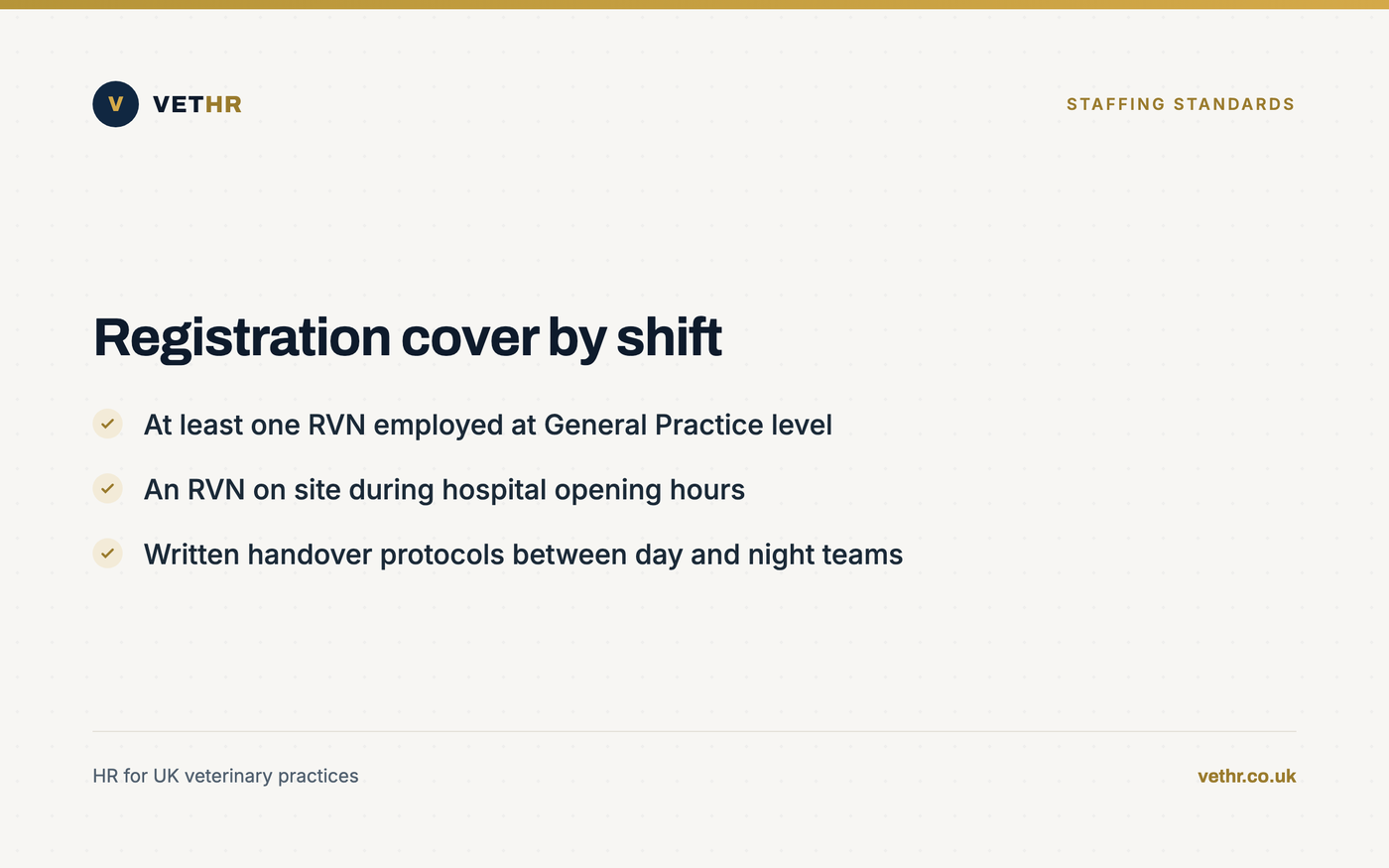
Enough people, with the right registration, at the right times. Following the review, at least one RVN must be employed at General Practice level, hospitals must have sufficient team members including an RVN on site during all normal opening hours, and the Nursing Award carries a 1:1 ratio of veterinary nurses to veterinary surgeons.
Hospitals must also provide protocols and checklists for handovers between day and night teams. In HR terms that is a shift design question: your rota has to make the handover a paid, staffed, scheduled event rather than a five-minute overlap that happens if everyone is running on time.
Staffing requirements are where accreditation collides with recruitment reality. If you are one RVN resignation away from failing a standard, the Practice Standards Scheme has just told you where your retention risk sits. A rota system that shows registered cover by shift makes that visible before it becomes a problem.
Three linked things: a wellbeing policy with real support routes, evidence that staff take sufficient breaks, and evidence that annual leave is actually used. Assessors look for mechanisms, not sentiment. A named contact, a signposted support service and a policy the team has seen all count.
Breaks are the awkward one. Every practice intends to give them. Few can prove it, because break time is the first thing consumed by an emergency at 4:50pm. If your clock in and out records show a nurse working eight hours with no recorded break for months, that is a working time issue as well as a Practice Standards Scheme finding.
Annual leave is easier to evidence and easier to get wrong. Untaken leave concentrated in one or two people usually means the rota cannot cope without them. Our guides to clock in and out records and working time rules for veterinary practices cover both sides.
With records, per person, kept current. The RCVS requires 35 hours of CPD a year for veterinary surgeons and 15 hours for registered veterinary nurses, plus reflection on the activities. The Practice Standards Scheme expects the practice to know where each person stands.
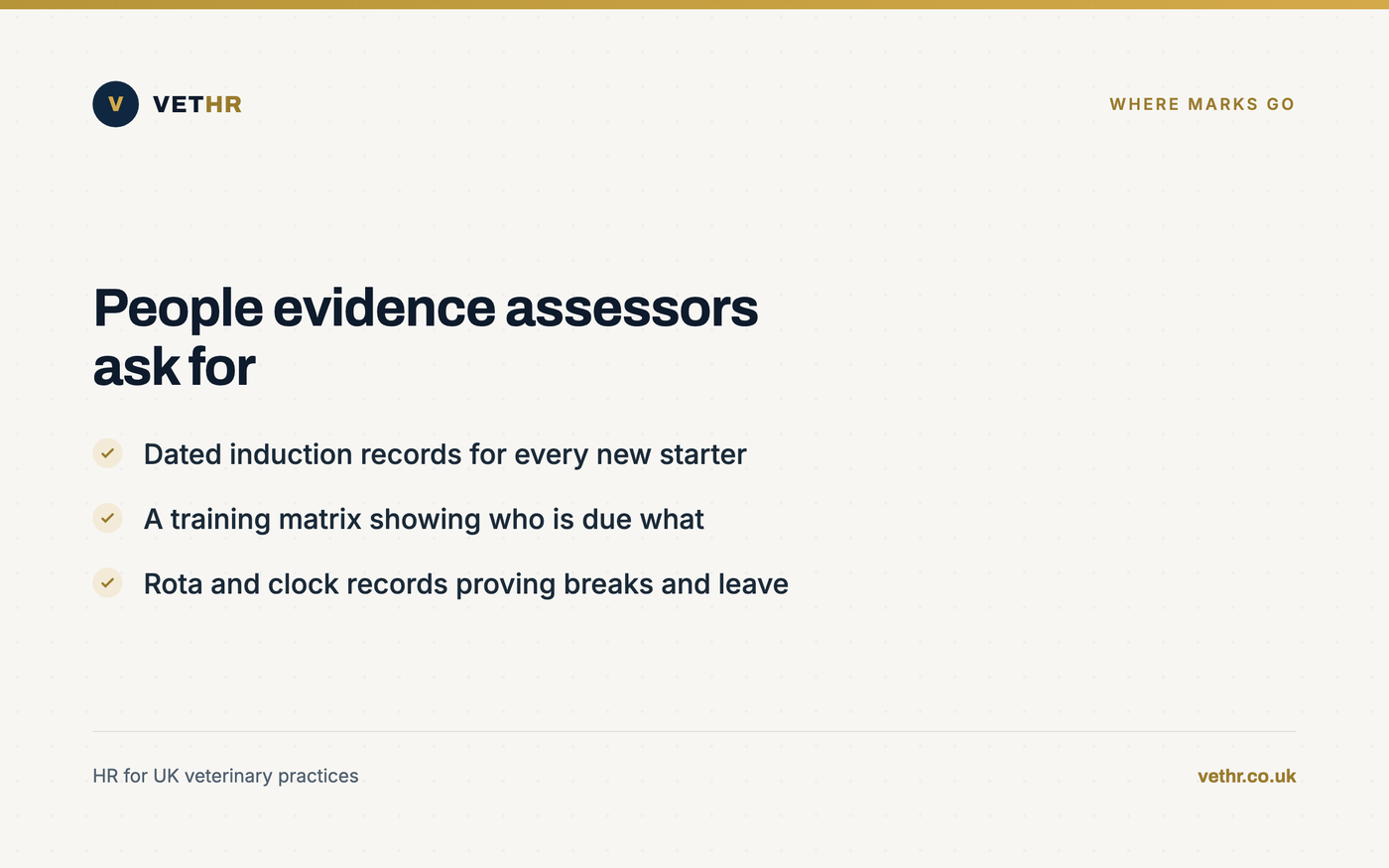
Individual CPD compliance is the professional’s own duty. Practice level evidence is yours: who has done their mandatory training, who is due, who has been signed off on the equipment they use, and what induction each new starter received.
Induction is the most commonly thin record in a small practice. A new receptionist gets shown the phone system and the kettle, and nobody writes anything down. A dated induction checklist, signed by both sides, takes ten minutes and answers a question the assessor will ask.
More than most practices keep. RCVS guidance on clinical governance asks practices to hold a no-blame meeting of all staff involved as soon as possible after a critical incident, record all the details, record minutes of clinical discussion meetings, and record complaints and the responses given.
Every one of those is a people record as much as a clinical one. A no-blame meeting only works if the team believes reporting will not be punished, which is a culture built by how the last report was handled, not by the policy wording.
This is where an incident reporting system earns its place. See It Report It gives staff one route for near misses, equipment faults, aggression from clients and anything else, and gives the practice a dated trail of the response for the Practice Standards Scheme file.
Written risk assessments, an incident log and proof that findings led to action. Veterinary work carries hazards most workplaces never meet: ionising radiation, anaesthetic agents, cytotoxic drugs, zoonoses, animal handling injuries and lone working at branch sites. Each needs an assessment on file and a named person responsible.
The Health and Safety Executive requires an individual risk assessment for pregnant workers and new mothers once the employer has been told in writing, and names radioactive material, infectious diseases, cytotoxic drugs, heavy lifting and long periods standing among the risks to consider. A veterinary practice can tick every one of those in a single shift.
For the Practice Standards Scheme, the assessment itself is only half the evidence. The other half is what happened next: the guard that was fitted, the protocol that changed, the training that followed, the date it was reviewed. Assessors are looking for a loop that closes, not a folder that exists.
Practices that keep incidents, actions and reviews in one place find this section straightforward. Practices that keep them in three inboxes and a notebook do not.
Assessment in the next 12 months? A free 30-minute HR health check will tell you which of these eight areas your practice can already evidence. Book your HR health check.
No. It is a voluntary RCVS accreditation scheme. The obligations underneath much of it are not voluntary, though, because the RCVS states that each accreditation level aligns with the legal requirements that apply to all UK veterinary practices. Choosing not to join does not remove the employment law duties.
Assessments are scheduled rather than sprung, and practices are assessed every four years, so the date is knowable well in advance. The useful question is not how much notice you get but how much of your evidence exists as a matter of routine rather than as a fortnight of preparation.
Not necessarily. Plenty of well-run practices pass on their own paperwork. What outside help buys is speed and certainty: someone who has seen what evidence satisfies an assessor, and who can produce the missing policies and records in weeks rather than over a stressful winter.
No. The requirement is for clear policies and support mechanisms for staff who need help. An employee assistance programme is one way of meeting it. Named internal contacts, signposting to professional support services and a policy that explains how to ask for help can also satisfy it in a smaller team.
Deal with it as a recruitment and retention problem rather than a paperwork one, and be honest with your assessor about the plan. Practices that lose an RVN and cannot replace them usually have a rota or pay structure issue underneath. Fixing that is what protects the accreditation long term.
The Practice Standards Scheme rewards practices that already run well. Nothing in the people section asks for anything a good employer would not do anyway: induct properly, train people, give them breaks, let them take leave, listen when they report something, write it down.
If your clinical care is strong and your paperwork is not, that is a solvable problem. Our policy library and HR consultancy are built for exactly that gap, and the free HR health check is the fastest way to see what is missing.
The Vet HR Team provides HR consultancy and white-labelled staff systems exclusively to UK veterinary practices.
Contracts, rotas, holiday, a difficult conversation. Tell us what you are dealing with and we will come back within one working day. Nothing to sign up to.
Got it. We will come back to you within one working day. If you do not see a reply, please check your spam folder.
