Last updated: 14 June 2026
TL;DR: Casual workers cover the gaps in a veterinary practice rota, but casual does not mean rights-free. Most bank staff are workers in law, entitled to paid holiday, the National Minimum Wage and a written statement from day one. For irregular hours, holiday accrues at 12.07% of hours worked each pay period. This guide covers status, holiday, pay, pensions and the records that keep it all defensible.
Every practice relies on them: the bank RVN who covers maternity leave, the student on Saturday reception, the retired nurse who says yes to the odd shift. This guide explains where casual staff sit in employment law, what they are owed, and the paperwork that stops a flexible arrangement becoming an expensive argument.
A casual worker is someone who works when the practice offers a shift and they accept it, with no fixed pattern: bank RVNs, relief receptionists, kennel assistants on a zero hours arrangement. They are engaged directly by the practice, unlike freelance vet cover, which is normally a self-employed business arrangement.
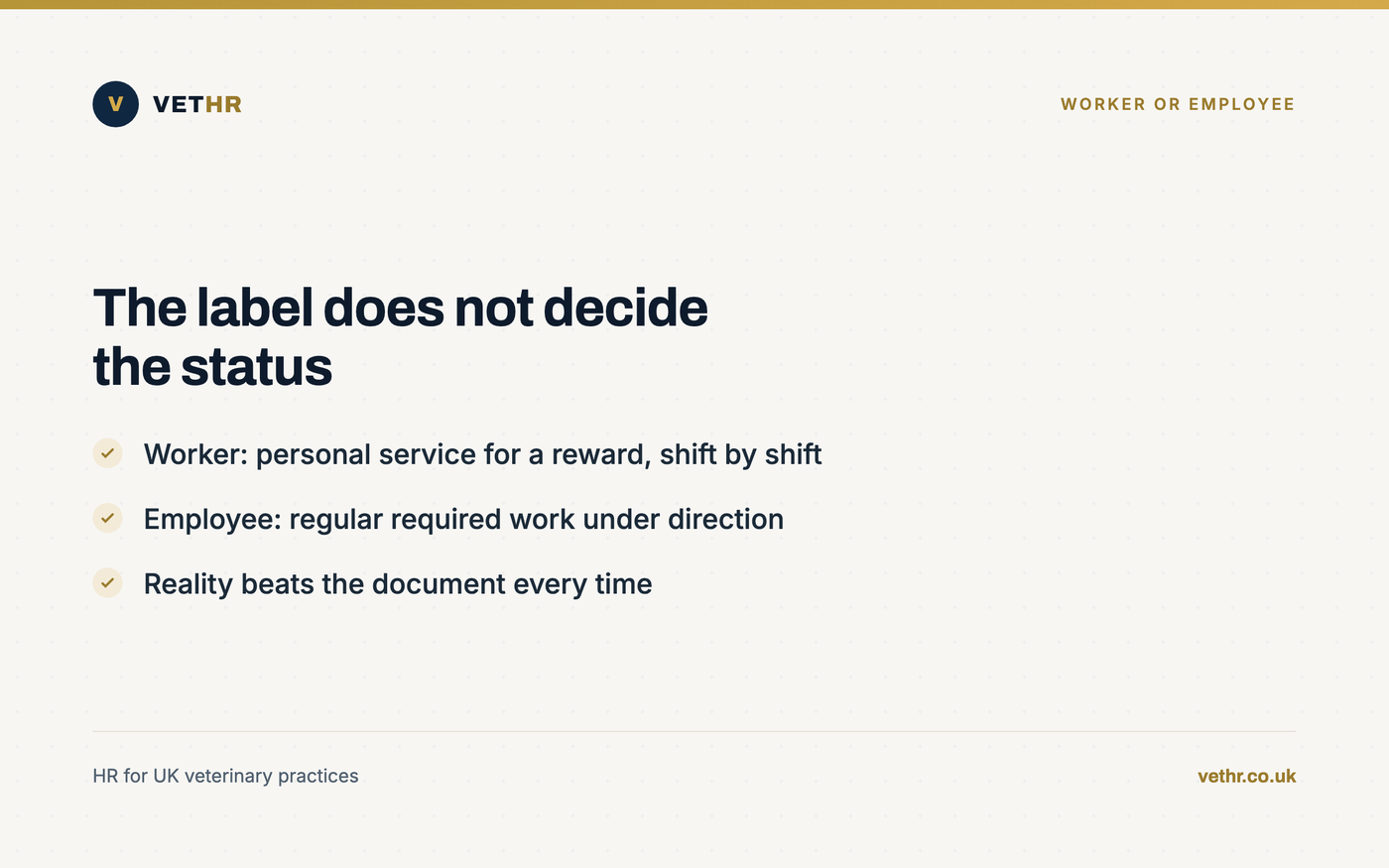
The labels vary: bank, relief, zero hours, as required. The label is not what decides anything. GOV.UK guidance on worker status says someone doing occasional work is likely to be a worker where the arrangement uses terms like casual or zero hours, the practice supervises the work, the person cannot send someone else in their place, and tax is deducted through payroll. That describes almost every bank RVN and relief receptionist in the country.
Freelance vet cover is different. A genuinely self-employed vet runs their own business: they invoice the practice, carry their own insurance and offer their services elsewhere. This guide is about the people your practice engages directly and pays through payroll. Mixing the two categories up is where trouble starts, so keep the paperwork for each distinct.
Most casual workers in a veterinary practice hold worker status: they have a contract or arrangement to do work personally for a reward, without the regular obligations of employment. Workers get paid holiday, the National Minimum Wage and rest breaks. Employees get those plus extra rights, including unfair dismissal protection and statutory redundancy pay.
Worker status carries real entitlements. Workers get the National Minimum Wage, statutory paid holiday, rest breaks, protection from unlawful deductions and a 48 hour average weekly working limit unless they opt out, according to the same GOV.UK guidance. What workers usually do not get: minimum notice periods, unfair dismissal protection, statutory redundancy pay or the statutory right to request flexible working.
Employees sit a rung higher. GOV.UK guidance on employee status puts it plainly: all employees are workers, but an employee has extra employment rights and responsibilities. The practical question for a practice is not which label you prefer. It is which one the day to day reality supports.
It means the practice is not obliged to offer shifts and the person is free to refuse them. That freedom on both sides is what keeps the arrangement casual. If, in reality, someone works the same shifts every week and refusing would have consequences, the arrangement starts to look like employment, whatever the document says.
The indicators of employment are about regularity and control. The same employee status guidance lists them: the person is required to work regularly unless on leave, must do a minimum number of hours and expects to be paid, has a manager directing their workload, and cannot send someone else to do the work. None of that depends on what the document is called.
Watch for drift. A bank nurse who has worked every Tuesday and Thursday for eighteen months, who is booked a rota cycle ahead, and who would be questioned if she stopped coming, no longer looks casual. The arrangement has grown a pattern, and patterns are how status changes. The document says casual. The reality says part time employee.
The fix is boring and cheap: review your regulars once a year. If someone’s shifts have settled into a pattern the practice depends on, offer a proper part time contract with the security that goes with it. Our veterinary contracts service drafts both: clean casual worker agreements and the part time contracts your regulars graduate into.
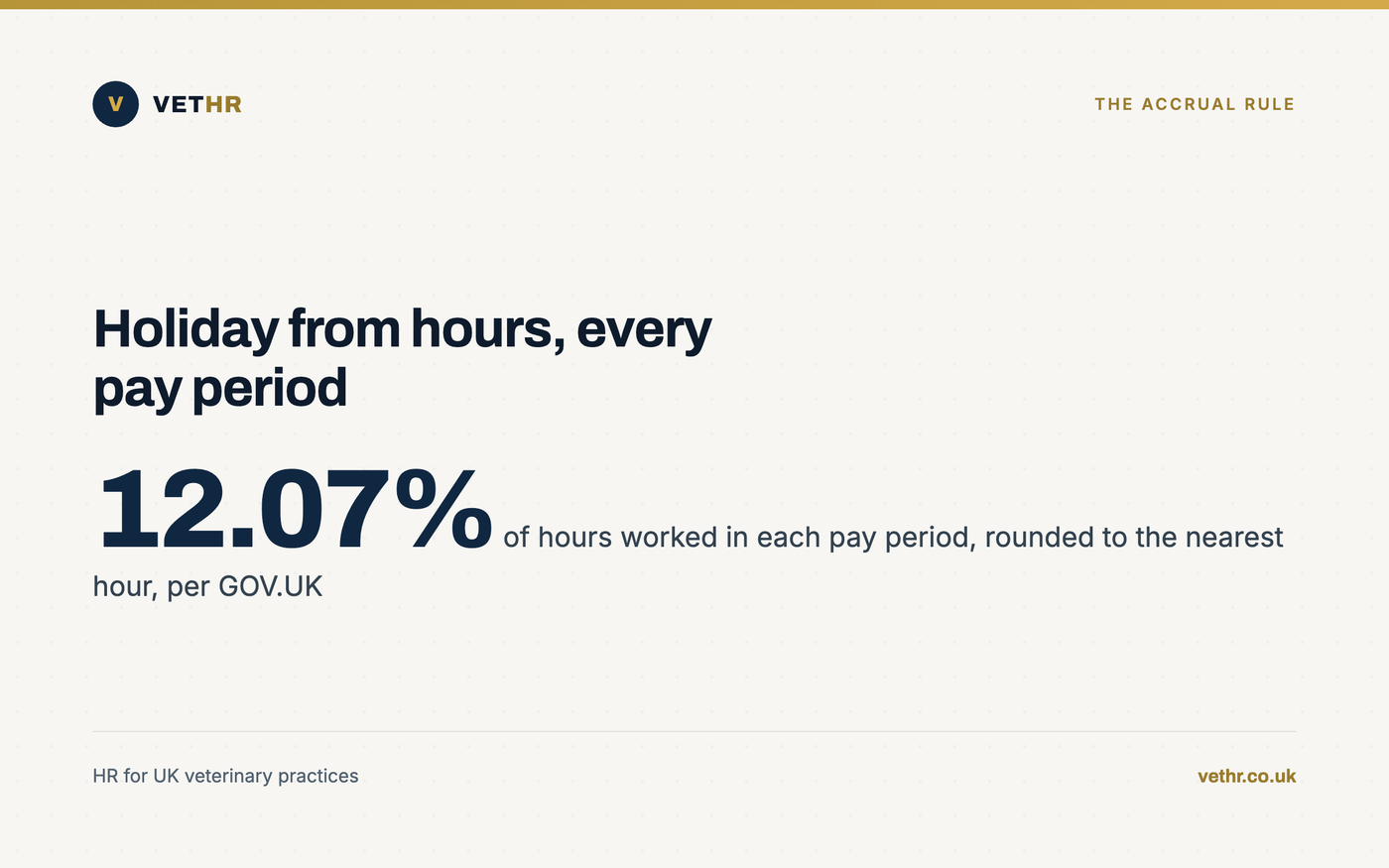
Casual workers get the same statutory minimum as everyone else: 5.6 weeks of paid holiday a year. Because their hours vary, the entitlement accrues rather than arriving as a fixed block of days. For leave years starting on or after 1 April 2024, it builds at 12.07% of the hours actually worked in each pay period.
Start with the entitlement itself. Almost all people classed as workers are legally entitled to 5.6 weeks of paid holiday a year, according to GOV.UK guidance on holiday entitlement, and workers with irregular hours build up leave from the hours they have already worked.
The accrual method is now defined in law. GOV.UK guidance on the holiday pay and entitlement reforms defines an irregular hours worker as someone whose paid hours in each pay period are wholly or mostly variable under their contract, which is exactly what a casual arrangement is. Holiday accrues at 12.07% of hours worked in the pay period, rounded to the nearest hour, with 30 minutes or more rounding up.
A worked example. A bank RVN does 43 hours in June. Divide 43 by 100, multiply by 12.07, and you get 5.19, which rounds to 5 hours of holiday accrued for the month. Do that every pay period, per person, and the balance is always current. Our holiday calculations system runs this arithmetic automatically from recorded hours.
Rolled-up holiday pay is also lawful for this group. The same guidance permits it for irregular hours and part-year workers: an uplift of 12.07% of total pay in the pay period, shown as a separate item on the payslip and paid at the same time as wages. If you pay casual staff this way, that payslip line is not optional. We cover the pay side in detail in our guide to holiday pay for zero hours veterinary staff.
Not sure whether your bank arrangements would stand up to a status challenge or a holiday pay claim? Book a free HR health check. In 30 minutes we will look at how your casual staff are engaged, paid and documented, and tell you plainly which gaps matter for a practice your size.
A written statement of employment particulars, from day one. The statement is not just for employees: workers must receive one too. The principal statement is due on the first day of work, with a wider statement within 2 months, and it must say how hours and days of work may vary.
This catches practices out because the statement is widely believed to be an employee document. It is not. GOV.UK guidance on the written statement of employment particulars says employees and workers must both receive one. The principal statement must cover pay, hours and days of work and if and how they may vary, and holiday entitlement. Variable hours do not exempt you: they are exactly what the statement must describe.
Changes need telling too: staff must be informed in writing within one month of any change to the particulars, per the same guidance. In practice the cleanest vehicle is a short casual worker agreement that doubles as the statement: worker status, how shifts are offered and accepted, the right to refuse on both sides, the 12.07% accrual method and how to raise a problem.
Casual workers must be paid at least the National Minimum Wage for every hour worked. From 1 April 2026 that is £12.71 an hour for staff aged 21 and over. Pension duties can apply too: anyone aged between 22 and State Pension age earning at least £10,000 a year must be enrolled.
The rates move every April, so check them annually. The current GOV.UK minimum wage rates from 1 April 2026 are £12.71 an hour for those aged 21 and over, £10.85 for 18 to 20 year olds, and £8.00 for under 18s and apprentices. Casual shifts paid as a round daily figure need checking against the hours actually worked, or a long day can quietly slip under the line.
Pensions are the quiet one. Employers have automatic enrolment duties from the moment their first member of staff starts work, and anyone aged between 22 and State Pension age who earns at least £10,000 a year and normally works in the UK must be put into a pension scheme, per GOV.UK guidance on workplace pensions for employers. Casual earnings fluctuate, and a run of busy months can carry someone over the criteria. When that happens, you must enrol them and write to them within 6 weeks of the day they qualify.
Accurate records of hours worked, pay, holiday accrued and holiday taken, per person and per pay period. The 12.07% method only works if the hours underneath it are right, and minimum wage checks and pension assessments run from the same numbers. Guesswork fails quietly until someone challenges it.
Hours are the foundation. Every calculation in this guide starts from hours actually worked: holiday accrual, minimum wage checks, pension eligibility. A clock in and out system that records real start and finish times, for every shift and every person, produces the numbers everything else depends on.
Keep the arrangement’s history too: the agreement they signed, the shifts offered and accepted, holiday accrued and taken, and payslips showing any rolled-up holiday pay as its own line. If status or pay is ever challenged, the practice that can produce these records has a short conversation. The practice that cannot has a long one.
Yes. Almost all workers are entitled to 5.6 weeks of statutory paid holiday a year, and casual staff with irregular hours accrue it at 12.07% of the hours worked in each pay period, per GOV.UK. Rolled-up holiday pay is permitted for irregular hours workers if it appears separately on the payslip and is paid with wages.
They must receive a written statement of employment particulars: GOV.UK is explicit that workers as well as employees get one, with the principal statement due on the first day of work. A short casual worker agreement covering status, shift offer and refusal, pay and holiday accrual is the practical way to meet the duty.
Yes. Status follows reality, not the label. If someone works a settled pattern the practice depends on, is expected to attend, and cannot send a substitute, the arrangement looks like employment whatever the paperwork says. Review your regulars yearly and move settled patterns onto part time contracts deliberately rather than by accident.
If they are aged between 22 and State Pension age, earn at least £10,000 a year and normally work in the UK, yes. GOV.UK says you must enrol them and write to them within 6 weeks of the day they meet the criteria, so check casual earnings at each pay run.
No. Genuinely self-employed freelance vet cover runs its own business: it invoices the practice, carries its own insurance and takes on other clients, and worker rights generally do not apply. Bank and casual staff engaged personally through payroll are usually workers, with holiday, minimum wage and written statement rights. Keep the two on different paperwork.
Casual workers are not a grey area. The law is clear about what they are owed: worker rights, holiday accrued at 12.07% of hours worked, at least the minimum wage, a written statement from day one and a pension assessment when earnings qualify. None of it is difficult once hours are recorded and the paperwork exists.
If your bank arrangements have grown by habit rather than design, start with the documents. Get clean agreements from our veterinary contracts service, let a clock in and out system feed the sums, or book a free HR health check and we will tell you plainly what needs fixing first.
The Vet HR Team provides HR consultancy and white-labelled staff systems exclusively to UK veterinary practices.
Read next: Pay Bands for a Veterinary Practice.
Contracts, rotas, holiday, a difficult conversation. Tell us what you are dealing with and we will come back within one working day. Nothing to sign up to.
Got it. We will come back to you within one working day. If you do not see a reply, please check your spam folder.
