Last updated: 14 June 2026
TL;DR: Most employers do not have to give employment references unless a written agreement or a regulated industry requires it, according to GOV.UK. Any reference you do give must be fair and accurate. This guide covers basic versus detailed references, the risks of a bad reference, references during disputes, what a sensible practice policy says, and how to request references properly when hiring vets and RVNs.

Every practice ends up on both sides of this. This guide covers employment references for veterinary staff in both directions: what the law expects when you write one for a leaver, and how to request them properly when you hire vets and RVNs.
Usually not. GOV.UK guidance on work references is clear that employers do not normally have to give a reference unless there is a written agreement to do so or they are in a regulated industry, and the example it gives is financial services. For a veterinary practice, any duty usually comes from its own paperwork.
That written agreement exception matters more than it looks. Acas guidance on providing a job reference lists the cases where a reference must be given: where the employer has put in writing that it will provide one, for example in an employment contract, where the role is in regulated financial services, and where a reference has been agreed as part of a settlement agreement. So the first step of any reference decision is not judgement. It is reading what the contract says.
GOV.UK adds a further risk for the employer who refuses: according to its guidance on work references, a person may be able to claim damages if their employment contract required a reference and the employer would not give one. An old contract clause can quietly turn a courtesy into an obligation.
In practice, few veterinary employers refuse outright. A practice that never gives references makes every leaver look worse than they are, and makes its own requests awkward when hiring. The sustainable position is a consistent one: decide what the practice gives, write it down, and give it every time.
A reference must be fair and accurate, according to GOV.UK. It can include details about performance and even that someone was dismissed, provided what it says is true and gives a balanced picture. If a reference is misleading or inaccurate and the person suffers a loss, such as a withdrawn job offer, they may be able to claim damages.
Fair and accurate applies to all employment references, and it is a duty to two audiences at once. The person deserves a reference that does not unfairly damage their prospects. The receiving practice deserves one that does not hide something material behind polite wording. A reference that flatters someone you dismissed for conduct fails the second audience just as surely as an unfairly harsh one fails the first.
The practical test is evidence. Before a sentence goes in, ask what record supports it. Appraisal notes, absence records and disciplinary outcomes can support a statement. A general feeling that someone had an attitude cannot. If your written records are thin, that is an argument for fixing the records, not for writing from memory.
Assume the person will read it. GOV.UK notes that once someone starts a new job, they can ask their new employer to show them the reference you sent. Anything you would not defend to their face, line by line, does not belong in it.
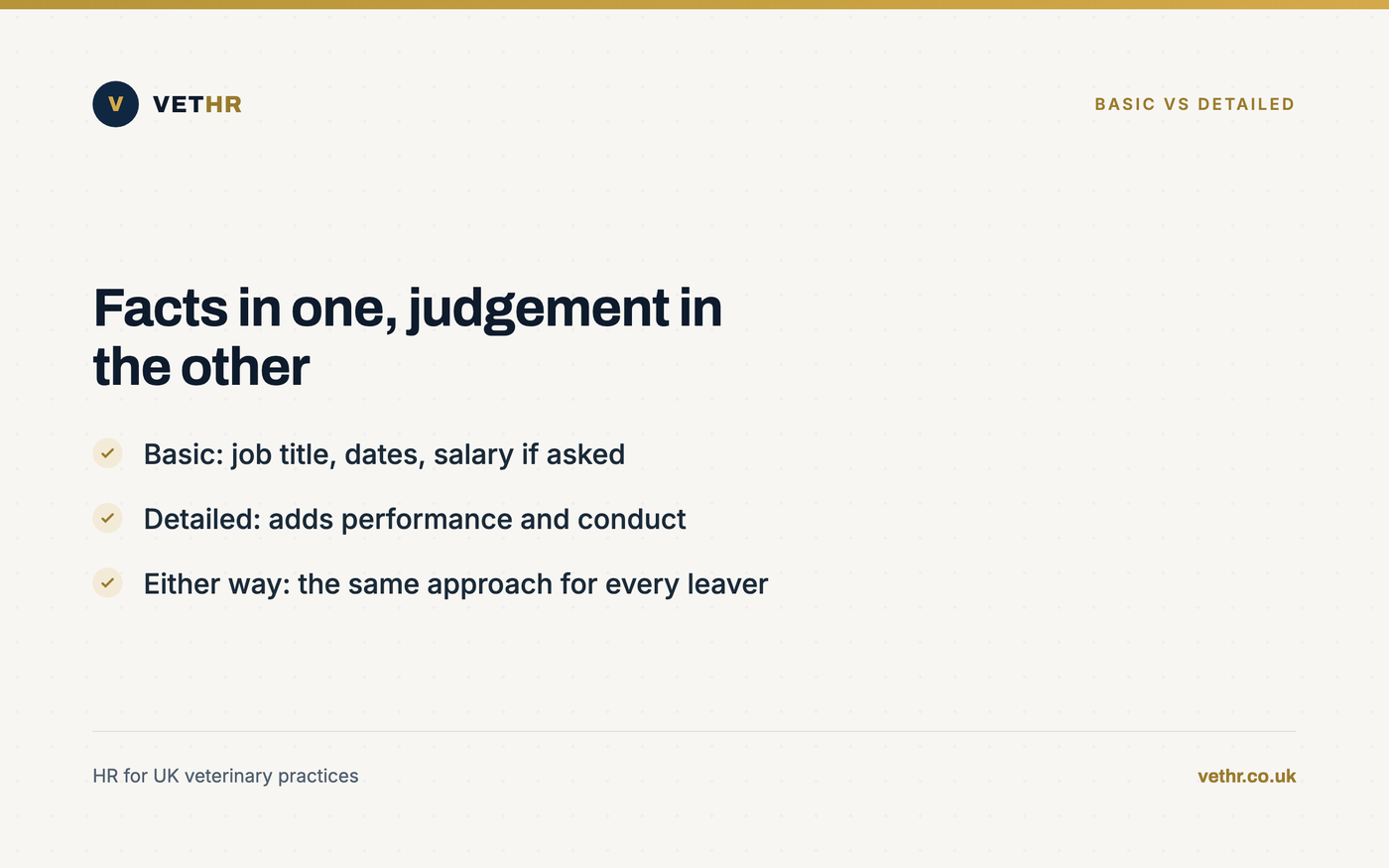
A basic reference confirms facts only: job title, dates of employment and, if asked, salary. A detailed reference adds performance, conduct and suitability. Many employers now give basic employment references for everyone, because facts are easy to verify and hard to argue with. Whichever you choose, apply the same approach to every leaver.
GOV.UK describes minimal references covering job title, salary and dates of employment as a normal option, and many employers stop there as standard. A short factual reference is not a coded warning about the person. Very often it is simply the policy of the practice that wrote it.
Detail still has a place. Veterinary teams are small and the profession is smaller, and a strong, evidenced reference genuinely helps a good RVN or vet move on well. If you give detailed employment references, the discipline is consistency: the same structure and the same honesty for everyone, not glowing paragraphs for favourites and two lines for the rest.
Acas notes that an employer can have a reference policy that restricts how much a reference includes and who is allowed to give one. That is the clean solution: choose basic or detailed deliberately, once, and apply the choice to every leaver.
Yes. A reference can be critical, and GOV.UK confirms it can say that someone was dismissed, as long as what it says is fair and accurate. The risk sits in the evidence. A critical reference you cannot back up with records invites a claim, so evidence what you say or stay factual.
The legal risk is specific. GOV.UK explains that a person can seek damages where a reference was misleading or inaccurate and they suffered a loss as a result, such as a job offer being withdrawn. Notice what the test is not. It is not negativity. A true, evidenced, balanced reference that costs someone a job is not the same thing as a misleading one.
The safer failure mode is silence on opinion. If you cannot evidence a criticism, leave it out and let the facts stand. If the facts themselves are serious, a dismissal for gross misconduct for example, a basic reference that confirms role and dates while adding nothing further is a legitimate, consistent position.
Not sure what your practice would say if a reference request landed tomorrow? Book a free HR health check. In 30 minutes we will look at your contracts, your records and your reference habits, and tell you plainly where the gaps are. Straight answers, nothing sold for the sake of it.
Handle them carefully and in writing. Acas guidance notes that a reference can become an obligation where it has been agreed as part of a settlement agreement. If a grievance, disciplinary process or tribunal claim is live, agree the wording of any reference as part of resolving it, then stick to that wording.
Settlement agreements commonly include an agreed form of reference. Once wording is agreed it binds the practice: every future request gets the agreed text, nothing more and nothing less. Route all requests to one named person so a partner does not improvise something warmer, or colder, on the phone.
Phone calls are the leak in most reference processes. An informal chat between practice managers carries weight in exactly the way a written reference does, so whatever is said should match the written wording. If a dispute is live and no wording has been agreed yet, take advice before saying anything at all.
A reference policy names who gives employment references, what a standard reference contains, and how requests are logged. It removes improvisation: the practice manager is not drafting from memory on a busy Friday, and a well-meaning colleague is not giving an unofficial opinion on headed paper. One page is usually enough.
Keep it beside your other people policies rather than in a drawer. A one-page reference policy in a hosted, acknowledged policy library means the standard survives a change of practice manager, because the next one finds it, reads it and signs for it.
Then make sure your contracts agree with it. If an old contract promises a full reference and your policy now says basic only, the contract wins, as the GOV.UK guidance above makes clear. Our veterinary contracts service lines the two documents up so they tell the same story.
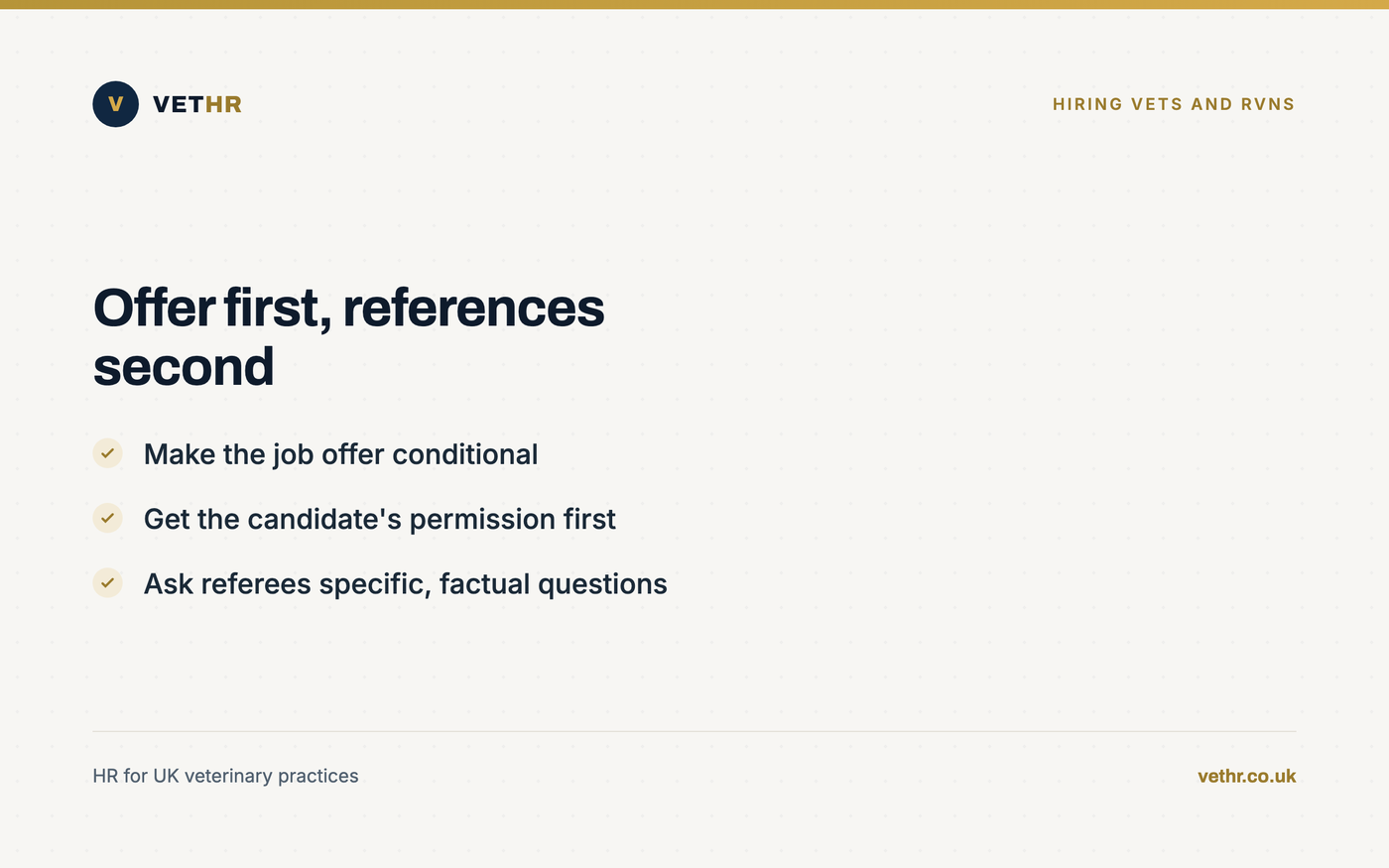
Request references at the final stage of recruitment, after the candidate has accepted a conditional offer and given permission, as Acas recommends. Asking earlier can expose a candidate’s job search to their current employer. Make the offer conditional on satisfactory references, and be specific about what you ask each referee.
Acas explains why the timing protects candidates: requesting employment references before an offer is made can make things difficult for the applicant, because it can reveal a job search their current employer knew nothing about. In a small local veterinary market that is not hypothetical. Ask permission first, and name the referees you intend to contact.
Ask referees specific, factual questions: dates of employment, the role held, the responsibilities carried, and anything the referee is willing to add under their own policy. Expect basic replies. A facts-only reference is many employers’ standard for everyone, so treat it as neutral rather than as a warning.
A reference also has limits. It tells you about past employment, not current professional standing, so check registration directly with the RCVS rather than relying on a referee to confirm it. Apply the same diligence to freelance vet cover as to permanent hires, because the clinical risk does not shrink with the contract length.
Quick answers to the questions practice owners ask us most often. More are answered on our FAQ page.
Usually, yes. GOV.UK is clear that employers do not have to give a reference unless a written agreement requires it or they are in a regulated industry such as financial services, and Acas adds settlement agreements to that list. The practical caveat is consistency: refusing one individual while providing references for everyone else invites the question of why, so set a policy and follow it.
Yes. A reference can be critical and can state that someone was dismissed, provided it is fair and accurate, per GOV.UK. The risk arises when a reference is misleading or inaccurate and the person suffers a loss, such as a withdrawn job offer, which can support a damages claim. Evidence every critical statement from written records, or leave it out and stay factual.
Not from you, at least not automatically. GOV.UK notes that while still job hunting a person has no right to ask a previous employer to show them a reference, but once they start the new job they can ask their new employer for a copy. The safe habit is to write every reference on the assumption its subject will one day read it.
Job title, dates of employment and, where asked and agreed, salary. GOV.UK describes references limited to these facts as a normal, lawful option, and many employers make it their standard for every leaver. It keeps references quick, consistent and easy to defend. Anything a practice adds beyond the facts should come straight from written records.
At the final stage of recruitment, per Acas: after you have made a conditional job offer and after the candidate has given permission to approach referees. Requesting earlier can expose their job search to a current employer. Make the offer conditional on satisfactory references and confirm that condition in writing, so nobody starts before the checks are done.
Employment references reward the practice that decides its position in advance. Decide whether you give basic or detailed references, write the policy, align the contracts, and route every request through one person. Then apply the same discipline when hiring: conditional offer first, permission first, facts checked against records.
If your reference habits have grown up by accident, start with the documents. Put a one-page reference policy in your policy library, check your contracts do not promise more than you intend to give, or book a free HR health check and we will look at both with you.
The Vet HR Team provides HR consultancy and white-labelled staff systems exclusively to UK veterinary practices.
Contracts, rotas, holiday, a difficult conversation. Tell us what you are dealing with and we will come back within one working day. Nothing to sign up to.
Got it. We will come back to you within one working day. If you do not see a reply, please check your spam folder.
