Last updated: 17 July 2026
TL;DR: A veterinary HR compliance checklist covers eight areas: written particulars from day one, right to work checks before someone starts, working time and rest breaks, holiday entitlement, the policies the law actually requires, payslips and payroll records, pension auto-enrolment, and data protection for staff records. Work through each area, note the gaps, and fix them in order of risk. This guide gives you the checks and the official source for each one.

Most practices are not missing the big things. They are missing one contract clause, one policy, one record that nobody thought to keep. This checklist walks through the eight areas where those gaps hide, with the official rule and source for each.
A veterinary HR compliance checklist is a structured run through the employment basics every UK practice must have in place: written particulars, right to work checks, working time and holiday, required policies, payslips, pensions and staff data protection. Work through it once a year and after any major change to the team.
The point is not box ticking. Each item on the list is something an employment tribunal, HMRC, the HSE or the ICO can ask you to evidence, usually at short notice and usually at a bad moment. A practice that can produce the document wins the argument early. A practice that cannot spends months reconstructing what happened.
Vet practices have a harder version of this than most small businesses: shift patterns that cross midnight, OOH work, freelance vet cover coming and going, students on placement, and clinical hazards an office never sees. The checklist below is built for that reality, theme by theme.
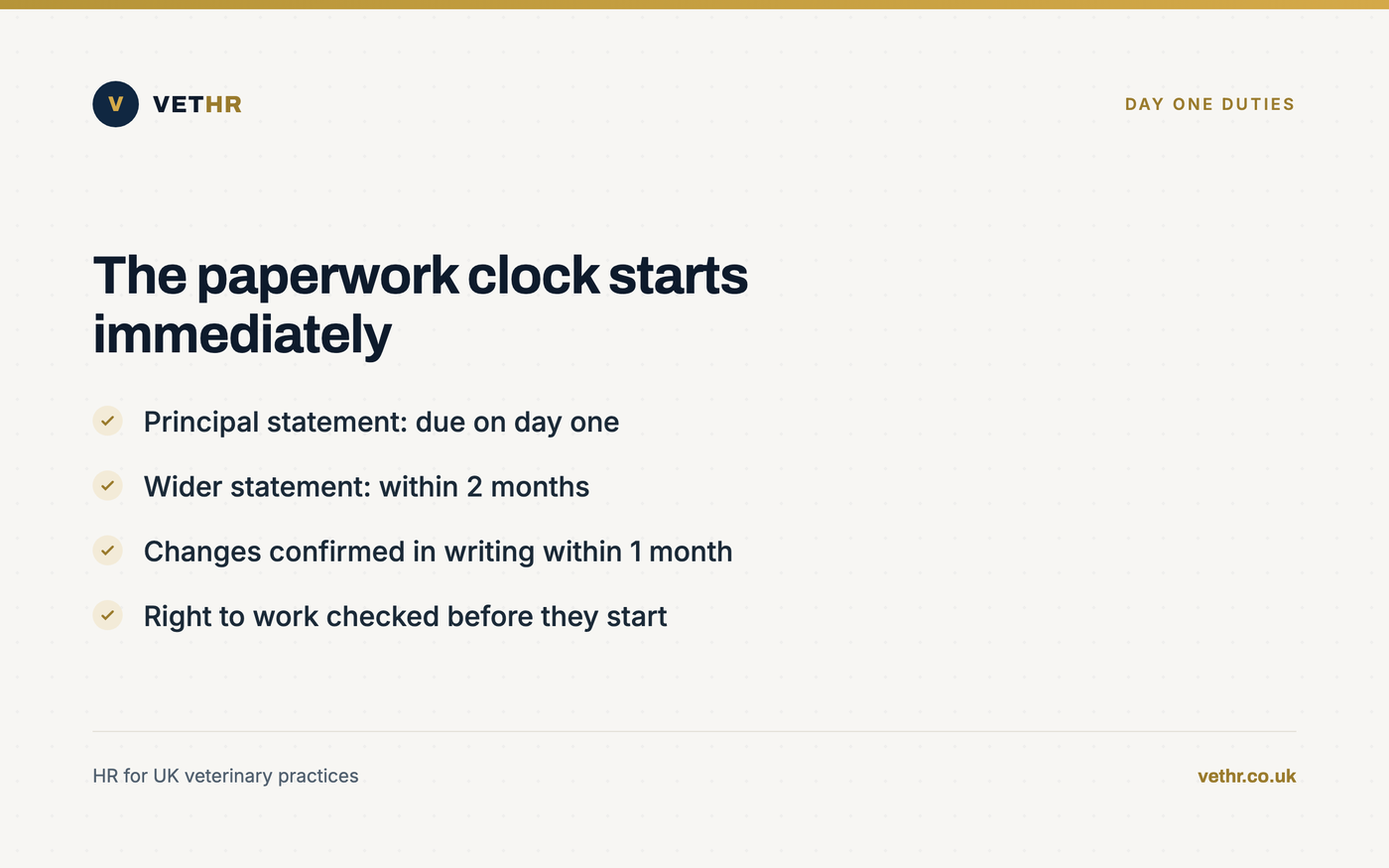
Every employee and worker must receive a written statement of employment particulars. The principal statement is due on the first day of employment, a wider statement within 2 months, and any change must be notified within one month, according to GOV.UK. Missing or stale paperwork is the most common gap we find in practices.
The principal statement covers the concrete terms: names, job title, start date, pay, working hours and days, holiday entitlement, place of work, probation terms, benefits and any required training. Information on sick pay, other paid leave and notice periods must also be provided from day one, either in the statement itself or in a separate document staff can reasonably access, per the GOV.UK guidance on the written statement of employment particulars.
The wider written statement follows within 2 months and covers pensions, collective agreements, non-compulsory training and the disciplinary and grievance procedures. When anything in the statement changes, staff must be told in writing within one month of the change.
You must check every new starter’s right to work before you employ them, using an online share code, their original documents or a certified identity service provider. Keep copies for the whole employment and for 2 years after they leave, and record the date of the check, per GOV.UK guidance.
The check applies to everyone you take on, not just people you suspect might need a visa. GOV.UK’s guidance on checking a job applicant’s right to work is blunt about the consequence: you could face a civil penalty if you employ an illegal worker and have not carried out a correct check. The correct check, done and kept, is what protects the practice.
Two details catch practices out. First, if someone’s permission to work is time limited, you must repeat the check when it expires. Second, the copies you keep must be clear enough to read and in a form that cannot be altered, held for the full employment plus 2 years after the person stops working for you.
Workers over 18 get an uninterrupted 20 minute break when working more than 6 hours a day, 11 hours of rest between working days and at least 5.6 weeks of paid holiday a year. Average weekly hours cannot exceed 48 over a 17 week reference period unless the worker chooses to opt out.
The break rules come straight from GOV.UK’s page on rest breaks at work: one uninterrupted 20 minute break in any working day of more than 6 hours, which does not have to be paid, plus 11 hours between shifts and either 24 hours clear each week or 48 hours clear each fortnight. In a practice running late consults into OOH cover, the 11 hour gap is the one to watch on the rota.
On hours, GOV.UK’s guidance on maximum weekly working hours sets the 48 hour average over a normal reference period of 17 weeks, notes that a worker can choose to opt out, and states that employers must keep some records about working hours. Holiday entitlement is at least 5.6 weeks a year, capped at 28 days, applied pro rata for part time staff, per the GOV.UK page on holiday entitlement. Bank holidays do not have to be extra.
Rather have a second pair of eyes on it? Our HR consultancy runs this exact checklist against your practice as part of a free 30 minute HR health check. Book a slot and we will tell you plainly what is solid, what is missing and what to fix first.
Two written items are legally unavoidable: a written health and safety policy once you have five or more employees, and information on disciplinary and grievance procedures as part of the written statement. Everything else, from sickness absence to social media, is optional in law but very hard to manage without.
On safety, the HSE’s guidance on preparing a health and safety policy says every business must have a policy for managing health and safety, and that with five or more employees it must be written down and shared with staff. Almost every practice crosses that line, and a clinic’s version needs to cover sharps, medicines, radiation, zoonoses and lone working, not generic office risks.
On discipline and grievances, the written statement must include the procedures, and the Acas Code of Practice describes the minimum an employer should follow, which is taken into account if a case reaches an employment tribunal. A practice with no written procedure is improvising in the one situation where improvising is most expensive.
Beyond those, the sensible core for a practice is a short set of working policies: sickness absence reporting, equality and dignity at work, data protection, social media and phones in clinical areas. Our hosted policy library keeps each one current and records a dated acknowledgement from every member of staff, which is the evidence half of the job.
Employees and workers must get a payslip on or before payday, payroll records must be kept for 3 years from the end of the tax year they relate to, and staff aged 22 to State Pension age earning at least £10,000 a year must be put into a workplace pension the practice pays into.
Payslips must show earnings before and after deductions, any deductions that change month to month, and the hours worked where pay varies with time worked, per GOV.UK’s page on payslips. That last point matters for hourly paid nurses and receptionists: variable hours must appear on the slip.
HMRC expects PAYE records to be kept for 3 years from the end of the tax year, and GOV.UK’s guidance on PAYE record keeping warns that incomplete records can bring a penalty of up to £3,000. On pensions, GOV.UK’s guidance for employers on workplace pensions requires you to enrol eligible staff and write to them within 6 weeks of the day they meet the criteria. GOV.UK’s page on pension contributions puts the employer minimum at 3% of qualifying earnings, within a total minimum contribution of 8%.
Staff records are personal data, so the practice must tell staff what it holds and why, keep access limited to the people who need it, and keep nothing longer than necessary. The ICO publishes dedicated guidance on keeping employment records, and it expects a written retention schedule rather than a shrug.
The ICO’s guidance on keeping employment records covers the whole ground: what you may keep, the lawful bases, security, retention and what you must tell workers about their information. For a practice the practical version is short. Personnel files live where only authorised people can open them. Health information gets extra protection. Leavers’ records are reviewed against a schedule, not kept forever by default.
This area is big enough that we cover it separately, but for checklist purposes three questions expose most gaps: who can currently open a staff file, what would you send an employee who asked for a copy of everything you hold on them, and when did you last delete anything.
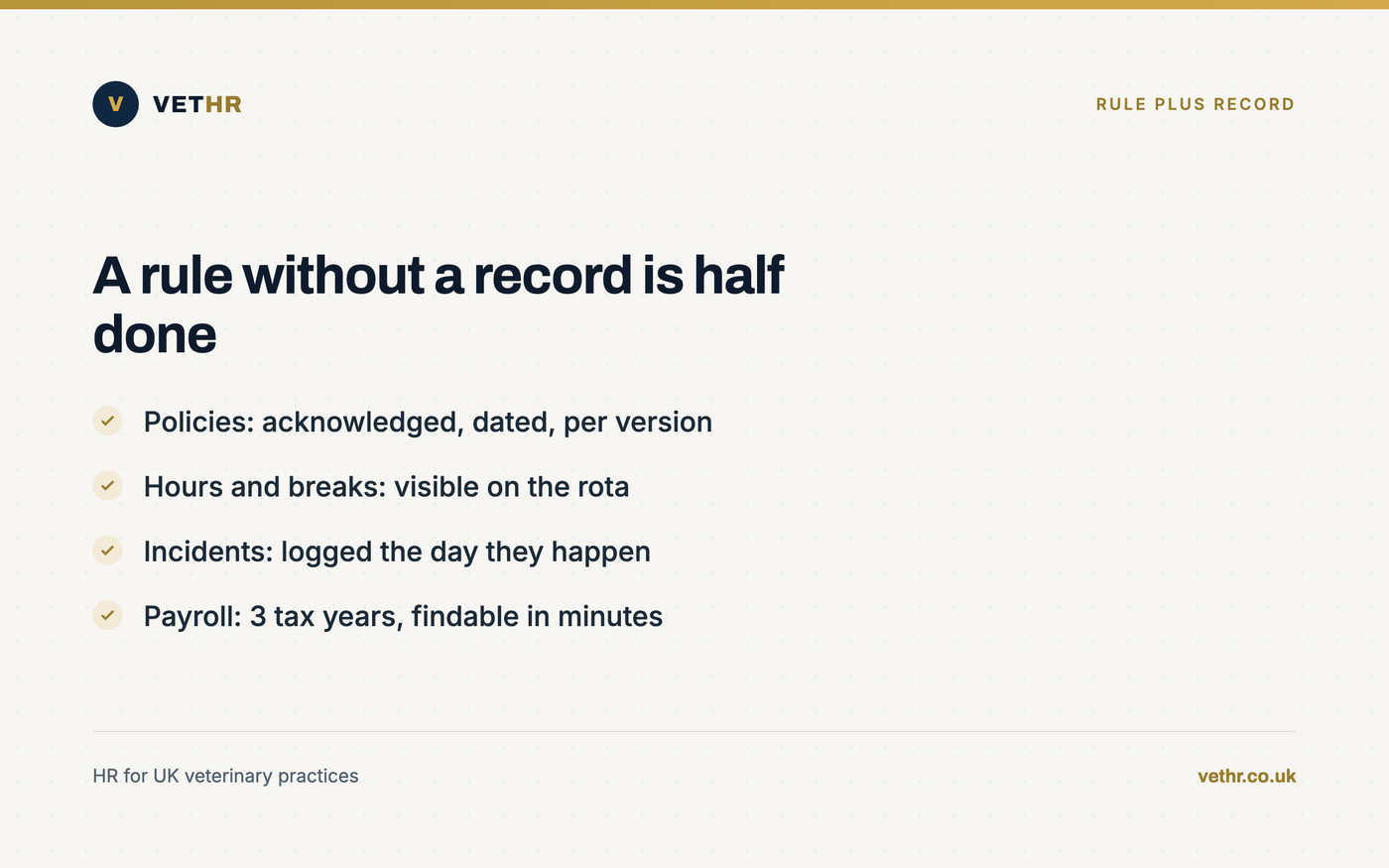
Compliance fails quietly when the evidence lives in ten places. Keep written particulars, policy acknowledgements, hours records, incident reports and training records where you can find them in minutes, because a tribunal claim, an HSE visit or an HMRC check is always a request for documents first.
Incidents are the clearest example. A written health and safety policy says what should happen; an incident log shows what did. Our See It Report It system gives every member of staff a simple way to report hazards and incidents from their phone, so the record exists the day it happened rather than being reconstructed a year later.
The same logic runs through the whole veterinary HR compliance checklist. A rule without a record is only half done. When the paperwork, the policies and the acknowledgements sit in one system, the annual review takes an afternoon instead of a month.
No. The law sets obligations on the employer, not on how you resource them. A practice owner or manager can meet every duty on this list themselves. The requirement is that the duties are met and evidenced, which is why many independent practices use outside HR support rather than hiring in house.
The principal statement of employment particulars: names, job title, start date, pay, hours and days, holiday, place of work, probation terms, benefits and required training, plus information on sick pay, other paid leave and notice, per GOV.UK. The wider statement, covering pensions and disciplinary and grievance procedures, follows within 2 months.
Every business must have a policy for managing health and safety, and once you have five or more employees it must be written down, according to the HSE. For a clinic it should name the real hazards: sharps, medicines, radiation, zoonoses, manual handling and lone working, and say who does what.
Right to work copies must be kept for the whole employment and for 2 years after the person stops working for you, per GOV.UK. PAYE records must be kept for 3 years from the end of the tax year they relate to. Diarise the deletion dates as well as the retention.
The statutory 20 minute break for a working day over 6 hours does not have to be paid, per GOV.UK. Your contracts can be more generous, and many are. What matters for compliance is that the break is uninterrupted and actually taken, which on a busy consult day takes deliberate rota planning.
None of the eight areas above is difficult on its own. The risk is the quiet gap: the starter who never got particulars, the expired visa nobody rechecked, the policy nobody can prove was read. A veterinary HR compliance checklist, run honestly once a year, finds those gaps while they are still cheap to fix.
If you would rather not run it alone, our HR consultancy will do it with you: a free 30 minute health check, a plain list of gaps, and a fixed written quote for anything you want fixed. Book your free HR health check and start with the area that worries you most.
The Vet HR Team provides HR consultancy and white-labelled staff systems exclusively to UK veterinary practices.
Free tool: Score your practice with the free HR compliance scorecard
Read next: The Veterinary Practice HR Calendar.
Contracts, rotas, holiday, a difficult conversation. Tell us what you are dealing with and we will come back within one working day. Nothing to sign up to.
Got it. We will come back to you within one working day. If you do not see a reply, please check your spam folder.
