Last updated: 6 July 2026
TL;DR: Onboarding a new vet properly means the paperwork and logins are ready before day one, week one covers clinical systems and culture rather than a full diary, a named mentor is in place from the start, the caseload ramps up in planned steps, and progress is reviewed at 30, 60 and 90 days. New starters form their view of a practice early, so the first month is where retention is really won or lost.
Recruiting a vet is slow, expensive and competitive, and yet the weeks after the offer often get less planning than the advert did. This guide sets out a calm, practical structure for the first 90 days, from the paperwork that must exist before day one to the review that ends probation with a confident yes.
Onboarding a new vet is the planned journey from accepted offer to a fully settled clinician, and it has five parts: pre-start paperwork and setup, a week one induction covering both clinical systems and culture, a named mentor, a staged caseload ramp, and structured reviews at 30, 60 and 90 days. Each part answers a different question the new starter is quietly asking.
Notice what is not on that list: luck. The common failure mode is treating onboarding as a first-morning tour and a login, then wondering why the new vet seems hesitant in month two. Acas describes an induction as the process of welcoming someone to an organisation or role, and notes that a well-designed programme helps people settle in, get the information they need and understand what is expected of them, in its guide to staff induction. That is precisely the job of the first 90 days.
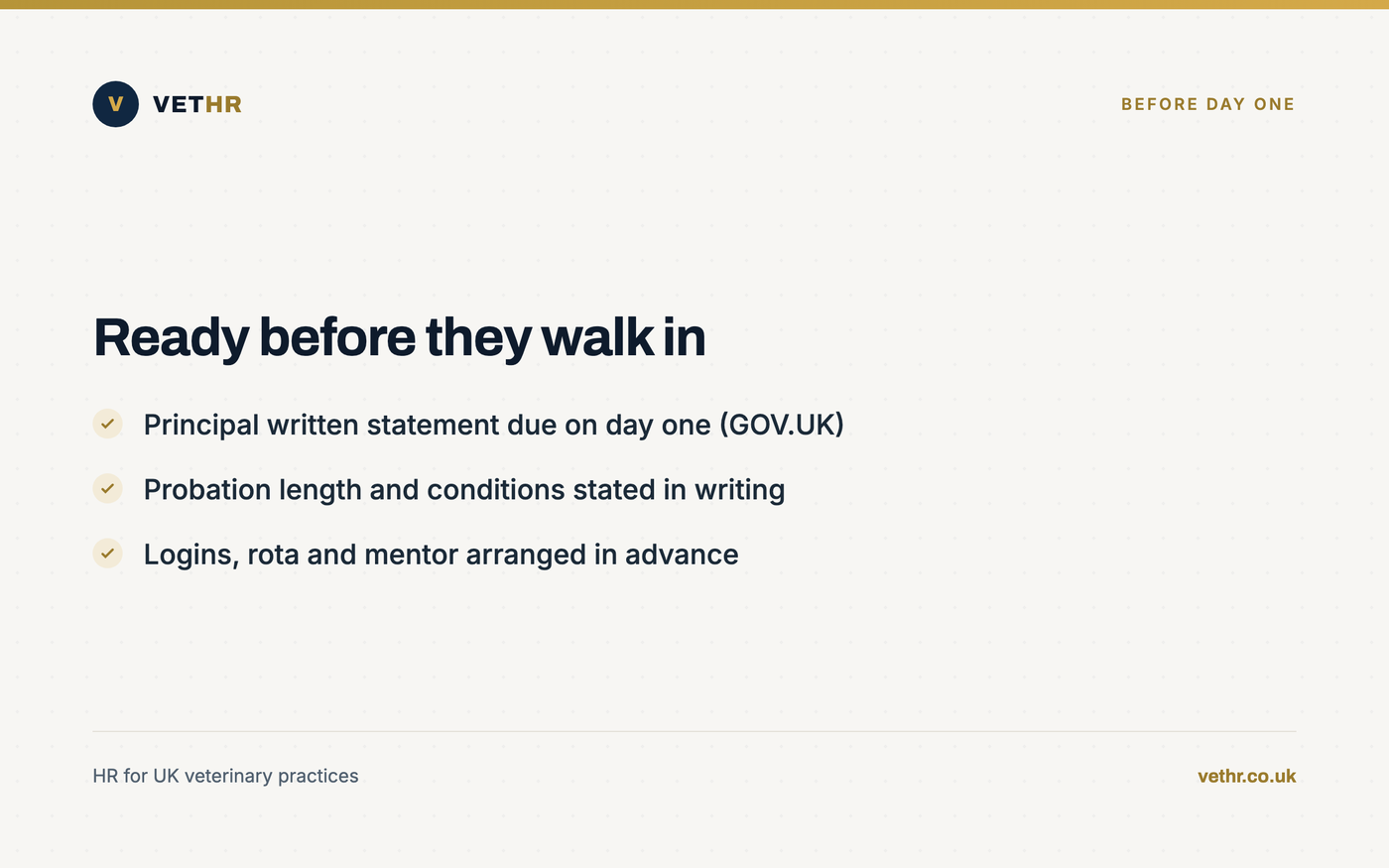
Before a new vet’s first day you need the contract signed, the principal written statement prepared, systems access created, the rota showing their induction time, and the team told who is arriving and why. The aim is simple. Nothing about day one should be improvised, because improvisation reads as indifference to the person living it.
Some of this is law, not preference. GOV.UK is explicit that employees and workers must receive the principal written statement of employment particulars on the first day of employment, covering pay, hours, holiday entitlement, place of work and, importantly, how long any probation period is and what its conditions are, as set out in its guidance on the written statement of employment particulars. The wider written statement, covering matters such as disciplinary and grievance procedures, must follow within two months.
Ideally the contract does that work in one document, issued and signed before the start date rather than on it. If your current template has drifted, or probation terms are vague, our veterinary contracts service puts that right before it becomes a dispute. For the full pre-start list, from RCVS registration checks to uniform sizes, see our veterinary new starter checklist.
Week one should cover two inductions in parallel: the clinical one, which is your practice management system, drug protocols, lab and imaging workflows, referral habits and out of hours arrangements, and the cultural one, which is how decisions get made, who to ask what, and what good looks like here. Most practices deliver the first and forget the second.
The clinical induction deserves real diary time. Shadowed consults before solo consults. A walkthrough of how estimates, consent and clinical notes are done in this practice, not in general. Where the emergency drugs live. Which sums the front desk can waive and which they cannot. None of it is glamorous, and all of it is what makes a competent vet feel competent in a new building.
The cultural induction is quieter but does more retention work. Introduce every team member by name and role, including the Saturday receptionist. Explain how the rota is built and how requests work. Share the written policies rather than the folklore, so the new vet is not guessing at sickness reporting or social media rules in week three. If your policies are scattered or stale, our policies system keeps them in one current, accessible place.
Two practical notes from Acas guidance: there is no legal requirement to run an induction, and no set length it must last, but induction time is working time and must be paid from day one. Treat the induction as an investment you are already paying for, and design it accordingly.
Every new vet needs a named senior colleague who owns their first 90 days, meets them on a fixed rhythm and is genuinely interruptible between meetings. For new graduates this role is formalised by the RCVS. For experienced hires it is informal but just as necessary, because a new building is a new job even for a ten-year clinician.
For new graduates the structure is mandatory. The RCVS Veterinary Graduate Development Programme requires all new graduates to complete a supported programme built around entrustable professional activities, typically over 12 to 18 months, with monthly progress reviews and an e-portfolio, and it earns them 52.5 hours of CPD credit. The VetGDP Adviser must be a vet registered in the UK for at least three years who has completed the specific VetGDP training.
The practical implication for a practice owner: if you are hiring a new graduate, the adviser, their training and their protected time are part of the cost of the hire, not an optional extra. Budget the rota for it. A mentor who is always mid-consult when needed is a mentor in name only, and the new graduate will notice the gap long before you do.
For experienced vets, keep the same shape with a lighter touch. A named buddy, a weekly sit-down for the first month, then fortnightly. The agenda is not performance. It is friction: what is slowing you down, what does not make sense yet, what would you change. Experienced hires rarely ask for help unprompted in a new workplace, so build the asking into the diary.
If you have a vet starting soon and no written plan for their first 90 days, that is fixable in half an hour. Book a free HR health check and we will walk through your contract timing, induction plan and review structure, and tell you plainly what is solid and what needs work. No jargon, nothing sold for the sake of it.
Ramp the caseload in planned steps: shadowed consults in week one, solo consults with longer appointment slots in weeks two to four, a standard diary by around week six for experienced hires and later for new graduates, and no sole charge or out of hours responsibility until you have directly observed the competence and confidence to carry it.
The temptation runs the other way. The practice has been short-staffed for months, perhaps paying for freelance vet cover, and the new vet looks like relief. Loading a full diary in week one converts that relief into risk: rushed consults, avoidable callbacks, a stressed new starter and a first impression of the practice as a place that consumes people. The two months you save are borrowed from the person’s tenure.
Longer consult slots early are the cheapest retention tool you have. They give the new vet time to find things in an unfamiliar system, write notes to your standard and ask questions between patients rather than swallowing them. Tighten the slots as fluency grows, visibly and by agreement, so the ramp feels like progression rather than pressure.
Put the ramp in writing before day one. A one-page plan saying what weeks one, four and eight look like does two jobs at once: it forces you to resource the plan on the rota, and it shows the new vet that their workload is a decision someone made, not a tide that happens to them.
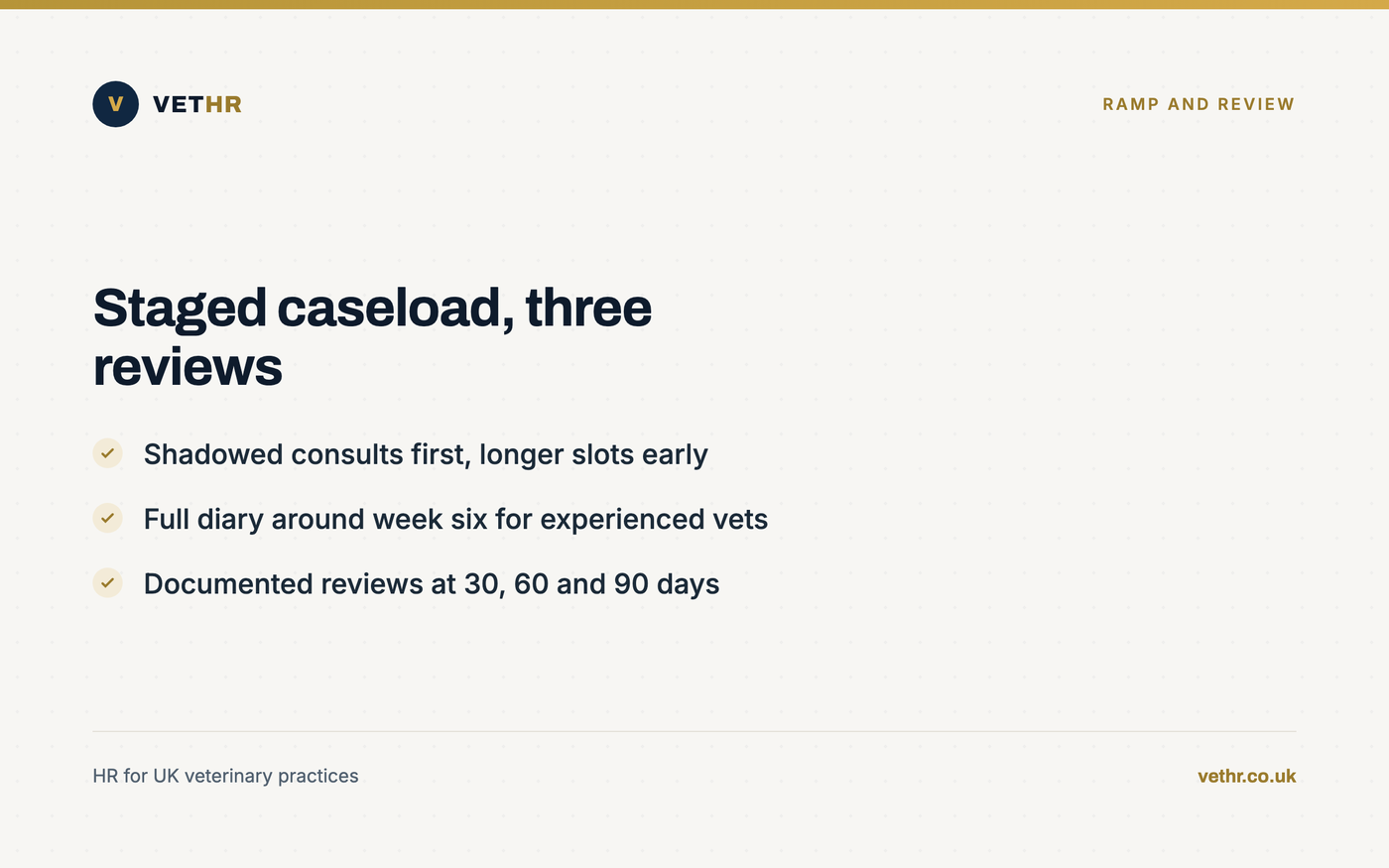
The 30, 60 and 90 day rhythm is three short, structured, documented conversations. Day 30 asks how the landing has gone and fixes early friction. Day 60 reviews clinical progress against the ramp plan and resets anything drifting. Day 90 is the formal probation checkpoint where you confirm, extend or part ways, with reasons recorded either way.
Each review works best with the same simple shape. What is going well, evidenced with examples. What is not yet working, said plainly and early. What changes before the next review, owned by a named person on each side. Thirty minutes is enough. The value is not the length but the certainty that the conversation will happen and will be written down.
Documentation matters because probation decisions lean on it. Remember that GOV.UK requires the length and conditions of any probation period to be in the day one principal statement, so the 90 day decision should be measured against conditions the vet has seen in writing since before they started. A probation extension that arrives as a surprise, against criteria never shared, is how a fixable situation becomes a resignation.
Keep the notes somewhere findable, not in an inbox. A one-page record per review, signed by both people, stored with the personnel file, is enough to make the 90 day decision defensible and fair.
Because month one is when the new vet compares the practice they joined with the practice they were sold, and the verdict tends to stick. A vet who resigns at month five is usually acting on a judgement formed in the first few weeks: the support that never materialised, the diary that filled before the induction finished, the mentor who was never free.
Look at the mechanics of quitting and the timing makes sense. Leaving a brand new job carries low cost. There is no long tenure to walk away from, the recruiters who called last month still have the number, and in a market where practices compete hard for clinicians the exit is easy. What holds someone through the awkward early weeks is evidence that the practice planned for them. Every element in this guide is that evidence.
This is also why onboarding a new vet cannot be delegated to chance or to whoever happens to be on shift. The signals that decide month one are exactly the ones a plan controls: paperwork ready on day one, a real induction, a mentor with time, a workload that ramps, a review that happens when promised. None of them are expensive. All of them are visible.
Plan for 90 days as the core structure, with reviews at 30, 60 and 90 days. Acas notes there is no legal requirement to run an induction and no set length, so the honest answer is role-dependent. An experienced vet may reach a full diary by week six. A new graduate is supported through the RCVS VetGDP, which typically runs 12 to 18 months.
By law, the principal written statement of employment particulars is due on the first day of employment, covering pay, hours, holiday, place of work and the length and conditions of any probation period, per GOV.UK. The wider statement, including disciplinary and grievance procedures, must follow within two months. In practice, issue a full signed contract before the start date.
All new veterinary graduates must complete the RCVS Veterinary Graduate Development Programme, supported by a VetGDP Adviser: a vet registered in the UK for at least three years who has completed the specific training. Experienced hires do not need one, but they still benefit from a named mentor and a fixed meeting rhythm during their first 90 days.
In steps, not at once. Shadowed consults in week one, solo consults with longer appointment slots through the first month, then a standard diary around week six for experienced vets and later for new graduates. Hold back sole charge and out of hours responsibility until competence has been directly observed, and put the ramp plan in writing before day one.
Three things each time: what is going well with examples, what is not yet working said plainly, and what changes before the next review with a named owner. Day 30 focuses on settling in, day 60 on clinical progress against the ramp plan, and day 90 is the documented probation decision measured against conditions stated in the day one paperwork.
You spent months and real money recruiting this vet. The first 90 days decide whether that investment compounds or evaporates, and the deciding factors are unglamorous: paperwork ready on day one, two proper inductions, a mentor with protected time, a written ramp plan and three reviews that actually happen. A practice that does these five things is rare enough to be memorable.
If you want the groundwork checked before your next start date, begin with our new starter checklist, make sure your contracts carry the probation terms the law expects on day one, or simply book a free HR health check and we will give you a straight view of your onboarding within 30 minutes.
The Vet HR Team provides HR consultancy and white-labelled staff systems exclusively to UK veterinary practices.
Read next: Work Experience in a Veterinary Practice.
Contracts, rotas, holiday, a difficult conversation. Tell us what you are dealing with and we will come back within one working day. Nothing to sign up to.
Got it. We will come back to you within one working day. If you do not see a reply, please check your spam folder.
