Last updated: 6 July 2026
TL;DR: Overtime for veterinary staff splits into contractual hours you can require and voluntary hours you cannot. There is no automatic right to a higher rate, but the contract must say what applies, and average pay across all hours actually worked must never fall below the National Minimum Wage. Time off in lieu is a lawful alternative if it is recorded properly. Capture extra hours as they happen, because reconstructing them after a dispute rarely ends well.
Extra hours are woven into practice life. A consult overruns, a surgery goes long, an out-of-hours handover slips, and someone stays. The law is calm about all of this, provided the contract is clear, the pay maths holds up and the hours are actually recorded. This guide covers all three.
Overtime for veterinary staff is time worked beyond the hours set in the employment contract. Acas describes overtime pay as what happens when employers choose to pay people for working more hours than the contract says, and notes there is no automatic legal right to it. The contract, not habit, defines where normal hours end and overtime begins.
In a clinic the extra time rarely arrives as a tidy block. It is the last consult of the day running twenty minutes over, the RVN staying with a post-operative patient, the Saturday morning that stretches into early afternoon, the handover to out-of-hours cover that never quite happens on time.
That fragmented pattern is exactly why overtime causes trouble. Fifteen minutes here and forty minutes there feel too small to write down, so nobody does, and by month end the practice is paying, or not paying, for hours nobody can evidence. Every rule in the rest of this guide depends on knowing what was actually worked.
It matters because it decides who can insist. GOV.UK guidance on overtime rights is direct: an employee only has to work overtime if their contract says so. If the contract is silent, extra hours are voluntary, and a vet or nurse can decline them without being in breach.
The distinction cuts both ways. Under the same GOV.UK guidance, unless the contract guarantees overtime, the employer can stop offering it, though it must not pick and choose who gets overtime in a way that discriminates. So a practice can wind extra hours down when the diary quietens, provided it does so fairly.
There is a ceiling on compulsion too. Even with a contractual overtime clause, staff cannot usually be made to work more than an average of 48 hours a week, and an agreement to go beyond that limit must be in writing and signed, per GOV.UK. For a practice juggling out-of-hours rotas, that average is worth watching, not assuming.
The practical fix is to make the contract say what you actually intend. If Saturday cover is essential, put contractual overtime in writing. If extra hours are genuinely optional, say so. Our veterinary contracts service exists precisely to close the gap between what a practice assumes and what its paperwork says.
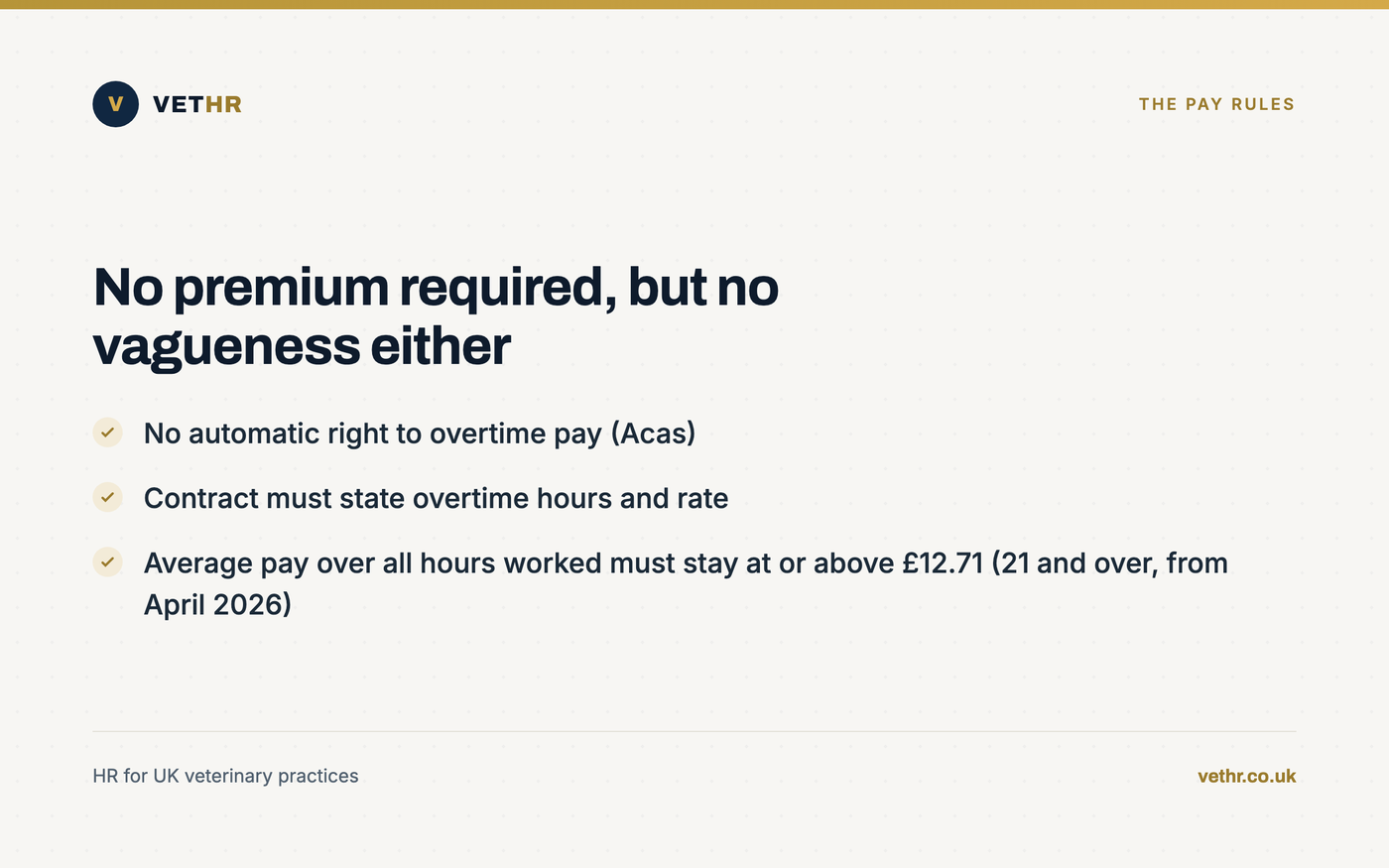
No. There is no automatic legal right to overtime pay, let alone an enhanced rate, according to Acas guidance on overtime pay. What the law does require is clarity: the written statement of employment must set out which hours count as overtime and what the rate of pay for those hours is.
Within that frame, a practice has options. It can pay a premium such as time and a half, pay the normal hourly rate, or offer time off in lieu instead of payment, all of which Acas recognises. What it cannot do is leave the question vague and decide case by case, because that is how two nurses doing the same Saturday end up treated differently.
Two details catch practices out. First, Acas states that where an employee has regularly received overtime pay during the previous year, that overtime must be included in their holiday pay. Regular extra hours quietly raise the cost of every week of annual leave, so budget for it rather than discovering it.
Second, part-time staff. Acas notes that part-time employees are not entitled to overtime rates until they have worked more than the normal hours of full-time staff, unless the organisation’s own policy is more generous. A part-time RVN doing an extra shift is usually earning plain rate, not premium, and both sides should know that before the shift, not after.
This is the rule that turns unpaid goodwill hours into a legal problem. GOV.UK states that employers do not have to pay workers for overtime, but average pay for the total hours worked must not fall below the National Minimum Wage. The floor is measured against hours actually worked, not hours contracted.
The current rates make the arithmetic concrete. From April 2026 the National Minimum Wage is £12.71 an hour for workers aged 21 and over, and £10.85 for those aged 18 to 20, per GOV.UK. The rates change every 1 April, so this check needs repeating each year.
Now the worked example. A salaried assistant contracted to 40 hours on the equivalent of £13.50 an hour earns £540 a week. Divide that £540 by the hours genuinely worked and the average drops below £12.71 once the true week passes roughly 42 and a half hours. A pattern of staying late that nobody records can put a practice below the legal floor without anyone deciding to underpay.
Salaried staff near the floor are the risk zone. Student nurses, receptionists and new graduates on modest salaries have far less headroom than a senior vet, and unpaid overtime for veterinary staff in those roles erodes the average fastest. The only reliable defence is knowing the real hours, which is a recording problem before it is a payroll one.
Not sure whether your overtime arrangements would stand up to a query? A 30-minute conversation usually settles it. Book a free HR health check and we will look at what your contracts say, how extra hours are recorded and paid today, and where the gaps are. Plain answers, nothing sold for the sake of it.
Both are lawful, and the right answer depends on your rota. Acas confirms an employer can offer either a higher rate of pay for overtime or time off instead of overtime pay. TOIL suits a practice with quiet spells where hours can genuinely be given back. Paid overtime suits a practice that is short-staffed every week.
Be honest about which practice you are. TOIL that can never actually be taken is not time off in lieu, it is unpaid work with a promise attached, and it breeds exactly the resentment it was meant to avoid. If the diary never has slack, pay for the hours instead.
Whichever route you choose, TOIL needs the same discipline as pay: a written policy, an agreed rate of accrual, a live balance per person and a clear rule on when it must be used. We cover the mechanics in our full guide to time off in lieu for veterinary staff, including how balances go wrong and how to keep them fair.
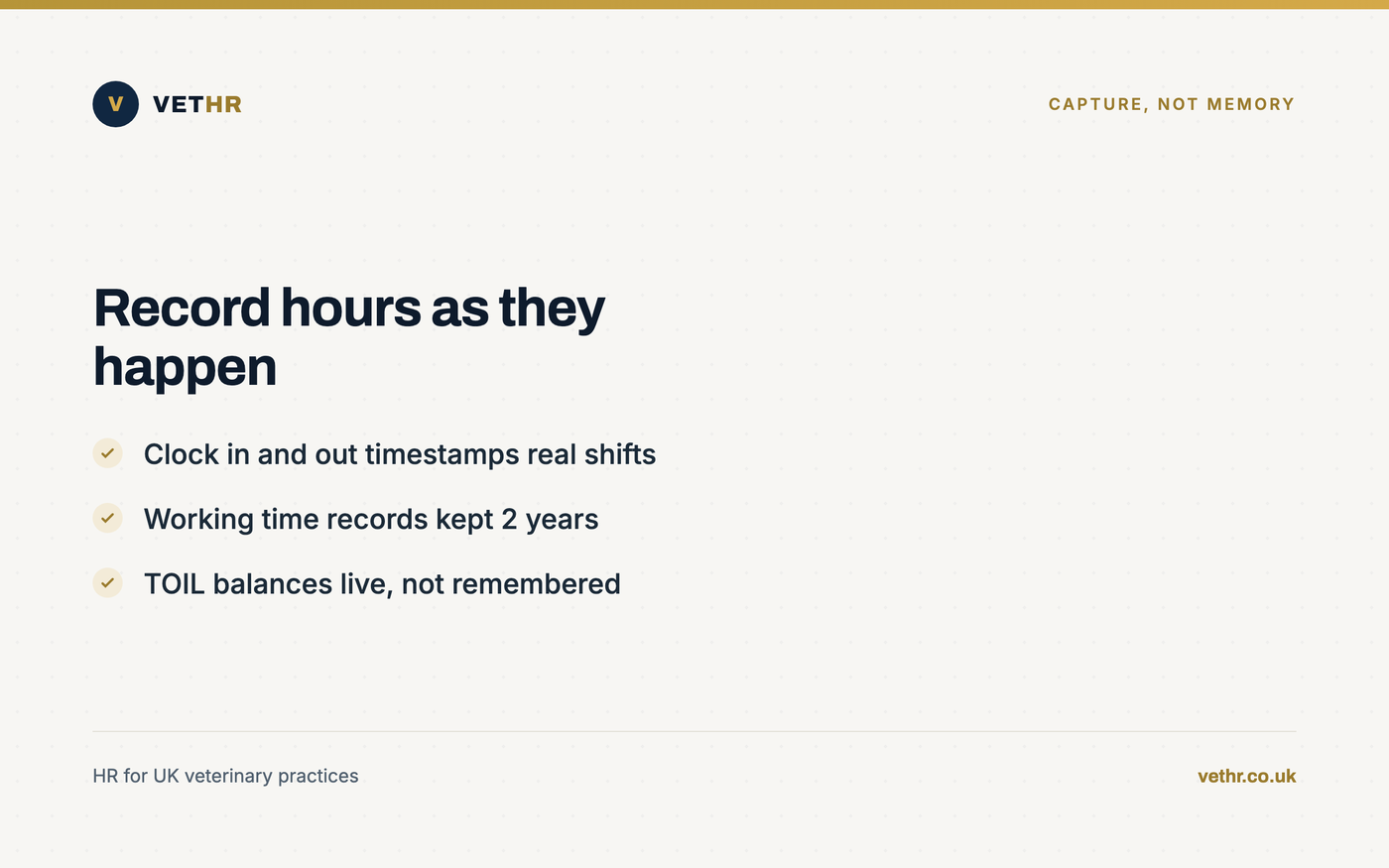
Because a record made at the time is the only version everyone trusts. Every rule above leans on the same fact: the hours actually worked. The minimum wage average, the overtime rate, the TOIL balance and the holiday pay calculation all fail if that number is a guess made weeks later.
There is a record-keeping duty in the background too. Employers must keep records showing working time limits are being met, and must keep them for 2 years from the date they were made, according to Acas guidance on working time rules. A drawer of remembered favours does not satisfy that.
Reconstruction is the alternative, and it is grim. When an employee queries their pay, someone sits down with old rotas, message threads and memory, and builds a timeline both sides can argue with. The employee’s diary says one thing, the practice’s recollection says another, and the absence of a contemporaneous record helps nobody.
Capture is cheap by comparison. A clock in and out system timestamps the real start and finish of every shift, so extra minutes accumulate into a figure nobody has to argue about. Pair it with a veterinary rota system and you can see planned hours against actual hours side by side, which is the whole overtime question in one view.
That comparison also changes behaviour. When a practice sees the same person finishing late every Thursday, it can fix the rota rather than quietly absorb the hours. Overtime for veterinary staff stops being an invisible subsidy and becomes a visible cost the practice can manage.
No. Acas is clear there is no automatic legal right to overtime pay, and employers do not have to pay a higher rate for extra hours. The written statement of employment must say which hours count as overtime and what rate applies. The one hard limit is that average pay across all hours worked must not fall below the National Minimum Wage.
Yes. Acas recognises time off instead of overtime pay as a lawful option. It works only if it is written down and genuinely usable: an agreed accrual rate, a live balance for each person and a realistic window to take the time back. TOIL that can never be taken is just unpaid work by another name.
Yes, if the contract says so. GOV.UK confirms staff only have to work overtime where the contract requires it. Even then, they cannot usually be made to work more than an average of 48 hours a week, and any agreement to exceed that limit must be in writing and signed by the employee.
Yes. Acas states that where an employee has regularly received overtime pay during the previous year, it must be included in their holiday pay. A practice that relies on routine extra hours is therefore also committing to higher holiday pay, which is another reason to know exactly how much overtime is really being worked.
Keep a contemporaneous record of actual start and finish times, overtime approved and paid, and TOIL accrued and taken. Acas guidance says employers must keep records showing working time limits are met for 2 years from the date they were made. A clock in and out system produces all of this automatically.
Overtime is not legally complicated. Say in the contract whether extra hours can be required, say what they earn, keep the average above the minimum wage floor, and record what is actually worked. Practices get into trouble not because the rules are hard but because the hours were never captured, and everything downstream became an argument.
If extra hours are a live issue in your practice, start with the record. See how a clock in and out system captures real hours without fuss, read our guide to time off in lieu for veterinary staff if TOIL is your preferred route, or book a free HR health check and we will give you a straight view of where you stand.
The Vet HR Team provides HR consultancy and white-labelled staff systems exclusively to UK veterinary practices.
Contracts, rotas, holiday, a difficult conversation. Tell us what you are dealing with and we will come back within one working day. Nothing to sign up to.
Got it. We will come back to you within one working day. If you do not see a reply, please check your spam folder.
