Last updated: 27 June 2026
TL;DR: HR for multi-site veterinary practices is about keeping people management consistent once you run two or more branches: the same policies everywhere, fair rotas with shared cover between sites, central records you can trust, and local managers who feel supported rather than second-guessed. The hard part is not the second site itself. It is stopping each branch from quietly inventing its own way of doing things. This guide covers the specific problems that appear at scale and the systems that hold a group together.
One practice is a team you can hold in your head. Two or more is a system, whether you have built one or not. This is a calm look at the people problems that only appear once you have branches, and how to keep them consistent without micromanaging every site from the centre.
HR for multi-site veterinary practices changes the moment a single person can no longer see the whole picture. With one branch, the owner or practice manager knows every rota, contract and grievance personally. Add a second site and that knowledge fragments, so HR for multi-site veterinary practices becomes a system to be designed, not knowledge to be held. Each branch starts solving the same problems differently, and small inconsistencies become unfairness over time.
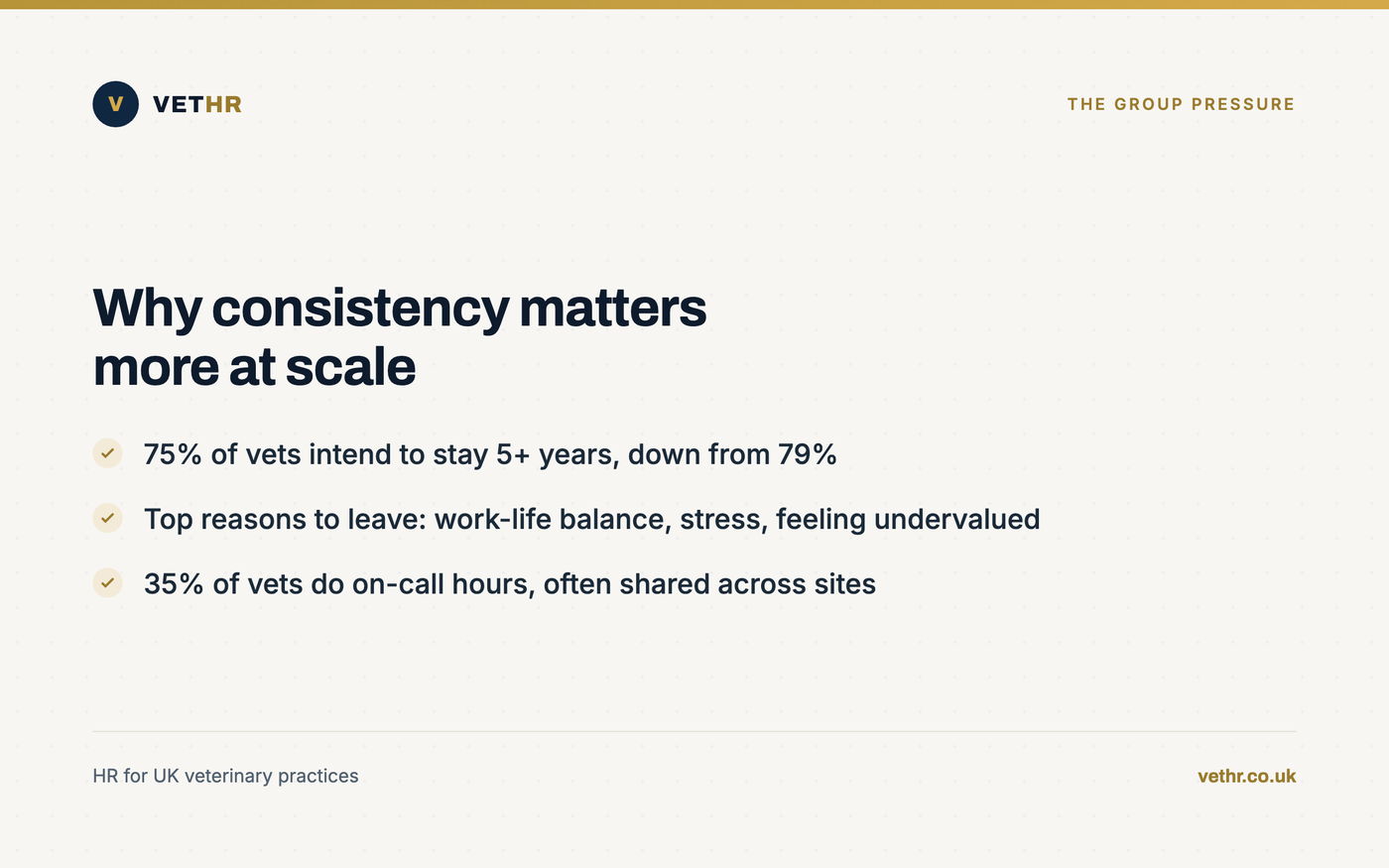
The pressure is real because the workforce is already stretched. In the RCVS Surveys of the Professions 2024, the share of vets intending to stay in the profession for five or more years fell to 75 percent, down from 79 percent in 2019, per the RCVS. Across a group, every avoidable inconsistency adds to that drift.
The leading reasons people leave make the multi-site angle clear. The same RCVS research lists poor work-life balance at 56 percent, chronic stress at 54 percent, and not feeling rewarded or valued in a non-financial sense at 47 percent. All three are shaped by how fairly hours, cover and decisions are handled, and in a group those things have to be fair not just within a site but between sites too.
Out-of-hours work concentrates the risk. The RCVS found 35 percent of vets and 16 percent of veterinary nurses did on-call hours. When cover is shared across branches, on-call is exactly where a group either feels fair or feels like one site carrying another, so it is the first thing a multi-site system has to get right.
You keep HR policies consistent across branches by holding one master set centrally and letting each site reference it, rather than letting branches keep their own copies. The goal is a single source of truth for contracts, holiday rules, sickness, conduct and grievance, so a nurse moving between sites meets the same standards everywhere and no manager is guessing.
The risk in a group is policy drift. One branch tweaks its sickness wording, another keeps an old contract template, and within a year you have several versions of the truth. When a dispute arises, that inconsistency is what gets picked apart, because it looks like staff at different sites were treated under different rules.
Consistency is also a legal habit, not just a tidy one. GOV.UK guidance on enforcing the minimum wage states that, from 1 April 2021, employers must keep records for a minimum of six years and be able to produce them for a worker in a single document on request. Across several sites that is far easier when policies and records sit in one shared system than when each branch keeps its own.
The practical move is one approved library, version-controlled centrally, with local managers able to read and apply but not rewrite. See how we structure this in our policies system. It gives every branch the same answer to the same question, which is the whole point of running a group rather than a loose collection of clinics.
You run fair rotas across sites by planning them where the whole group is visible, not branch by branch in isolation. Shared cover, freelance vet cover and out-of-hours need a single view so the centre can see who is stretched, who has capacity, and whether one site is quietly carrying the on-call burden for the others.
Branch-only rotas hide the unfairness. A nurse may look fine on her own site’s schedule while actually covering shifts at a second branch every week, and nobody at the centre sees the total. That invisible load is precisely the kind of thing the RCVS links to burnout, with full-time vets in the 2024 survey reporting hours above their contracted time.
The hours themselves carry legal weight. Acas confirms the 48-hour weekly maximum that staff can only exceed with a written opt-out, and states that working time records must be kept for two years from the date they were made, in its guidance on the working time rules. When cover crosses sites, those hours have to be totalled across branches, not counted separately at each.
A group-level rota fixes this by making cover a shared resource with one set of rules. Our staff systems are built so a regional manager can plan across branches, spot a site running thin before it breaks, and offer open shifts to qualified staff at any location, so cover feels like a group helping itself rather than a favour owed.
Running two or more sites and not sure where the inconsistencies are hiding? A 30-minute conversation usually surfaces them. Book a free HR health check and we will look at how your group handles policies, rotas, shared cover and records today, then tell you honestly where a system would help and where you are already fine. No jargon, nothing sold for the sake of it.
You keep central records by holding every contract, right-to-work check, registration and review in one system that the centre can read across all sites, with each branch updating its own people. The test is simple: can someone at head office produce a clean record for any staff member at any branch within minutes, without ringing the site?
In a single practice, scattered records are an annoyance. In a group, they are a reporting failure. If registrations are tracked on one branch’s spreadsheet and right-to-work on another’s, nobody has a group-wide view of who is current, and a lapsed registration can sit unnoticed at a site the owner rarely visits.
Central reporting is where multi-site practice management earns its keep. One dashboard showing headcount, holiday liability, training and expiring documents across every branch turns a fortnight of phone calls into a single screen. It also means due diligence, whether for a bank, an acquisition or an inspection, is a query rather than a scramble.
The structure that works is shared records with role-based access: local managers maintain their own team, the centre sees everything, and sensitive data stays controlled. That balance lets each branch own its day to day while the group keeps oversight, the line every multi-site owner is trying to walk.
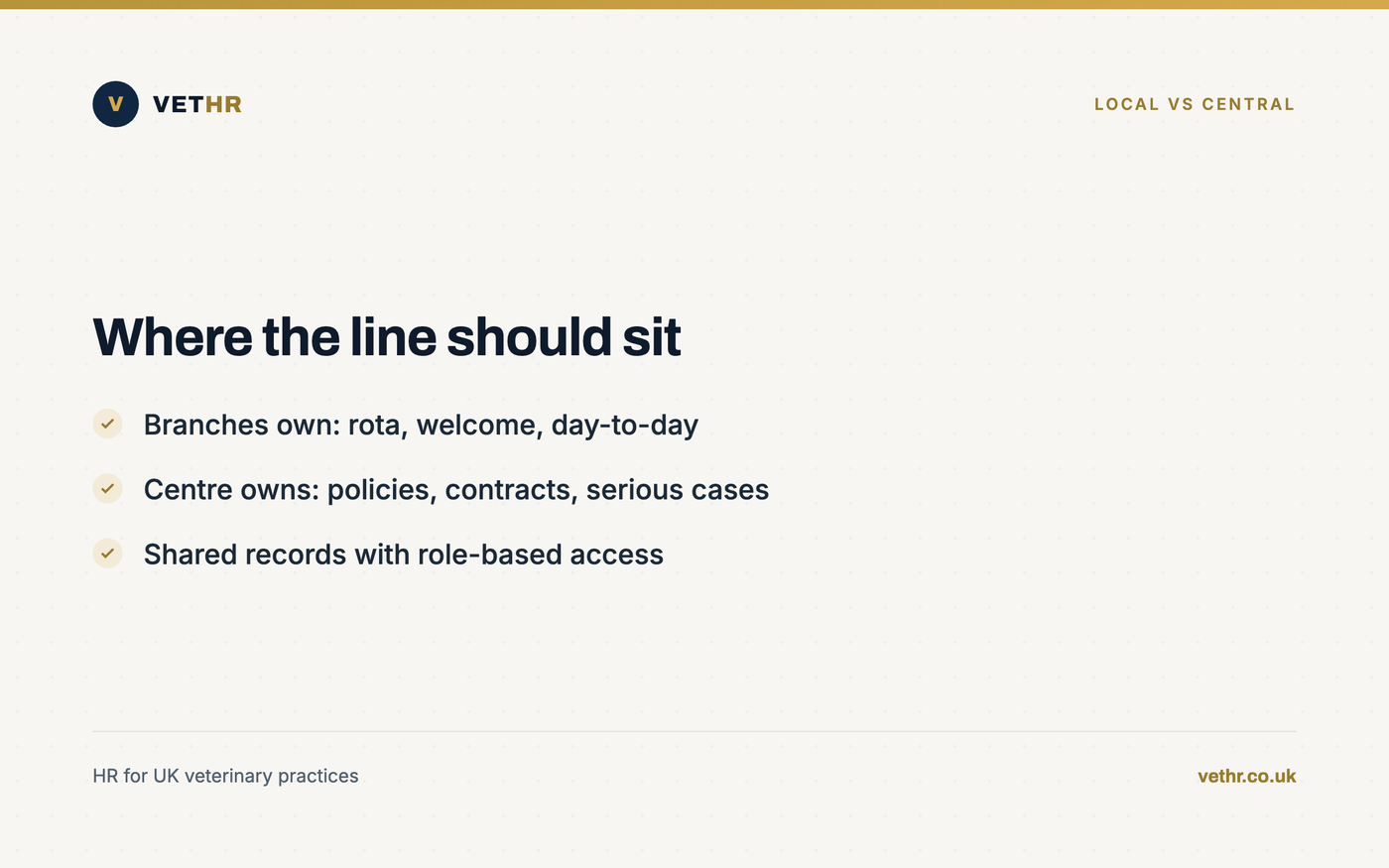
The workable answer is both, with the line drawn clearly. Local managers own the day to day, the rota, the welcome, the quiet word, because they are there and they know the team. The centre owns the framework, the policies, the contracts and the serious cases, so that fairness and compliance do not depend on which branch you happen to work at.
Get the line wrong in either direction and a group suffers. Too central, and capable branch managers feel powerless and disengaged, which is exactly the not-feeling-valued that 47 percent of leavers cited to the RCVS. Too local, and you get inconsistent decisions, the kind that turn one mishandled grievance into a claim that names the whole group.
The practical structure is delegation with a backstop. Branch managers handle routine people matters using the shared policies, and escalate disciplinaries, grievances and dismissals to a central point where the judgement and the paper trail are consistent. That is the model our HR consultancy supports, giving local managers a single expert to call before they act, not after.
Clarity is the kindness here. When everyone knows what they decide and what they escalate, managers act with confidence and staff get consistent treatment, whether a tough call lands at your busiest site or your smallest.
You onboard consistently by running one defined process that every branch follows, rather than leaving each manager to improvise a welcome. A shared checklist, the same contract and policy pack, the same right-to-work and registration steps, and the same first-week plan mean a new nurse gets the same start whether she joins your flagship or a small branch.
Inconsistent onboarding shows up fast and costs most. A starter set up properly at one site and half-forgotten at another forms an early view of the whole group, and first impressions are hard to undo when retention is already under pressure across the profession.
At scale, the right-to-work and records steps are where a casual welcome becomes a compliance gap. A standard onboarding flow makes sure those checks happen and are logged centrally every time, and gives the new starter their contract, policies and rota access on day one rather than chasing them in week three.
The fix is a single onboarding template wired into your central records, so completing it at any branch updates the same system. That is how a growing group keeps its welcome consistent as it adds sites, instead of watching standards quietly drift down at the branches furthest from head office.
The systems that keep a veterinary group consistent share one trait: they hold the group’s data centrally while letting each branch work locally. Good HR for multi-site veterinary practices should cover rotas, hours, holiday, records, policies and incident reporting in one place, with a central view on top, so consistency is built in rather than chased branch by branch.
For groups that want their own identity on it, the system can carry your branding rather than a supplier’s. A white-label option puts your group name on the front, so staff across every branch use one tool that feels like yours, which quietly reinforces that they belong to one organisation.
The point of all of it is the same as the point of running a group: the right system lets each branch keep its personality while the group keeps its standards, and that balance turns several practices into one organisation people are glad to work for.
Consistency. The biggest challenge in HR for multi-site veterinary practices is stopping each branch from quietly developing its own policies, rotas and standards. When a single person can no longer see every site, small differences become unfairness, and unfairness is what drives both disputes and the retention problems the wider profession already faces.
Plan cover where the whole group is visible, not site by site. A group-level rota shows who is stretched and who has capacity, so out-of-hours and cross-branch shifts are shared rather than dumped on one site. Hours worked across more than one branch must be totalled together, both for fairness and for working time compliance.
No. A group should hold one master set of policies centrally and apply it identically at every branch, with local managers reading and using them but not rewriting them. Separate branch policies create several versions of the truth, which is exactly what gets picked apart if a dispute reaches a tribunal.
Local managers handle routine, day-to-day matters using the shared policies, but serious cases such as disciplinaries, grievances and dismissals should escalate to a central point. That keeps judgement and the paper trail consistent across sites, so a tough call is handled the same way whichever branch it arises in, and the whole group is protected.
They need the same building blocks plus a central layer. Veterinary group HR systems must hold rotas, records and policies in one place, then add group-wide reporting and role-based access so the centre sees everything while each branch maintains its own team. That central view is the part a single-practice setup does not require.
A second site does not double your HR work; it changes its nature. The job stops being personal knowledge and becomes a system, and the practices that thrive as groups build that system deliberately rather than waiting for inconsistency to force the issue. Consistent policies, fair shared cover, central records and a clear line between local and central decisions are what hold a group together.
If you are running two or more branches, start with where the inconsistencies hurt most. To see how the pieces fit, browse our staff systems, read how we work in HR consultancy, or simply book a free HR health check and we will give your group a straight recommendation. Nothing sold that you do not need.
The Vet HR Team provides HR consultancy and white-labelled staff systems exclusively to UK veterinary practices.
Related reading: HR for multi-site veterinary groups
Contracts, rotas, holiday, a difficult conversation. Tell us what you are dealing with and we will come back within one working day. Nothing to sign up to.
Got it. We will come back to you within one working day. If you do not see a reply, please check your spam folder.
