Last updated: 14 June 2026 | By The Vet HR Team
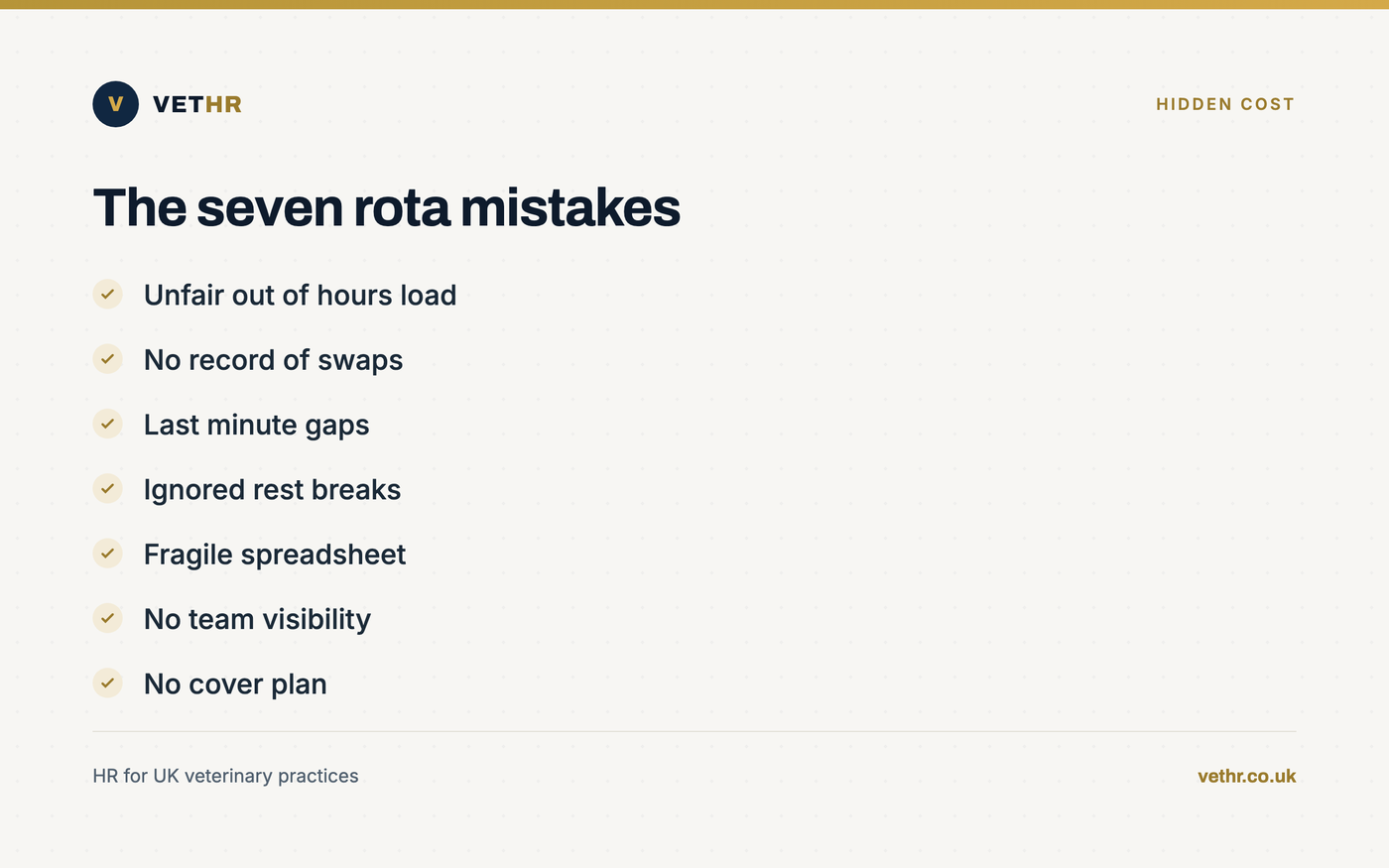
TL;DR: The most common veterinary rota mistakes are an unfair out of hours load, no record of swaps, last minute gaps, ignored rest breaks, a fragile spreadsheet, no team visibility, and no cover plan. Each one quietly drains your nurses and vets, and each one has a practical fix. Fix the rota and you protect both your team and your retention.
Veterinary rota mistakes cause burnout because the rota is the one document that decides how your team lives. It sets who works the late consults, who carries the on call phone, and who gets a real weekend. When that allocation feels unfair or unpredictable, the stress is daily and visible, and it compounds week after week.
This is not a soft problem. In a BVA Voice of the Veterinary Profession survey, 74% of vets said they were very or quite concerned about stress and burnout in the profession (BVA, 2020). The rota is one of the few levers a practice owner can pull directly, this week, without a budget.
The good news is that rota burnout is preventable. Below are the seven veterinary rota mistakes we see most often in independent UK practices, and the fix for each. Work through them in order and you will close the gaps that cost you good people.
The first and most damaging veterinary rota mistake is letting the same people absorb the worst shifts. Without a defined pattern, out of hours, weekends, and the on call phone drift toward whoever is reliable or quiet. They notice. So does everyone else, every time they read the rota.
Unfairness here is corrosive precisely because it is measurable. A vet who works three weekends in four can count. When the load is visibly lopsided, the message your most dependable people receive is that dependability is punished, and that is the quiet beginning of a resignation.
Set a written rotation for out of hours and weekends, so the pattern is predictable and shared. Then run a monthly check: count the evenings, weekends, and on call sessions each person carried, and rebalance before the gap widens. A fair share is easy to defend, and a defended rota stops the resentment before it forms. Our veterinary rota system tracks this distribution automatically.
Shift swaps are healthy. Lost swaps are not. When a nurse covers a colleague’s Saturday on a verbal agreement, with nothing written down, you have created a debt nobody can see. Two missed swaps later, someone feels used, and you have no record to settle it.
The same gap creates real operational risk. If two people quietly swap and the rota is never updated, your day starts with the wrong person on the floor, the wrong vet on call, and a manager piecing together who is actually in. That is a safety question as much as a fairness one.
Make one rule: a swap is not real until it is recorded and the rota reflects it. A request and approve flow, where the change updates the live rota the moment it is agreed, gives you a clean audit trail and a single version of the truth. Nobody has to remember a favour, because the system remembers it for them.
Sickness happens, so this is one of the veterinary rota mistakes that hides as bad luck. The damage comes from how you fill the gap. When a vet calls in unwell at 7am and cover is found through a flurry of group texts, the people who answer fastest are the people who get pulled in most often, on the days they had planned to be off.
This is the unpredictability that erodes work life balance. Long and unpredictable hours are among the top factors veterinary professionals cite when they think about leaving, and a rota that can disrupt any day without notice is unpredictability by design.
Keep a short, fair list of who is willing to cover at short notice, and rotate through it rather than asking the usual two. Where you can, give shift notice well ahead; a clear four week horizon lets people plan their lives around the rota instead of bracing against it. Predictability is itself a retention tool.
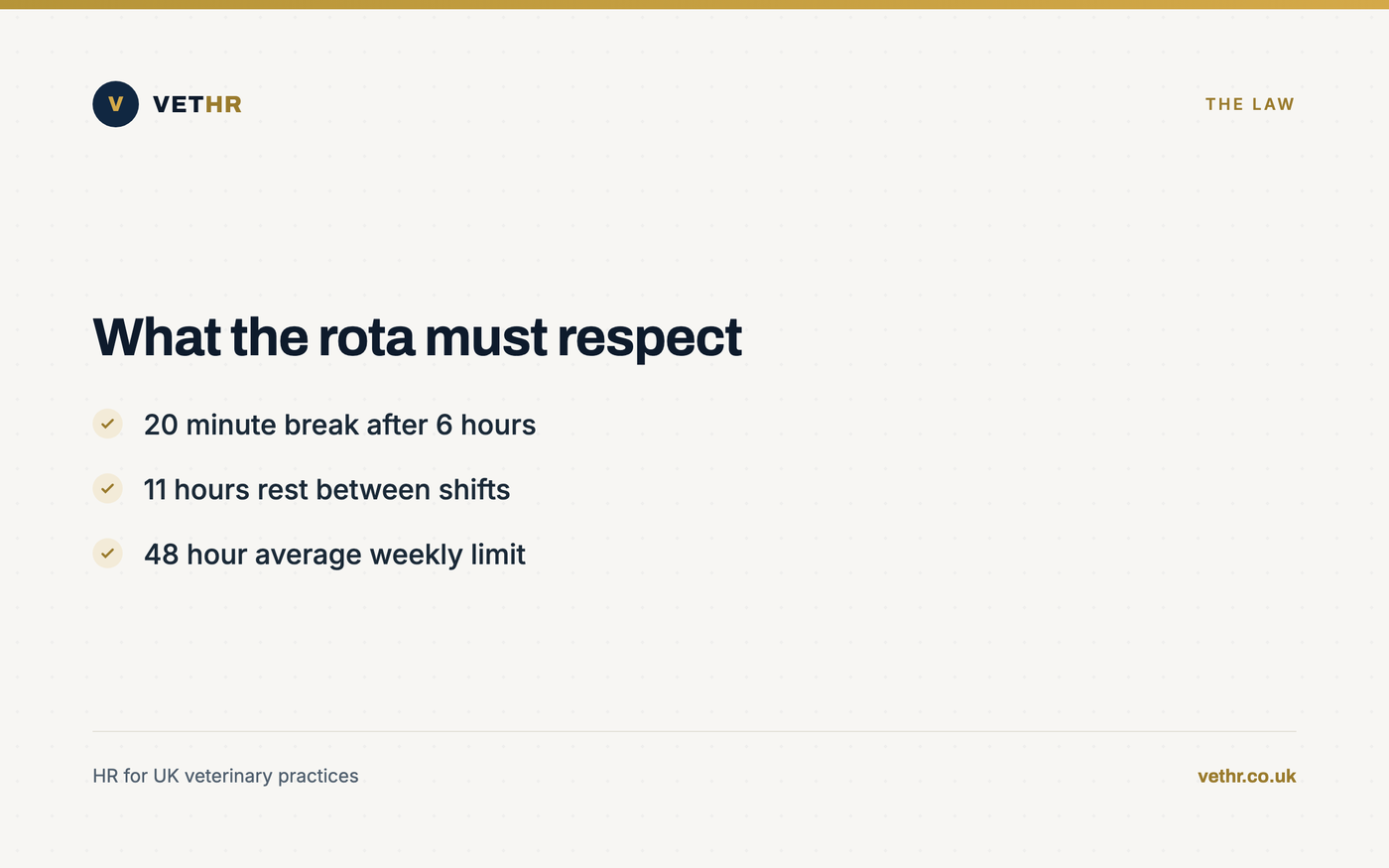
A rota that skips rest is both a wellbeing failure and a legal one. Under UK working time rules, a worker who works more than six hours a day is entitled to an uninterrupted 20 minute rest break, and to 11 hours of rest between working days (GOV.UK). A rota that books back to back consults through lunch is not just unkind, it is non compliant.
The weekly limit matters too. Staff cannot be required to work more than 48 hours a week on average, normally measured over 17 weeks, unless they have chosen to opt out in writing (GOV.UK). Out of hours work and long ops days can push a rota past that line without anyone meaning to.
Schedule the 20 minute break as a fixed block, not a hope. Protect the 11 hour gap between a late finish and an early start, and watch the rolling 48 hour average for anyone near the limit. ACAS confirms that where rest cannot be given as planned, the worker has a right to compensatory rest, so missed breaks must be made up, not waved away (ACAS). Vet HR provides HR documentation support, not legal advice, but we will help you build a rota that respects these rules.
If two or three of these mistakes sound like your practice, that is normal, and it is fixable. In a free 30 minute HR health check we will look at your rota, your cover plan, and your rest break compliance, and tell you the two changes that will help most. Book your free HR health check with the Vet HR team.
A spreadsheet rota works until it does not. One person owns the file, edits it on a laptop, and emails out a screenshot. The version on the wall is from Tuesday, the version in the inbox is from Thursday, and a swap agreed on Friday lives only in someone’s memory. The cracks show on the busiest morning.
Spreadsheets also hide the things you most need to see. They do not flag a clash, warn that someone is over their hours, or show you the on call balance at a glance. The manager becomes the system, and when the manager is off, the system is too.
Once a team passes roughly five staff, a single shared, always current rota saves more than it costs. It keeps one version of the truth, links to absence and holiday, and lets people see their own shifts without asking. Pair it with accurate holiday calculations so leave never silently collides with a thin rota.
Of all the veterinary rota mistakes, poor visibility is the easiest to miss because it looks like normal admin. If your team cannot see the rota easily, every question becomes a message to the manager. When am I next on call? Did my swap go through? Who is the duty vet on Sunday? Each query is small, but together they create a constant low hum of uncertainty that sits on top of clinical work.
Poor visibility also hides unfairness. If only the manager can see the whole pattern, nobody can check that the load is shared, and trust quietly leaks out. Transparency is not a nicety here; it is the thing that lets people believe the rota is fair.
Put the live rota where every team member can see it, on their phone, at any time. When people can check their own shifts, see the fortnight ahead, and watch the on call balance for themselves, the manager’s inbox empties and the sense of fairness becomes something the team can verify rather than take on faith.
The final veterinary rota mistake is treating every absence as a fresh emergency. Holidays are known months ahead. Maternity leave has a date. Conferences are in the diary. Yet many practices plan cover only when the gap is already at the door, which guarantees the scramble and the unfair short notice ask.
No cover plan is also how good rotas quietly become unsafe. When a known absence meets a thin week, you are one sickness away from being below safe staffing, and the people on the floor absorb the strain. That strain is exactly the workload pressure that drives experienced staff toward the door.
Map known leave across the year, set a minimum safe cover threshold for each day, and arrange freelance vet cover early for the weeks you can already see are tight. Keep a documented plan for the unplanned, so that when sickness lands, the answer is a list, not a panic. Calm cover is the difference between a hard week and a damaging one.
Fixing veterinary rota mistakes improves retention because the rota is where your team feels respected or taken for granted. A fair, visible, predictable rota tells people their time and wellbeing matter, and that signal is one of the strongest reasons good clinicians stay. Excessive workload and unpredictable hours are repeatedly named among the reasons they leave.
The cost of getting this wrong is steep. Recruiting and onboarding a replacement vet or RVN takes months of advertising, interviewing, and ramp up, during which the remaining team carries the gap and the same burnout deepens. Every avoidable resignation makes the next one more likely.
In one independent veterinary practice we supported, simply moving from a shared spreadsheet to a transparent, rotated rota with a logged swap process removed the weekly arguments about fairness, and the manager got hours back each week. The rota did not become more generous; it became fair, visible, and trusted. That is usually enough.
The most common veterinary rota mistakes are an unfair out of hours and weekend load, no record of shift swaps, last minute gaps filled by panic texts, ignoring statutory rest breaks, relying on a fragile spreadsheet, giving the team no visibility of the rota, and having no plan for cover. Each one drives avoidable stress.
Workers cannot be required to work more than 48 hours a week on average, normally calculated over a 17 week reference period, unless they have opted out in writing. Under 18s cannot work more than 40 hours a week. The figures are set out on the GOV.UK maximum weekly working hours page.
An adult worker who works more than six hours a day is entitled to one uninterrupted 20 minute rest break during the day, 11 hours of rest between working days, and either 24 hours off each week or 48 hours each fortnight. Where rest is missed, the worker is entitled to compensatory rest.
Set a written rotation so the on call and weekend pattern is predictable, log every swap in one place, and audit the distribution monthly to catch anyone carrying more than their share. Make the rota visible to the whole team so fairness can be checked rather than assumed. Fairness people can see is fairness they trust.
A spreadsheet can work for a very small team, but once a practice passes roughly five staff a purpose built rota usually pays for itself. It keeps one current version, flags clashes and hours, links to holiday and absence, and lets staff self serve, which removes the version control and visibility problems that spreadsheets create.
Most rota burnout is not caused by one big failure. It is the slow accumulation of small, fixable mistakes: an unfair share here, a lost swap there, a missed break, a panic text on a Monday. Fix them one at a time and the rota stops being a source of stress and starts being a sign that the practice is well run.
If you want a second pair of eyes, start with a free 30 minute HR health check. We will review your rota and cover, point out anything that conflicts with working time rules, and show you how a transparent rota system can carry the fairness for you. Vet HR works exclusively with UK veterinary practices, 12 hours a day, every day of the year.
The Vet HR Team provides HR consultancy and white labelled staff systems exclusively to UK veterinary practices. We are HR and documentation specialists, not a law firm.
Contracts, rotas, holiday, a difficult conversation. Tell us what you are dealing with and we will come back within one working day. Nothing to sign up to.
Got it. We will come back to you within one working day. If you do not see a reply, please check your spam folder.
