Last updated: 6 July 2026
TL;DR: Veterinary practice manager admin swallows Monday morning: rota fixes after a weekend call-out, leave requests, timesheet chasing, the same policy question again and an incident report from Friday. Most of these ten tasks are process, not judgement, so a staff system should do them for you. This guide walks through a realistic Monday, names each task and shows which system removes it.
Nobody becomes a practice manager to chase timesheets. Yet in most independent practices, veterinary practice manager admin claims Monday before the team gets a look in. This is a calm walk through a realistic Monday morning, task by task, with an honest view of which jobs a staff system should quietly take off your desk.
A typical veterinary practice manager admin Monday is a queue of small, urgent jobs left over from the weekend: a rota broken by sickness, leave requests waiting for an answer, missing timesheets from last week, a policy question someone needs settled and an incident report that must not be forgotten. None of it is clinical. All of it lands first.
Here is the list this guide works through. If your Monday looks anything like it, the question is not how to work faster. It is how many of these ten tasks still need a human at all.
Every one of these is real work. Very little of it is management. The rest of this article takes them in groups and shows where a staff system does the job instead.
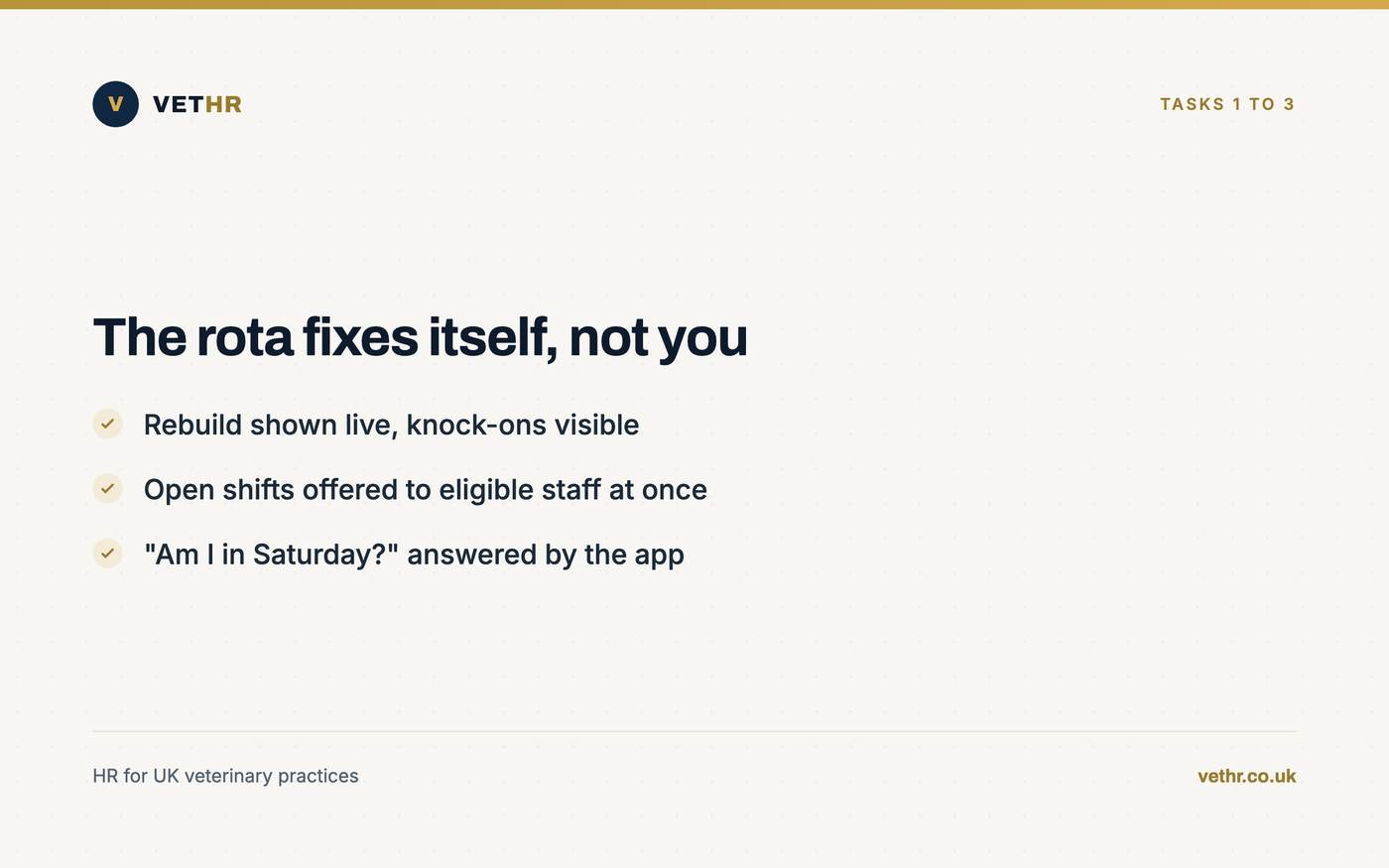
The system should handle the rebuild, the cover search and the “who is in when” questions. When a shift breaks, a proper rota tool shows who is qualified, available and within their hours, offers the gap to eligible staff, and publishes the updated week so everyone sees the same live version on their own phone.
Take task 1, the Monday rebuild. On a whiteboard or spreadsheet, one nurse off sick means redrawing the week by hand and holding the knock-on effects in your head. In a live rota, you move the shift and the system shows you immediately what the change does to cover, out-of-hours and the rest of the week.
Task 2 is the cover search, which on the phone means calling down a list until someone says yes. A system offers the open shift to every eligible person at once and records who accepted. If nobody internal can take it, you know early enough to arrange freelance vet cover calmly rather than at the last minute.
Task 3 disappears entirely. When the rota lives in each person’s pocket and updates in real time, “am I working Saturday?” stops being a message to you and becomes a glance at a screen. Our veterinary rota system is built around exactly this: one live version, visible to everyone, with changes pushed out the moment they happen.
The system should check every leave request against the person’s live balance and the rota before you see it, and it should keep entitlement correct automatically when hours change. Your part becomes a single informed yes or no, not a morning of arithmetic and cross-referencing.
Task 4 is the weekend’s leave requests. Approving one safely means knowing three things: how much leave the person has left, who else is already off that week, and whether the floor still works without them. A holiday system that talks to the rota answers all three at request time, so the clash surfaces before you approve, not on the morning it bites.
Notice periods are part of the same check. Acas guidance on asking for and taking holiday explains that workers must ask for holiday at least twice the number of days before as the amount they want to take off, unless the contract says otherwise, and an employer refusing must say so with at least as much notice as the leave requested. A system that timestamps every request makes both easy to evidence.
Task 5 is the entitlement recalculation. Statutory paid holiday is 5.6 weeks a year, capped at 28 days, and part-time staff get it in proportion, so someone on 3 days a week must get at least 16.8 days, according to GOV.UK guidance on holiday entitlement. When a nurse drops from 4 days to 3, that maths has to be redone. Our holiday calculations system does it automatically, so the balance staff see is always the right one.
If you want a straight answer on which of these ten tasks your current setup is quietly leaving on your desk, book a free HR health check. Thirty minutes, no jargon, and a plain recommendation on what would actually save you time. Nothing sold for the sake of it.
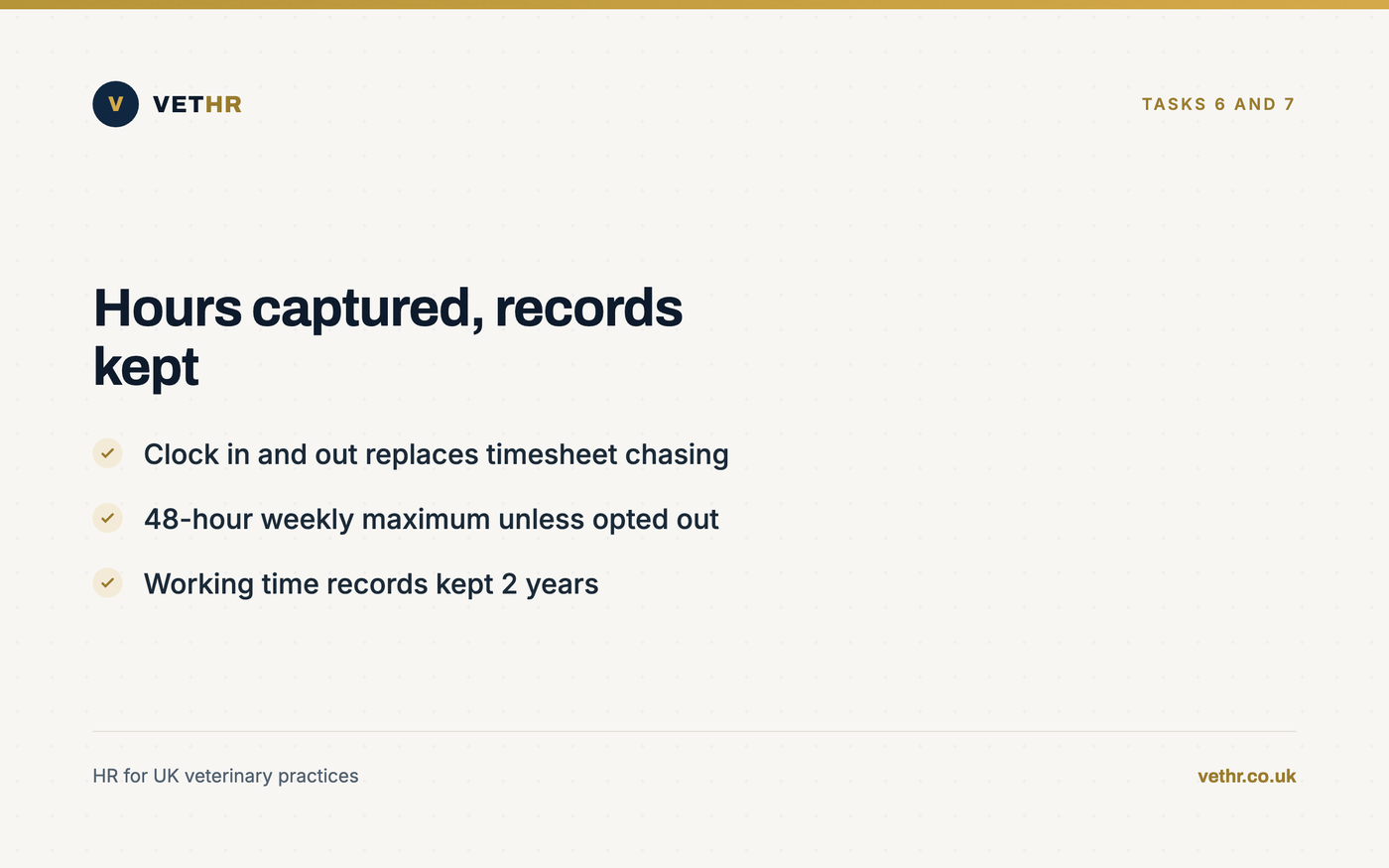
The system should capture hours as they happen, so there is nothing to chase, and it should hold the record you need for payroll and compliance. Clocking in and out at the practice replaces the paper timesheet, and the export replaces the Monday reconciliation.
Task 6, timesheet chasing, only exists because hours are written down after the fact. When staff clock in and out on the day, the timesheet writes itself and the gaps you would have chased are flagged as they occur. Our clock in and out system exists precisely to make this task disappear rather than merely faster.
Task 7 is the reconciliation, and it carries legal weight. Under the working time rules, most workers cannot be required to work more than the 48-hour weekly maximum unless they have signed an opt-out, they are entitled to a rest break of at least 20 minutes when working more than 6 hours in a day, and 11 hours of rest between working days, as set out in Acas guidance on the working time rules.
The same Acas guidance notes that employers must keep working time records for 2 years from the date they were made. Accurate clock data turns that from a filing job into a by-product. It also means the conversation about a long run of late finishes starts from numbers both of you trust, not from memory against memory.
The system should hold one current version of every policy where staff can find it themselves, track who has read and acknowledged each one, and give the team a simple way to report incidents that automatically creates the record and the follow-up. Three tasks, all of them process, none of them yours.
Task 8 is the repeated policy question. “What is the sickness reporting procedure?” is a fair question with a written answer, yet it lands with you because the document lives in a drawer or a folder nobody can find. A policies system puts the current version in every staff member’s pocket, so the question answers itself and out-of-date copies stop circulating.
Task 9 is the sign-off chase. When you update a policy, you need to know who has actually read it, because “we sent it round” is not evidence if a dispute ever turns on it. A system that records each acknowledgement with a date turns a fortnight of reminders into a dashboard you glance at once.
Task 10 is Friday’s incident. A near miss with a fractious dog, a sharps injury, a slip in the prep room: each needs a factual record, a follow-up action and somewhere the whole thing lives. Our See It Report It system lets any staff member log an incident in the moment, so Monday’s follow-up starts from a written report rather than a second-hand account, and nothing quietly evaporates over the weekend.
What is left is the work that actually needs you: the judgement calls, the conversations and the planning. The system fills the rota gap with candidates; you choose between them. It flags the leave clash; you decide whose week matters more. It records the incident; you decide what changes so it does not happen again.
That distinction is the honest test for any tool. A staff system should never make people decisions for you. It should remove the collecting, chasing, checking and filing that sit in front of every people decision, which is where most of the veterinary practice manager admin hours actually go.
There is a retention point hiding here too. A manager who spends Monday chasing paper is not walking the floor, catching the nurse who is struggling or noticing the vet who has quietly stopped taking breaks. The admin does not just cost your time. It costs the team the version of you they hired.
The process layer, which is most of it. Rota publishing, cover offers, leave balance checks, timesheet capture, policy distribution, acknowledgement tracking and incident records can all run without you. The decisions stay yours. In practice that turns a Monday of ten admin tasks into a short list of approvals and one or two genuine judgement calls.
Unless the contract says otherwise, Acas guidance is that workers must ask for holiday at least twice the number of days before as the amount they want to take off, so 10 days off needs at least 20 days’ notice. An employer refusing a request must give at least as much notice as the leave requested.
Acas guidance on the working time rules says employers must keep working time records for 2 years from the date they were made, and the 48-hour weekly maximum can only be exceeded where the worker has agreed an opt-out. A clock in and out system produces those records automatically as staff work.
They get the same 5.6 weeks, in proportion to the days they work. GOV.UK gives the worked example: someone on 3 days a week must get at least 16.8 days’ leave a year. A holiday calculations system applies that automatically and adjusts the balance whenever contracted hours change, which removes the recalculation task entirely.
Judge it by friction, not headcount. A five-person team with a stable rota and no disputes may be fine on paper for now. The moment leave gets contested, timesheets go missing or an incident needs a proper record, the manual method starts costing more than a system would, and the cost lands on one person’s Monday.
None of the ten tasks in this article is beneath a practice manager. They are simply beneath what a practice manager’s time is for. Cutting veterinary practice manager admin is not about doing less for the team. It is about doing the work only you can do. Every hour spent chasing a timesheet or redrawing a rota is an hour not spent on the team, and the team is the practice.
If your Monday looks like the one described here, start with the task that hurts most and see which system removes it. Browse the full set of staff systems, look at how the rota and holiday calculations work together, or book a free HR health check and we will tell you plainly which of the ten tasks you could stop doing this month.
The Vet HR Team provides HR consultancy and white-labelled staff systems exclusively to UK veterinary practices.
Read next: From Spreadsheet to System.
Contracts, rotas, holiday, a difficult conversation. Tell us what you are dealing with and we will come back within one working day. Nothing to sign up to.
Got it. We will come back to you within one working day. If you do not see a reply, please check your spam folder.
