Last updated: 14 June 2026
TL;DR: Every UK practice needs a core set of veterinary practice HR policies: disciplinary, grievance, sickness absence, health and safety, data protection, social media, working time and rest breaks, out of hours, and leave. Several are legally required once you employ five or more people. The rest protect your team and your reputation. Use the checklist below, then book a free HR health check.
Ask ten practice owners which policies they have written down, and you will get ten different answers. Some have a thick handbook nobody reads. Many have nothing more than a contract and good intentions. This guide sets out the veterinary practice HR policies a UK practice actually needs, why each one matters on the consulting room floor, and where the law draws a hard line. Every legal point is checked against current ACAS or GOV.UK guidance and linked so you can verify it yourself.
A handful of policies are effectively mandatory. Once you employ five or more people you must put your health and safety policy in writing. Every employer must have disciplinary and grievance procedures that meet the ACAS Code. You must handle staff data lawfully under UK GDPR. Everything else is strongly advised rather than strictly required, but the advised list is where most practices get caught out.
The Health and Safety Executive is unambiguous on the threshold. Its guidance states: “If you have five or more employees, you must write your policy down.” A small branch surgery with three staff is exempt from writing it down, though doing so is still sensible. A typical practice of fifteen to forty people clears that bar easily, so a written health and safety policy is not optional for you.
The second hard requirement is fair process. ACAS publishes the Code of Practice on disciplinary and grievance procedures, and as ACAS notes, “the procedure an employer follows and an employee’s actions will be taken into account if the case reaches an employment tribunal.” Skip a fair procedure and an otherwise reasonable dismissal can still be ruled unfair. That is why the disciplinary and grievance policies sit at the top of the list.
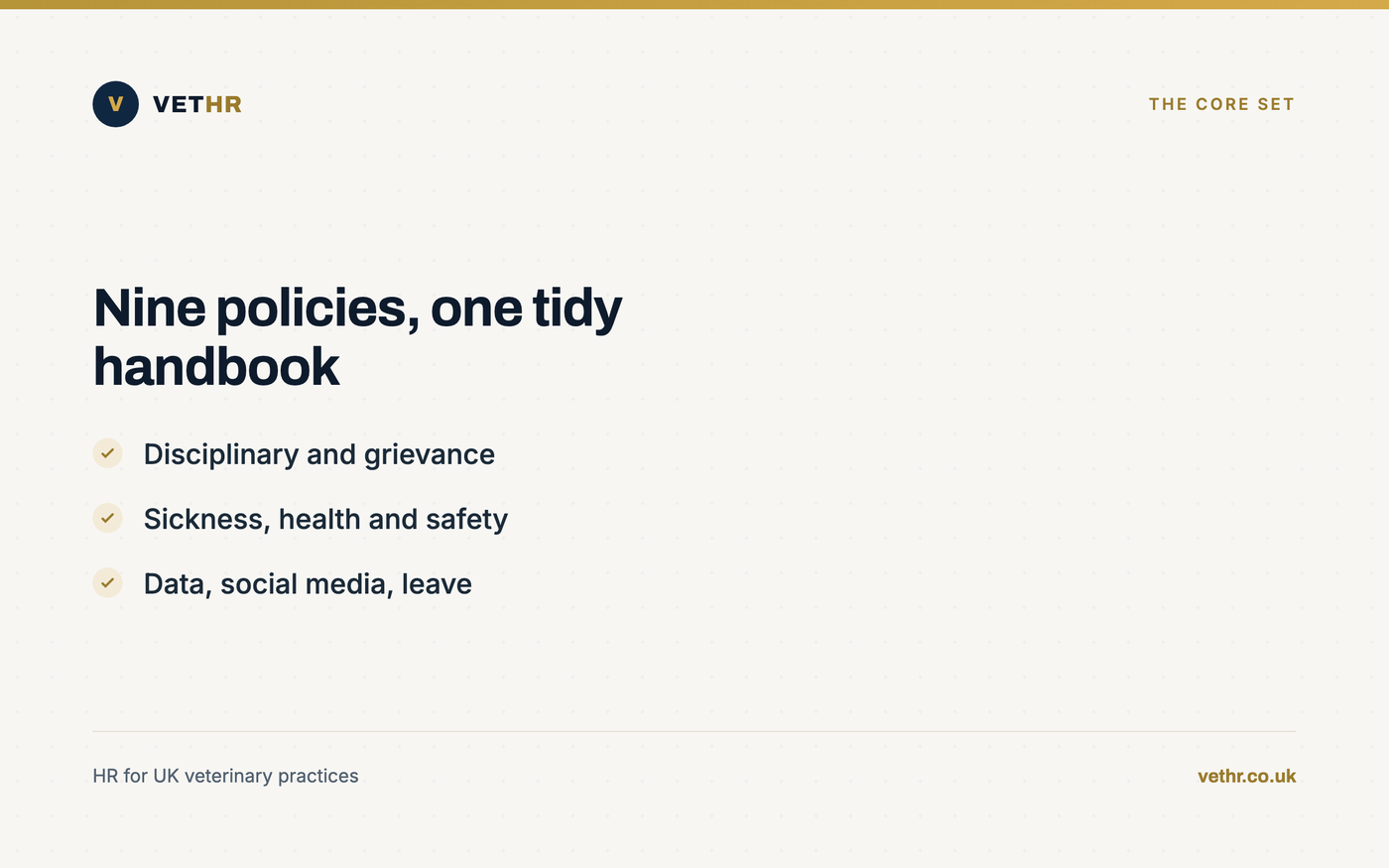
These nine policies cover the situations practices meet most often: a difficult disciplinary, a sickness pattern across a small rota, a controlled drugs query, a photo of a patient posted online. Each one should be short, specific to your practice, and written in plain language your whole team can follow.
This is your structured, fair route for handling conduct or performance problems, from a missed controlled drugs entry to repeated lateness on early consults. A good policy lists examples of misconduct and gross misconduct, sets out investigation and hearing steps, and confirms the right to be accompanied. Following it consistently is what protects you at tribunal.
A grievance policy gives staff a clear, safe way to raise concerns, whether about workload on a short-staffed rota, a rota clash, or a colleague’s behaviour. ACAS makes the point that grievances can be raised by letter, by email or verbally, so your policy should explain how a concern is logged, investigated and answered. Handle grievances early and many never escalate into formal disputes.
In a practice running tight rotas, one unplanned absence can collapse a day’s consults. A sickness policy sets out how staff report absence, when self-certification ends and a fit note is needed, return to work conversations, and how statutory sick pay works. It should also explain how absence triggers a supportive review, not an automatic sanction, so RVNs and support staff feel able to be honest.
This is the legally required one for practices of five or more, and veterinary work makes it more than a formality. Anaesthetic gases, x-ray exposure, sharps, animal bites, manual handling of large dogs and zoonotic risk all belong in your risk assessments. A strong See It Report It process for near misses turns the policy from a document into a daily habit. Pair it with our See It Report It incident reporting system to capture issues before they become claims.
Practices hold sensitive data on both clients and staff: medical histories, payment details, sickness and disciplinary records. A data protection policy explains lawful handling under UK GDPR, who can access records, how long you keep them and how a data breach is reported. It should cover the obvious veterinary pinch points too, such as client contact lists and images stored on personal phones.
A single photo of a patient or an off-hand comment about a client can become a reputational problem fast. Your social media policy should say who may post on the practice’s behalf, whether staff can share clinic content on personal accounts, the rules on images of patients and owners, and the tone you expect. It is not about silencing your team, it is about protecting clients, colleagues and the practice name.
Long days and back to back consults make working time a real risk in practice. Under GOV.UK guidance, a worker over 18 is entitled to “one uninterrupted 20 minute rest break during their working day, if they work more than 6 hours a day”, 11 hours rest between working days, and an uninterrupted 24 hours off each week or 48 hours each fortnight. Your policy should show how the rota honours these, not just record that they exist.
Out of hours cover is where pay, rest and fairness get tangled, especially when you blend your own team with freelance vet cover. An OOH policy should define on-call rates, how on-call time interacts with daily rest, expectations on response times, and how the following day’s rota adjusts after a heavy night. Clarity here prevents both burnout and disputes over pay.
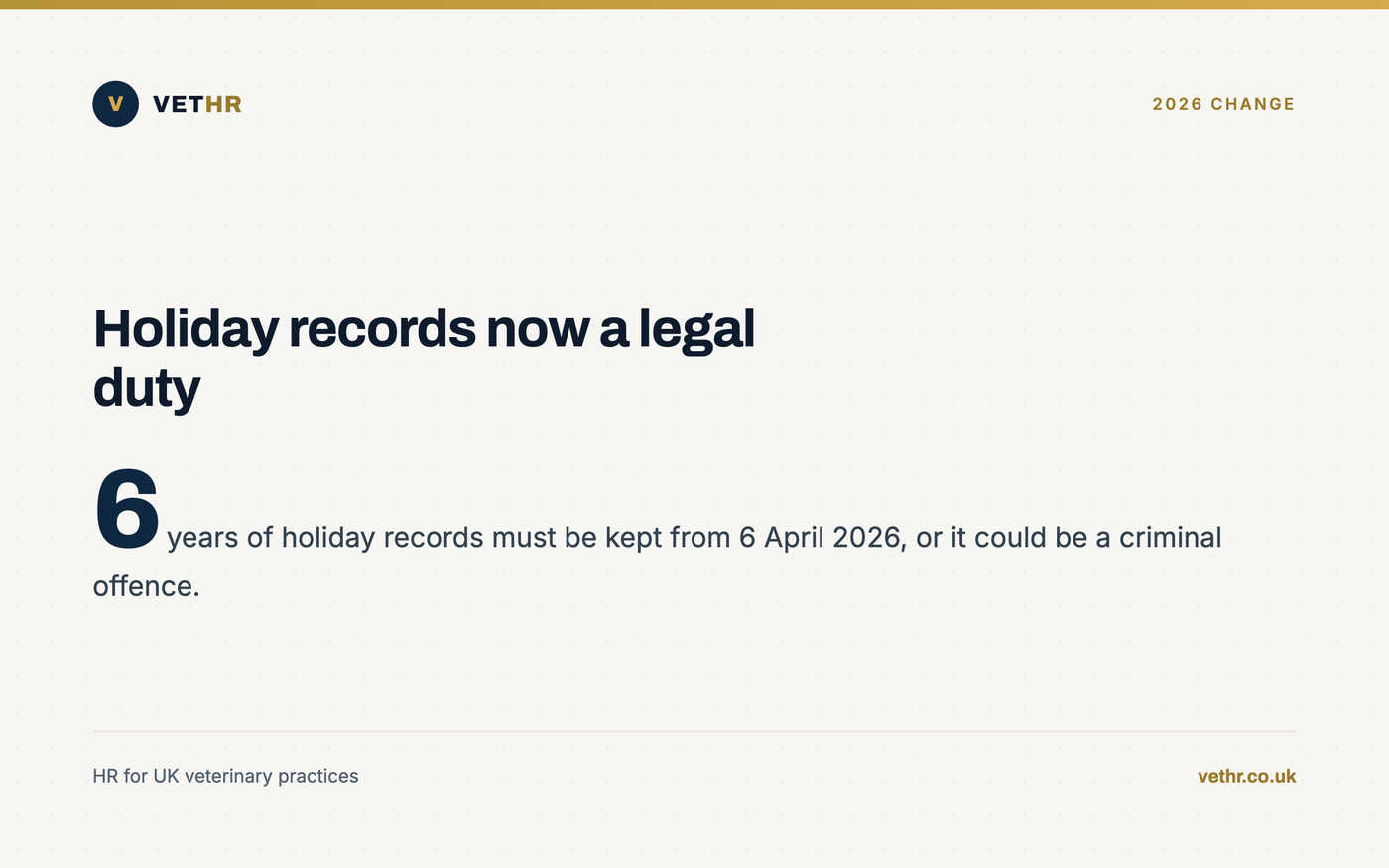
One policy can cover annual leave, maternity, paternity, parental and other statutory leave, plus how holiday is requested and approved around the rota. This is also where 2026’s biggest change bites. As ACAS confirms, from 6 April 2026 employers must keep holiday records, kept “for at least 6 years”, and warns that if an employer cannot prove they have holiday records “it could be a criminal offence”. Accurate holiday calculations are now a compliance task, not just admin.
UK law does not require a full handbook, but it does require several of the policies that would sit inside one. A handbook is simply the tidiest way to hold those policies together, communicate them, and prove staff have read them. For a busy practice, one source of truth beats a drawer of loose documents nobody can find when a dispute starts.
There is a contract point here too. GOV.UK confirms employees and workers must receive a written statement of employment particulars, with the principal statement given “on the first day of employment” and the wider statement “within 2 months of the start of employment”. Disciplinary and grievance procedures are part of that wider statement, so your handbook and your contracts need to point at the same policies and agree with each other.
An independent veterinary practice came to us with a contract template downloaded years ago and no written policies behind it. We mapped the gaps, built a handbook around the nine core policies, and aligned every contract to it. The disciplinary process they had been dreading became a checklist, not a crisis.
Most independent practices land on between nine and twelve written policies. The nine above are the working core. Depending on your size and setup you may add an equality and inclusion policy, a flexible working policy, a whistleblowing policy, and a controlled drugs and clinical governance procedure that sits alongside your HR set. More is not automatically better. Each policy should earn its place.
The test is simple. A policy is worth writing when it answers a question your team or your managers actually face, when it keeps you on the right side of the law, and when you will genuinely follow it. A document you ignore is worse than no document, because a tribunal will ask why you did not follow your own process. Keep them lean, current and practice-specific.
If writing or refreshing all of this feels like a job you never get to, that is exactly the work we take off your desk. Our veterinary policy templates and management give you a complete, practice-ready set, and our HR consultancy for vets keeps them current as the law changes. Book a free 30-minute HR health check and we will tell you which policies you are missing.
Use this list to audit your veterinary practice HR policies in one sitting. Tick what you already have in writing, dated within the last twelve months and actually followed. Anything unticked is a gap worth closing before it costs you.
A written health and safety policy is legally required once you employ five or more people, per HSE guidance. You must also have disciplinary and grievance procedures that follow the ACAS Code, and you must handle personal data lawfully under UK GDPR. Other policies are strongly advised but not strictly mandatory.
No single law forces you to have a handbook, but several of the policies inside it are required, and your contracts must reference your disciplinary and grievance procedures. A handbook is the simplest way to keep every required policy in one place, communicate it to staff and prove they have read it.
From 6 April 2026, ACAS confirms employers must keep holiday records and retain them for at least six years. If an employer cannot prove they hold those records, ACAS warns it could be a criminal offence. Practices should make sure their leave policy and holiday calculations capture and store this information.
Review your full policy set at least once a year, and sooner when the law changes or your practice restructures. Employment law moves quickly, and a policy that is out of date can be as damaging as having none, because a tribunal expects you to follow your own current procedures.
GOV.UK states that the principal written statement of employment particulars must be given on the first day of employment, with the wider statement provided within two months. Issuing terms late, or not at all, is a common and easily avoided compliance gap in busy practices.
Strong veterinary practice HR policies are not box-ticking. They are how you protect your team, keep your registration and reputation safe, and handle the hard days without losing sleep. Start with the nine core policies, hold them in a handbook, and put a review date on every one.
If you would rather not build it all from scratch, we work only with UK veterinary practices and do exactly this every day. Explore our veterinary policy library, see how ongoing HR consultancy for vets keeps you compliant, and book your free HR health check today. Thirty minutes now can save you a very expensive year.
The Vet HR Team provides HR consultancy and white-labelled staff systems exclusively to UK veterinary practices. We are HR and documentation specialists, not a law firm.
Contracts, rotas, holiday, a difficult conversation. Tell us what you are dealing with and we will come back within one working day. Nothing to sign up to.
Got it. We will come back to you within one working day. If you do not see a reply, please check your spam folder.
