Last updated: 14 June 2026
TL;DR: We built HR for veterinary practices because generic HR firms did not understand clinical teams and veterinary software ignored people. Our first practice, an independent veterinary practice, taught us five lessons: contracts must be issued on day one, rotas and holiday must share one source of truth, retention is built before anyone resigns, incidents need a route, and plain advice beats jargon. Each one now shapes how we work.
Vet HR did not start with a business plan. It started inside one practice, on the floor, with a rota that would not balance and a folder of contracts that nobody had signed. This is the honest version of how we began, and the five lessons that shaped everything we do now.
We built HR for veterinary practices because nothing on the market fit a real clinical team. Generic HR firms knew employment law but not consults, freelance vet cover or out of hours. Veterinary software handled patients beautifully and people barely at all. The practice in the middle was left to bridge that gap alone, usually late on a Friday.
The founder did not arrive with a theory. He arrived to build staff systems for a working UK practice and quickly saw the same pattern everywhere: rotas in one place, contracts in another, holiday worked out by hand, and a practice manager holding it all together by memory. The tools existed. They simply did not speak the language of a veterinary team.
That gap is not small. The administrative load on practice managers, who often run HR with little formal training, is one of the quieter pressures in the sector. When the people side of a practice runs on spreadsheets and goodwill, something eventually slips, and it is rarely the part you can afford to lose.
So we made a decision that still defines us. We picked one industry and stayed. Not HR for everyone, but HR for veterinary practices specifically, the kind that understands an RVN shortage, a single-vet branch and a Saturday clinic. Everything below came from that first practice, and from getting things wrong before we got them right.
Lesson one: issue the contract on day one, every time. Our first practice had brilliant people working without a current written statement of terms, not from neglect but from being busy. That is a legal exposure and a trust problem at once. The fix is not complicated, but it has to be a habit, not a scramble when someone hands in their notice.
The law here is unambiguous. ACAS confirms that employers must give a written statement of employment particulars “on or before the first day of work”, and that this right now covers workers as well as employees who started on or after 6 April 2020 (ACAS, Employment contracts and the law). Day one means day one, not day thirty.
For a veterinary team this matters more than in many sectors, because the working pattern is genuinely complicated. Out of hours commitments, on-call expectations, freelance vet cover and variable shifts all need to be written down clearly. A vague contract is the seed of nearly every dispute we are later asked to untangle.
What we built from this lesson was a contract process, not just a template. New starter, correct terms, issued before the first shift, stored where the practice manager can find it in seconds. If you want a second pair of eyes on what your team is actually signed onto, our work on veterinary employment contracts starts exactly there.
Lesson two: a rota and a holiday calculation that disagree will always cost you. In our first practice, contracted hours lived in one document, the rota in another, and leave in a third. Keeping them aligned ate hours every week and still produced errors. When holiday is worked out separately from the hours actually rostered, mistakes are not a risk, they are a certainty.
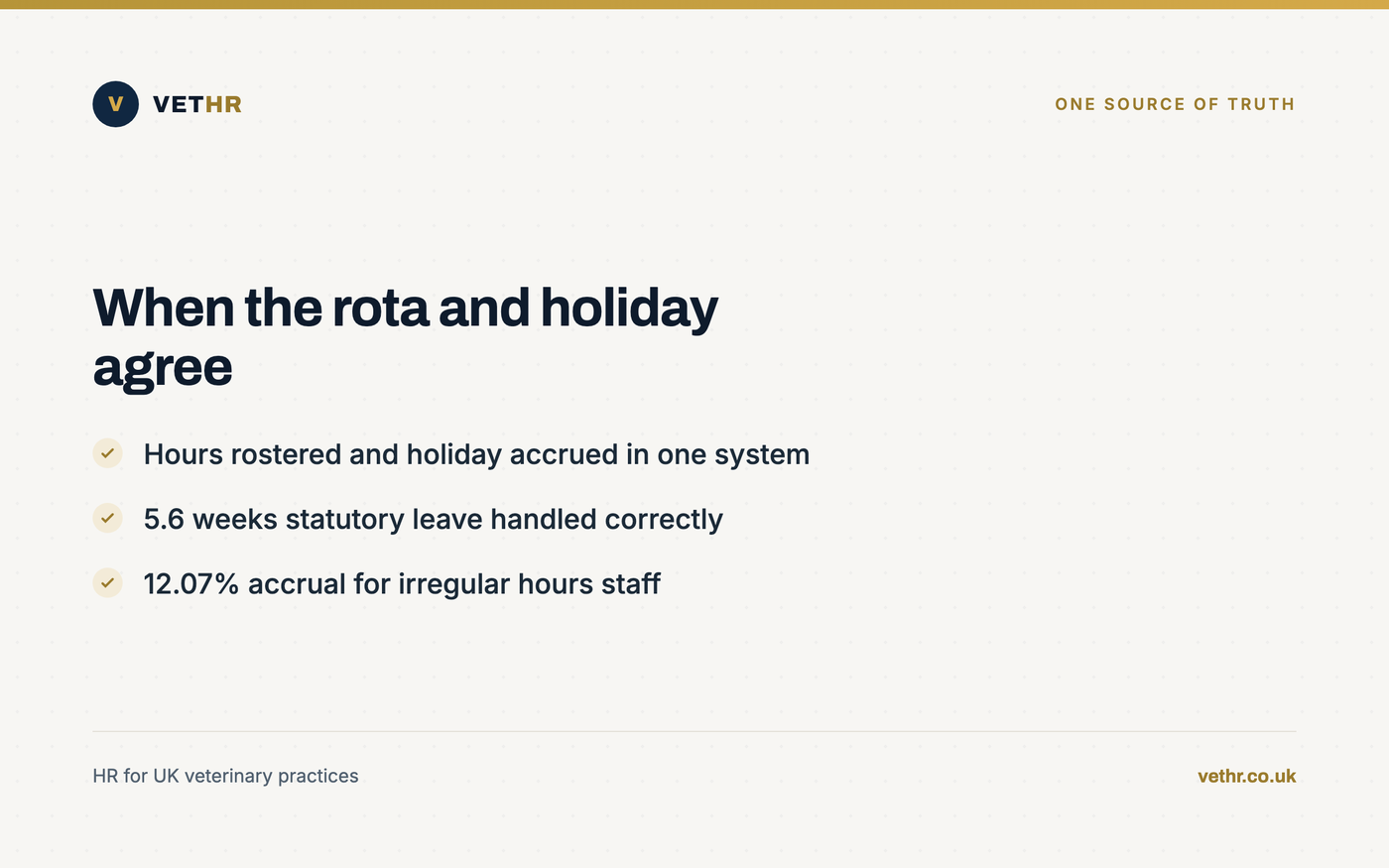
Holiday is where the maths bites hardest. Almost all workers are legally entitled to 5.6 weeks of paid holiday a year, which is 28 days for someone on a five day week (GOV.UK, Holiday entitlement). For a stable full-timer that is straightforward. For variable shifts and bank staff, it is not.
For leave years starting on or after 1 April 2024, irregular hours and part-year workers build up holiday “at 12.07% of the hours they work in a pay period”, according to ACAS (ACAS, Holiday entitlement for irregular hours and part-year workers). Get that percentage wrong across a year of bank shifts and you have either underpaid your team or quietly overspent. Neither is a position any practice wants to defend.
So we stopped treating these as separate jobs. The hours someone is rostered should be the hours their holiday accrues against, in one connected system. That principle runs through our rota system and our holiday calculations, because a practice manager should be running the floor, not reconciling three spreadsheets.
Lesson three: retention is built quietly, long before anyone hands in a resignation. Our first practice did not have a turnover crisis, but it did have the same near-miss every practice has, a valued person who was tired, overstretched and one bad month from looking elsewhere. By the time someone resigns, the conversation that might have kept them has usually been missed.
The wider picture explains the pressure. In the RCVS Survey of the Professions 2024, 91% of vets described their work as stressful, and full-time vets reported working an average of five hours above their contracted hours each week (Agilio, summarising the RCVS Survey of the Professions 2024). A team running that hot does not need a fruit bowl. It needs hours that hold.
Crucially, pay is rarely the top reason people leave a practice. Work-life balance, chronic stress and feeling undervalued consistently rank higher. That is good news for an independent practice that cannot outbid a corporate group, because the things that retain people are mostly within your control: predictable rotas, honest one to ones, and being heard when something is wrong.
What we took from this is simple. Look after the basics relentlessly and the headline numbers follow, because practices that feel looked after keep their people. If you want to see how that plays out for the teams we support, our customer stories show the pattern in practice rather than in theory.
Lesson four: if there is no easy way to report a problem, the problem does not disappear, it just stops reaching you. In our first practice, near-misses and concerns were raised in passing, in the corridor, then forgotten. A drug error, a difficult client, a safety worry, all the things you most want to know about were the things least likely to be written down.
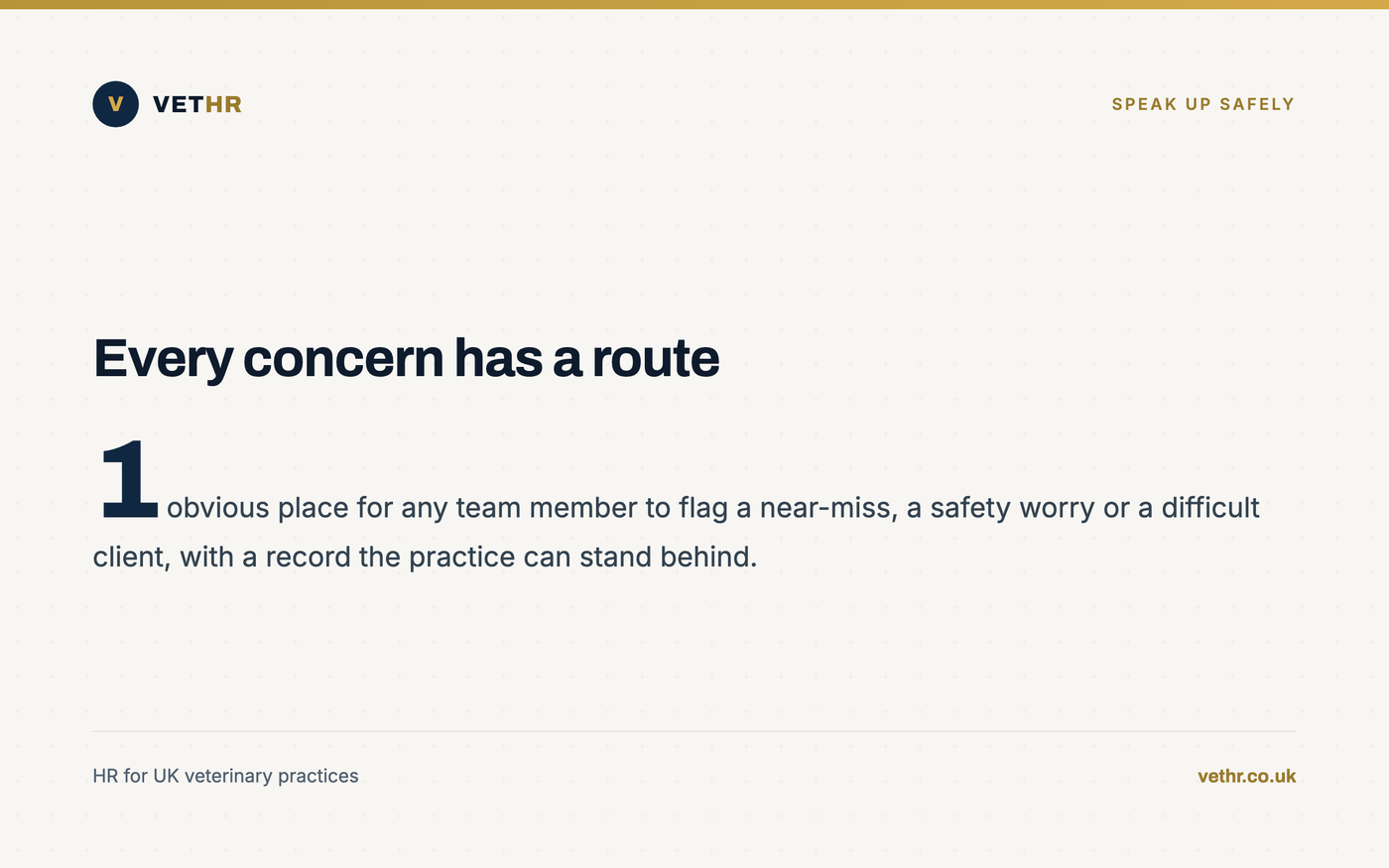
An incident route does two jobs at once. It gives you a record, which matters for clinical governance and for any later question about what happened and when. Just as importantly, it tells the team that raising something is normal and welcome, not a complaint that lands on the wrong desk. Silence is not safety, it is just the absence of information.
The cultural effect is the real prize. When reporting is easy and acted on, people report. When it is awkward or ignored, they stop, and small issues grow into the formal grievances and disciplinary cases that consume a practice manager’s week. A light, consistent process is far cheaper than the mess it prevents.
This is why we built a simple reporting tool rather than another policy nobody reads. Our See It Report It system gives every team member one obvious place to flag a concern, and gives the practice a record it can stand behind. It came directly from watching good information evaporate in a corridor.
Lesson five, and maybe the most important: good HR support for vets sounds like a plain answer to a real question, not a lecture. Our first practice did not need a manual on employment law. They needed someone to say, in clear English, “here is what the rule is, here is what I would do, and here is the wording to use.” Confidence comes from clarity, not from being impressed.
That sets a boundary we hold firmly. Vet HR is HR consultancy and documentation support, not a law firm. We help you build sound contracts, policies and processes, and we point to the current GOV.UK and ACAS guidance behind them, but we are honest about where formal legal advice is the right call. Knowing that line is part of giving safe advice.
It also shapes how we are built as a company. One specialist, one industry, one number to call, available twelve hours a day, every day of the year, because that is when practice problems actually happen. A panic on a bank holiday is not a ticket in a queue. It is a practice manager who needs a calm answer now.
That is the whole story, really. We built HR for veterinary practices by sitting inside one, learning what genuinely helped, and refusing to bolt on anything that did not. Five lessons, one practice, and a standard we still measure ourselves against every day. You can read more about how we think on our about page.
If any of these five lessons sound like your practice, that is normal, and it is fixable. The fastest way to find out where you stand is a free 30-minute HR health check. We will look at your contracts, rotas, holiday and reporting, tell you plainly what is solid and what is exposed, and you are under no obligation to do anything more. Book your free HR health check.
Because a veterinary team is not a generic workplace. Out of hours, on-call, freelance vet cover, RVN shortages and variable shifts create contract and rota questions a general HR firm rarely meets. Specialist HR for veterinary practices means advice that already understands the clinical pattern, so you spend less time explaining your own working week.
On or before their first day. ACAS states that a written statement of employment particulars must be provided “on or before the first day of work”, and this applies to most workers as well as employees (ACAS). In practice, the safest habit is to issue the contract before the first shift, not after probation.
Almost all workers are entitled to 5.6 weeks of paid holiday a year, which is 28 days for a five day week (GOV.UK). For irregular hours and part-year staff, holiday for leave years from 1 April 2024 builds up at 12.07% of hours worked in a pay period, per ACAS guidance.
No. Vet HR provides HR consultancy and documentation support, not legal services. We build sound contracts, policies and processes for veterinary practices and point to current GOV.UK and ACAS guidance, and we will tell you clearly when a matter needs a qualified solicitor.
Faster than most owners expect. A free 30-minute HR health check usually shows the priorities within the first call, and from there practices choose a fixed-price project or a monthly subscription. The systems for rota, holiday and reporting can be set up without disrupting day-to-day clinical work.
Vet HR exists because one independent veterinary practice showed us, lesson by lesson, what real support looks like: contracts on day one, rotas and holiday in step, retention built before resignations, a clear route for incidents, and plain answers over jargon. None of it is glamorous. All of it keeps a practice steady.
If you would like the same standard applied to your team, start with a free HR health check, learn more about us, or see the practices we already work with. One specialist, one industry, one number to call.
The Vet HR Team provides HR consultancy, documentation support and white-labelled staff systems exclusively to UK veterinary practices.
Read next: The Practice Manager's Monday.
Contracts, rotas, holiday, a difficult conversation. Tell us what you are dealing with and we will come back within one working day. Nothing to sign up to.
Got it. We will come back to you within one working day. If you do not see a reply, please check your spam folder.
