Last updated: 6 July 2026
TL;DR: Hiring a veterinary practice manager works when three things are right: the timing, the scope of the role and the contract behind it. This guide covers the signals that your practice is ready, what the role should and should not own, the contract essentials, a handover with a proper probation, how the owner learns to let go, and the systems that make the job doable.

The first practice manager is the most consequential non-clinical hire an independent practice makes. Done well, it hands the owner back their clinical time. Done badly, it creates an expensive job title with no real authority. This is a practical look at getting the role, the paperwork and the first three months right.
A practice is usually ready for its first practice manager when the owner spends more time running the business than practising medicine, and the admin no longer fits around consults. The telltale signals are a rota built late at night, HR questions that wait days for an answer, and compliance tasks that only happen when something prompts them.
Team size matters less than where the owner’s hours go. A single-site practice with a stable, experienced team can run longer without a manager than a smaller practice that is growing, recruiting or opening a second branch. The honest test is a fortnight of noting what you actually do each day. If a large share of it is rotas, holiday queries, supplier chasing and staff admin, the role already exists. You are simply doing it unpaid, in the evenings, instead of someone doing it properly.
There are also wrong reasons to hire. A practice manager will not fix a culture problem the owner created, and they cannot manage a team the owner keeps managing over their head. If the real issue is an underperformer nobody has addressed, or a policy vacuum, deal with that first. A new manager inheriting an unresolved mess starts the job with the hardest conversations and none of the trust.
A first practice manager should own the operational running of the practice: the rota, HR administration, recruitment logistics, supplier relationships, the compliance calendar, the complaints process and the building. They should not own clinical decisions, clinical standards or the strategic choices that belong to the owner, such as pricing, partnerships or selling. Scope creep in either direction is where the role fails.
Write the boundary down before you advertise. A practice manager job description that says “responsible for the smooth running of the practice” is not a role, it is a wish. Specific is kinder: name the tasks, the decisions they can make alone, and the ones that need the owner. Ambiguity does not stay neutral. It resolves into either a manager who decides nothing, or one who decides things the owner never intended to hand over.
Note the difference from a head nurse role. A head RVN leads clinical standards and the nursing team. A practice manager runs the business machinery around them. Some practices combine the two in one person, and that can work in a small team, but combine the duties deliberately and pay for both, rather than letting one role silently swallow the other.

When hiring a veterinary practice manager, the contract must nail down the job title and duties, hours, pay, place of work, holiday, probation, notice and confidentiality, plus the limits of the manager’s authority. Employers must give the principal written statement of employment particulars on or before the first day of employment, as set out in GOV.UK guidance on written statements.
That principal statement must include, among other things, pay, hours and days, holiday entitlement, the job title, the place of work and any probation period details. A wider written statement covering pensions, collective agreements, non-compulsory training and the disciplinary and grievance procedures must follow within 2 months of the start date, per the same GOV.UK guidance. For a management hire, treat these as the floor, not the finish line.
Two clauses deserve particular care in this role. First, authority limits: state what the manager can spend and sign off without the owner, so neither side discovers the boundary in a dispute. Second, confidentiality: this person will see pay, health information and disciplinary records for the whole team, so the contract should say so explicitly. A generic template rarely covers either well, which is why our veterinary employment contracts service drafts management terms around how your practice actually runs.
Before any of it takes effect, do the basics. You must check the person’s right to work in the UK before you employ them, and keep copies of the check during their employment and for 2 years after they leave, according to GOV.UK guidance on right to work checks. It takes minutes at offer stage and is miserable to fix afterwards.
Thinking about the hire but not sure the practice is ready, or what the contract should say? Book a free HR health check. In 30 minutes we will look at where your time goes, what the role should cover in your practice and what needs to be in writing before day one. Straight answers, nothing sold for the sake of it.
Run the handover as a planned transfer of knowledge, not a fortnight of shadowing. Before the start date, write down everything that currently lives only in the owner’s head: supplier contacts, renewal dates, passwords, the quirks of the building and the history behind sensitive staffing situations. Then hand it over in stages, with a weekly review through probation.
A simple three-stage structure works. In the first month the manager learns the practice: people, systems, suppliers and the rhythm of the week. In the second they run the routine work, rota and holiday admin included, with the owner reviewing decisions after the fact rather than making them. In the third they own the operational day entirely, and the review meetings shift from checking work to discussing priorities.
Probation is where you protect both sides. There is no legal requirement to have a probation period and it can be any length, as Acas explains in its guidance on probation periods, but for a management role a longer period with scheduled reviews is usually sensible. Put the length, the review points and the notice that applies during probation in the contract, hold the reviews on time and write down what was said. A fair, documented process is what makes the outcome defensible, whichever way it goes.
The owner lets go by moving decisions, not just tasks. Delegation fails when the manager does the work but every choice still routes through the owner, because the team learns quickly that the manager is a messenger. Agree the decisions the manager makes alone, in writing, and then honour it, especially the first time you disagree with one.
The hardest habit to break is being the shadow manager. When a nurse walks past the practice manager to ask the owner about a day off, the answer has to be “ask your manager”, every time, even when it would be quicker to just say yes. Every exception rebuilds the old wiring. Expect a clumsy patch while the new routes bed in, and judge the hire at three months, not three weeks.
Letting go is also easier when the manager is not improvising. Clear policies, a documented way of handling absence, grievances and performance, and an owner who backs the process rather than overriding it. If those foundations are missing, that is consultancy work worth doing before or alongside the hire, and it is exactly what our HR consultancy for veterinary practices covers.
The role is doable when the routine work runs on systems rather than spreadsheets: a rota tool the team can see, clock in and out records, automatic holiday balances, a proper incident reporting route and policies staff can actually find. Without them, your new manager becomes an expensive administrator, retyping data instead of managing people.
This matters most in the first months. A manager who inherits clean systems can see the state of the practice from day one: who is in, who is off, what has been reported and what the policy says. A manager who inherits a drawer of paper and five spreadsheets spends their probation reconstructing information instead of improving anything. If you are hiring soon, putting the systems in first is the cheapest way to make the hire succeed.
It is also what makes the role sustainable at independent-practice scale, where the manager is one person rather than a head-office department. Our staff systems for veterinary practices cover the rota, clock in and out, holiday calculations, See It Report It incident reporting and policies, white-labelled to your practice, so the manager runs the practice rather than the paperwork.
No, and some of the strongest practice managers come from other people-heavy, regulated sectors. What the role needs is organisation, calm judgement with people and comfort with systems and numbers. Veterinary context can be learned; the clinical side stays with the vets and the head RVN regardless. Hire for management ability first and sector familiarity second.
Both can work. Promoting internally keeps knowledge and trust but risks losing your best clinical leader to admin, and asks the team to accept a colleague as their manager. Hiring externally brings management experience but a slower start. Either way, define the role and contract first, then choose the person, not the other way round.
The law does not set one. There is no legal requirement to have a probation period at all and it can be any length, per Acas guidance. For a management hire, a longer probation with scheduled, documented reviews is common sense: the role takes months to show its shape. Whatever you choose, state the length, the reviews and the notice during probation in the contract.
Day-to-day HR administration, yes: absence, holiday, records, onboarding and routine people questions. The riskier moments, such as dismissals, contract changes, grievances and anything that could end in a claim, deserve proper advice behind the manager rather than improvisation. A manager plus expert backup is a stronger and cheaper combination than expecting one person to be an HR department.
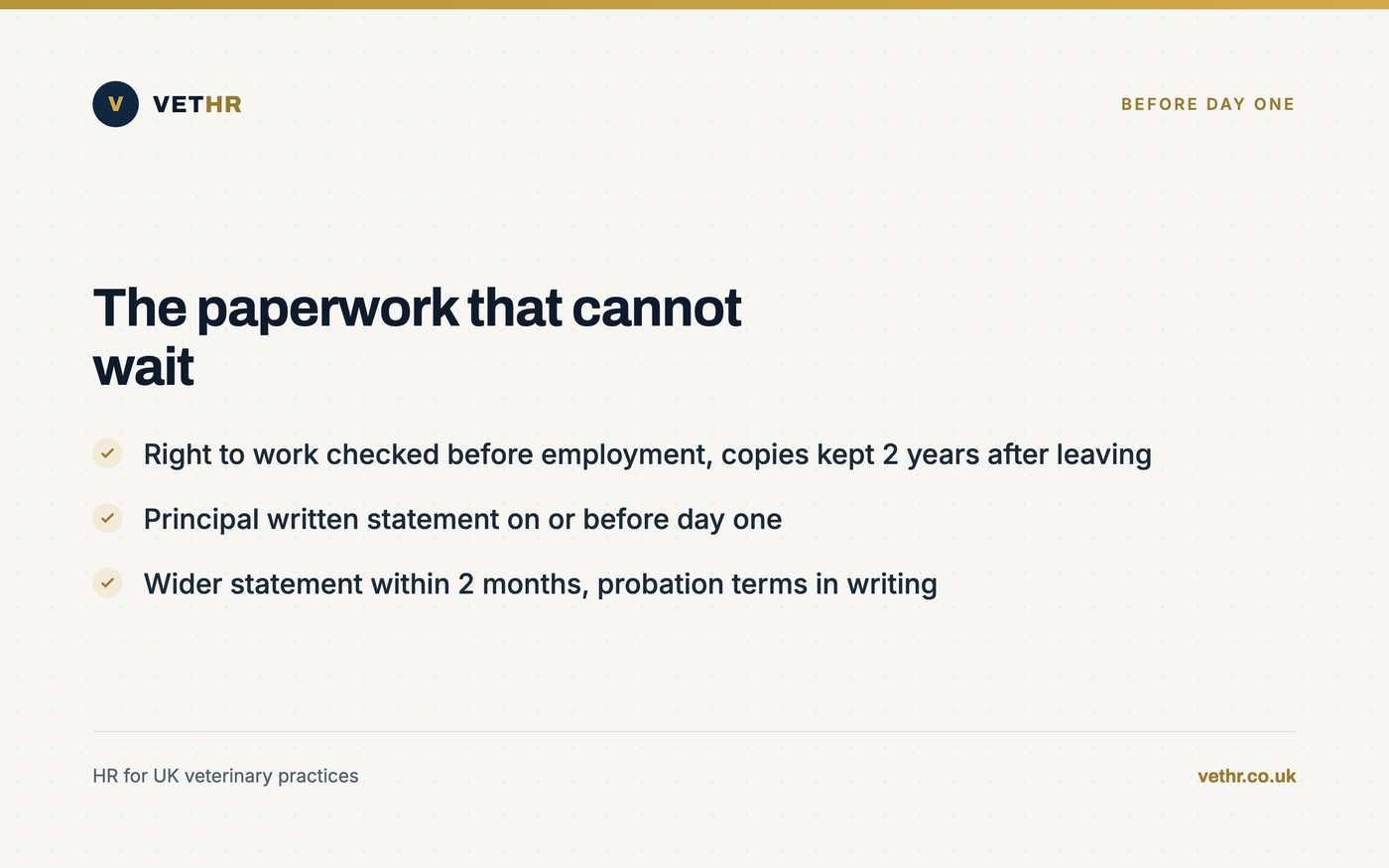
Two things are non-negotiable. The right to work check must be done before employment starts, with copies kept during employment and for 2 years after they leave, per GOV.UK. The principal written statement of employment particulars must be given on or before the first day, with the wider statement within 2 months. Have the full contract signed before day one and both are covered.
Hiring a veterinary practice manager is not really a recruitment problem. It is a definition problem. Practices that write down the role, put the authority and the probation in the contract, plan the handover and then genuinely move the decisions across tend to keep the person and get the owner’s clinical time back. Practices that hire a title and keep deciding everything themselves pay a salary for the privilege of staying overloaded.
If the hire is on your horizon, get the foundations right first: a contract drafted for a management role through our contracts service, and staff systems the new manager can run from day one. Or start simpler and book a free HR health check, and we will tell you honestly whether your practice is ready and what to put in place before you advertise.
The Vet HR Team provides HR consultancy and white-labelled staff systems exclusively to UK veterinary practices.
Related reading: HR for new veterinary practices
Read next: VetGDP: What Your Practice Must Have in Place Before Hiring a New Graduate.
Contracts, rotas, holiday, a difficult conversation. Tell us what you are dealing with and we will come back within one working day. Nothing to sign up to.
Got it. We will come back to you within one working day. If you do not see a reply, please check your spam folder.
