Last updated: 6 July 2026
TL;DR: A veterinary practice HR calendar spreads the year’s fixed HR work across twelve months so nothing lands late. Statutory rates change every April, RCVS CPD runs on the calendar year, policies need an annual review, appraisals need windows away from your busiest months, and the holiday year needs a clean reset. This guide sets out what belongs in each quarter and how to keep the rhythm going without it depending on anyone’s memory.

Most HR problems in a practice are not surprises. Rate changes, expiring training records and overdue appraisals all arrive on dates you could have written down a year earlier. This guide turns those dates into a working calendar you can actually run.
A veterinary practice HR calendar is a twelve-month plan that fixes dates for the HR work every practice must do anyway: pay reviews, policy refreshes, appraisal windows, contract checks, training renewals, the holiday-year reset and the statutory rate changes that land each April. It turns recurring obligations into scheduled, quiet jobs instead of urgent scrambles.
The reason it earns its own document is that the deadlines come from different clocks. Government rates move on 1 April. RCVS CPD runs January to December. Your leave year runs on whatever date your contracts say. Individual anniversaries, probation ends and certificate expiries scatter across the year. Nobody holds all of that reliably in their head while also running consults.
The calendar does not need software to start. A single page with four quarters, each holding three or four named tasks with an owner and a month, beats a perfect system that never gets built. The test is simple: could a new practice manager pick it up in January and know what the year requires? If yes, you have an HR annual planner. If not, you have a to-do list wearing a costume.
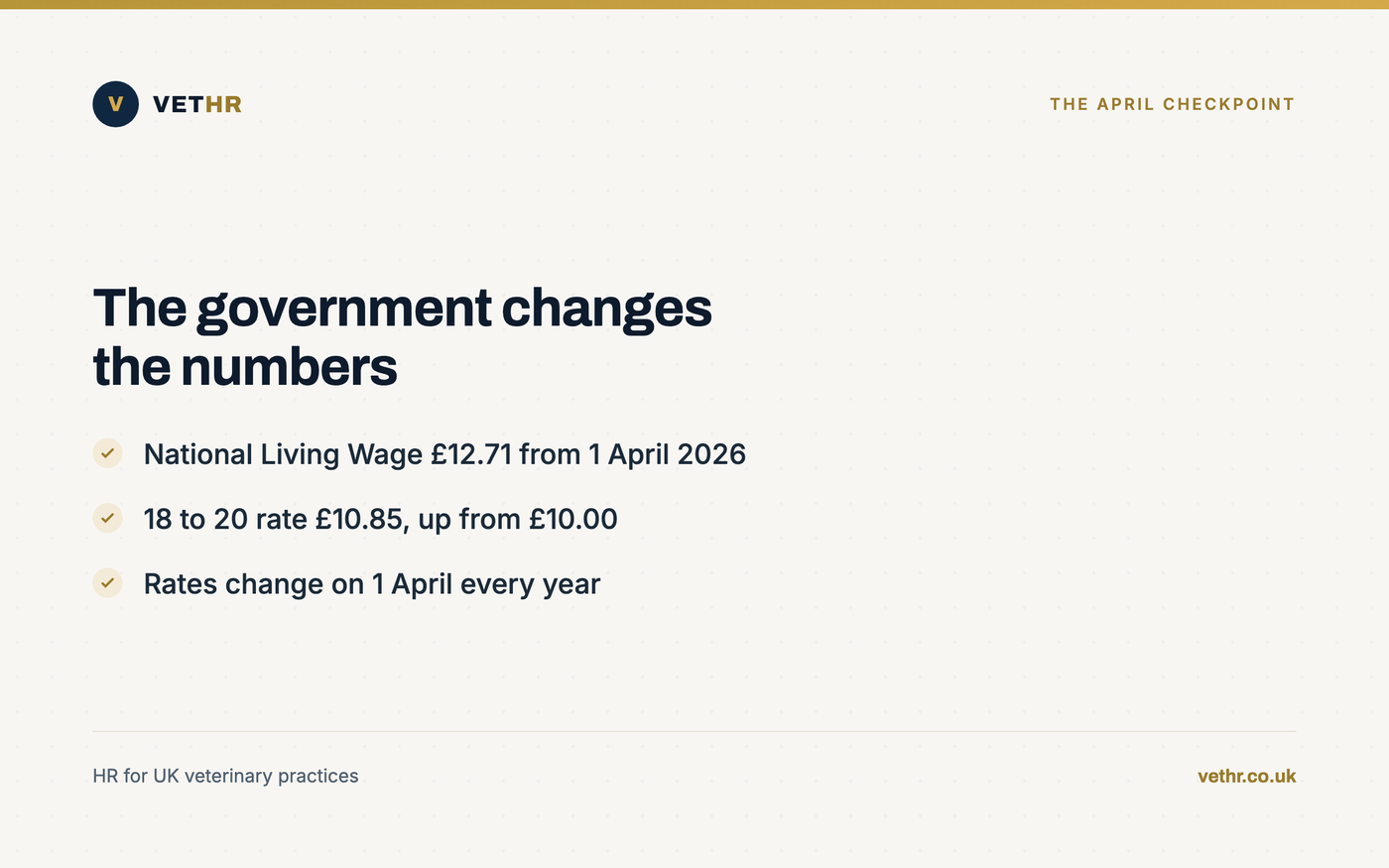
April matters most because it is when the government changes the numbers. National Minimum Wage and National Living Wage rates rise on 1 April every year, other statutory payments such as sick pay usually rise around the same time, and many practices run their pay review and their leave year from the same date. Miss April and you can be underpaying by law within a week.
The current figures show why this needs a diary entry rather than goodwill. From 1 April 2026 the National Living Wage for workers aged 21 and over is £12.71 an hour, up from £12.21, and the rate for 18 to 20 year olds is £10.85, up from £10.00, according to the GOV.UK page on National Minimum Wage rates. The same page confirms the rates change on 1 April every year, so the diary entry repeats annually.
For a practice, the April job is wider than the headline rate. Check every wage against the new floors, including apprentices, students on placement pay and younger reception staff, because the age bands move by different amounts. Update payroll before the first April run, not after it. Then confirm any pay changes in writing, because a rate change is a contractual change and the paperwork should say so.
April is also the natural month to sanity-check anything priced off those rates: out-of-hours supplements, bank staff rates and what you pay for freelance vet cover relative to your employed team. None of that is statutory, but all of it drifts out of shape if it is only ever reviewed when someone complains.
Schedule appraisals in one or two fixed windows a year, placed away from your busiest clinical months, and put the dates in the calendar before the year starts. A staff appraisal schedule that exists in January gets done. One that waits for a quiet week does not, because a busy practice never volunteers a quiet week.
Two windows work well for most independent practices: one early in the year, after the January rush has settled, and one in early autumn, before the run-in to Christmas. Splitting the team across two windows halves the load on whoever conducts them and means no one waits eleven months to raise something that mattered in month two.
Keep event-driven reviews out of the annual windows. Probation reviews belong at the dates set by each person’s start date, and a performance concern should be addressed when it arises, not parked until the next window. The calendar handles the routine so that the exceptions get proper attention when they happen.
Review every HR policy at least once a year, and sooner whenever the law or your practice changes. A policy review cycle works best as two scheduled batches: a spring pass after the April statutory changes settle, and an autumn pass that catches everything else before the new year. Ad hoc reviews then become rare instead of constant.
The spring batch exists because a rate change often touches more documents than people expect. Pay-related policies, overtime and on-call arrangements, and any handbook page that quotes a figure all need checking against the new numbers. The autumn batch is the wider sweep: disciplinary and grievance, absence, flexible working, social media, and whatever this year’s working patterns have quietly made inaccurate.
Contracts deserve one scheduled audit a year. Check that every member of staff has a signed, current contract, that job titles and hours match reality, and that anyone whose role changed mid-year has the change recorded in writing. Our veterinary contracts service exists precisely because this audit keeps finding contracts that describe a job someone stopped doing two years ago. If your policies live in a drawer rather than a system, our policies system keeps the current version, the review date and the acknowledgement record in one place.
If you are not sure where your practice’s year has gaps, a 30-minute conversation will usually find them. Book a free HR health check and we will walk through your reviews, policies, contracts and renewal dates, and tell you plainly which ones need a date in the diary first. No jargon and nothing sold for the sake of it.
CPD fits the calendar as three checkpoints: a plan in January, a progress check in midsummer and a completion check in late autumn. The RCVS requires veterinary surgeons to complete 35 hours of CPD a year and veterinary nurses 15 hours, recorded with reflection, as set out in the RCVS guidance on continuing professional development.
The detail that catches practices out is that hours cannot be carried over from one year to the next, per the same RCVS guidance. A vet who reaches November with 30 hours still to log is not going to do them well, and the practice ends up funding a December scramble of whatever courses still have places. A July progress check costs ten minutes per person and removes the scramble entirely.
Non-clinical training runs on its own anniversaries rather than the calendar year. First aid certificates, fire marshal training and similar workplace requirements each expire on the date they were issued, so the calendar job is to hold a renewals list with expiry dates and check it quarterly. The person who booked the course three years ago has usually forgotten it expires; the list has not.
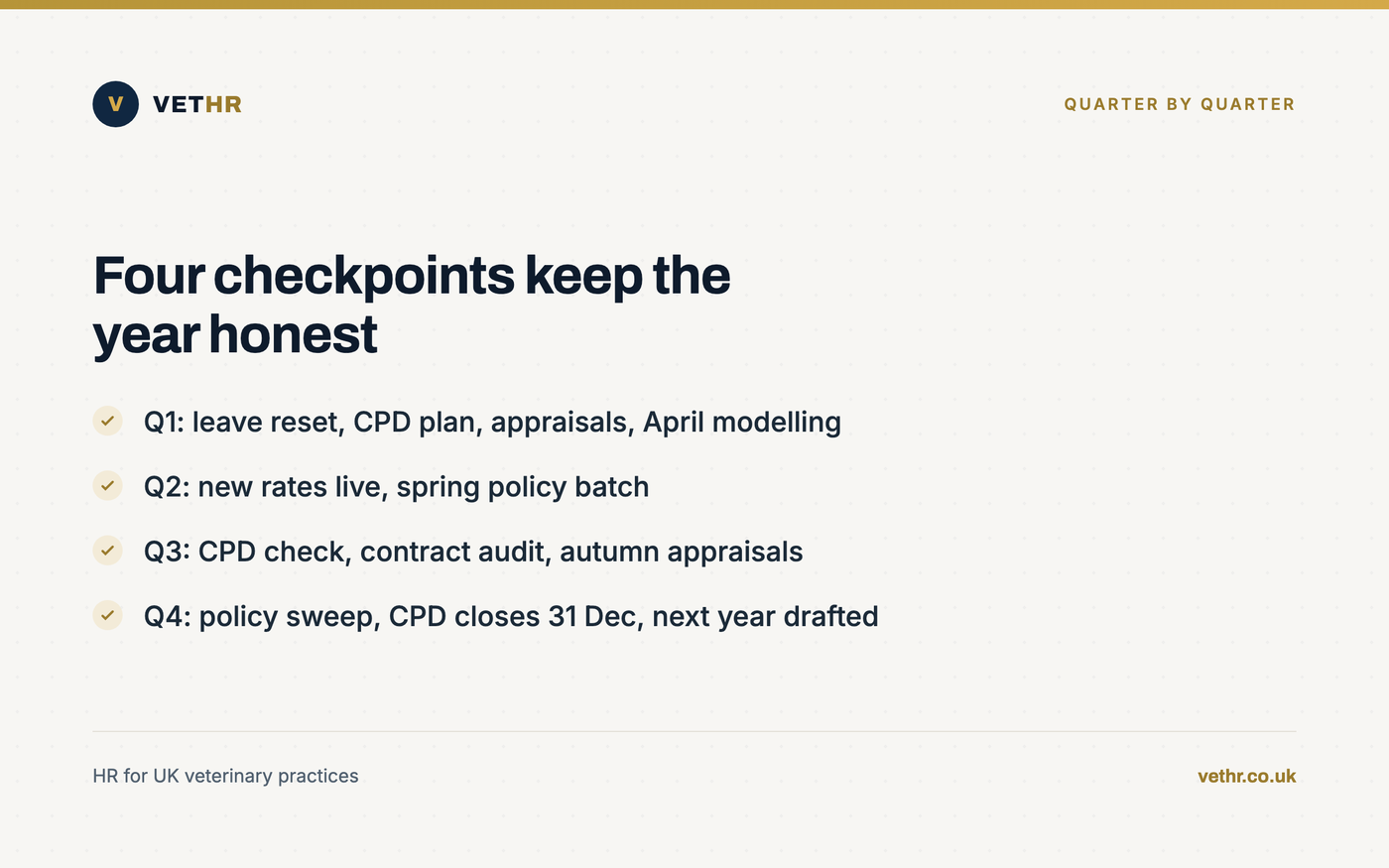
A workable calendar puts three to five named jobs in each quarter, each with an owner and a month. The exact months flex around your leave year and your seasonal peaks, but the shape below fits most independent practices and keeps every fixed deadline ahead of you rather than behind you.
Two habits keep the rhythm honest. First, every task has one named owner, because a job owned by “the practice” is owned by nobody. Second, the December drafting session is itself a calendar entry, so the system renews itself instead of relying on someone remembering to remember.
National Minimum Wage and National Living Wage rates change on 1 April every year, according to GOV.UK. From 1 April 2026 the National Living Wage for workers aged 21 and over is £12.71 an hour. Other statutory payments, such as sick pay and family-related pay, usually rise around the same time, so treat early April as a fixed payroll checkpoint.
At least once a year, plus whenever the law or the practice changes. Two scheduled batches work well: a spring pass after the April statutory changes, covering anything that quotes a figure, and an autumn sweep of the wider handbook. Record the review date on each policy so you can show when it was last checked.
In one or two fixed windows placed away from your busiest clinical months, booked before the year starts. Many practices use late winter and early autumn. Splitting the team across two windows spreads the load and shortens the wait between conversations. Probation and performance reviews stay event-driven and sit outside the windows.
Yes. The RCVS requirement is 35 hours a year for veterinary surgeons and 15 hours for veterinary nurses, recorded with reflection, and hours cannot be carried over into the next year. That is why a midsummer progress check belongs in the practice calendar: it turns a December scramble into a routine top-up.
Confirm every balance, apply your carry-over rules consistently and encourage early booking for the new year. Statutory paid holiday is 5.6 weeks a year, capped at 28 days, according to GOV.UK guidance on holiday entitlement, and disputes usually trace back to balances nobody confirmed at the reset.
None of the work in this calendar is optional. The rates will change in April, the CPD year will close in December and the policies will age whether or not anyone schedules the review. The only choice is whether those jobs arrive on dates you picked or on dates that pick you.
If you want the documents behind the calendar kept current for you, our policies system handles versions, review dates and staff acknowledgements, and our HR consultancy can build the full annual rhythm around your practice rather than a template. Or start with the simplest step and book a free HR health check: 30 minutes, a straight look at your year, and a clear list of which dates need to go in the diary first.
The Vet HR Team provides HR consultancy and white-labelled staff systems exclusively to UK veterinary practices.
Contracts, rotas, holiday, a difficult conversation. Tell us what you are dealing with and we will come back within one working day. Nothing to sign up to.
Got it. We will come back to you within one working day. If you do not see a reply, please check your spam folder.
