Last updated: 6 July 2026
TL;DR: HR support for veterinary practices comes in two shapes. A one-time project fixes a defined problem, such as contracts or a staff handbook, for a fixed price agreed in writing. A monthly subscription gives ongoing advice, documents kept current and staff systems for a predictable cost. Projects suit defined, one-off jobs. Subscriptions suit practices where people questions arrive all year. This guide helps you choose honestly.
Most practice owners do not wake up wanting to buy HR. They wake up with a contract question, a leave dispute or a difficult conversation to run, and then have to decide what shape of help to buy. This is an honest comparison of the two options, written so you can self-select rather than be sold to.
HR support for veterinary practices covers employment contracts and written particulars, policies and handbooks, disciplinary and grievance handling, holiday and working time compliance, and the day-to-day systems staff use, such as rotas and leave. It is delivered in two shapes: a one-time fixed-price project with a defined end, or an ongoing monthly subscription.
The veterinary part matters. A practice team is not a flat office team. It mixes vets, RVNs, receptionists and freelance vet cover across out-of-hours rotas, Saturday consults and branch sites, usually with no in-house HR manager. In most practices the HR hat sits on the practice manager, on top of everything else they already carry.
The legal baseline is the same as for any employer. An employer must give a new employee or worker the principal statement of employment particulars on the first day of employment, and the wider written statement within two months, according to GOV.UK guidance on the written statement of employment particulars. Whichever shape of support you buy, it should start by getting that baseline right.
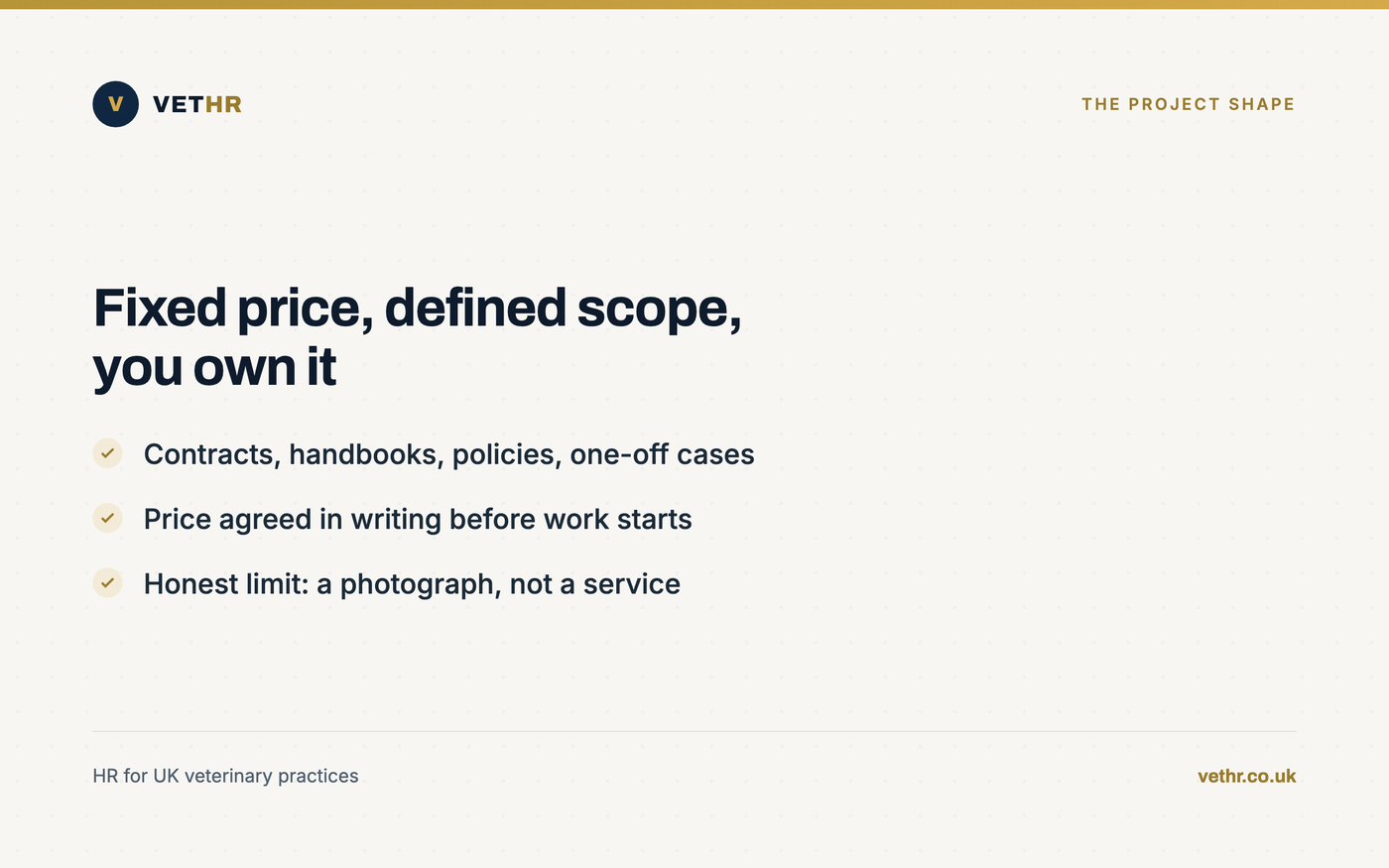
A one-time HR project is right when the job has a defined scope and a clear end state. Contracts brought up to standard, a staff handbook written, policies overhauled, or expert support through a single difficult process. You agree the scope, receive a fixed price in writing, the work is delivered and you own the result.
The classic examples in a practice are documents. A contract review is the most common, because the day-one duty above means every new starter tests whether your paperwork is actually ready. Handbooks and policy suites are close behind, along with one-off support through a restructure or a single disciplinary matter. This is the work our fixed-price HR consultancy handles, and our contracts service is the most requested project of all.
The strengths are certainty and ownership. The price is fixed and agreed in writing before any work starts, there is no rolling commitment, and at the end you hold documents written for your practice rather than a template with your logo on it. For a practice that simply needs its foundations fixed, that is the whole job.
The honest limit is that a project is a photograph. It is accurate on the day it is delivered, and then your team changes, the law moves and the documents start to drift. GOV.UK is specific on one part of that drift: employers must tell employees or workers about any change to the written statement within one month of making the change. A finished project does not notice the change for you, and it does not answer the phone six months later.
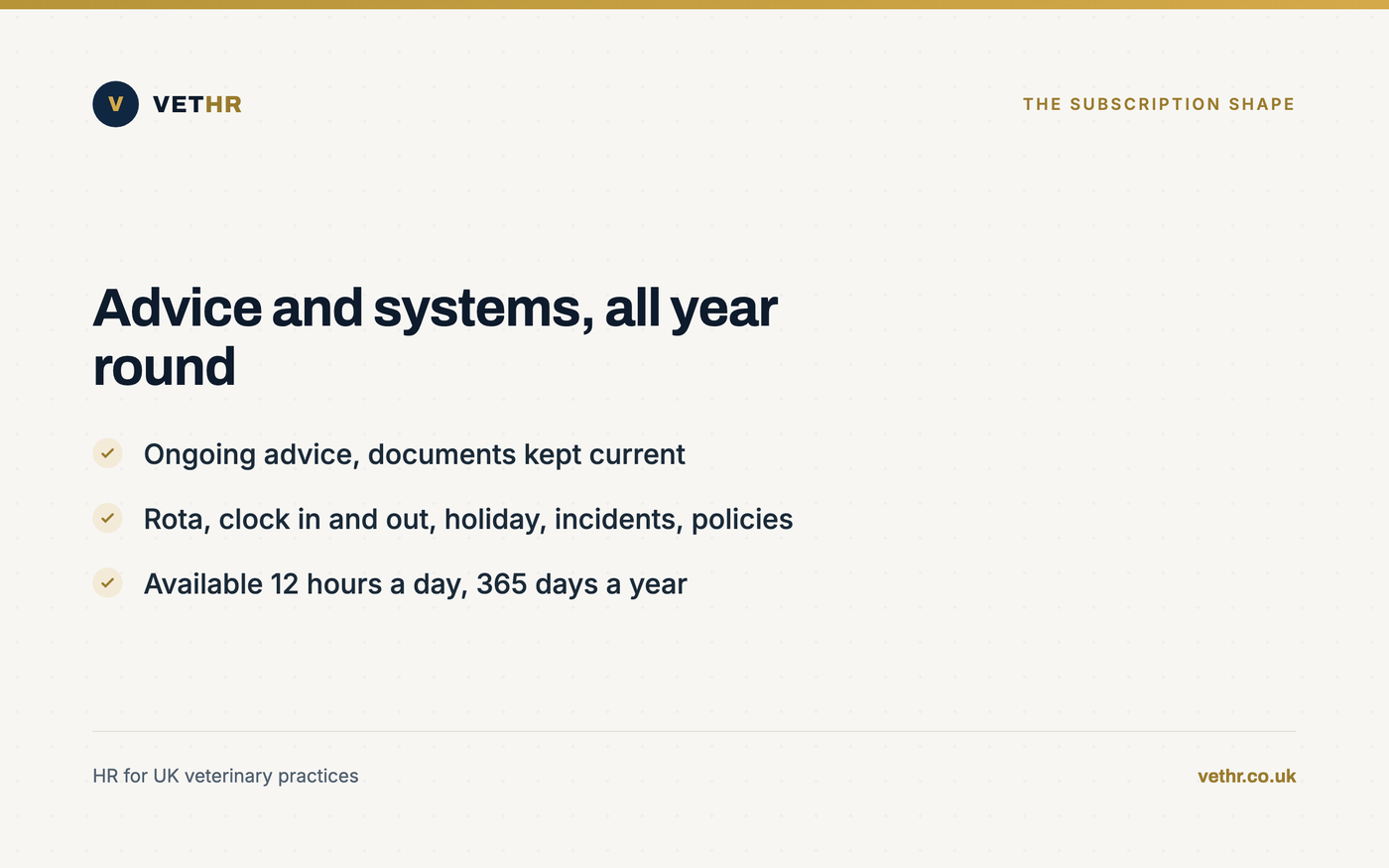
A monthly subscription makes more sense when people questions arrive all year rather than once. A growing team, regular hiring, recurring leave and rota questions, or nobody in-house with real HR time. You get ongoing advice, documents kept current as the rules move, and staff systems your team uses daily, for a predictable monthly cost.
Part of the case is that compliance is not a one-off event. Statutory paid holiday is 5.6 weeks a year, capped at 28 days, under GOV.UK guidance on holiday entitlement. That is simple for a full-time vet and much less simple for part-time nurses and variable hours, and every new starter, leaver and changed contract re-opens the maths. A subscription keeps the rules applied, not just written down somewhere.
The other part is the moment of need. When a disciplinary or grievance issue starts, the Acas Code of Practice is the minimum standard, and an employment tribunal can adjust awards by up to 25 percent where an employer unreasonably fails to comply with it, as set out in the Acas Code on disciplinary and grievance procedures. The Code is far easier to follow with advice from day one of an issue than after steps have already been missed. Ongoing support means that call happens at the start.
Our monthly subscription pairs that advice with white-labelled staff systems: rota, clock in and out, holiday calculations, See It Report It incident reporting and policies, all under your practice’s name. Support is available 12 hours a day, 7 days a week, 365 days a year, which matters in a sector where the difficult conversation rarely lands on a quiet Tuesday.
The honest limit runs the other way. If your team is small and stable, your paperwork is in good order and your last HR question was a year ago, a subscription can mean paying for quiet months. In that position, a well-scoped project is the better spend, and it would be dishonest to pretend otherwise.
A 30-minute conversation usually settles it. Book a free HR health check and we will look at your contracts, policies and the questions that actually reach your desk, then tell you plainly whether a project, a subscription or nothing at all is the right answer for your practice.
A project is a single fixed price for a defined scope, agreed in writing before work starts, paid once. A subscription is a recurring monthly cost per practice covering advice and systems. Vet HR quotes both per practice, in writing, because the right figure depends on team size and the state of the paperwork.
A useful way to think about it: a project is a one-off spend against a known deliverable, like equipping a new consult room. A subscription is a running cost, like your practice management software. Neither is cheaper in the abstract. The comparison only makes sense against how often you genuinely need help, which is why the five questions below matter more than any price list.
The other comparison worth making is against the cost of getting it wrong. A tribunal adjustment of up to 25 percent for ignoring the Acas Code, a contract dispute with no written particulars to point to, or simply the practice manager’s hours lost to redoing leave maths by hand. Both models exist to make those costs not happen. The question is only which shape of prevention fits your practice.
You can usually self-select with five questions. Answer them honestly about the last twelve months, not the worst week you can remember. If your answers point at a defined, one-off gap, choose a project. If they point at questions that keep arriving, choose the subscription. If they point at neither, keep your money.
Most practices find their answers cluster clearly to one side. If yours split down the middle, that usually means the foundations need a project first and the recurring questions need cover afterwards, which leads to the next point.
Yes, and it is the most common path we see. A project fixes the foundations, typically contracts and core policies, and the subscription then keeps them current and answers the questions that follow. The reverse also works: a subscription can surface a gap that becomes a separately quoted project.
The order matters less than the honesty of the scoping. A subscription built on out-of-date contracts spends its first months doing project work anyway, so it is usually cleaner to fix the documents as a defined piece and let the ongoing support start from a sound base. Either way, each piece is quoted separately, in writing, and nothing about a project obliges you to take the subscription afterwards.
A project is a defined piece of work, such as contracts or a handbook, delivered for a fixed price agreed in writing, with a clear end. A subscription is ongoing: monthly advice, documents kept current as the rules change, and staff systems, for a recurring cost. One buys an outcome, the other buys cover.
It makes you compliant on the day it is delivered, which is the essential first step. Staying compliant is a moving target: GOV.UK requires employers to tell staff about changes to the written statement within one month of the change, and rules on leave and working time continue to evolve. Someone has to watch for that, whether in-house or through ongoing support.
With Vet HR it includes ongoing HR advice, documents kept up to date, and white-labelled staff systems: rota, clock in and out, holiday calculations, See It Report It incident reporting and policies, all presented under your practice’s own name. Support is available 12 hours a day, 7 days a week, 365 days a year.
Both shapes of HR support for veterinary practices are priced per practice and quoted in writing before any work starts. A project carries one fixed price for the agreed scope. A subscription carries a recurring monthly cost. There is no public price list because the right figure depends on team size and the state of your current paperwork.
Not always. A small, stable team with sound documents may only need a one-off project. But the legal duties do not scale down: the principal statement is due on an employee’s first day and statutory holiday of 5.6 weeks applies from person one, per GOV.UK. The question is not size but how often people questions actually reach your desk.
If the problem is defined and has an end, buy the project. If the questions keep arriving and nobody in-house has the time or the training to answer them, buy the subscription. If neither is true, keep your money and revisit when something changes. Any adviser who cannot say that plainly is selling, not advising.
When you are ready to look properly, see what a fixed-price HR project covers, compare it with the monthly subscription, or skip straight to a free HR health check and we will tell you which one your practice actually needs. Sometimes the honest answer is neither, and we will say so.
The Vet HR Team provides HR consultancy and white-labelled staff systems exclusively to UK veterinary practices.
Related reading: Compare the main veterinary HR providers
Read next: HR for a Growing Veterinary Practice, One-Off HR Project or Monthly Retainer and HR for Multi-Site Veterinary Practices.
Contracts, rotas, holiday, a difficult conversation. Tell us what you are dealing with and we will come back within one working day. Nothing to sign up to.
Got it. We will come back to you within one working day. If you do not see a reply, please check your spam folder.
