Last updated: 6 July 2026
TL;DR: Holiday pay for zero-hours staff works like this: they are workers, so they get the full 5.6 weeks of statutory paid holiday. For leave years starting on or after 1 April 2024, their entitlement accrues at 12.07 percent of the hours they actually work in each pay period, and rolled-up holiday pay is lawful for them if it is itemised on the payslip. This guide covers the rules, the maths and the mistakes that catch practices out.
Most practices lean on casual help somewhere: a bank RVN who covers gaps, a receptionist who picks up shifts, a kennel assistant who works when asked. Their holiday is the entitlement most likely to be calculated wrongly, because the rules changed in 2024 and the old shortcuts no longer match the law. Here is the current position, in plain terms.
Yes. Statutory paid holiday belongs to workers, not just employees, and a zero-hours contract does not remove worker status. Acas confirms that workers are entitled to 5.6 weeks of statutory paid holiday a year whether they work full time, part time or under a zero-hours contract, in its guidance on checking holiday entitlement.
The 5.6 weeks is capped at 28 days of statutory leave, according to GOV.UK guidance on holiday entitlement. For casual staff the entitlement simply builds in proportion to the hours they work, rather than arriving as a fixed block of days. “No guaranteed hours” never means “no holiday”.
One boundary matters. Genuinely self-employed people, which is how much freelance vet cover is engaged, are generally outside worker rights. But the label on the invoice does not decide status; the reality of the arrangement does. A “self-employed” nurse who works your rota, under your direction, week after week, may well be a worker with holiday rights. When in doubt, treat status as a question to answer, not an assumption to make.
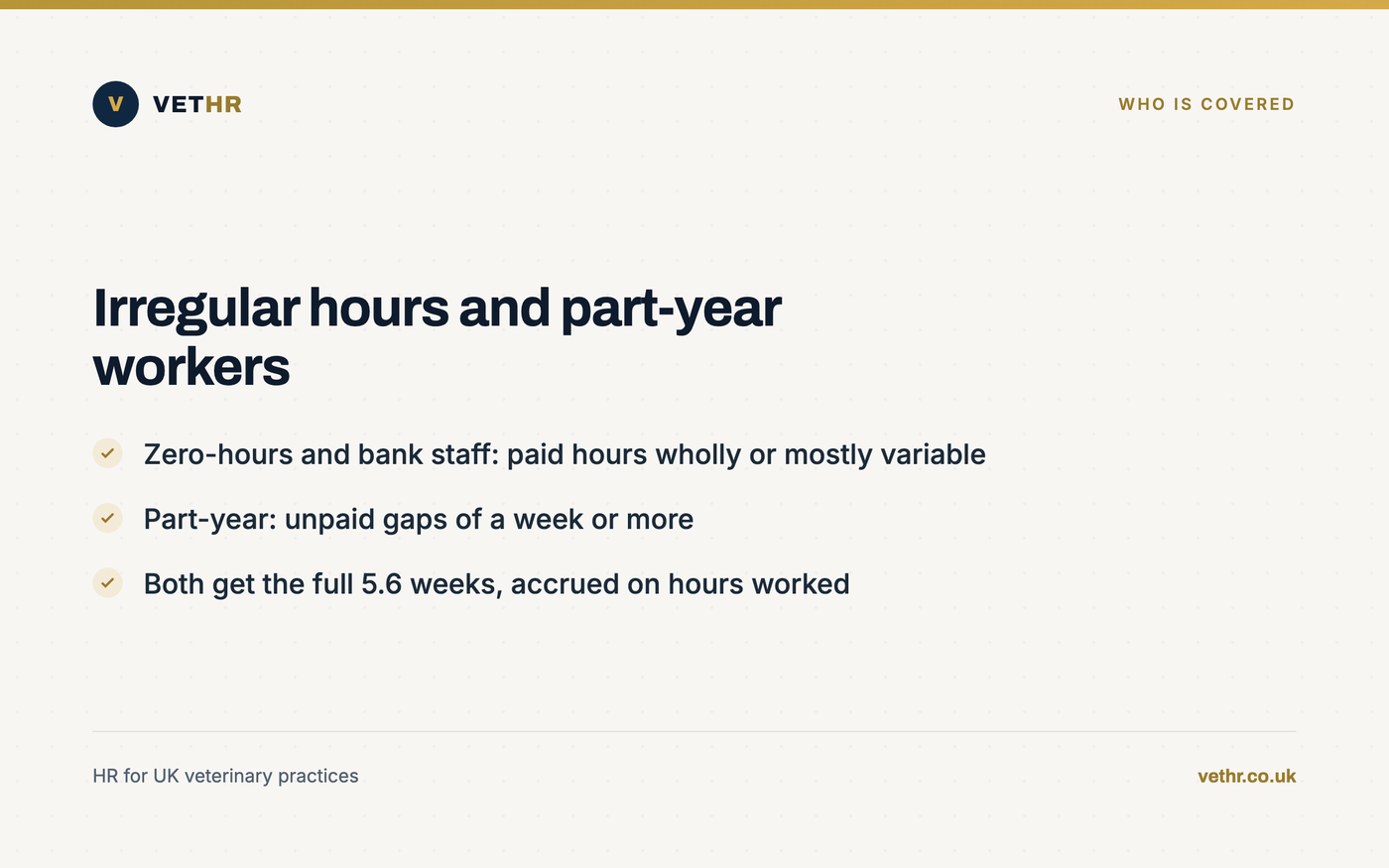
An irregular hours worker is someone whose paid hours in each pay period are, under their contract, wholly or mostly variable. A part-year worker is someone only required to work part of the year, with unpaid gaps of at least a week. Both definitions come from the GOV.UK guidance on the holiday pay and entitlement reforms.
In a practice, the bank RVN, the casual receptionist and the zero-hours kennel assistant will usually be irregular hours workers, because their contract fixes no set hours. A student who only works university holidays, or seasonal help over the summer surge, will often be a part-year worker.
The classification matters because these two groups now have their own regime. For leave years beginning on or after 1 April 2024, their holiday accrues by a different method, and rolled-up holiday pay is available for them and only for them. Get the classification right first, and the rest of the maths follows.
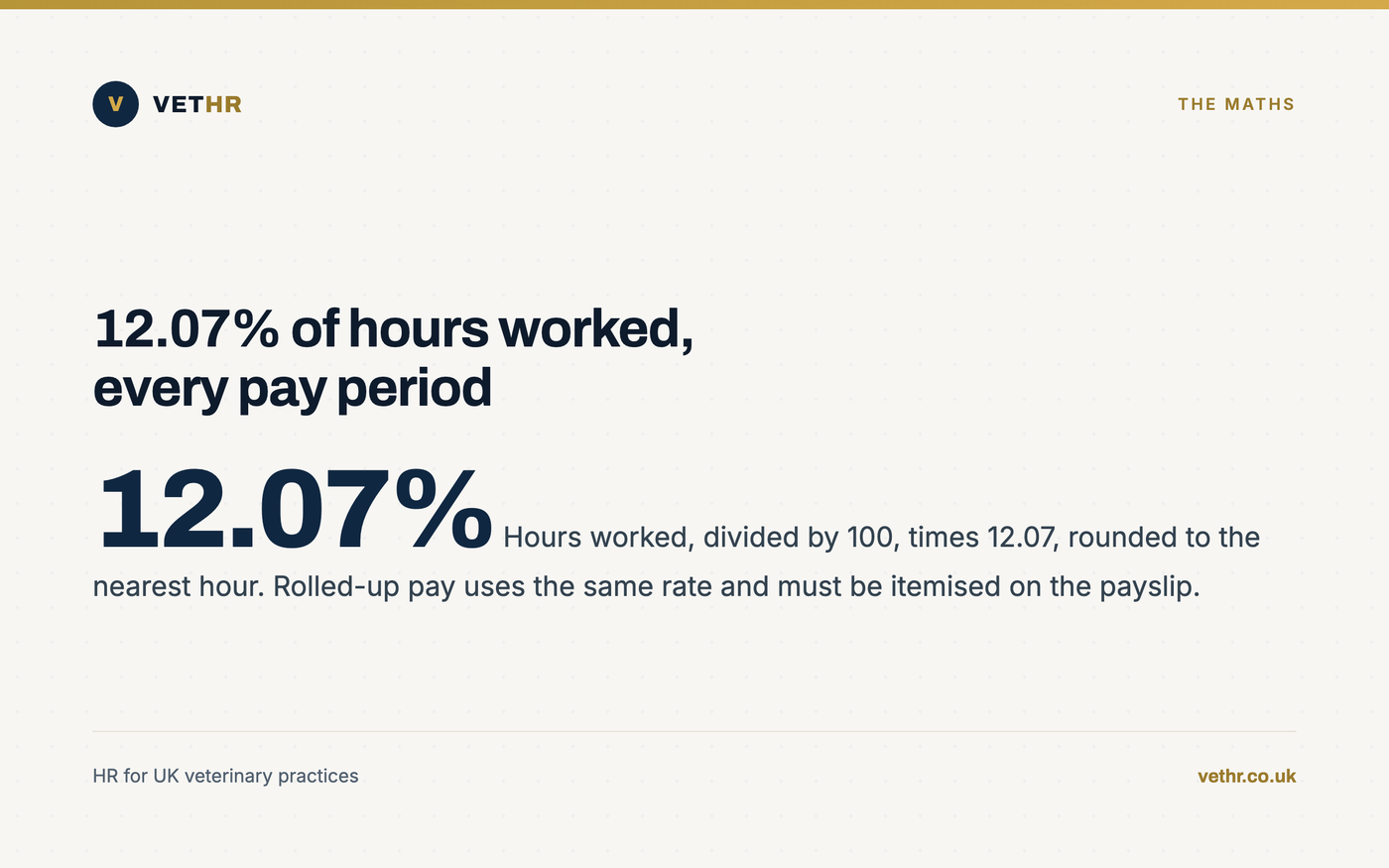
For leave years beginning on or after 1 April 2024, irregular hours and part-year workers accrue holiday at 12.07 percent of the actual hours they work in each pay period, capped at 28 days a year, per the GOV.UK reforms guidance. The entitlement builds as the hours are worked.
The GOV.UK guidance sets out the calculation in three steps: divide the hours worked in the pay period by 100, multiply by 12.07, then round to the nearest whole hour, with 0.5 hours or more rounding up. So a bank nurse paid monthly who works 60 hours in June accrues 60 divided by 100, times 12.07, which is 7.242, rounded to 7 hours of paid holiday for that month.
Why 12.07 percent? Everyone is entitled to 5.6 weeks of leave, which leaves 46.4 working weeks in a 52-week year, and 5.6 divided by 46.4 is 12.07 percent. The figure is not a convention; it is the statutory entitlement expressed as a proportion of working time.
Notice what the method depends on: an accurate record of hours actually worked, every pay period. If casual hours live in memory or on scraps of paper, the accrual is guesswork. A clock in and out system gives you the worked-hours record the calculation is built on.
Yes, with conditions. For leave years beginning on or after 1 April 2024, employers may use rolled-up holiday pay for irregular hours and part-year workers only. It is calculated as 12.07 percent of the worker’s total pay in each pay period, paid at the same time as the pay for the work, and it must be clearly marked as a separate item on each payslip, per the GOV.UK reforms guidance.
Each of those conditions does real work. The uplift cannot be quietly absorbed into a “generous” hourly rate; it has to be visible and itemised. And the permission only covers the two worker classes above. GOV.UK is explicit that an employer cannot include an amount for holiday pay in the hourly rate of a regular-hours worker, in its guidance on holiday pay.
Rolled-up pay solves the money side, not the rest side. Holiday exists so people actually stop working, and a casual nurse who is paid the uplift but never takes a week off is a fatigue risk in a clinical setting. Pay it correctly, and still encourage the time off.
Not sure whether your casual staff are accruing correctly, or whether your rolled-up arrangement would stand up to a query? Book a free HR health check. Thirty minutes, no jargon, and we will tell you plainly whether your current method matches the 2024 rules and what to fix if it does not.
If you do not roll it up, holiday pay for zero-hours staff is worked out when they take leave: a week’s pay for each week of statutory leave. Because their pay varies, a week’s pay is their average pay over the previous 52 weeks, counting only weeks in which they were paid, per GOV.UK guidance on holiday pay.
Unpaid weeks are skipped, not averaged in at zero. You look further back to gather 52 paid weeks, and the GOV.UK reforms guidance caps that lookback at 104 weeks before the holiday. A casual receptionist who worked nothing in August does not have her average dragged down by it; those weeks simply do not count.
The rate itself is broader than basic pay. Four weeks of the entitlement must be paid at the worker’s normal rate, which includes regular overtime and commission-type payments, while the remaining 1.6 weeks can be paid at basic rate, according to the same GOV.UK reforms guidance. In practice terms: if OOH supplements or overtime are a regular part of someone’s pay, they belong in the holiday rate too.
This is repeated, fiddly arithmetic, done per person, per booking. It is exactly the kind of calculation our holiday calculations system exists to keep right without anyone opening a spreadsheet.
The common mistakes are the same in most practices: assuming casual means no holiday, rolling up pay without itemising it, applying rolled-up pay to regular-hours staff, averaging in unpaid weeks, forgetting accrual during absence and keeping no reliable record of hours. Each one is cheap to fix now and expensive to discover later.
None of these requires bad faith to go wrong. They happen because holiday pay for zero-hours staff changes with every pay period, and hand-kept records cannot keep up. The fix is a system that does the accrual automatically and a payslip that shows its working.
Yes. GOV.UK guidance on the 2024 reforms says irregular hours workers continue to accrue holiday during sick leave and family-related leave. The employer looks back over a 52-week relevant period, works out average weekly hours excluding the absence weeks, and uses that average to calculate what accrues while the person is off.
No. GOV.UK states an employer cannot include holiday pay in the hourly rate of a regular-hours worker. Rolled-up holiday pay is only permitted for irregular hours and part-year workers, for leave years starting on or after 1 April 2024, and it must be shown as a separate 12.07 percent item on the payslip.
GOV.UK guidance says workers can normally carry over a maximum of 8 days into the next leave year, with the employer’s agreement. Someone unable to take leave because of maternity or other family-related leave can carry over up to 28 days. Your own policy can be more generous, but it should be written down.
No. GOV.UK is clear that bank or public holidays do not have to be given as paid leave; an employer can count them within the 5.6 weeks statutory entitlement. For a practice that opens on bank holidays, what matters is that the contract says clearly how those days are treated, so casual staff know where they stand.
Keep the hours worked in each pay period, the accrual calculated from them, every request and approval, and payslips showing any rolled-up uplift as a separate line. If a worker or an inspector asks how a balance was reached, you want to show the working, not reconstruct it. A system that timestamps all of this makes the question routine.
Casual and zero-hours staff have the same 5.6 weeks of holiday as everyone else; the 2024 rules just changed how it accrues and how it can be paid. The method is now mechanical: 12.07 percent of hours worked, a visible uplift if you roll it up, and a proper average if you do not. Mechanical is good news, because mechanical can be automated.
If your casual balances live in a spreadsheet, start there. See how our holiday calculations system keeps the accrual right every pay period, how clock in and out supplies the worked-hours record it depends on, or simply book a free HR health check and we will review how your practice handles casual holiday today. Straight answers, nothing sold that you do not need.
The Vet HR Team provides HR consultancy and white-labelled staff systems exclusively to UK veterinary practices.
Free tool: Work it out with the free holiday calculator
Read next: Staff Benefits in a Veterinary Practice and Pay Bands for a Veterinary Practice.
Contracts, rotas, holiday, a difficult conversation. Tell us what you are dealing with and we will come back within one working day. Nothing to sign up to.
Got it. We will come back to you within one working day. If you do not see a reply, please check your spam folder.
