Last updated: 27 June 2026
TL;DR: A holiday booking system for veterinary practices replaces the spreadsheet-and-messages method with self-service requests, automatic entitlement and balance tracking, clash detection against the rota, an approval workflow and an audit trail. Staff request leave in one place, the system keeps the maths right, and clashes show up before they catch you out. This guide covers what the system does, why the manual method fails, the features that matter and how to choose well.
Holiday is the quiet flashpoint in a busy practice. It rarely feels urgent until two nurses are booked off the same week and the rota cannot cover the floor. This is a calm, practical look at how a booking system removes that risk, and where it earns its place over a shared spreadsheet.
A holiday booking system for veterinary practices is software that handles staff leave from request to approval in one place. People book their own time off, the system tracks each person’s entitlement and remaining balance, flags clashes against the rota, routes the request for approval and keeps a dated record of every decision. It replaces the patchwork of spreadsheets, group messages and memory.
The difference from a generic leave management tool is fit. A practice rota is not a flat office week. It has out-of-hours cover, registered nurses, freelance vet cover and minimum staffing on the floor, so a holiday request is never just a date. A booking system built for clinics treats those constraints as normal, which means the approval is informed rather than a guess.
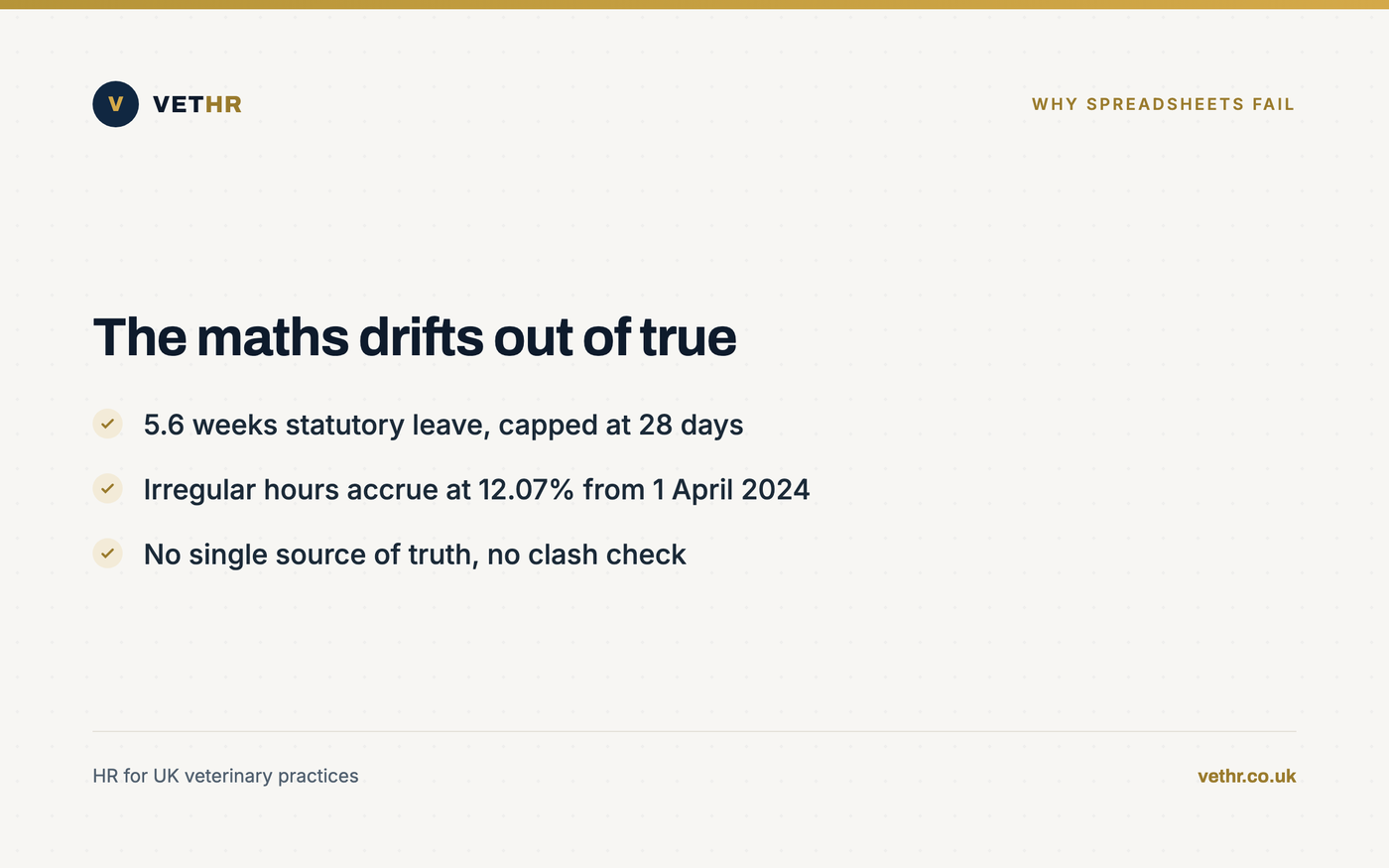
The spreadsheet and messages method fails because it has no single source of truth. Requests arrive by text, email and corridor conversation, balances are updated by hand if at all, and nobody can see the whole picture at once. It works while the team is tiny, then quietly breaks as soon as two people want the same week.
The maths is where it hurts first. Statutory paid holiday is 5.6 weeks a year, capped at 28 days, according to GOV.UK guidance on holiday entitlement. For a five-day worker that is simple. For part-time nurses, bank staff and irregular shifts it is not, and a hand-kept spreadsheet drifts out of true within months.
Irregular hours make it harder still. For leave years beginning on or after 1 April 2024, holiday for irregular-hours and part-year workers accrues at 12.07 percent of the hours worked in each pay period, as set out in GOV.UK guidance on the holiday pay reforms. Doing that by hand, every period, for every variable-hours worker, is exactly the kind of repeated calculation a spreadsheet gets wrong.
Then there is the record. When a worker queries their leave, you need to show what was requested, approved and taken. A scatter of messages is not a record you can hand over with confidence, and reconstructing one after the fact is precisely the scramble a system is meant to end.
A holiday booking system tracks balances automatically by holding each person’s entitlement and deducting approved leave in real time, so the remaining figure is always live. Staff see their own balance before they book, approvers see it before they decide, and nobody is reverse-engineering a number from a spreadsheet at the end of the year.
The real value is in the awkward cases. Part-time staff on set days, nurses who pick up extra shifts, and variable-hours workers accruing at 12.07 percent each pay period are all handled by the system rather than by you. The entitlement updates as hours are worked, which keeps the part-year and irregular-hours rules right without a monthly recalculation by hand.
It also removes the year-end carry-over headache. The system knows what has been taken, what remains and what your policy allows to roll over, so the conversations that used to depend on someone’s memory now point at a shared, accurate figure. A good staff holiday tracker is simply this maths, kept honest, all year. See our holiday calculations system for how the entitlement side fits together.
Clash detection works by checking each holiday request against the rota and minimum staffing before it is approved. When someone books a week, the system shows who else is already off, whether the floor still has enough cover, and where out-of-hours or branch staffing would fall short. The clash surfaces at request time, not on the morning it bites.
This is the feature that separates a holiday request system from a calendar. A shared calendar shows dates. It does not know that you need two nurses on the floor on a Saturday, or that losing your only out-of-hours vet that week leaves a gap. Tying leave to the rota turns “looks free” into “is actually coverable”, which is the decision that matters.
For practices that run a proper schedule, the holiday and the rota should never be two separate systems. When they share data, an approved request updates the rota and the cover gap is visible immediately. See how our veterinary rota system works alongside leave so planned time off and planned shifts stay in step.
Not sure whether your current method is costing you? A 30-minute conversation usually makes it clear. Book a free HR health check and we will look at how you handle leave today, where clashes and balance errors creep in, and whether a booking system would genuinely help. No jargon, nothing sold for the sake of it.
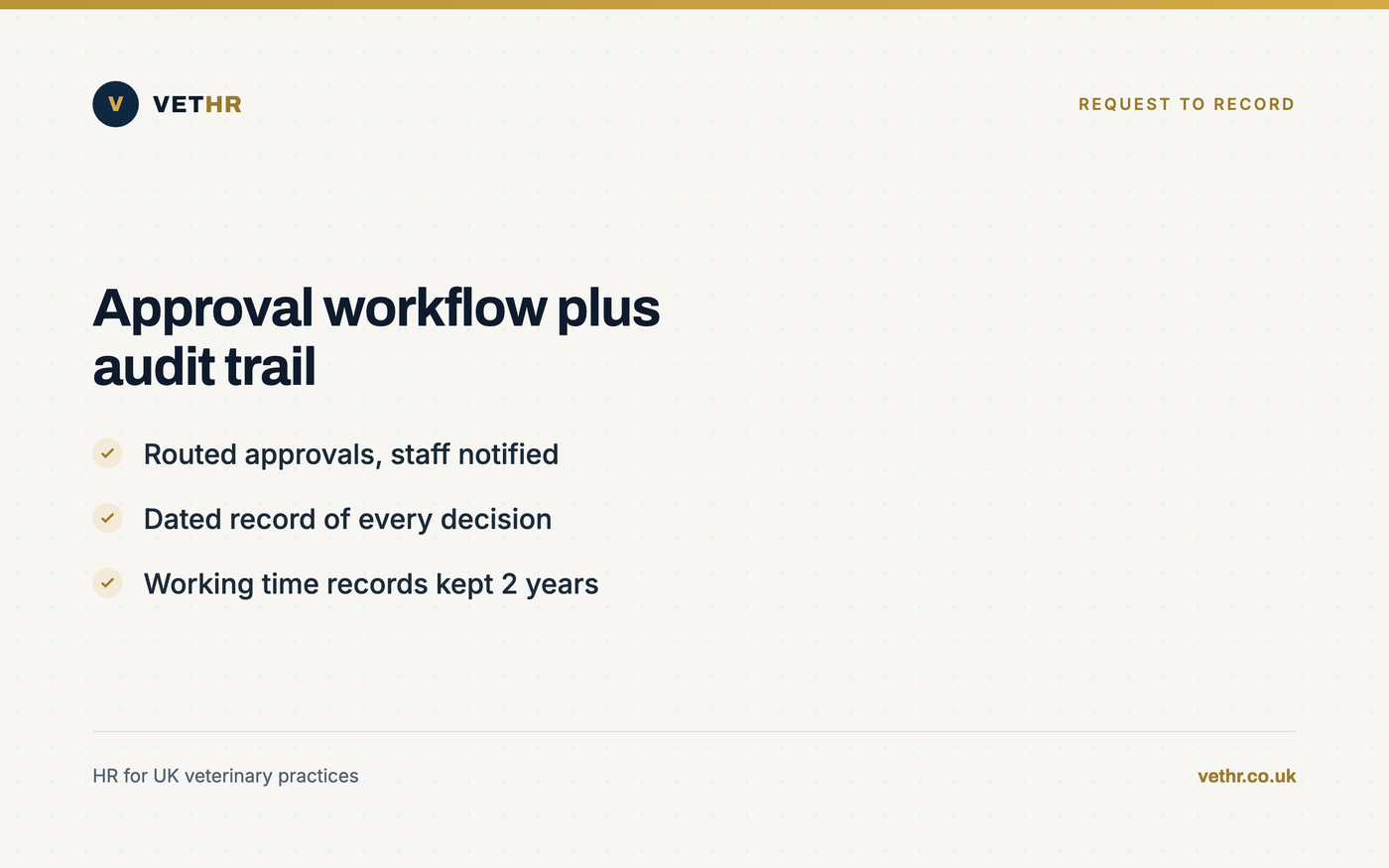
An approval workflow routes each request to the right person, records the decision and notifies the staff member, all in one tracked place. The audit trail then keeps a dated history of who requested what, who approved or declined it and when. Together they turn leave from an informal favour into a fair, documented process.
The fairness matters as much as the tidiness. When requests are visible and decisions are recorded, “first come, first served” is demonstrable rather than a claim, and the staff member who missed out can see why. That is the difference between a holiday approval system people trust and a process that quietly breeds resentment.
The audit trail also carries a compliance benefit. Employers must keep working time records for two years from the date they were made, and the 48-hour weekly maximum can only be exceeded with a written opt-out, according to Acas guidance on the working time rules. A system that timestamps and stores leave decisions makes that record-keeping a non-event rather than a chore.
A good system should cover seven things: self-service requests, automatic balances, clash detection, an approval workflow, an audit trail, support for irregular hours and clean exports. The test for each is the same. Does it reflect how a clinic actually runs, and does it save more time than it costs? Anything that fails both is a feature you are paying to ignore.
Notice how few of these a shared spreadsheet delivers. It can hold a balance, badly, and nothing else on the list. Annual leave software earns its keep precisely on the features a spreadsheet cannot fake: the live clash check, the routed approval and the record you can stand behind.
Choose by fit, not feature count. The right holiday booking system handles your real staffing model, links leave to the rota, gets the irregular-hours maths right and produces a clean record on request. A generic tool with a vet page will do none of those well, and you will spend your time fighting it rather than using it.
Ask the practical questions. Does it track part-time and variable hours correctly? Does the rota know when someone is off? Can you export one person’s full leave history in a single document? Who can see and change the data? Honest answers are quick. Evasive ones around compliance or data are a warning worth heeding.
Decide too whether you want software alone or software with support. A tool records a request neatly, but it will not advise you on a contested booking, a contractual term or a fair carry-over policy. That is why our monthly HR support pairs the systems your team uses with human judgement, so the holiday booking system is backed by advice when a decision is not obvious.
Yes, and that is one of its main jobs. For leave years from 1 April 2024, irregular-hours and part-year workers accrue holiday at 12.07 percent of hours worked each pay period, per GOV.UK guidance. A good system applies that automatically, so part-time nurses and variable-hours staff keep an accurate balance without anyone recalculating by hand.
It checks each request against the rota and minimum staffing before approval. When a clash would leave the floor short or remove your only out-of-hours cover, the system flags it at request time. The approver sees who else is off and whether the week is genuinely coverable, rather than discovering the problem on the day.
For anything beyond a tiny, stable team, yes. A spreadsheet has no single source of truth, no clash check against the rota and no real audit trail. A booking system gives staff self-service, keeps balances live, routes approvals and records every decision, which removes the month-end scramble and the disputes that follow.
Yes, and the system makes it easier. Employers must keep working time records for two years from the date they were made, according to Acas. A booking system timestamps and stores every leave request and decision, so producing a clean per-person record on request becomes a quick export rather than a reconstruction job.
It should. Leave and the rota describe the same week, so keeping them apart is where clashes hide. When they share data, an approved request updates the rota and the cover gap is visible at once. Practices that link the two stop discovering staffing shortfalls only when someone fails to turn up.
A shared spreadsheet is fine while the team is small and the calendar is quiet. It stops being fine the moment leave gets contested, hours get irregular, or you need to show a clean record. A proper booking system is the answer when those things start costing you accuracy, fairness or time you do not have.
If you are weighing it up, start with the friction and let it point to the fix. To see how the pieces fit, look at our holiday calculations, see how leave sits with the rota, or simply book a free HR health check and we will give you a straight recommendation for your practice. Nothing sold that you do not need.
The Vet HR Team provides HR consultancy and white-labelled staff systems exclusively to UK veterinary practices.
Contracts, rotas, holiday, a difficult conversation. Tell us what you are dealing with and we will come back within one working day. Nothing to sign up to.
Got it. We will come back to you within one working day. If you do not see a reply, please check your spam folder.
