Last updated: 27 June 2026
TL;DR: Handling flexible working requests in a veterinary practice is now a day-one right: since 6 April 2024, any employee can ask from their first day. They may make two statutory requests in any 12-month period, and you must decide, including any appeal, within two months unless you agree an extension. You can only refuse on one of eight business grounds, and you must consult first. Handled well, flexibility becomes a retention tool, not a rota headache.

Flexibility is no longer a perk you grant when you feel generous. It is a legal right your team can exercise from day one, and a quiet driver of whether good nurses and vets stay. This is a calm, practical guide to getting the process right and using it to your advantage.
Flexible working is any change to when, where or how much an employee works. In a practice that means part-time hours, compressed hours, set days, predictable shifts, term-time working, job shares, or a different start and finish around the school run. The clinical setting does not remove the right; it just shapes what you can realistically agree.
GOV.UK confirms an employee can request a change to the number of hours they work, when they start or finish, the days they work, or where they work, as set out in its flexible working guidance. In a clinic, “where” is usually limited by the obvious fact that consults and procedures happen on site, but hours, days and shift patterns are all live options.
A request is not automatically a demand for less work. A nurse might ask for compressed hours, four longer days instead of five, to cut commuting. A vet returning from parental leave might ask for three fixed days. A receptionist might want to swap a late finish for an early one. Each is a flexible working request, and each is judged on the same statutory footing.
Any employee can make a statutory flexible working request, and since 6 April 2024 it is a day-one right. There is no longer a 26-week qualifying period, so a new starter can ask on their first shift. An employee may make two statutory requests in any 12-month period, so the right is real but not unlimited.
The Acas Code of Practice on requests for flexible working states plainly that the changes came into force on 6 April 2024, and that “an employee may make two statutory requests for flexible working within any 12-month period”. GOV.UK mirrors this, noting employees can make two applications in any 12-month period.
This matters for hiring. A candidate can accept a role and request a four-day week in week one. That is lawful, and it is not bad faith. The sensible move is to discuss working patterns honestly at offer stage, so a day-one request rarely arrives as a surprise that throws your rota into disarray.
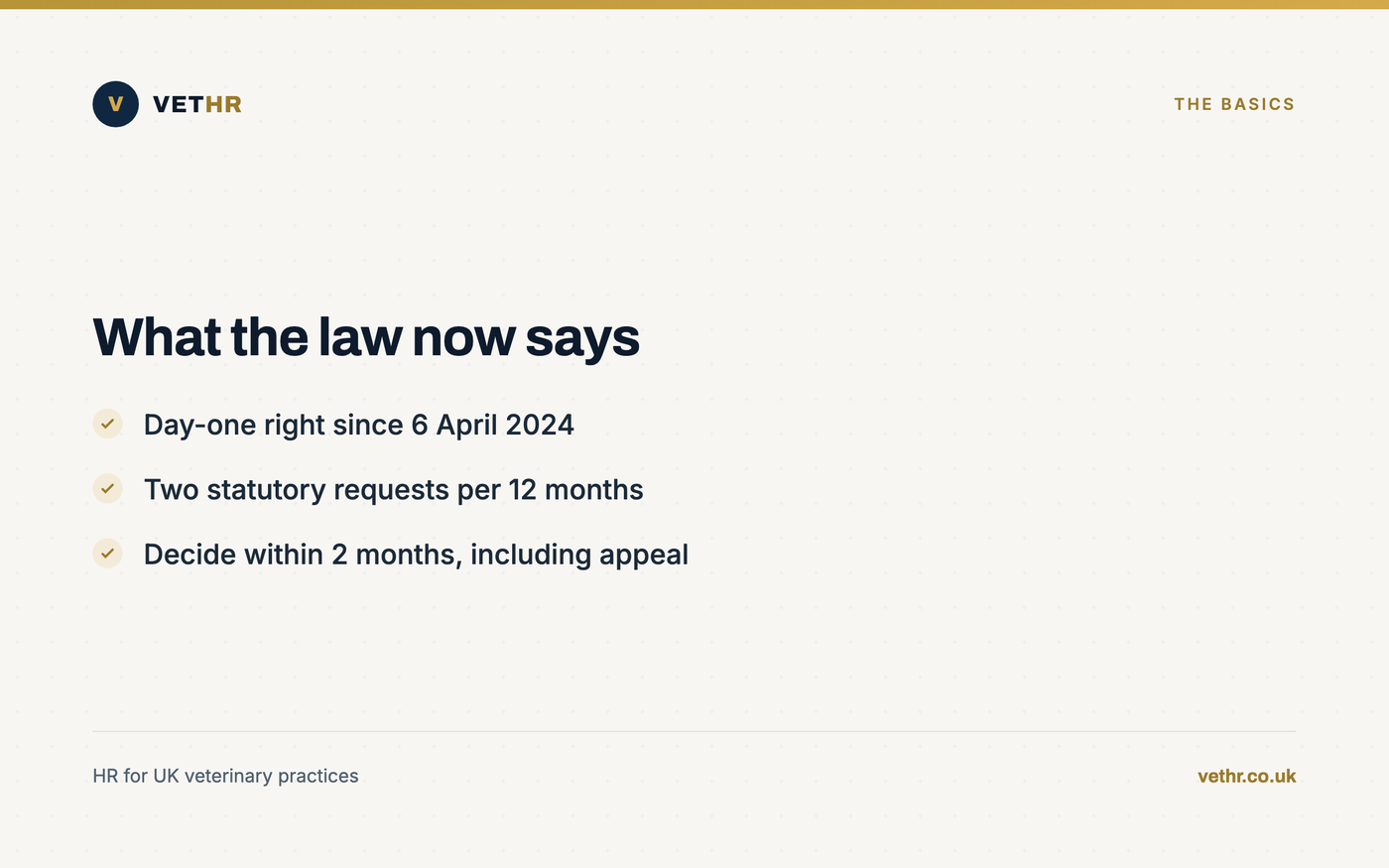
Once you receive a written statutory request, the clock starts. You must decide it, including any appeal, within two months unless you and the employee agree to extend that period. Before you refuse, you have a legal duty to consult the employee. The process is light on paperwork but firm on fairness and timing.
The employee should put the request in writing, state that it is a statutory request for flexible working, and set out the change they want and when they want it to start, per the GOV.UK applying for flexible working guidance. That written record is your starting point and your evidence trail, so keep it.
The Acas Code is specific on timing: “All requests, including any appeals, must be decided and communicated to the employee within a period of two months.” It adds that “the employer and employee may agree to extend this period,” which is useful when you need cover figures or want to trial a pattern before committing.
Consultation is not optional. Acas guidance on making a decision states that “unless you agree to the employee’s request in full, you have a legal obligation to consult the employee before making a decision.” In practice that is a proper conversation about what is possible, not a rubber stamp on a “no”.
Not sure your request process would stand up if it were challenged? A 30-minute conversation usually settles it. Book a free HR health check and we will look at how you receive, consult on and record flexible working requests today, then tell you honestly where you are solid and where a tidy flexible working policy would protect you. No jargon, nothing sold for the sake of it.
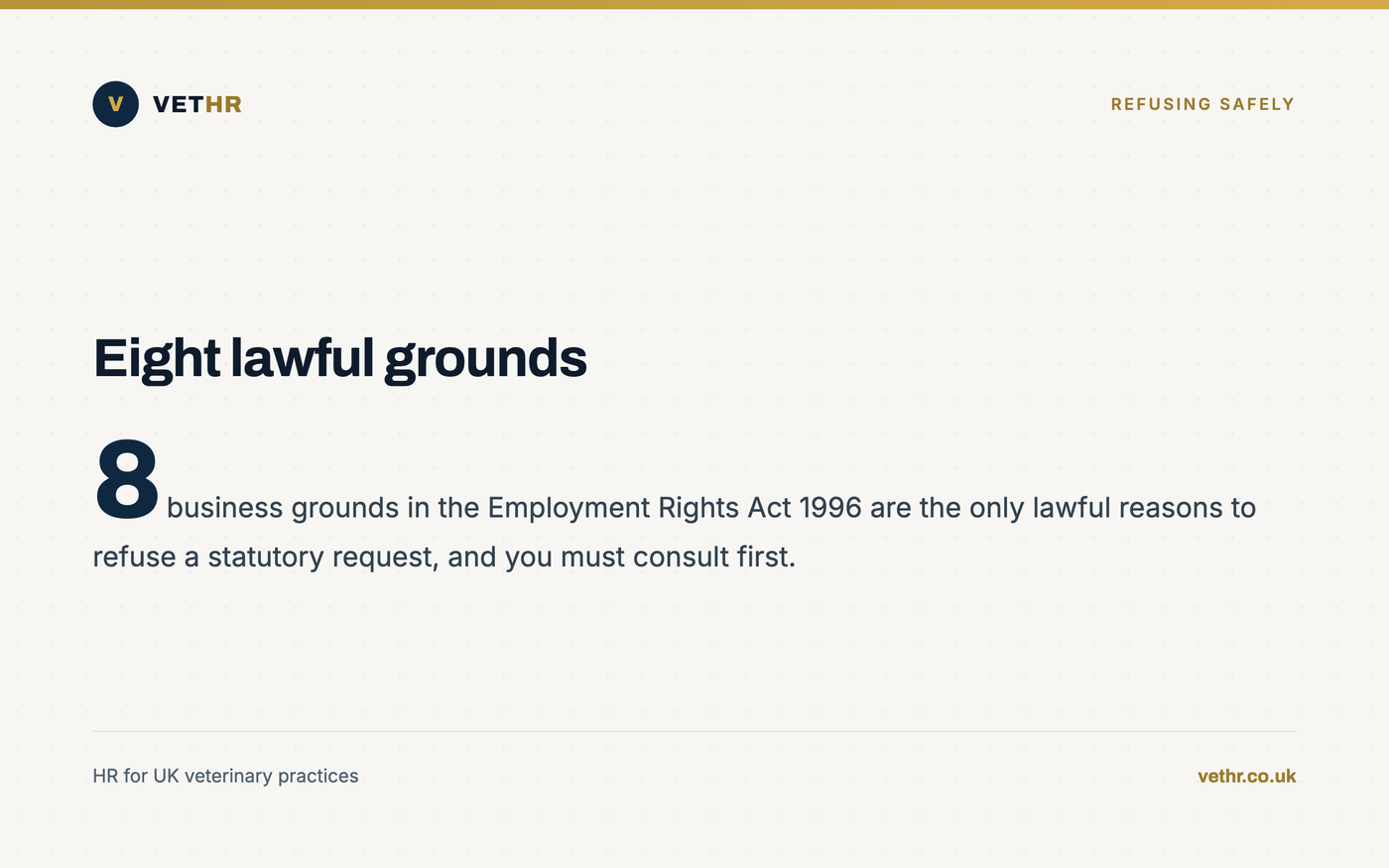
You can only refuse a statutory request for one or more of eight business grounds set out in the Employment Rights Act 1996. You cannot refuse because you simply prefer the old pattern. The reason must be genuine, and after consultation you should be able to point to the specific ground and explain how it applies to your practice.
The Acas Code lists the eight permitted grounds. They are:
In a clinical context, “ability to meet customer demand” and “inability to reorganise work amongst existing staff” are the grounds most likely to bite. If a sole night-cover nurse asks to drop all out-of-hours shifts, the demand and reorganisation grounds may genuinely apply. The test is whether the difficulty is real and evidenced, not whether saying yes is inconvenient.
Refusing safely means showing your working. Record the consultation, the alternatives you considered, the trial you offered or why one was not workable, and the ground you relied on. A “no” with reasoning that ties to one of the eight grounds is defensible. A flat refusal with no consultation is the version that ends up at a tribunal. Keep the dated paperwork too, because a clear record of the conversation and the cover figures is often what turns a contested decision into one that simply holds.
Fairness across a shift-based team means a consistent process, not an identical outcome for everyone. You will not be able to grant every request, because one person’s fixed days can land on a colleague’s shoulders. The duty is to consider each request properly and avoid the perception that flexibility is reserved for favourites.
The friction in a clinic is finite cover. If three nurses all want Fridays off, the rota cannot absorb it, and the eight grounds give you a lawful basis to manage that. The risk is handling two similar requests differently for no clear reason, which can look like discrimination even when it is not intended. Consistency is your protection.
This is where a clear rota system earns its place. When planned and actual cover sit in one view, you can show exactly why a fourth Friday request will not work, and exactly why the first three did. That turns a contested decision into a transparent one your team can accept, even when the answer is no.
Yes, and in veterinary it is one of the strongest retention levers you have. The profession’s biggest people problems are work-life balance and stress, and flexible patterns speak directly to both. A practice that says yes thoughtfully, and no clearly, tends to hold its team longer than one that treats every request as a threat.
The evidence is stark. The RCVS Surveys of the Professions 2024 found the leading reasons vets leave include poor work-life balance at 56 percent and chronic stress at 54 percent, according to the RCVS. Both are shaped by how a practice plans hours and shares cover, which is exactly what flexible working changes.
Out-of-hours work concentrates the strain. The same RCVS research found 35 percent of vets and 16 percent of veterinary nurses did on-call hours, and on-call is precisely where burnout builds. Offering predictable patterns and fair rotation of unsocial shifts is often the difference between a valued nurse staying and quietly handing in notice.
Treat flexibility as a tool, not a tax. Saying yes to a compressed week or a fixed-days pattern can cost less than recruiting a replacement, and a reputation for handling requests fairly makes your practice easier to staff. Our HR consultancy helps practices turn this from a compliance worry into a hiring advantage.
Yes. Since 6 April 2024 the right to request flexible working applies from an employee’s first day, with no qualifying period. Any employee in your practice can make a statutory request immediately. They can make two statutory requests in any 12-month period, so the right is genuine but not open-ended.
You must decide the request, including any appeal, within two months of receiving it, unless you and the employee agree to extend that period. Before refusing, you have a legal obligation to consult the employee. Missing the deadline or skipping consultation are the two most common ways practices get this wrong.
You can, but only on one or more of the eight business grounds in the Employment Rights Act 1996, such as an inability to reorganise work among existing staff or a detrimental effect on meeting customer demand. You must consult first, and the reason must be genuine and evidenced, not simply a preference for the old pattern.
No. Part-time hours are one option, but flexible working also covers compressed hours, fixed or predictable days, job shares, term-time working and different start or finish times. In a clinic, changing when someone works is often easier to accommodate than changing how much, because cover, not headcount, is usually the constraint.
You should. The request itself should be in writing, and your decision should be confirmed in writing, whether you approve it, approve part of it, or refuse on a named ground. A change to working pattern is usually a change to the contract, so record it clearly to avoid disputes later about what was agreed.
Flexible working requests in a veterinary practice are not a trap; they are a process. Receive the request in writing, consult properly, decide within two months, and tie any refusal to one of the eight lawful grounds. Do that consistently and you protect the practice while keeping the door open to the patterns that keep good people in clinic.
If you want a tidy, defensible approach, start with the documents and the rota. Browse our HR policies, see how a clear rota system makes fair decisions easy to show, or simply book a free HR health check and we will give you a straight read on your current process. Nothing sold that you do not need.
The Vet HR Team provides HR consultancy and white-labelled staff systems exclusively to UK veterinary practices.
—
Read next: Job Shares in a Veterinary Practice.
Contracts, rotas, holiday, a difficult conversation. Tell us what you are dealing with and we will come back within one working day. Nothing to sign up to.
Got it. We will come back to you within one working day. If you do not see a reply, please check your spam folder.
