Last updated: 27 June 2026
TL;DR: Right to work checks for veterinary practices are a legal duty for every new hire, vet, nurse or receptionist, before their first day. Do the check correctly and you gain a statutory excuse that protects you from a civil penalty of up to £45,000 per worker. There are three approved methods: a manual document check, a Home Office online check using a share code, and identity document validation technology. You must repeat checks for time-limited permission and keep records during employment and for two years after.

Recruitment in the profession is tight, and a growing share of vets and nurses are recruited from overseas. That makes the right to work check a routine part of hiring, not an edge case. This is a calm, practical guide to doing it correctly, so a good appointment never turns into an avoidable fine.
Every UK employer, including every veterinary practice, must check that a person can legally work in the country before they start. The duty applies to all staff equally, with no exceptions for clinical roles. Right to work checks for veterinary practices are the only way to gain a statutory excuse, which is the legal protection against a civil penalty if a worker later turns out to be employed illegally.
The stakes are not abstract. GOV.UK guidance is explicit that you could face a civil penalty if you employ someone who does not have the right to work and you have not carried out a correct check, as set out in its guide to checking a job applicant’s right to work. The check is your shield, and it only works if you do it before employment begins.
This matters more in veterinary than in many sectors because international recruitment is common. The RCVS Code of Professional Conduct and registration routes accommodate overseas-qualified vets and nurses, and practices regularly hire them to fill rotas. A practice that treats checks as a formality for “obvious” cases, and a paperwork burden for others, is the practice most likely to slip.
One more point that catches owners out: the check applies to British and Irish citizens too. You cannot pick and choose who to check based on name, accent or assumption, both because the law requires a check for everyone and because selective checking risks unlawful discrimination. The safe habit is simple. Everyone, every time, before day one.
Everyone you employ needs a check, and it must be completed before their first day of work. That means vets, registered veterinary nurses, student nurses, receptionists, kennel assistants and practice managers alike. The timing is the part practices most often get wrong: a check done after someone has started does not give you a statutory excuse for the period before it.
Freelance vet cover sits in a grey area worth naming. If the person is genuinely self-employed and engaged through their own business, the duty differs from employing them directly. If in doubt about employment status, treat the relationship cautiously and take advice, because getting the category wrong can leave you exposed on both tax and immigration compliance.
The practical answer for most practices is to build the check into onboarding, alongside the contract and the RCVS registration confirmation. When it is a fixed step that happens before the start date, no good hire ever slips through unchecked, and no manager has to remember it under pressure.
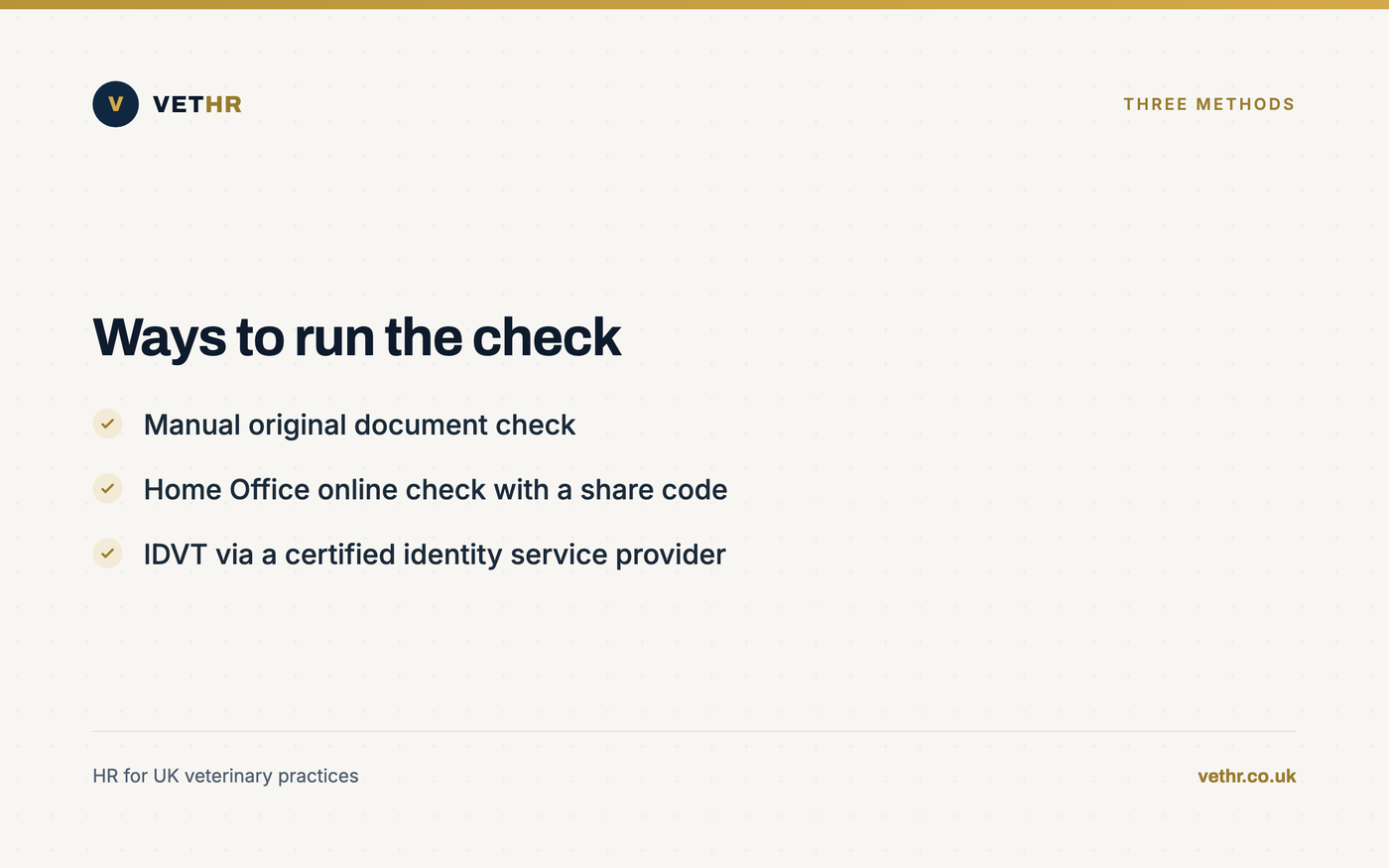
There are three approved ways to carry out a right to work check: a manual check of original documents, a Home Office online check using a share code, and identity document validation technology through a certified identity service provider. Each one, done correctly, gives you a statutory excuse. You choose the method that fits the person in front of you.
You obtain the person’s original acceptable documents, such as a passport, check them in their presence, and confirm they are genuine and consistent. GOV.UK guidance requires you to check the documents are valid, that photographs and dates of birth are consistent across them, and to make and date a clear copy. This route works but it is the most manual, and it does not cover everyone.
Many people, including most visa holders, prove their status digitally. They give you a share code, you enter it with their date of birth on the Home Office service, and the system confirms their right to work in real time. The Home Office confirms the online service lets checks happen by video call, with no need to see physical documents, on its page for checking a job applicant’s right to work. For overseas-recruited staff, this is usually the cleanest method.
For British and Irish citizens who hold a valid passport, you can use a certified identity service provider (IDSP) to verify identity digitally through IDVT, rather than seeing the document yourself. The 2024 Home Office code of practice confirms IDVT is available for British and Irish passport holders at a minimum medium level of confidence, in its code of practice on preventing illegal working. It is convenient, but you pay the provider and you remain responsible for the outcome.
Not sure your onboarding captures every check at the right moment? A 30-minute conversation usually makes the gaps obvious. Book a free HR health check and we will look at how you handle right to work, contracts and registrations today, then tell you honestly where you are solid and where a small change would protect you. No jargon, nothing sold for the sake of it.
You get a statutory excuse by carrying out one of the three prescribed checks correctly, before the person starts work, and keeping the evidence. The statutory excuse is the legal protection that means you will not have to pay a civil penalty if a worker is later found to be illegal, provided your check followed the rules. It is established by doing the steps, not by intention.
The 2024 code of practice frames the statutory excuse as the set of steps an employer can take to avoid liability for a civil penalty. In plain terms: check the right document or status, in the right way, before day one, and keep a dated copy. Miss any of those and the excuse does not bite, even if the person turns out to have been perfectly entitled to work.
The reassuring part is that the excuse is fully within your control. Unlike many compliance risks, this one has a clear, repeatable process. A practice that builds the four steps above into hiring rarely has to think about penalties at all, because the protection is already in place every time someone joins.
You need a follow-up check when an employee has time-limited permission to work, such as a visa with an expiry date. You must check again before that permission runs out to keep your statutory excuse. This is where overseas-recruited vets and nurses most often need attention, because their right to work can lapse while their employment continues.
GOV.UK is direct on this point: if an employee’s right to work is time-limited, you will need to check their documents again when it is due to expire, per the right to work guidance. The 2024 code adds that repeat checks are required to retain the statutory excuse. Miss the date, and your protection quietly disappears even though nothing about the person changed.
The practical fix is a diary system. When you hire someone on time-limited permission, record the expiry date and set a reminder a month or two before. A simple shared calendar or a staff records system that flags expiry dates turns a high-risk deadline into a routine prompt, so a valued team member’s status never lapses on your watch.
You must keep a clear copy of each right to work check for the whole period of the person’s employment, and for two years after their employment ends. You also record the date you made the check. These retention rules are not optional housekeeping; without the records, you cannot prove you held a statutory excuse if you are ever asked.
The 2024 code of practice states you must retain a clear copy of the document for the duration of employment and for two years after the employment has come to an end. For online checks, you keep the profile page the Home Office service generates, which carries its own reference. Store these securely, because they contain personal data you are responsible for protecting.
In practice, the safest place for these records is a proper staff file, not a drawer or a personal inbox. A system that holds contracts, registrations and right to work evidence together, with access controls and a clear date stamp, means you can produce any record on request in seconds. That is the difference between a calm enquiry and a scramble.
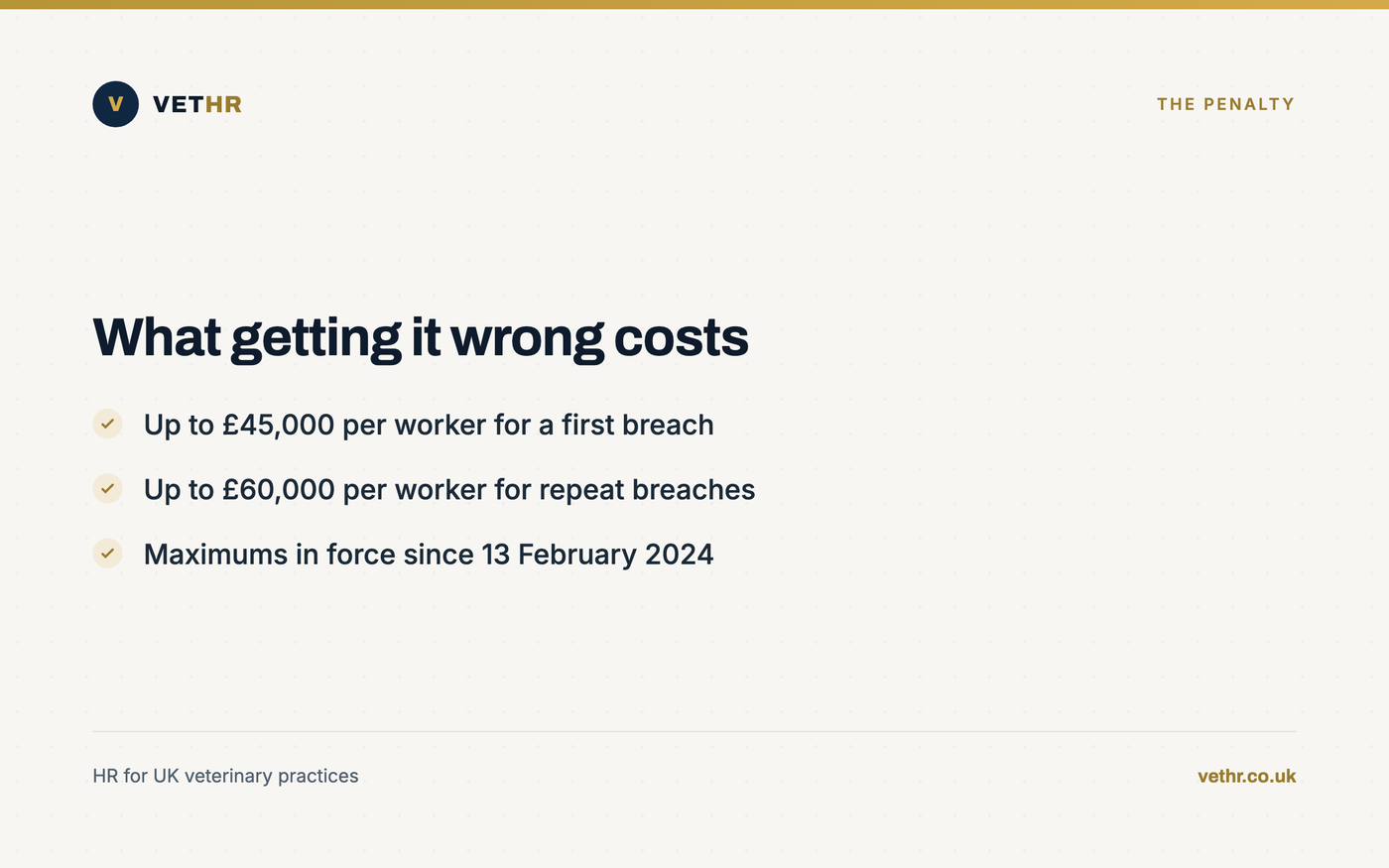
The civil penalty for employing someone without the right to work, when you have not carried out a correct check, is up to £45,000 per worker for a first breach and up to £60,000 per worker for repeat breaches. These figures are per illegal worker, so a single missed check on a multi-person hire can become a very large bill. The check is far cheaper than the penalty.
These maximums took effect on 13 February 2024 and represent a sharp rise. The Home Office’s 2024 code of practice on preventing illegal working sets the maximum at £45,000 per worker for a first breach and £60,000 per worker for a repeat breach within three years, up from £15,000 and £20,000 previously.
The point is not to frighten anyone. It is that a few minutes of correct process, done every time, removes the risk almost entirely. The penalty exists for employers who skip checks, not for those who follow them. If your onboarding reliably captures the right check before day one, and you diary your follow-ups, this is a problem you have already solved.
Yes. The duty applies to everyone you employ, including British and Irish citizens. Checking only people who seem foreign is both non-compliant and a discrimination risk. The safe rule is to check every new starter on the same basis, before their first day, using one of the three approved methods. Consistency protects both the practice and your team.
A share code is a reference the worker generates that lets you check their status online. They give you the code, you enter it with their date of birth on the Home Office service, and it confirms their right to work in real time. It can be done by video call, with no physical documents, which makes it ideal for overseas-recruited vets and nurses.
Keep a clear, dated copy of every check for the whole period of employment and for two years after the person leaves. For online checks, retain the Home Office profile page. Store records securely, because they hold personal data. Without them, you cannot demonstrate a statutory excuse, which is the protection the records exist to provide.
If an employee has time-limited permission and you miss the follow-up check before it expires, you lose your statutory excuse from that date. Continuing to employ them could then expose you to a civil penalty of up to £45,000 per worker. A simple diary reminder set a month or two before any expiry date prevents this entirely.
It depends on employment status. If the person is genuinely self-employed and engaged through their own business, the right to work duty differs from employing them directly. If you treat someone as a worker or employee in practice, you should check them. When status is unclear, take advice, because getting the category wrong can expose you on tax and immigration alike.
Right to work checks for veterinary practices are not difficult, but they are non-negotiable and time-sensitive. Use one of the three methods, do it before day one, keep a dated copy during employment and for two years after, and diary every follow-up. Do that, and a civil penalty becomes a risk you have designed out of your hiring entirely.
If you want this built into your onboarding properly, start with the friction. See how we keep records tidy and findable in our policies and staff records, explore our wider staff systems, read how we work in HR consultancy, or simply book a free HR health check and we will tell you honestly where you stand. Nothing sold that you do not need.
The Vet HR Team provides HR consultancy and white-labelled staff systems exclusively to UK veterinary practices. This guide is general information, not legal advice.
—
Contracts, rotas, holiday, a difficult conversation. Tell us what you are dealing with and we will come back within one working day. Nothing to sign up to.
Got it. We will come back to you within one working day. If you do not see a reply, please check your spam folder.
