Last updated: 27 June 2026
TL;DR: Maternity leave in a veterinary practice means up to 52 weeks off, with up to 39 weeks of Statutory Maternity Pay if your team member qualifies. Your job as the employer is to handle notice properly, keep her job open, run a risk assessment, and cover the rota fairly without burning out the rest of the team. Get the basics right and a maternity leave becomes a planned event, not a panic.
For a small practice, one person going on leave reshapes the whole rota. This is a calm walk through the rules and the human side, so you protect your nurse or vet, stay compliant, and keep the rest of the team standing. Every figure here is checked against current GOV.UK and Acas guidance.
Almost every employed nurse, vet or support team member is entitled to up to 52 weeks of Statutory Maternity Leave, whatever their hours or length of service. It splits into 26 weeks of Ordinary Maternity Leave and 26 weeks of Additional Maternity Leave. She does not have to take all of it, but she has the right to.
GOV.UK confirms that Statutory Maternity Leave is 52 weeks, made up of 26 weeks Ordinary and 26 weeks Additional leave, on its maternity leave guidance. Unlike maternity pay, the leave itself has no service requirement: it does not matter how long she has worked for you, how many hours she does, or what she earns.
There is a hard rule you must enforce. By law, an employee cannot work for the 2 weeks immediately after the birth, and that compulsory period rises to 4 weeks if she works in a factory, again per GOV.UK. For a practice, the 2-week rule is the one that bites, so never roster a new mother back inside that window, even if she offers.
The earliest maternity leave can normally start is 11 weeks before the expected week of childbirth. It can also start automatically: the day after the birth if the baby arrives early, or if she is off with a pregnancy-related illness in the 4 weeks before the due date. Knowing these triggers helps you plan cover with a realistic start date.
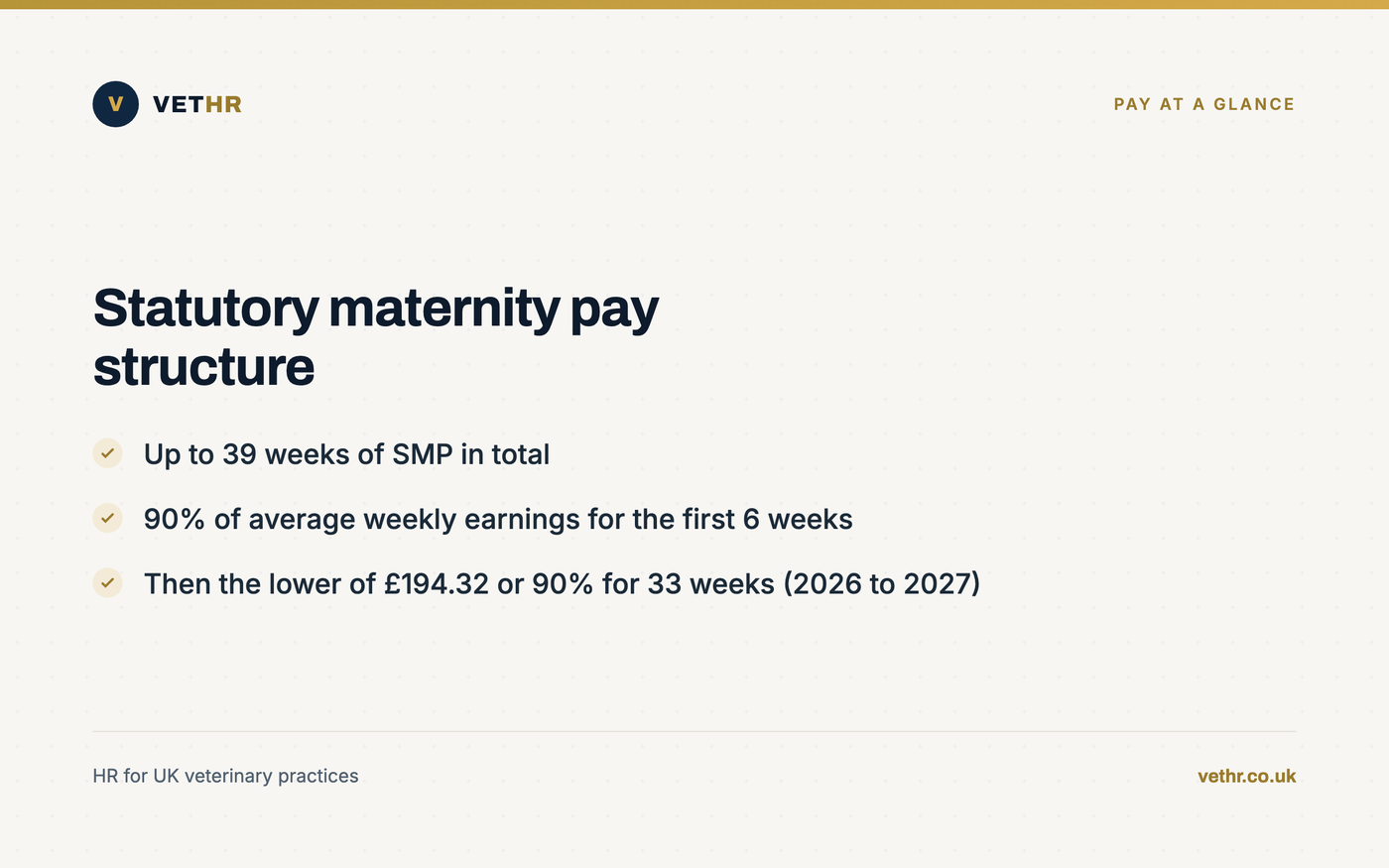
Statutory Maternity Pay (SMP) is paid for up to 39 weeks. For the first 6 weeks she gets 90% of her average weekly earnings before tax. For the remaining 33 weeks she gets the lower of £194.32 or 90% of her average weekly earnings. You pay it through payroll and reclaim most of it from HMRC.
Those figures are confirmed on the GOV.UK maternity pay guidance. The £194.32 standard weekly rate applies for the 2026 to 2027 tax year and took effect from 5 April 2026, per the GOV.UK rates and thresholds for employers. Always check the current rate at the time of the claim, because it changes each April.
Not everyone qualifies for SMP. To be eligible, she must have worked for you continuously for at least 26 weeks up to the qualifying week, which is the 15th week before the expected week of childbirth, and earn on average at least £129 a week, as set out on the GOV.UK eligibility guidance. A newer team member may not meet the service test.
If she does not qualify for SMP, she may be able to claim Maternity Allowance from the government instead. That is paid by the state, not by you, but pointing her towards it is part of being a good employer.
She must tell you she is pregnant, her due date, and when she wants her leave to start, by the end of the 15th week before the expected week of childbirth. To claim SMP she gives you proof of the pregnancy, usually the MATB1 certificate from her midwife or doctor, and the correct notice. Once she has given notice, you confirm her arrangements in writing.
The notice cuts both ways. If she later wants to change her return date, perhaps coming back earlier or taking the full year, she must give you at least 8 weeks’ notice, per the GOV.UK leave guidance. That window matters to you, because 8 weeks is roughly the lead time you need to wind down or extend any cover arrangement on the rota.
Good practice is to write back within 28 days of her notice, confirming her leave end and expected return dates. A clear written trail stops the “I thought you said” problem nine months later. A simple maternity policy and a strong employment contract make this routine rather than fraught.
Your core duties around maternity leave in a veterinary practice are to keep her job open, protect her from unfair treatment, carry out a health and safety risk assessment, and continue her non-pay benefits. A practice carries real physical risks, from anaesthetic gases to radiography and lifting, so the risk assessment is not a formality here.
Once you know an employee is pregnant, you have a legal duty to carry out an individual risk assessment and remove or reduce any risks, as Acas explains in its guidance on rights during pregnancy. In a clinic that can mean adjusting duties around scavenging, X-rays, heavy lifting or sharps. If you cannot remove a risk, you may need to change her duties or hours on suitable terms.
She is also protected from redundancy and unfair treatment. Dismissing someone because she is pregnant or on maternity leave is automatically unfair, and from 6 April 2024 the redundancy protection now stretches up to 18 months from the date the baby is born, as Acas sets out in its guidance on redundancy protection. If a genuine redundancy arises, she must be offered any suitable alternative vacancy first.
One thing that often surprises owners: holiday keeps building during the whole 52 weeks. She accrues her normal annual leave throughout maternity leave, so you will usually agree to carry it over and take it either side. Tracking this by hand is where mistakes creep in, which is why clean policies and records earn their keep.
Have a team member who has just shared their news, and you are not sure of your next move? A 30-minute conversation usually settles it. Book a free HR health check and we will walk through notice, pay, the risk assessment and your cover plan, then tell you exactly what to put in writing. Calm, specific, and built for how a practice actually runs.
Keeping in touch days, or KIT days, let an employee work up to 10 days during her maternity leave without losing any maternity leave or pay. They are entirely optional and must be agreed by both of you. They are useful for a team meeting, a training day, a CPD session or a gentle on-ramp back into clinic life.
GOV.UK confirms that an employee can work up to 10 KIT days during maternity leave, that both sides must agree to them, and that taking them does not affect her maternity leave or pay, on its employee rights when on leave guidance. Neither side can force them: you cannot demand she comes in, and she cannot insist on working.
Agree the type of work and the pay before the day, not after. Any part of a day worked counts as one full KIT day, so a two-hour team meeting uses a whole one. Used well, KIT days keep a valued nurse or vet connected and far more confident when she returns.
Separately from KIT days, you are allowed to keep in reasonable contact during leave: sending the team newsletter, telling her about a relevant vacancy, or checking in on her planned return date. Keep it light and welcome, never pestering, and always led by what she finds helpful.
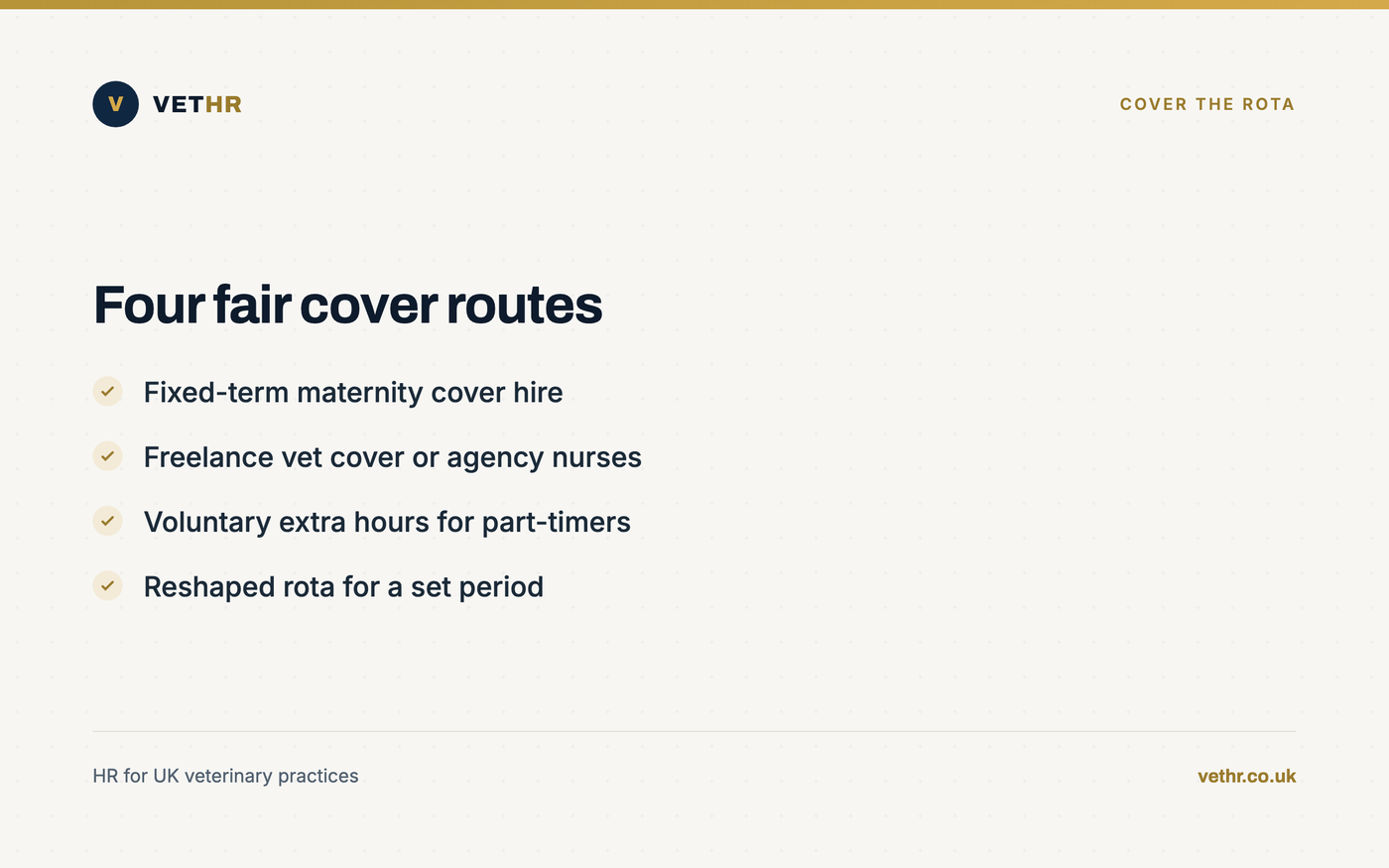
Cover maternity leave fairly by planning early, sharing the load deliberately, and bringing in extra hands rather than quietly leaning on the people who stayed. With up to 11 weeks of warning before the due date, you have time to choose a cover route on purpose instead of scrambling when she finishes.
You have a few honest options, and most practices blend them:
The burnout risk is real and worth naming. The RCVS Surveys of the Professions 2024 found poor work-life balance and chronic stress among the top reasons people leave the profession, with poor work-life balance cited by 56% of vets, according to the RCVS. Pile a year of uncovered shifts onto a stretched team and you risk losing a second person while the first is away.
Be transparent with the team. Tell them the plan, the timeframe, and what extra they are being asked to carry, then check in on it. Everyone watches how you treat someone when they need you, so a fair rota, set out clearly, is the practical heart of a leave handled well.
After Ordinary Maternity Leave of up to 26 weeks, she has the right to return to the same job on the same terms. If she takes Additional Maternity Leave and returns later, she is entitled to the same job, or a similar one on terms no worse than before if the original role genuinely is not available. Most practices simply welcome her back to her old role.
GOV.UK confirms the right to return to the same job after up to 26 weeks of maternity leave, and to the same or a similar job after longer leave, on its employee rights when on leave guidance. She also returns on her improved terms if pay or conditions rose while she was away, so do not freeze her on last year’s deal.
She may also ask to change her hours, often a flexible working request to go part-time. You must consider any such request reasonably and can only refuse for a sound business reason. For a hard-to-replace nurse or vet, a sensible pattern is often far cheaper than recruiting again.
Make the return feel like a welcome, not an interrogation. A short catch-up on what changed, a refresher on any new equipment, and a sensible first week go a long way. How she experiences week one shapes whether she stays, and good people are too scarce to lose at the door.
Maternity leave in a veterinary practice is up to 52 weeks, split into 26 weeks of Ordinary Maternity Leave and 26 weeks of Additional Maternity Leave, the same as any UK employer. It applies regardless of her hours or length of service. By law she cannot work for the 2 weeks immediately after the birth.
Statutory Maternity Pay is paid for up to 39 weeks: 90% of average weekly earnings for the first 6 weeks, then the lower of £194.32 or 90% of average weekly earnings for the next 33 weeks for the 2026 to 2027 tax year. To qualify she needs 26 weeks’ continuous service to the qualifying week and average weekly earnings of at least £129.
Only in a genuine redundancy, and with extra protection. You cannot select someone for redundancy because she is pregnant or on leave, and during the protected period, now up to 18 months from the birth, she must be offered any suitable alternative vacancy ahead of other staff. Dismissing her because of her maternity is automatically unfair.
Yes, KIT days are paid work and the pay should be agreed in advance. An employee can do up to 10 KIT days during maternity leave without affecting her leave or pay, but they are optional and both sides must agree. Any part of a day worked counts as one whole KIT day.
Yes. Statutory and contractual annual leave continues to accrue throughout the full 52 weeks of maternity leave. Because she usually cannot take holiday and maternity leave at the same time, you will normally agree to carry the leave over and take it before or after the maternity period.
Handled well, maternity leave is not a crisis but a planned chapter. Get the notice, pay and risk assessment right, keep her job open, cover the rota fairly, and welcome her back warmly. Do that, and you keep a skilled team member and earn the quiet loyalty of everyone who watched you do it properly.
If you want a second pair of hands on the paperwork and the plan, we are built for exactly this. Start with our maternity and family policies, see how we work in HR consultancy, or simply book a free HR health check and we will map out your next steps. Practical, kind, and tailored to your practice.
The Vet HR Team provides HR consultancy and white-labelled staff systems exclusively to UK veterinary practices.
—
Read next: Carer's Leave in a Veterinary Practice, Neonatal Care Leave in a Veterinary Practice and Paternity Leave in a Veterinary Practice.
Contracts, rotas, holiday, a difficult conversation. Tell us what you are dealing with and we will come back within one working day. Nothing to sign up to.
Got it. We will come back to you within one working day. If you do not see a reply, please check your spam folder.
