Last updated: 27 June 2026
TL;DR: Digital staff records for veterinary practices are the secure, organised version of every people file you must keep: contracts, right-to-work checks, working-time and pay records, training, registrations and absence. UK law sets minimum retention periods for several of them, and you must be able to produce them on request. Moving from drawers and spreadsheets to one access-controlled system makes that quick, accurate and far less risky than paper.
Staff records are the part of practice life nobody notices until they are needed. A right-to-work audit, a pay query, a tribunal, a sudden inspection: that is when a tidy file or a missing one decides how your day goes. This guide is a calm, practical look at what to keep, for how long, and how to hold it safely.
Digital staff records for veterinary practices are the complete set of employee files held in one secure system instead of paper folders, drawers and spreadsheets. They cover contracts, right-to-work evidence, working-time and pay records, training and CPD, professional registrations and absence, with access controls and a clear trail of who can see and change what.
The difference from paper is not just neatness. A digital record is searchable, backed up, and access-controlled, so the right person finds the right document in seconds and the wrong person never sees it at all. For a clinic with registered nurses, freelance vet cover and out-of-hours rotas, that single source of truth replaces the scattered filing that quietly creates risk.
This is a records and retention question, not a software shopping list. The aim is simple: keep what the law requires, keep it safe, and be able to hand it over when someone asks. Get those three right and the technology underneath matters far less than the discipline on top of it.
A veterinary practice must keep records covering employment terms, eligibility to work, hours, pay, training, registrations and absence. Some are a strict legal duty with a set retention period, others are needed to run a fair, defensible practice. Treat them as one connected file per person rather than separate piles that drift apart over time.
Two of those carry hard duties worth naming. Acas states that employers must keep working-time records for two years from the date they were made, and must be able to show that workers are not exceeding the 48-hour weekly maximum unless they have an opt-out agreement, in its guidance on the working time rules. A record that is missing for those two years is a gap you cannot fill later.
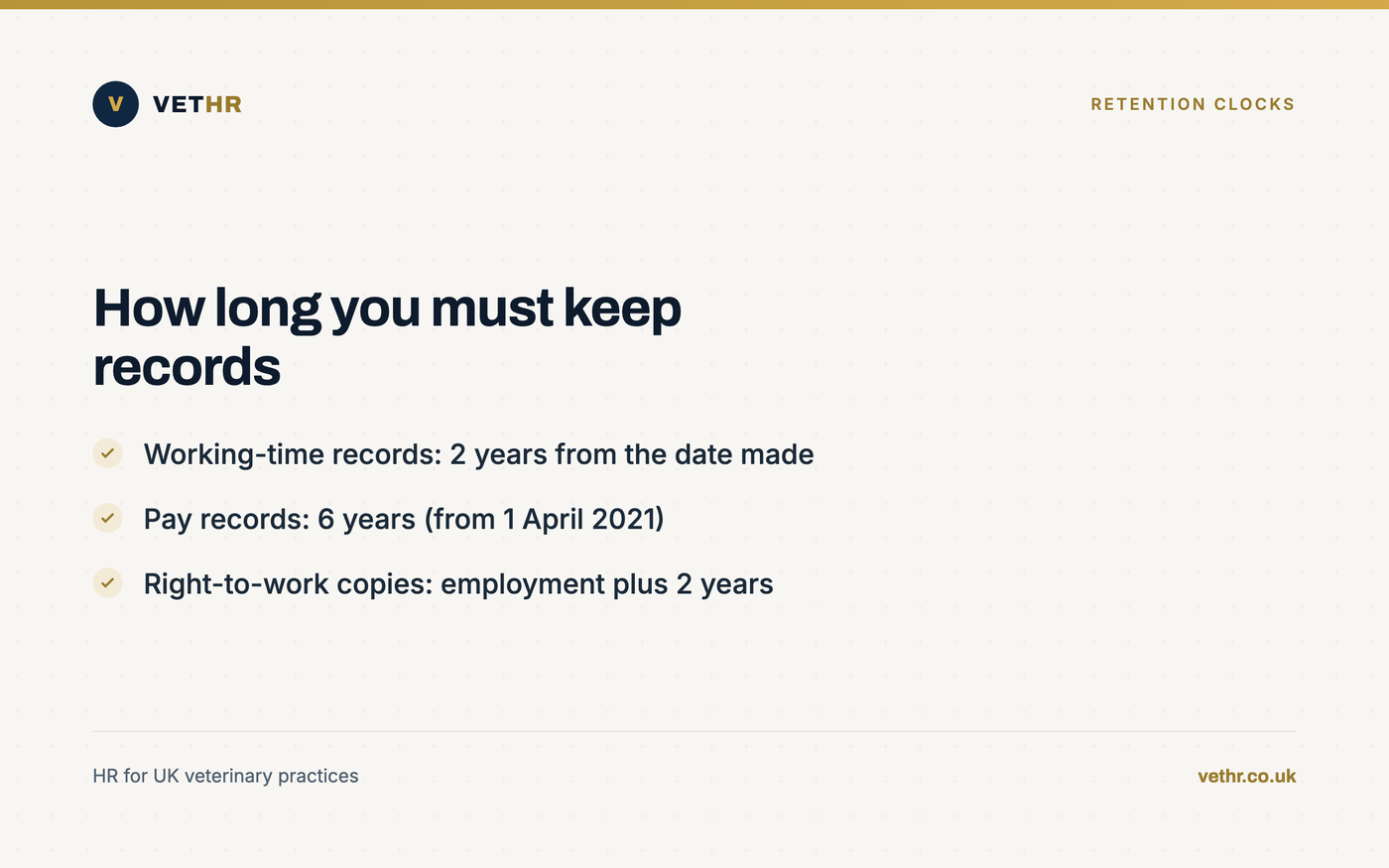
Retention varies by record type, and a few periods are set in law rather than left to choice. Pay and working-time records have fixed minimums, right-to-work copies have their own rule, and everything else should be kept only as long as you genuinely need it. Knowing the legal floors is what turns a guess into a defensible policy.
Pay records are the longest of the firm duties. GOV.UK guidance on enforcing the minimum wage states that, from 1 April 2021, employers must keep records for a minimum of six years after the end of the pay reference period following the one the records cover. If a worker asks for them, you have to produce them within 14 days, or a longer period you agree with the worker.
Right-to-work copies sit on their own clock. GOV.UK guidance on the right to work check says you must keep copies during the person’s employment and for two years after they stop working for you. Keep them earlier than that, or longer than that, and the copy stops protecting you in the way it was designed to.
For records without a fixed legal period, the rule is restraint. The ICO’s storage limitation principle says personal data must be kept for no longer than is necessary for the purpose, and that you must be able to justify how long you hold it, as set out in its guidance on the storage limitation principle. A written retention schedule, applied consistently, is how you show that judgement.
Not sure which of your records have a legal clock on them, or whether your retention is right? A 30-minute conversation usually settles it. Book a free HR health check and we will look at how you hold contracts, hours, pay and registrations today, then tell you plainly where you are compliant and where a tidy-up would help. Nothing sold for the sake of it.
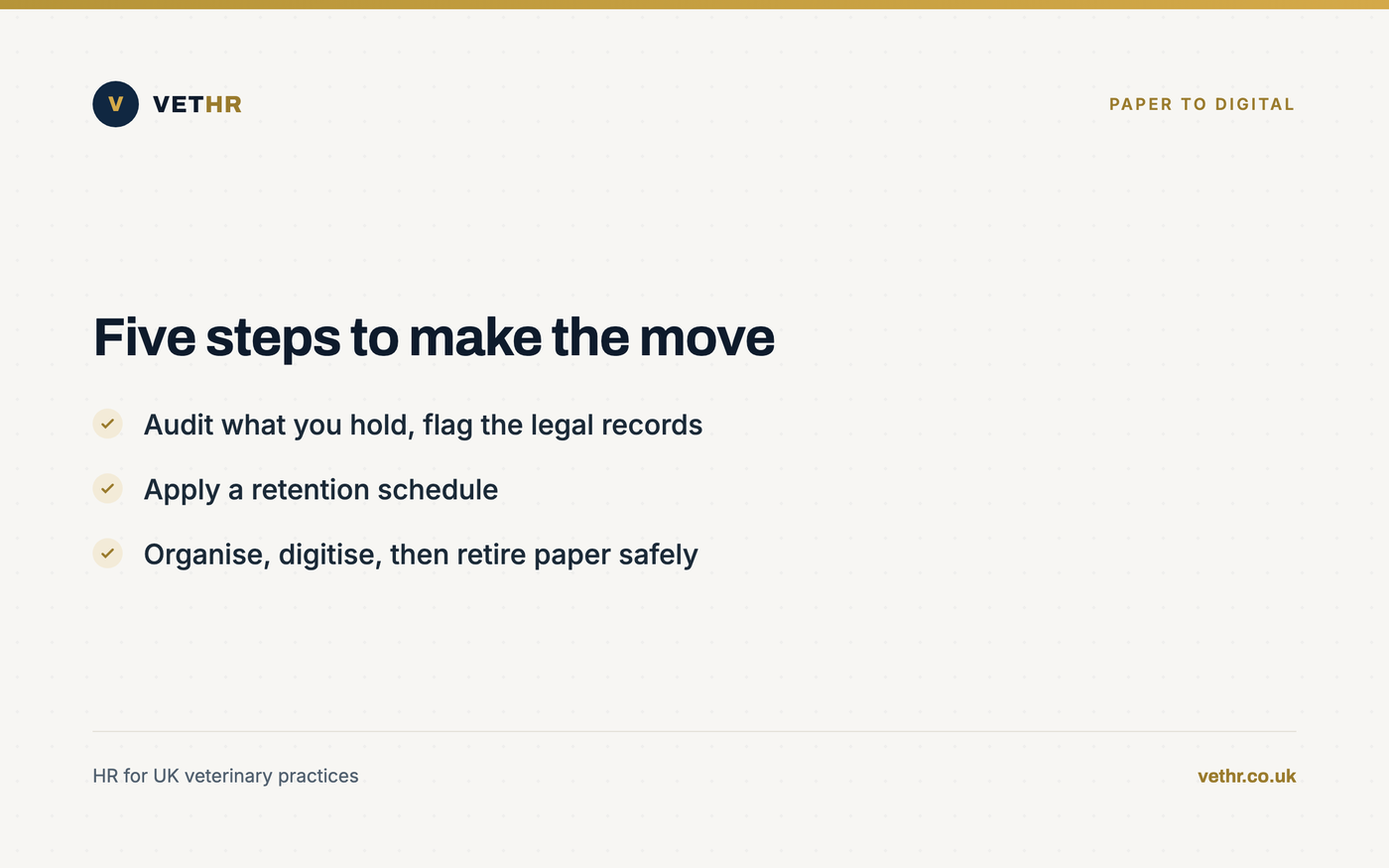
You move from paper to digital in stages: audit what you hold, decide what to keep, organise it per person, then store it in one access-controlled system and retire the drawers safely. Done in order, it is a calm afternoon’s project per handful of staff, not a leap. Rushing it is what creates the gaps you were trying to close.
The hidden benefit shows up later. Once records are digital and structured, renewals and reviews stop being a surprise, because a registration date or a contract change can prompt you instead of slipping past. Our staff systems and policies module are built so that the file and the workflow live together, not in separate worlds.
Staff records are personal data, so the UK GDPR applies in full. You must hold only what you need, keep it accurate, store it securely, retain it no longer than necessary, and let staff exercise their rights over it. A digital system makes those duties easier to meet, but it does not transfer them: the practice remains the responsible controller.
Data minimisation is the principle people forget. The ICO states you should hold the minimum personal data needed for your purpose and no more, and that holding more than necessary is likely to breach the principle, in its guidance on data minimisation. In practice that means not hoarding old applications, spare copies or details you will never use again.
Security is the duty paper quietly fails. A drawer has no audit trail and no access control, so anyone with a key sees everything. Digital staff records management lets you restrict sensitive files to the right people, log who opened or changed what, and recover from loss with a backup. That is a stronger position than a folder that walks out when someone leaves.
Health and disciplinary information needs extra care, because it is more sensitive than a holiday request. Keep it separate, restrict it tightly, and review it when a person leaves, retaining only what you genuinely still need for references or pensions. The goal is to protect the individual and the practice at the same time, not to keep everything just in case.
You produce records on request by being able to pull a complete, accurate per-person file quickly, whether the request comes from a worker, an auditor or a tribunal. That ability is the real test of your record-keeping. A system that stores everything but cannot export it cleanly fails the only moment that actually counts.
The minimum-wage rules make the standard concrete. GOV.UK’s enforcement guidance requires you to produce pay records to a worker within 14 days of a reasonable request, or a longer period you both agree. Fourteen days is generous only if your records are tidy; it is alarming if they live across drawers and spreadsheets nobody has reconciled.
The same principle covers a subject access request, where an employee asks for the personal data you hold on them. Digital records turn that from a frantic search into a controlled export, with a clear view of what you have and the chance to redact third-party detail properly. Our See It Report It incident log applies the same logic to dated, retrievable evidence.
The honest summary is that producing records on request is won long before the request arrives. If your files are complete, structured and access-controlled today, a future audit is a non-event. If they are not, no amount of urgency on the day will conjure a record that was never properly kept.
From 1 April 2021, employers must keep records for a minimum of six years after the end of the pay reference period following the one the records cover, according to GOV.UK guidance on enforcing the minimum wage. You must also be able to produce them for a worker within 14 days of a reasonable request, which is far easier with digital records than paper.
GOV.UK guidance says you must keep copies of a right-to-work check during the person’s employment and for two years after they stop working for you. Keeping them in a secure digital file, dated and linked to the individual, means the copy is there if you ever need to rely on it, and is not sitting in an unsecured drawer.
They can be, and usually more so than paper. The UK GDPR applies whatever the format, so you must minimise what you hold, keep it secure, and retain it no longer than necessary. Digital staff records management makes those duties easier through access controls, audit trails and a written retention schedule, but the practice stays responsible as the data controller.
At minimum, a written statement of employment particulars, right-to-work evidence, working-time records for two years, and pay records for six years. Most practices also keep training, professional registrations and absence, because they are needed to run fairly and to defend a decision. The legal records are the floor, not the ceiling, of sensible HR records retention.
It depends on the record. Right-to-work copies must be kept for two years after employment ends, and pay records for six years from the relevant pay period. Beyond fixed duties, the ICO’s storage limitation principle says you should keep personal data only as long as necessary and review it when someone leaves, deleting what you no longer need.
Good staff records are quiet insurance. You keep the contracts, right-to-work checks, hours, pay, training and registrations the law requires, hold them securely for the right length of time, and stay ready to hand them over. A digital staff records system simply makes that discipline practical, so a request becomes a non-event rather than a scramble.
If your files live across drawers and spreadsheets, start with an audit and let the gaps point the way. To see how the pieces fit, browse our staff systems, look at our policies module, or simply book a free HR health check and we will give you a straight view of where your records stand. You can also fold records support into a monthly subscription if you would rather we carried it with you.
The Vet HR Team provides HR consultancy and white-labelled staff systems exclusively to UK veterinary practices.
—
Read next: Employee Self Service in a Veterinary Practice.
Contracts, rotas, holiday, a difficult conversation. Tell us what you are dealing with and we will come back within one working day. Nothing to sign up to.
Got it. We will come back to you within one working day. If you do not see a reply, please check your spam folder.
