Last updated: 27 June 2026
TL;DR: Exit interviews in a veterinary practice are a short, structured conversation with someone who is leaving, run to learn why they are going and what would have made them stay. Done well, with a neutral interviewer and real confidentiality, they surface the patterns behind turnover that nobody mentions while still employed. The point is not the chat. It is the change you make afterwards.
When a good nurse or vet hands in their notice, the instinct is to focus on cover and move on. That is the moment you can least afford to skip. A leaver will tell you things a current employee never will, and those few honest minutes are some of the cheapest insight a practice can buy.
An exit interview in a veterinary practice is a structured conversation with a departing team member, held near the end of their notice, to understand why they are leaving and what would have changed their mind. It is not a goodbye chat. It is a deliberate way to gather leaver feedback you can act on, so the next person stays longer.
Acas frames the purpose plainly. In its guidance on responding to a resignation, it states that “arranging an exit interview can be useful to understand why the employee is leaving” and that “their reasons can help inform how you recruit or retain staff”, according to Acas. That last clause is the whole game: the interview only earns its place if it feeds a decision.
It is also part of good offboarding, not a bolt-on. The same conversation lets you hand over cases cleanly, recover keys and logins, and close outstanding matters before someone walks out of the door. A practice that runs exit interviews well rarely scrambles to reconstruct what the leaver knew.
Yes, and arguably more so in a small practice, where losing one person hits the rota harder and the cost of replacing them lands faster. Exit interviews in a veterinary practice are a low-cost way to catch a fixable problem that is quietly pushing others toward the door. You do not need a large team to benefit, only the willingness to listen and then act.
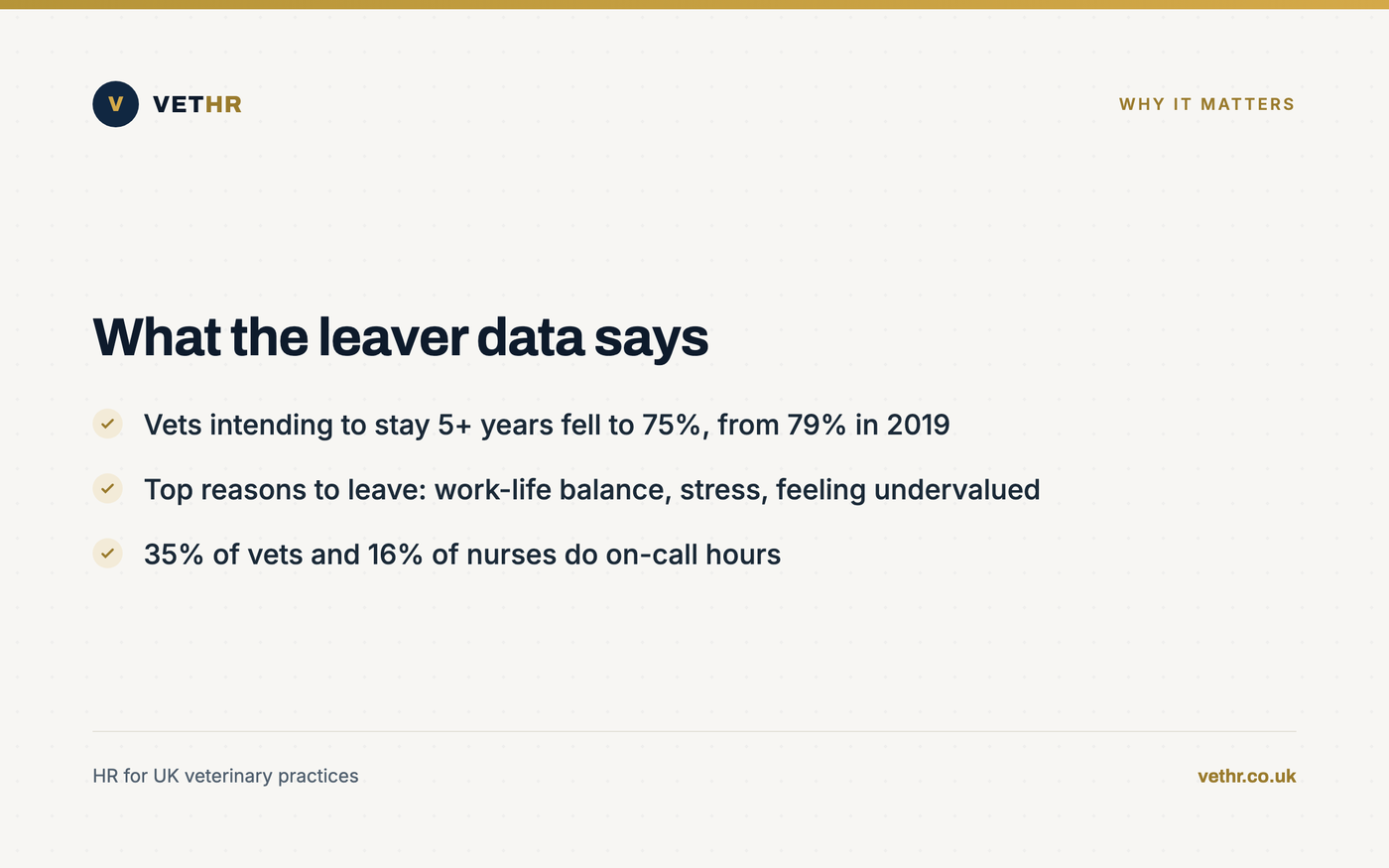
The wider picture explains the urgency. In the RCVS Surveys of the Professions 2024, the share of vets intending to stay in the profession for five or more years fell to 75 percent, down from 79 percent in 2019, according to the RCVS. In a tight recruitment market, every avoidable departure is harder and more expensive to replace.
What drives those exits is rarely a surprise once you ask. The same RCVS research lists the leading reasons for leaving as poor work-life balance at 56 percent, chronic stress at 54 percent, and not feeling rewarded or valued in a non-financial sense at 47 percent. Almost all of that is shaped by how a practice plans hours, shares cover and treats people day to day, which means almost all of it is within your control.
One leaver is an anecdote. Five leavers saying the same thing is a pattern, and a pattern is something you can fix. The practices that benefit most are the ones that treat every exit interview as one more data point in a picture that builds over time, rather than a one-off post-mortem.
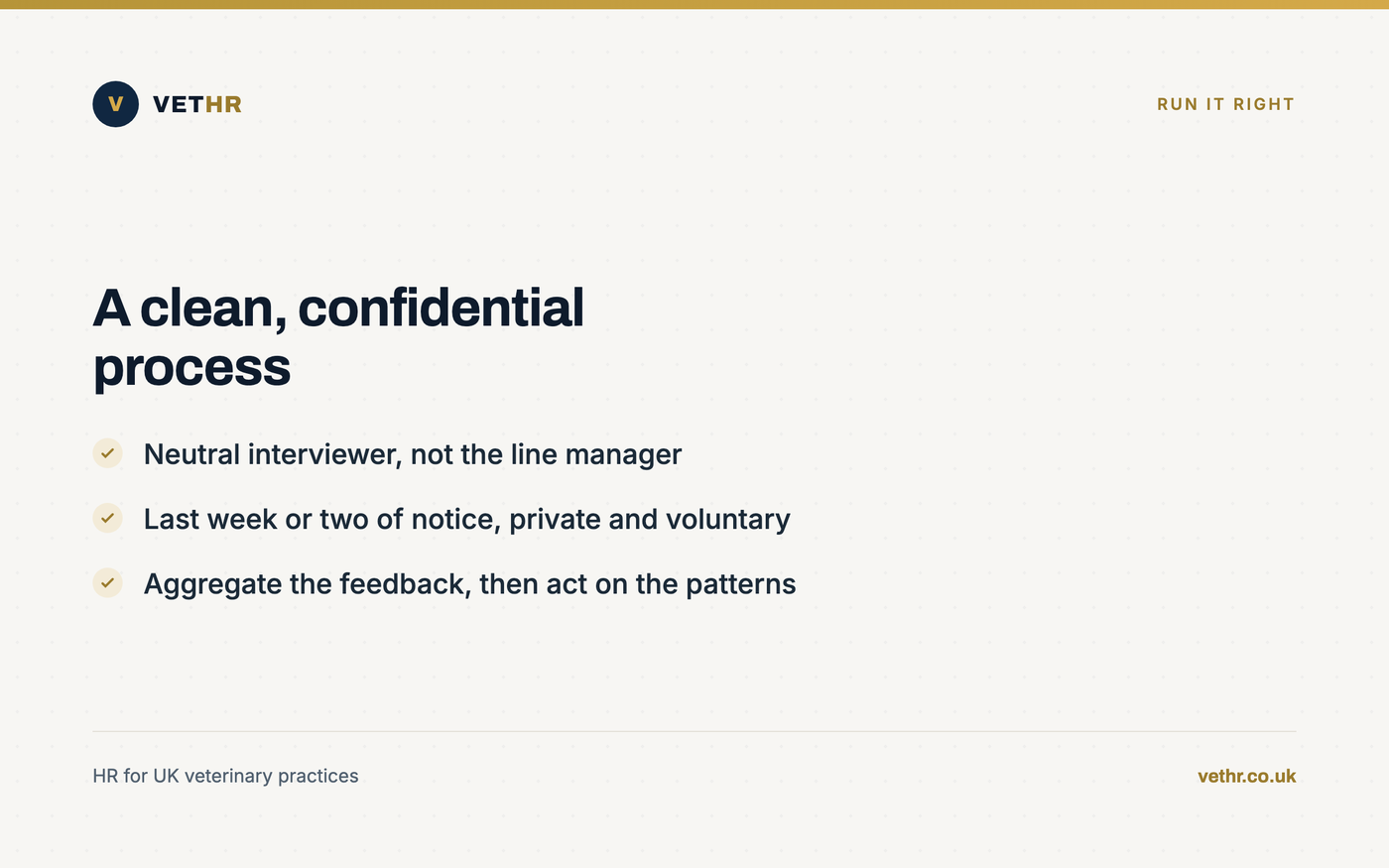
Exit interviews in a veterinary practice should be run by someone neutral, which usually rules out the leaver’s direct line manager. If a person is leaving partly because of their manager, they will not say so to that manager’s face. A practice manager, an owner who does not work alongside them daily, or an external HR specialist is far more likely to hear the truth.
This matters more in a small practice, where everyone knows everyone and candour costs more. The interviewer’s job is to ask, listen and record, not to defend the practice or relitigate decisions. The moment a leaver senses they are being argued with, the useful part of the conversation ends and you are left with politeness.
For some departures, a neutral outsider is the safer choice. If the exit is connected to a grievance, a conflict or a sensitive issue, an independent interviewer protects both the leaver and the practice and keeps the conversation calm. Our HR consultancy runs exit interviews on behalf of practices for exactly these cases, so the feedback is honest and the process is clean.
Run the exit interview in the last week or two of the notice period, once the leaver has decided and relaxed but before they have mentally left. Give notice of the meeting, hold it somewhere private and unhurried, and make clear that taking part is voluntary. A calm setting produces honest answers; a rushed one in the corridor produces nothing useful.
A live conversation usually beats a form. Talking in person, by phone or by video lets you follow up on a vague answer and hear the tone behind the words, which a tick-box sheet flattens. A short, consistent question set keeps you on track and makes patterns comparable across leavers, but the value is in the follow-up questions a form can never ask.
Whichever format you choose, keep it consistent. Asking every leaver broadly the same questions is what turns a handful of conversations into leaver feedback you can compare and trust, rather than a pile of unrelated impressions.
The best exit interview questions are open, specific and free of blame. Ask what prompted them to start looking, what the new role offers that this one did not, and what one change would have made them stay. Those three alone tend to surface the real reason behind the polite one, which is usually about hours, workload or feeling valued.
Pay attention to hours and cover in particular. The RCVS found that 35 percent of vets and 16 percent of veterinary nurses did on-call hours, and on-call is exactly where rotas turn unfair and resentment builds quietly. If several leavers raise the same shift pattern, you have found a retention problem worth fixing before the next person notices it too.
Listen for the gap between the stated reason and the underlying one. People often lead with pay because it is the safest answer, then reveal under gentle questioning that it was really the third weekend on call in a row or a feeling that nobody noticed the effort. The follow-up question is where the truth lives.
Not sure how to run an exit interview without it turning awkward, or who should hold it? A 30-minute conversation usually makes the path clear. Book a free HR health check and we will look at how you handle leavers today, share a question set you can use, and tell you honestly where leaver feedback could be tightening your retention. No jargon, nothing sold for the sake of it.
Confidentiality is what makes the honesty possible, so promise it and mean it. Tell the leaver how their feedback will be used, keep their identity out of anything you share with the wider team, and report findings in aggregate where you can. A leaver who fears their words will be quoted back to a colleague will simply tell you nothing useful.
That promise carries a data-protection duty too. Exit interview notes are personal data, so under UK GDPR you should only collect what you need, use it for the purpose you stated, and store it securely with controlled access, in line with the ICO’s data protection principles. Vague promises and a shared drive that everyone can read undermine the very confidentiality you offered.
Aggregation is the practical fix. When you tell the team that “several leavers raised on-call fairness this year”, you act on the insight without exposing any individual, which keeps future leavers willing to be candid. Handled this way, the conversation stays both honest and safe. Storing those notes properly is also where a tidy system helps; our staff systems keep records access-controlled rather than scattered across inboxes.
You close the loop. The value of an exit interview is realised only when the feedback becomes a decision, so log each one against a few consistent themes, review them together every quarter, and pick one or two changes the patterns clearly point to. Feedback that sits in a drawer is worse than no feedback, because it cost goodwill to gather.
Acas spells out the mechanism. It notes that a leaver’s reasons “can help inform how you recruit or retain staff”, giving the example that “if you find that employees regularly leave because the job is not what they expected, you could update future job adverts to be clearer about the role”, according to Acas. The pattern points to the fix; your job is to make it.
The themes worth tracking are the ones the wider data already flags. With work-life balance, stress and feeling undervalued topping the reasons people leave the profession, a recurring complaint about the on-call rota or a thin handover process is a signal, not noise. Fix the rota, share the cover more fairly, name the good work, and you treat the cause rather than the symptom.
This is the learning loop that separates a practice that keeps people from one that keeps replacing them. The leaver is gone, but the change you make is for everyone who stayed. Over a year, a handful of small adjustments driven by honest exit interviews can quietly lift retention more than any single grand gesture.
Whoever is most neutral. The leaver’s direct line manager is usually the wrong choice, because if the manager is part of the reason for leaving, you will not hear it. A practice manager, an owner who is one step removed, or an external HR specialist tends to get more honest answers and keeps the conversation calm.
No. There is no legal duty to hold an exit interview, and the leaver is never obliged to take part. Acas describes it as useful good practice for understanding why people leave, not a requirement. If you do hold one, the notes are personal data, so handle them in line with UK data protection rules.
A live conversation usually surfaces more, because you can follow up on a vague answer and hear the tone behind it. A form is quicker and lower pressure, which suits a reluctant or already disengaged leaver. Many practices get the fullest picture from a blend: a short form first, then a conversation about the answers.
Bring in a neutral interviewer, ideally external, and keep the meeting voluntary and unhurried. The aim is to listen and record, not to defend the practice or reopen the dispute. If the exit is tied to a grievance or conflict, an independent HR specialist protects both sides and keeps the feedback usable rather than heated.
Tell the leaver how the feedback will be used, keep their identity out of anything you share, and report themes in aggregate rather than quoting individuals. Store the notes securely with controlled access, since they are personal data under UK GDPR. Real confidentiality is what makes the honesty, and therefore the whole exercise, worthwhile.
Exit interviews in a veterinary practice are not a courtesy or a box to tick. They are the cheapest honest feedback you will ever get about why people leave, and the only catch is that you have to act on what you hear. Run them neutrally, keep them confidential, and let the patterns point to the fix.
If you want help building a simple, repeatable process, start with our HR consultancy, see how we keep records tidy with our staff systems, or simply book a free HR health check and we will give you a straight steer for your practice. Nothing sold that you do not need.
The Vet HR Team provides HR consultancy and white-labelled staff systems exclusively to UK veterinary practices.
—
Contracts, rotas, holiday, a difficult conversation. Tell us what you are dealing with and we will come back within one working day. Nothing to sign up to.
Got it. We will come back to you within one working day. If you do not see a reply, please check your spam folder.
