Last updated: 27 June 2026
TL;DR: Shift swaps in a veterinary practice work best with one clear rule set: staff request a swap, a named person signs it off, and the change is recorded in one place. Approval checks that cover is real, that rest and working-time limits still hold, and that pay is not quietly broken. Done well, swaps give your team flexibility without leaving the rota or payroll to chance. This guide gives you the policy, the checks and the seven rules that keep it fair.

Swaps feel small until one goes wrong. A nurse covers a colleague, nobody tells the rota, and the practice ends up double-booked or short on a Saturday. This is a calm, practical system for letting your team trade shifts fairly while keeping cover, compliance and pay intact.
Shift swaps cause problems when they happen by side conversation rather than by process. A swap arranged in the staff room, on WhatsApp or by a quick favour never reaches the rota, so the official record and reality drift apart. By the time anyone notices, cover is wrong, hours are off and payroll is guessing.
The veterinary week makes this worse than a flat office. You have consults running late, out-of-hours cover, registered nurses with set duties and the odd day filled by freelance vet cover. Swap two people without checking, and you can lose a skill the floor needs, or breach a rest rule without anyone meaning to.
There is a hard limit underneath all of it. Workers cannot work more than 48 hours a week on average, normally averaged over 17 weeks, according to GOV.UK guidance on maximum weekly working hours. A swap that pushes someone over without a written opt-out is not a favour, it is a breach the practice owns.
The fix is not to ban swaps. Staff value the flexibility, and refusing it costs you goodwill you cannot spare. The fix is to make every swap follow the same short path, so a kind gesture between colleagues never turns into a rota gap or a compliance problem the practice has to unpick later.
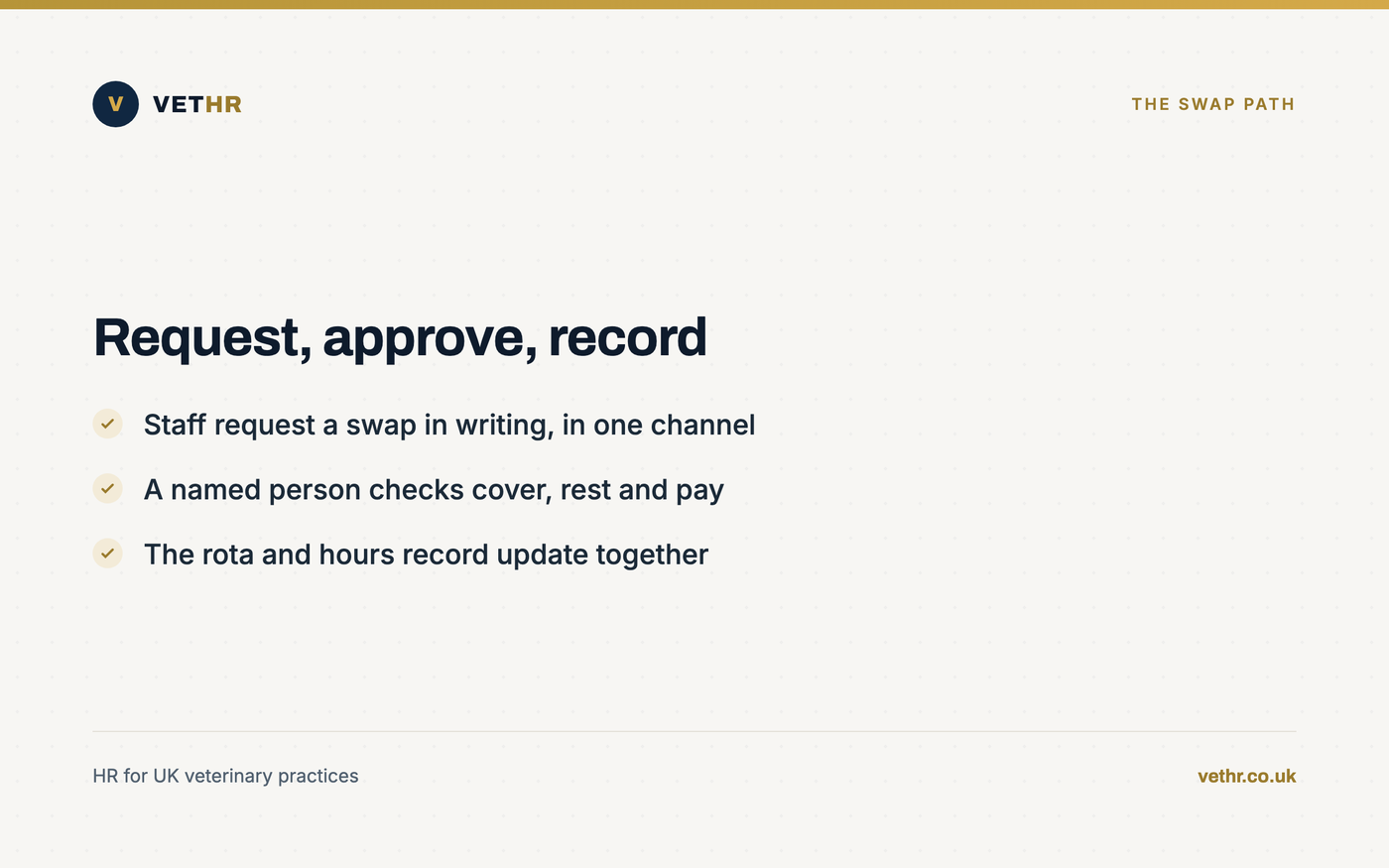
A shift swap policy should set out who can swap with whom, how far ahead a request must come in, who approves it, and what gets checked before a yes. It should be one page, written in plain terms, and the same for everyone. Clarity is what stops swaps becoming a source of resentment about who gets a favour.
The policy should also be honest about when a swap can be declined. A manager can say no if cover would suffer, if a rest or hours rule would break, or if one person is quietly carrying every unpopular shift. Naming the reasons in advance keeps a no fair rather than personal, and that fairness is what makes the whole system hold.
Keep the swap rules sitting alongside your other people documents, not in a separate silo. When your staff policies and your rota system point at the same rules, staff get one consistent answer instead of three versions depending on who they ask.
One named person should sign off every shift swap, usually the practice manager or whoever owns the rota that week. A single point of approval means someone always checks cover, skill mix and hours before the change is locked in. Without it, two staff can agree a swap that nobody with the full picture ever saw.
Approval is not a rubber stamp, it is a short checklist. Does the floor still have the right mix of vets and nurses on that shift? Does the swap keep both people inside their hours and rest entitlements? Is anyone now working a stretch that breaks a rule? Thirty seconds of checking prevents hours of untangling.
Build in cover for the approver too. If the practice manager is off, name a deputy who can sign swaps, so an urgent request does not stall or get waved through unchecked. The point of a named signatory is consistency, and consistency only works if the role is always filled, not just when one person is in.
A clock in and out record makes the approver’s job easier, because it shows what people actually worked, not what the old rota planned. When approval sits next to real attendance data, the person signing off is checking reality rather than a stale assumption. See how clock in and out feeds that picture.
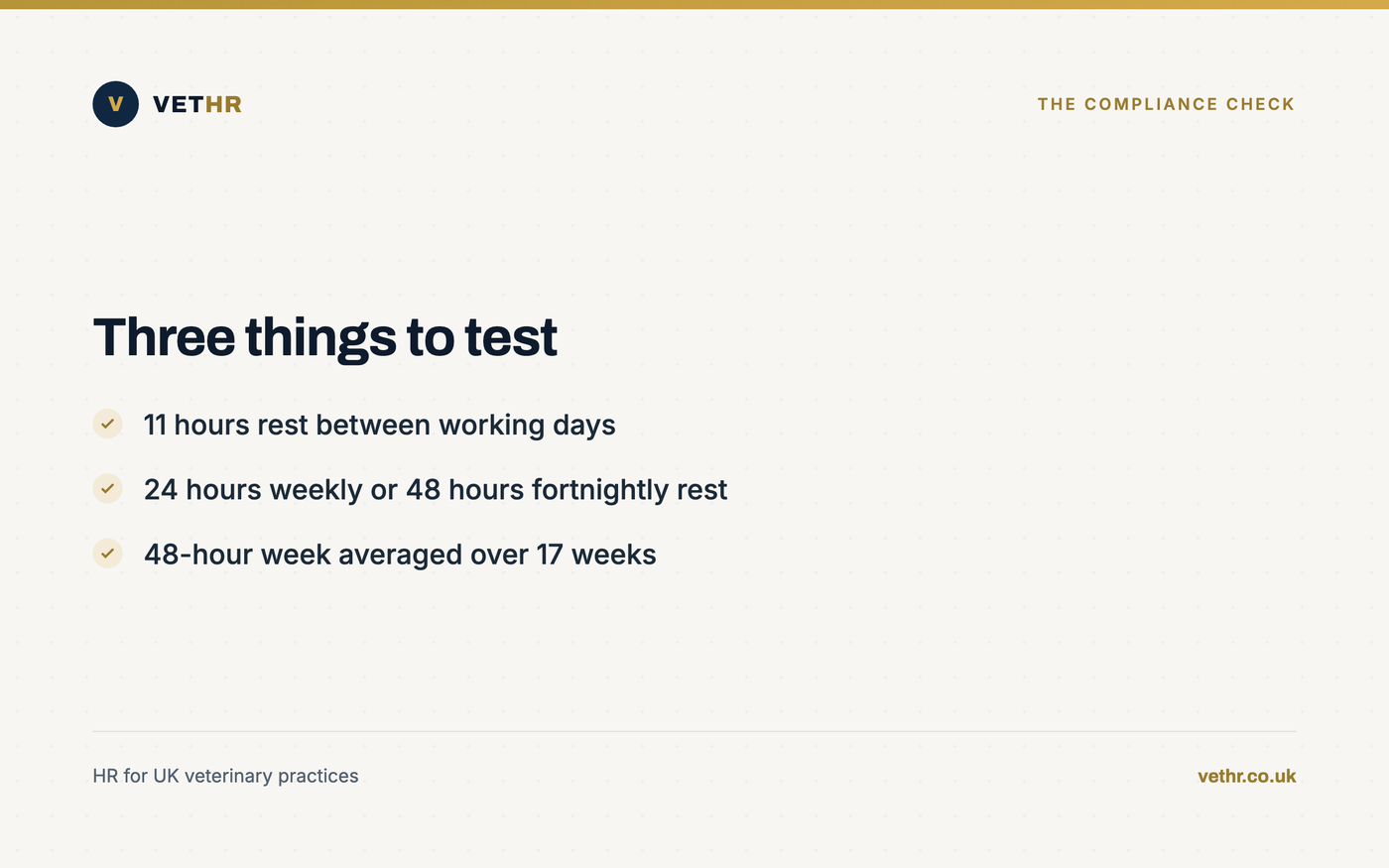
You keep a swap compliant by checking three things before approval: the weekly hours total, the daily rest gap, and the weekly rest gap. A swap can look fair on the surface yet quietly push someone past a limit, so the check has to run on the new pattern, not the old one. This is where most swaps go wrong unnoticed.
Start with rest between shifts. Workers have the right to 11 hours rest between working days, according to GOV.UK guidance on rest breaks. If a swap means someone finishes a late shift and starts early the next morning, that gap can vanish, so it is the first thing to test.
Weekly rest matters just as much. The same GOV.UK guidance confirms workers have the right to either an uninterrupted 24 hours without work each week, or an uninterrupted 48 hours without work each fortnight. A swap that strings shifts together can erase a rest day someone was entitled to, which the rota should flag before, not after.
Then the weekly ceiling. Because the 48-hour limit is averaged over 17 weeks, one heavy week from a swap is not automatically a breach, but a run of them can be. ACAS states that employers must keep records proving workers are not exceeding the 48-hour weekly maximum, in its guidance on the working time rules. If you cannot show the average, you cannot show compliance.
Not sure your current swap habit keeps you compliant? A short conversation usually makes it clear. Book a free HR health check and we will look at how your team trades shifts today, then tell you honestly where a swap could be breaching rest or hours rules, and where you are already fine. No jargon, nothing sold for the sake of it.
Yes, swapping shifts can change pay, which is why approval should always include a quick cost check. A like-for-like swap of two ordinary day shifts usually nets out. But swap a weekday for a weekend, a day for a night, or a standard shift for an on-call one, and the hours may carry different rates, enhancements or allowances.
The risk is that a swap arranged informally never reaches payroll, so people get paid for the shift they were rostered, not the one they worked. Over a month that quietly creates underpayments and overpayments, both of which erode trust and create work to correct. The swap record is what stops the gap.
Accurate hours are also a legal record, not just a courtesy. GOV.UK guidance on National Minimum Wage and different types of work sets out that what counts as working time, and therefore as paid hours, depends on the type of work and arrangement. A swap that changes the shape of someone’s hours can change what must be paid, so it needs to land in payroll correctly.
The practical answer is to make the swap record feed pay automatically. When the approved change updates the same hours your payroll runs from, nobody has to remember to tell anyone. The swap, the rota and the pay all move together, and the month-end reconciliation stops being a hunt.
For genuinely last minute cover, you need a faster lane that still records the change. A sick nurse at 7am is not the moment for a 48-hour notice rule, so the emergency route swaps the order: find cover first, confirm and log it straight after, rather than approve in advance. The discipline is logging it the same day, not skipping the record.
If last minute cover is happening every week, that is a signal, not a system to perfect. Constant scrambles usually mean the rota is too tight, the team is too thin, or absence is running high. The emergency lane should be a rare exception, and if it is not, the underlying rota is the thing to fix.
Every shift change should be recorded in one place that the rota, hours and pay all read from. The record needs five things: who was originally on, who covered, the date, who approved it, and when. That single entry is what keeps the official rota and the real day in step, and it is your evidence if anyone ever asks.
Records are not optional housekeeping, they are a legal duty. ACAS states that employers must keep working time records for two years from the date they were made, in its guidance on the working time rules. A swap changes what someone actually worked, so the record has to capture the real pattern, not the planned one.
Scattered records are where swaps unravel. If the change lives in a text message, the planned rota in a spreadsheet, and the worked hours in someone’s memory, none of them agree, and reconstructing the truth months later is painful. One source removes the guesswork and the argument.
This is exactly what a connected rota does well. When a swap is approved, the rota, the hours record and the pay calculation update together from one entry, so there is nothing to re-key and nothing to forget. See how our veterinary rota system keeps the plan, the hours and the pay aligned through every change.
Yes. An employer can refuse a shift swap if cover or skill mix would suffer, if it would break a rest or working-time rule, or if it creates an unfair pay or workload effect. The key is a consistent policy, so a no is based on stated reasons rather than who is asking. That consistency is what keeps shift swaps in a veterinary practice fair.
There is no legal notice period, so the practice sets its own. A common standard is 48 hours for planned swaps, which gives the approver time to check cover and hours, with a separate faster route for genuine emergencies like sickness. Putting the window in your shift swap policy stops every swap becoming a negotiation.
They can. A swap changes the hours someone actually works, so it counts toward the 48-hour weekly average and must still leave 11 hours of daily rest and the required weekly rest. The original rota no longer reflects reality, so compliance has to be checked against the new pattern the swap creates, not the plan it replaced.
Staff can find their own cover, but the swap should not be final until a named person approves and records it. Letting people sort cover between themselves is good for morale, but the practice still has to check skill mix, rest and pay. The split is simple: staff propose, the manager approves, the rota records.
Keep who was originally rostered, who covered, the date, who approved it and when. Because a swap changes worked hours, ACAS guidance says working time records must be kept for two years from the date they were made. Holding all of that in one connected place, rather than across messages and spreadsheets, is what makes the record reliable.
Handled well, shift swaps in a veterinary practice do not have to be a source of friction. The drama comes from swaps that skip the process, not from swaps themselves. One channel to request, one person to approve, one place to record, and the same checks every time, and a kind favour between colleagues stays exactly that.
If swaps are quietly breaking your rota or your pay, start there. To see how the pieces fit, look at our rota system, see how attendance feeds it with clock in and out, or simply book a free HR health check and we will give you a straight read on how your practice handles swaps today. Nothing sold that you do not need.
The Vet HR Team provides HR consultancy and white-labelled staff systems exclusively to UK veterinary practices.
Read next: Clock In and Out for Vet Practices and Shift Patterns for a Veterinary Practice.
Contracts, rotas, holiday, a difficult conversation. Tell us what you are dealing with and we will come back within one working day. Nothing to sign up to.
Got it. We will come back to you within one working day. If you do not see a reply, please check your spam folder.
