Last updated: 27 June 2026
TL;DR: To learn how to build a veterinary rota, work in order: map your demand and cover needs, list contracted hours and availability, slot in out-of-hours and breaks, then balance fairness before you publish. Start from what the clinic needs each day, not from who is free, and give the team enough notice to plan their lives. Build the legal rest rules in from the start, and treat changes as a process, not a panic.
A rota is the quiet engine of a practice. Get it right and the clinic feels calm, fair and properly staffed. Get it wrong and you pay in burnout, last-minute scrambles and good people drifting toward the door. This guide on how to build a veterinary rota gives you a constructive, step-by-step method, from a blank week to a published plan your team can trust.
The first step in how to build a veterinary rota is to start with what the clinic needs, not who is available. Map each day by the cover it requires: how many vets and registered nurses on the floor, consult capacity, theatre lists, reception and any branch sites. Build the rota around that demand picture first, and only then fit people to it. Staffing to availability is how practices end up overstaffed on Tuesdays and stretched thin on Saturdays.
Be honest about the shape of your week. Mondays after a weekend, late-afternoon consult rushes and seasonal peaks all need more cover than a flat average suggests. Look back at appointment data, admissions and walk-ins to find the real pattern, then set a minimum safe staffing level for each role in each slot.
Out-of-hours is a load-bearing part of this picture, not an afterthought. The RCVS Surveys of the Professions 2024 found 35 percent of vets and 16 percent of veterinary nurses did on-call hours. If on-call applies to you, factor it into the demand map from the very first draft so it is shared fairly rather than dumped on whoever is least likely to object.
Once you know the demand, lay the people against it. Gather every team member’s contracted hours, working pattern and any fixed commitments, such as a regular non-clinical day, study leave or a part-time arrangement. Veterinary rota planning falls apart when contracted hours live in someone’s memory rather than in front of you, so get them written down in one place before you place a single shift.
Separate three things clearly: what someone is contracted to work, when they are available, and when they have booked leave. Conflating them is where errors creep in. A nurse contracted for 30 hours over four days is a different planning problem from one contracted for 30 hours over five, even though the totals match.
Keep an eye on the weekly ceiling as you assign. UK working time rules cap the average working week at 48 hours, normally averaged over 17 weeks, and a worker can only exceed it with a voluntary written opt-out, as set out on the GOV.UK guidance on maximum weekly working hours. Track planned hours per person as you build, not after, so nobody quietly drifts over the limit across a busy run of weeks.
If your practice provides out-of-hours, slot it in before the day shifts feel finished, not after. On-call and night cover shape everything around them, because a person who worked late or carried the phone needs protected rest before their next shift. Treat out-of-hours as the first constraint you design around, then build the ordinary week to respect it.
The hard rule to honour is daily rest. Workers have the right to 11 hours of rest between working days, according to GOV.UK guidance on rest breaks at work. So if someone finishes a late or on-call shift, their next start has to sit at least 11 hours later. Bake that gap into the rota rather than discovering you have broken it after publishing.
Rotate on-call so it is shared, and make the pattern visible to everyone. When out-of-hours is spread evenly and planned weeks ahead, people can arrange their lives around it. When it is decided ad hoc, it becomes the single fastest way to make a fair rota feel unfair. Our veterinary rota system is built to treat shifts, cover and out-of-hours as normal, not edge cases.
Breaks are not a nicety you add if the day allows; they are a legal entitlement you design in from the start. Build them into the rota as real, rostered time so a busy clinic cannot quietly swallow them. A break that exists only on paper is the kind of detail that surfaces in a dispute, and it is entirely avoidable with a few minutes of planning.
The baseline is clear. Workers have the right to one uninterrupted 20-minute rest break during the working day when they work more than 6 hours, per the GOV.UK guidance on rest breaks at work. For a clinic, that means rostering cover so a vet or nurse can actually step away, rather than eating lunch between consults and calling it a break.
Weekly rest matters too. The same guidance gives workers an uninterrupted 24 hours without work each week, or 48 hours each fortnight. Plan those rest windows deliberately across the team so the rota guarantees genuine days off, not just the gaps that happen to fall out of the puzzle once everything else is placed.
Not sure your current rota respects breaks, daily rest and the weekly cap? A 30-minute conversation usually makes it clear. Book a free HR health check and we will look at how you plan shifts, out-of-hours and rest today, then tell you honestly where you are compliant and where a tidy-up would help. No jargon, nothing sold for the sake of it.
Fairness is what makes a rota stick. Once the demand is covered and the rules are met, balance the load: spread weekends, late finishes and on-call evenly, rotate the unpopular slots, and avoid loading the same reliable people every time. A rota that is technically legal but visibly lopsided will still cost you goodwill, and eventually staff.
Make the principles explicit so fairness is a system, not a favour. Decide how weekends rotate, how requests are prioritised when they clash, and how often someone can expect a Saturday off. Write it down. When the logic is visible, people accept an unwanted shift far more readily, because they can see their turn coming and going like everyone else’s.
Watch for the quiet imbalances. The most flexible nurse absorbs the awkward gaps, the newest vet gets the worst on-call run, and nobody means it to happen. Fair shift planning means tracking who carries what over time, not just within a single week, so the burden genuinely rotates across the whole team.
A finished rota is only useful if people see it in time to plan around it. Publish far enough ahead that the team can arrange childcare, appointments and a life outside work. There is no single legal notice period for a rota in Great Britain, but late and shifting rotas are one of the most reliable ways to erode trust, so set your own standard and hold to it.
Pick a notice window and make it a promise. Many practices commit to publishing two to four weeks ahead and protect that as a fixed habit. The exact number matters less than consistency: a rota that always lands on the same day, the same distance out, lets people stop worrying about it and get on with their work.
Publish it where everyone can see the same live version. One shared source, not a printout that goes stale and a group chat that contradicts it. When the team trusts that the published rota is the real rota, you remove a whole category of confusion. Our clock in and out system then captures the actual hours worked against the plan, so planned and real time sit together.
No rota survives a sick day untouched, so plan for change as part of the design. Agree in advance how swaps are requested, who approves them, and how the published rota gets updated so it stays the single source of truth. A clear, calm process turns a staffing wobble into a quick adjustment rather than a frantic round of phone calls.
Set simple rules for swaps. A swap should be requested with notice where possible, approved by whoever owns the rota, and checked against rest rules so two people do not solve one gap by creating another breach. Keep a record of who agreed to what, so there is no dispute later about a shift that quietly moved.
Have a cover plan for the genuine emergencies. Decide how short-notice gaps are filled, whether through a standby arrangement or freelance vet cover, before you need it. The practices that stay calm in a crisis are the ones that wrote the plan down on a quiet afternoon, not the ones improvising at 7am.
A good rota is never finished; it is reviewed. Every few weeks, compare planned hours against actual hours, look at where cover ran short or sat idle, and ask the team what felt fair and what did not. Treat the rota as a living system you tune, not a fixed grid you defend, and it will keep getting better.
Let the data lead the tweaks. If theatre lists keep overrunning, or a particular slot is always under-covered, the pattern will show up in the gap between plan and reality. Small, evidence-based adjustments beat a dramatic redesign every six months, because they keep the rota matched to how the clinic actually behaves.
Keep your records as you go, because the law expects it. Acas guidance on the working time rules states that employers must keep working time records for two years from the date they were made. A rota that captures planned and actual hours cleanly turns that obligation into a non-event, and gives you the evidence to keep improving.
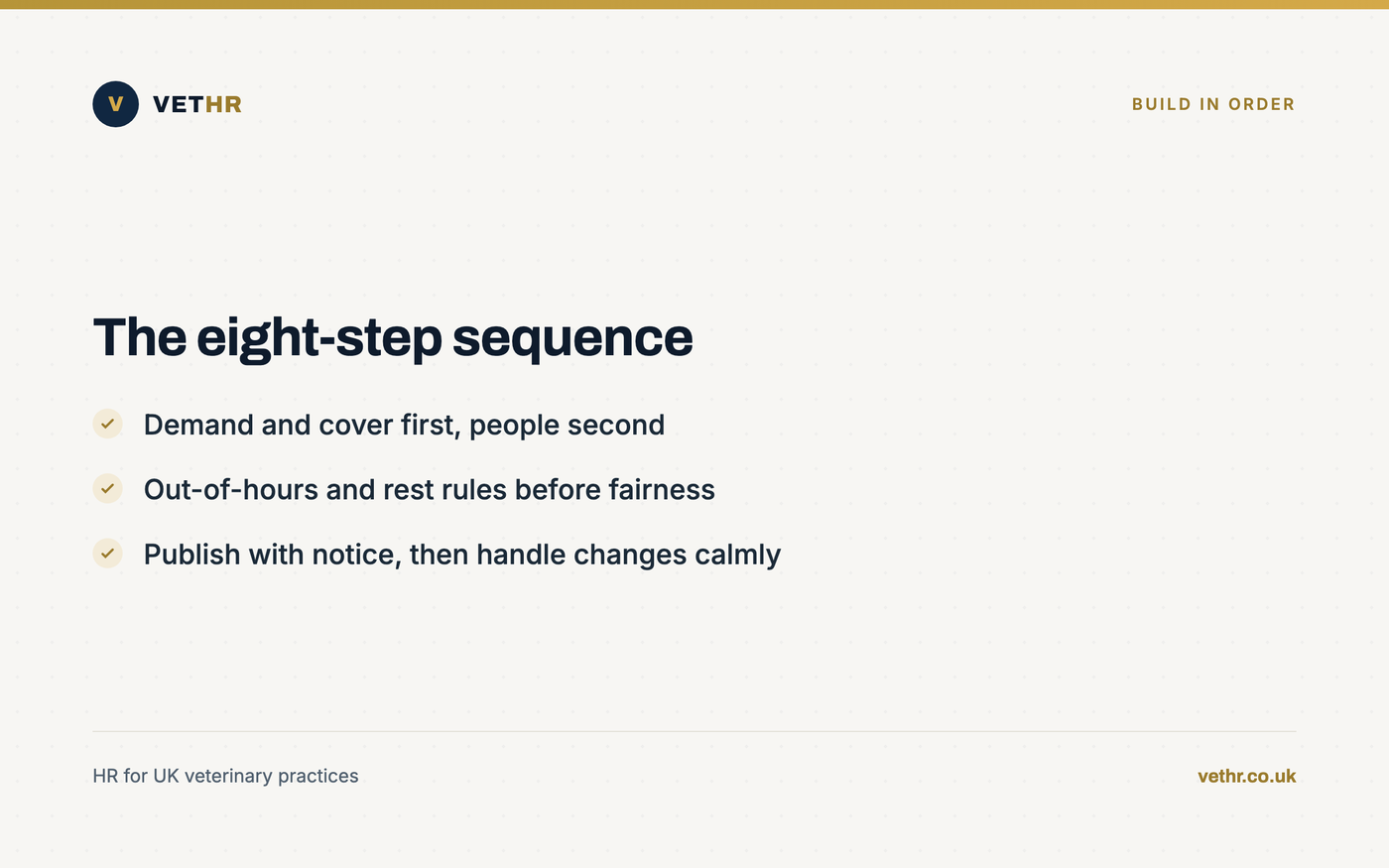
Build it in order. Map the demand and minimum safe cover for each day, then lay contracted hours and availability against it. Slot in out-of-hours and on-call, build in legal rest breaks and daily rest, balance fairness across the team, and publish with enough notice. Knowing how to build a veterinary rota is really about following that sequence every time.
There is no single statutory notice period for a rota in Great Britain, but more notice means a calmer, more loyal team. Many practices publish two to four weeks ahead and protect that as a fixed habit. The exact figure matters less than consistency: a rota that always lands the same distance out lets people plan their lives with confidence.
Spread the unpopular slots evenly and make the rules visible. Rotate weekends, late finishes and on-call so the same reliable people are not loaded every time, and track the burden across weeks, not just within one. When the team can see the logic and watch their turn come and go like everyone else’s, an unwanted shift feels acceptable rather than unjust.
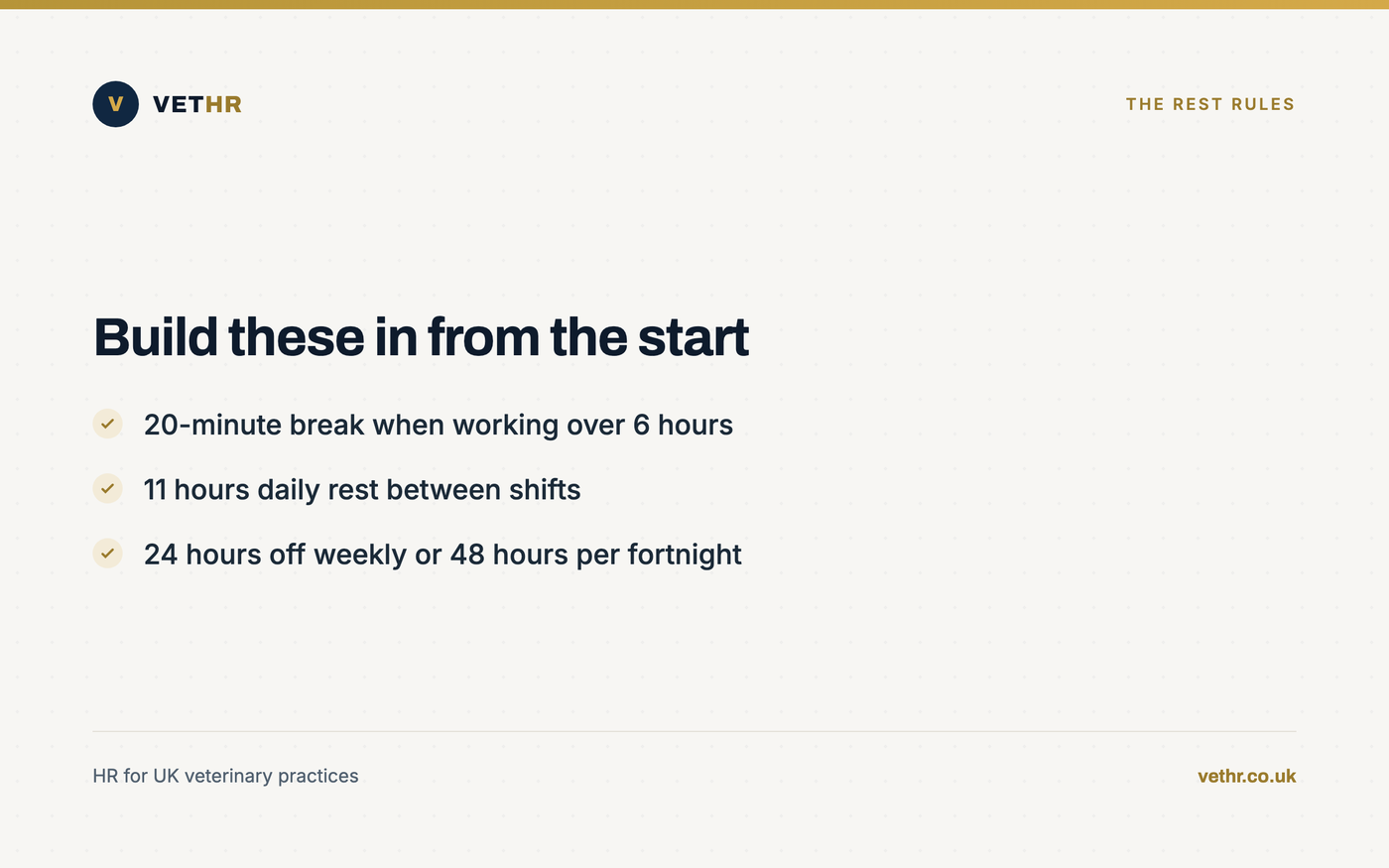
Workers have the right to one uninterrupted 20-minute break when they work more than 6 hours, 11 hours of rest between working days, and either 24 hours off each week or 48 hours each fortnight, per GOV.UK rest break guidance. Build all three into the rota as real rostered time, so a busy clinic cannot quietly absorb them.
A spreadsheet can work while the team is small and stable. The trigger to move is friction: rest-rule breaches slipping through, on-call landing unfairly, or planned and actual hours never quite matching. A purpose-built system tracks the weekly cap, rest gaps and fairness as you build, which a manual grid leaves you to police by hand.
A strong rota comes down to a deliberate order: demand first, then people, then rest rules, then fairness, then a clear publish-and-change routine. Do it that way and the rota stops being a weekly headache and starts being the thing that keeps your practice calm, compliant and properly covered. The legal rest rules are not obstacles; they are the floor you build on.
If you want a hand making it stick, explore our veterinary rota system, see the full range of staff systems, or simply book a free HR health check and we will give you a straight assessment of how your rota runs today. Nothing sold that you do not need.
The Vet HR Team provides HR consultancy and white-labelled staff systems exclusively to UK veterinary practices.
Related reading: HR for out of hours veterinary practices
Read next: Overtime for Veterinary Staff and The Christmas Rota in a Veterinary Practice.
Contracts, rotas, holiday, a difficult conversation. Tell us what you are dealing with and we will come back within one working day. Nothing to sign up to.
Got it. We will come back to you within one working day. If you do not see a reply, please check your spam folder.
