Last updated: 27 June 2026
TL;DR: TUPE for veterinary practices is the law that protects staff when a practice is bought, sold or merged. The team usually transfers to the new owner on their existing terms, with continuous service preserved, and both the old and new owner must inform and consult before the deal completes. Get the timing or the paperwork wrong and the bill can be high. This guide covers when TUPE applies, what staff keep, the duty to consult, measures letters, and the mistakes owners make.

Buying or selling a practice is a big moment, and the people are the practice. TUPE is the part of the deal that decides whether your team arrives settled or unsettled. This is a calm walk through how it works, written for owners, not lawyers, so you know what to expect before contracts move.
TUPE for veterinary practices is the Transfer of Undertakings (Protection of Employment) Regulations 2006 applied to a clinic that changes hands. When a practice is bought, sold or merged, TUPE protects the staff: their jobs usually move to the new owner, their employment terms and conditions transfer, and their continuity of employment is maintained.
In plain terms, the law treats the transfer as if nothing changed for the employee. According to GOV.UK guidance on business transfers and TUPE, when TUPE applies the employees’ jobs usually transfer over to the new company, their employment terms and conditions transfer, and continuity of employment is maintained. The receptionist keeps their start date. The nurse keeps their contract. The new owner inherits the team, not a blank slate.
This matters because a practice is its people. A buyer paying for goodwill is largely paying for a working team and its clients. TUPE is what stops that team being unpicked on day one, and it is why both sides need to handle the transfer carefully rather than hope it sorts itself out.
TUPE applies when a business, or part of a business, moves from one employer to another and keeps its identity, which covers most practice sales and mergers. GOV.UK splits protected transfers into two types: business transfers, where a business or part of it moves between employers including mergers, and service provision changes, where services move in or out of house.
For a typical practice deal, the relevant route is the business transfer. If you sell the practice as a going concern, with its clients, premises and team continuing, TUPE almost always bites. The same is true for a merger of two clinics where one team folds into another. The staff assigned to the transferring practice move with it automatically.
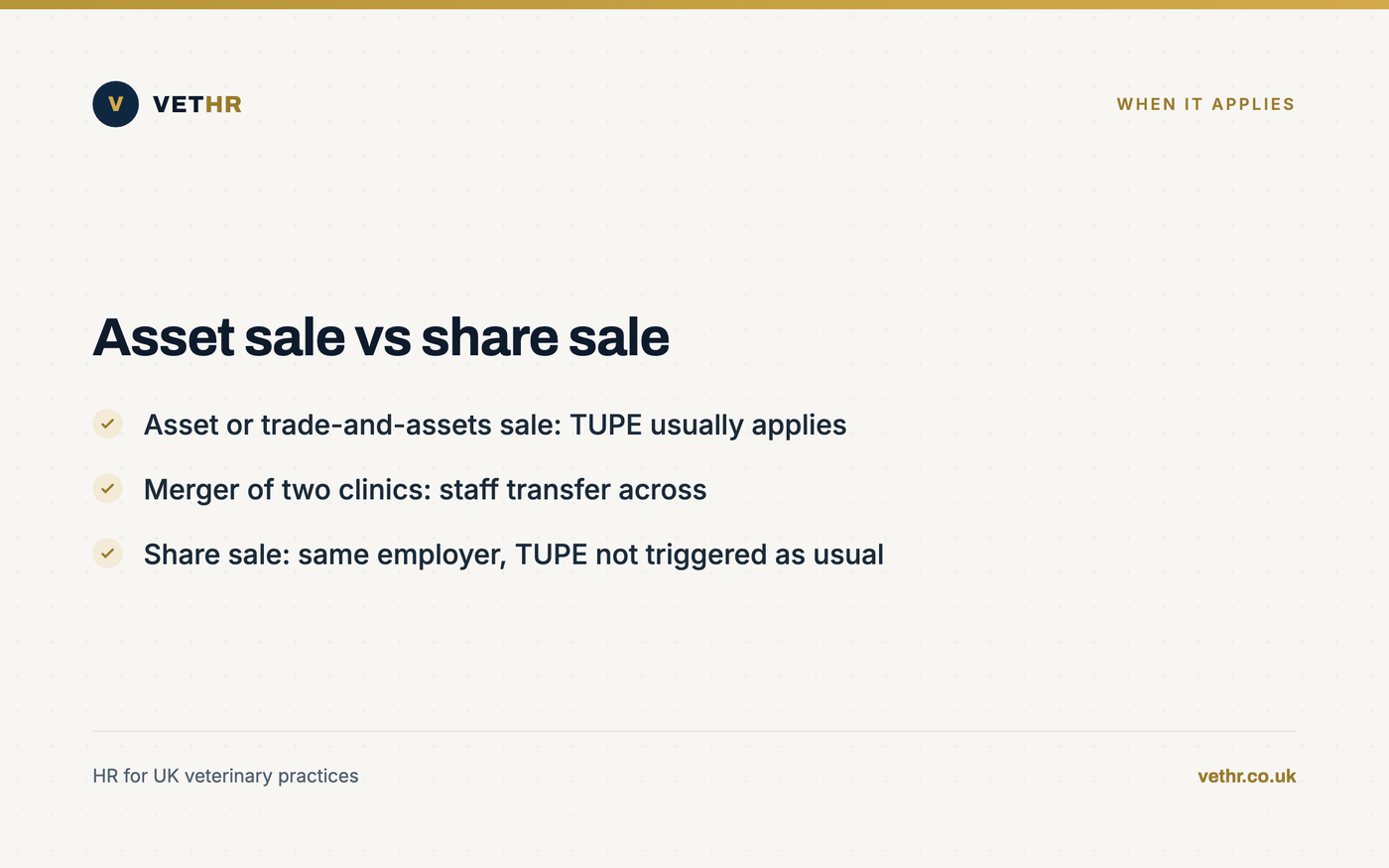
One distinction trips people up. Selling the company shares is not the same as selling the business assets. A share sale changes who owns the company, but the employer on the contracts stays the same, so TUPE does not apply in the usual way. An asset or trade-and-assets sale, which is common for independent practices, does trigger TUPE. The structure of your deal decides this, which is one reason a solicitor belongs at the table alongside HR support.
It is worth being clear here. Vet HR provides HR consultancy and documentation support, not legal advice, and a practice sale is exactly the point where a solicitor should also be involved. We handle the people and paperwork side; your solicitor handles the contract of sale and confirms how TUPE applies to your specific deal.
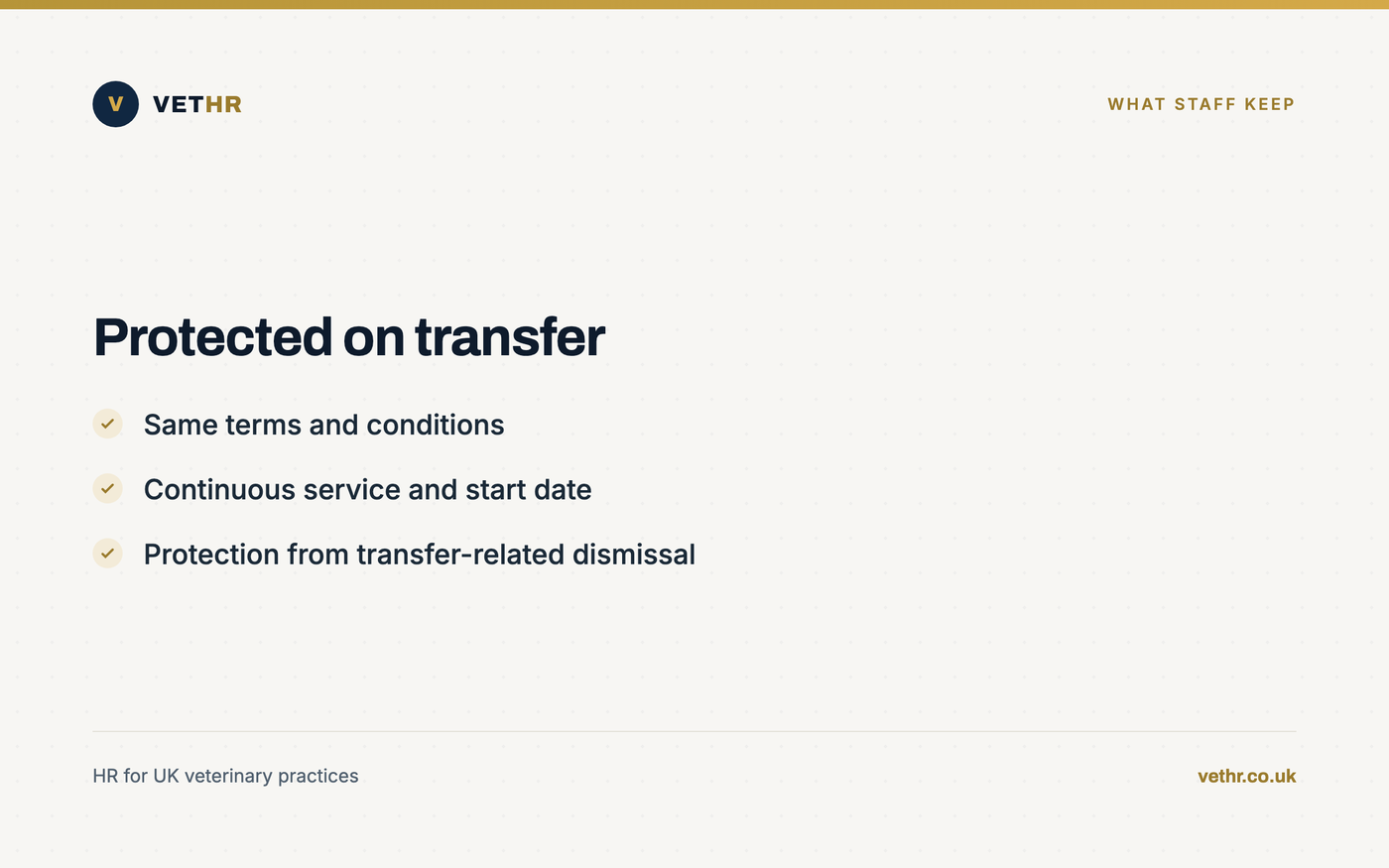
The whole point of TUPE for veterinary practices is that staff keep their existing terms and conditions, their continuous service, and protection from dismissal connected to the transfer. The new owner takes over the contracts as if they had made them in the first place. Pay, hours, holiday entitlement, notice periods and start dates all carry across unchanged.
GOV.UK is specific on this. Its guidance on transfers of employment contracts states that the new employer takes over employees’ employment contracts including all the previous terms and conditions, and that an employee’s start date is the same as before the transfer, so continuous employment is not broken. For your team, the message is simple: nothing about their deal gets worse because the practice changed owner.
Changing those terms afterwards is tightly limited. Acas guidance on changing a contract after a TUPE transfer states there is no limit on how long TUPE protects employees’ terms and conditions, and that an employer cannot change terms to something worse unless there is a valid economic, technical or organisational (ETO) reason involving a change in the workforce, and the employee agrees. You cannot simply harmonise the new team onto your existing contracts to tidy things up.
Dismissal is protected too. A dismissal is automatically unfair if the sole or principal reason is the transfer itself, rather than a genuine ETO reason entailing changes in the workforce, such as a real redundancy. Buyers sometimes assume they can let staff go to make room. Without an ETO reason, that is an unfair dismissal waiting to happen, and tribunals do not look kindly on it.
The duty to inform and consult means both the old and the new owner must, by law, tell affected staff about the transfer and consult them about any changes before it happens. Acas states that, by law, both the old and new employers must inform and consult before a TUPE transfer. This is not a courtesy. It is a legal step with real penalties if skipped.
Informing and consulting are two different things. Acas defines informing as telling affected employees or their representatives the facts about the transfer, and consulting as talking and listening to them about any expected “measures”, which Acas describes as any changes that will affect employees. You must inform even where there are no changes to consult about.
The detail you must share is set out plainly. GOV.UK guidance on consulting and informing during a transfer states employers must tell representatives that the transfer is happening, when it is happening and why, how it will affect employees, whether there will be any reorganisation, and how many agency workers are being used and what work they do. Vague reassurance is not enough.
Most independent practices can consult their team directly. Acas guidance on who you must inform and consult confirms an employer can consult employees directly where there are no recognised trade union or employee representatives and either there are fewer than 50 employees or fewer than 10 employees are transferring. For a five to fifty person practice, that usually removes the need to run an election for representatives.
Buying or selling and not sure where TUPE leaves you? A 30-minute conversation usually clears the fog. Book a free HR health check and we will look at your team, your contracts and your timeline, then tell you what the transfer needs and where your solicitor should pick up. No jargon, nothing sold for the sake of it.
A measures letter is the written notice the new owner gives the old owner setting out any “measures”, meaning changes, they plan to take in relation to the transferring staff. The seller needs it because they cannot lawfully consult their own team about the buyer’s plans without knowing what those plans are.
The chain runs in one direction. The buyer tells the seller their intentions in writing. The seller then informs and consults their staff using that information. Because Acas defines measures as any changes that will affect employees, the buyer’s letter should be honest about anything that touches rotas, reporting lines, pay arrangements, pension or location, even where the answer is “no changes planned”.
A clean measures letter protects both sides. For the seller it evidences that consultation was meaningful, not guesswork. For the buyer it sets expectations with the team they are about to inherit, which is exactly the team whose goodwill they have paid for. This is documentation work we do every day, sitting alongside your employment contracts so the wording is consistent before and after the deal.
The common TUPE mistakes are leaving consultation too late, assuming a share sale needs it, trying to change terms straight after, dismissing staff without an ETO reason, ignoring continuity of service, and skipping the measures letter. Each one is avoidable with a little planning. Each one can turn a smooth handover into a claim.
The thread running through all six is time. TUPE for veterinary practices rewards owners who plan the people side as early as the price, and punishes those who treat it as paperwork to rush at the end. The earlier you map the team, the contracts and the consultation, the calmer completion day is for everyone, including the clients who never notice a thing.
Usually, yes, if you buy the practice as a going concern. GOV.UK treats the sale of a business or part of a business, including a merger, as a transfer where the staff move with it. The exception is a share sale, where the company stays the same employer. Your solicitor should confirm how TUPE applies to your specific deal structure.
Not easily. Acas states there is no time limit on TUPE protection, and you cannot worsen terms where the reason is the transfer. Changes are only possible with a genuine economic, technical or organisational reason involving a change in the workforce, and the employee’s agreement. Harmonising the new team onto your existing contracts to tidy up is not allowed.
Yes, the duty to inform and consult always applies, but small practices can usually do it directly. Acas confirms you can consult employees directly where there are no recognised representatives and either you have fewer than 50 employees or fewer than 10 are transferring. Most independent practices fall inside that, so you avoid running a formal election.
They carry across intact. GOV.UK states an employee’s start date stays the same after a transfer, so continuous employment is not broken. Accrued holiday, notice entitlement and length of service all transfer to the new owner. Treating a transferred team member as a brand new starter is a common and costly error that the law does not recognise.
No. Vet HR provides HR consultancy and documentation support to veterinary practices, not legal advice. On a practice sale we handle the people side: consultation, measures letters, contracts and records. Because TUPE on a sale also has legal aspects, we work alongside your solicitor, who confirms the deal structure and how the regulations apply to it.
TUPE is not a hurdle to clear at the last minute. It is the framework that lets a practice change hands with its team intact, its clients undisturbed and its goodwill preserved. Handled early, it is calm. Handled late, it is where deals get expensive. The people are the practice, and TUPE is how you protect them through the change.
If you are buying, selling or merging, start with the team and let it guide the timeline. See how we support transfers in HR consultancy, get your employment contracts consistent before completion, or simply book a free HR health check and we will give you a straight steer for your deal, then point you to your solicitor where the law needs one.
The Vet HR Team provides HR consultancy and white-labelled staff systems exclusively to UK veterinary practices.
Read next: How to Restructure a Veterinary Practice Without Making Anyone Redundant.
Contracts, rotas, holiday, a difficult conversation. Tell us what you are dealing with and we will come back within one working day. Nothing to sign up to.
Got it. We will come back to you within one working day. If you do not see a reply, please check your spam folder.
