Last updated: 27 June 2026
TL;DR: Redundancy in a veterinary practice is fair only when the role is genuinely no longer needed, the selection is objective, you consult properly, and you pay the right notice and redundancy money. Get any of those wrong and a dismissal can become an unfair dismissal claim. This guide walks through genuine redundancy, fair selection criteria, consultation, redundancy pay and notice, and the alternatives worth exhausting first.
Few things weigh on a practice owner like letting a colleague go. The pressure to act quickly is real, but the law rewards a calm, documented process. This guide keeps it practical, so you protect both your people and your practice while doing a hard thing well.
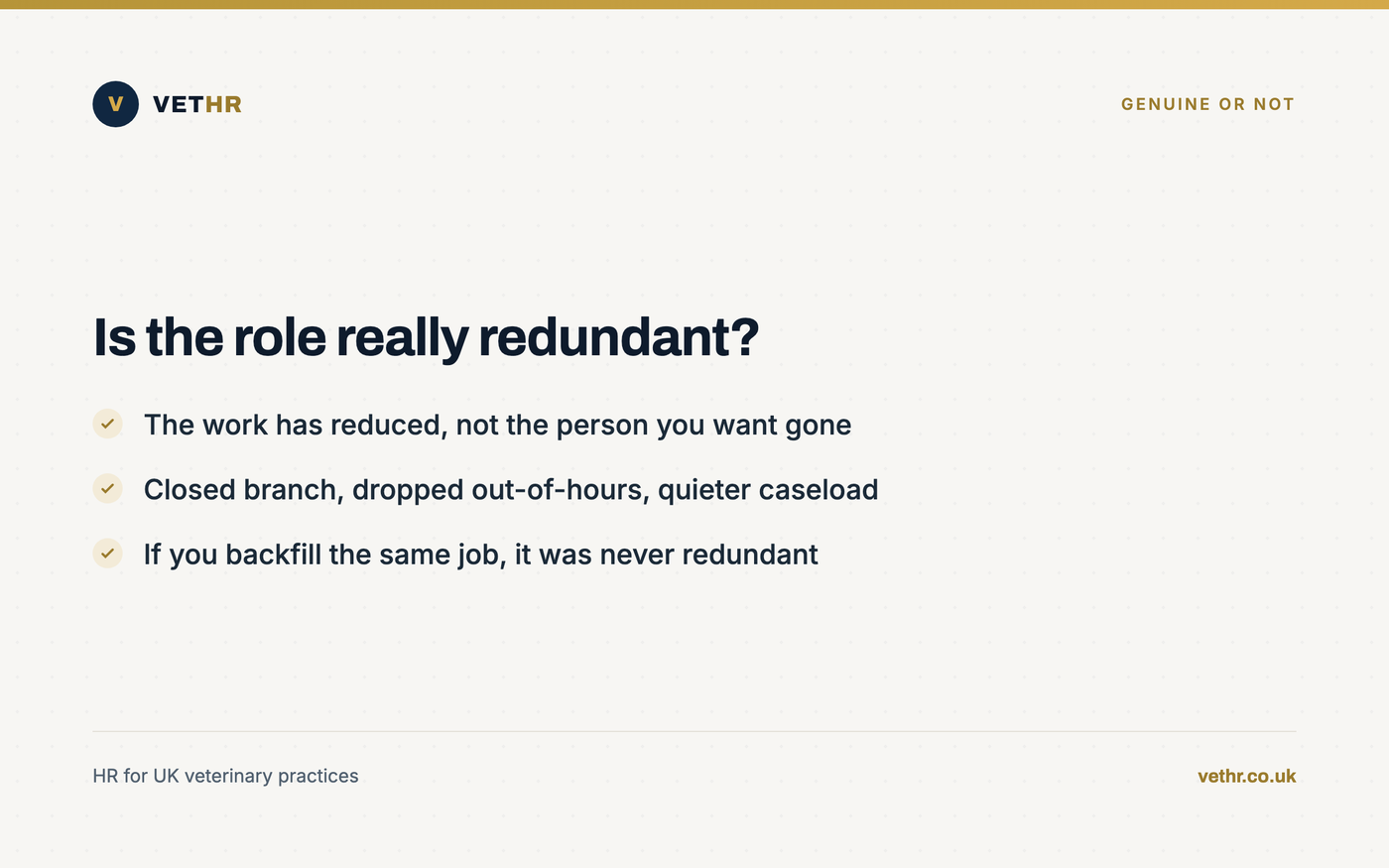
A role is genuinely redundant when the practice needs fewer people doing that work, not when you want to move a particular person on. Most redundancy in a veterinary practice starts here, with the job rather than the person. GOV.UK is clear that redundancy is a form of dismissal that happens “when employers need to reduce their workforce”, so the test is about the job, never the individual.
In a veterinary setting, that usually looks like a closed branch, a dropped out-of-hours contract, a service line you no longer offer, or a quieter caseload that no longer supports the headcount. The work shrinks or disappears, so the role does too. That is genuine redundancy.
What is not redundancy is using the word to remove someone whose face no longer fits, then quietly backfilling the same job weeks later. If the work still exists and you simply want a different person doing it, that is a performance or conduct matter with its own fair process, and dressing it as redundancy is how practices end up at an employment tribunal.
The honest first question is therefore simple. Has the requirement for this work actually reduced, and can you show why in writing? If you cannot, pause. A redundancy that cannot explain itself on paper is the one most likely to be challenged later.
A fair redundancy process is a sequence, not a single conversation: confirm the business case, define the pool, set objective selection criteria, consult openly, look for alternatives, then confirm the outcome with the correct notice and pay. Skipping a step is what turns a fair decision into an unfair dismissal, and it is the single most common reason these decisions end up disputed.
ACAS guidance on handling redundancies stresses that consultation “must be carried out with a view to reaching” agreement, even where the law sets no fixed timetable for small numbers, so a rushed, decision-already-made meeting is a red flag. Treat each step as evidence you can show later, because in practice that is exactly what it becomes.
Fair selection criteria are objective, measurable and applied identically across everyone in the pool. ACAS advises that criteria “should be as objective and measurable as possible”, which rules out gut feeling and favours things you can evidence, such as skills, qualifications, standard of work and a properly recorded disciplinary history.
Defensible criteria in a practice tend to include relevant clinical or nursing skills, qualifications and registrations, breadth of experience across species or services, and an accurate attendance record. ACAS is explicit that any attendance measure “must be accurate and not include absences relating to disability, pregnancy or maternity”, so clean the data before you score anyone.
Some criteria are off limits because they discriminate. You cannot select on age, disability, gender reassignment, marriage or civil partnership, pregnancy or maternity, race, religion or belief, sex, or sexual orientation, nor on union activity, part-time or fixed-term status, or whistleblowing, as the GOV.UK redundancy guidance confirms that selecting someone because they are, for example, pregnant or disabled “could be classed as an unfair dismissal”.
Watch hidden bias too. ACAS warns that a neutral-looking measure can still discriminate indirectly: using “flexible working as one of the criteria” can amount to sex discrimination because caring responsibilities fall unevenly. Score against the same matrix for everyone, keep the sheet, and you can show the decision was about the work, not the worker.
Proper redundancy consultation means telling affected staff what is proposed and why, then genuinely listening before deciding. It is a real conversation about avoiding or reducing redundancies, not a notification. GOV.UK confirms consultation “does not have to end in agreement, but it must be carried out with a view to reaching it”.
Most independent practices fall into individual consultation, because the collective rules only bite at scale. GOV.UK states that collective consultation applies when “making 20 or more employees redundant within any 90-day period at a single establishment”, which is rare for a 5 to 50 person practice but worth knowing if you run a larger group.
Where the collective rules do apply, the timetables are fixed. GOV.UK sets a minimum consultation period of “30 days” before any dismissal for 20 to 99 redundancies, rising to “45 days” for 100 or more, with notification to the Redundancy Payments Service over the same periods. Miss these and the redundancies “will almost certainly be unfair”.
For the individual conversations that most practices actually face, fairness is in the conduct. Give people the reasons and the criteria, hold more than one meeting where you can, let them respond or suggest alternatives, allow a companion, and offer an appeal. None of that is bureaucracy for its own sake; it is what makes the dismissal defensible.
Facing a possible redundancy and unsure your process holds up? A 30-minute conversation usually settles it. Book a free HR health check and we will look at your business case, pool and consultation plan, then tell you honestly where it is sound and where it needs shoring up before you act. Calm, practical, never alarmist.
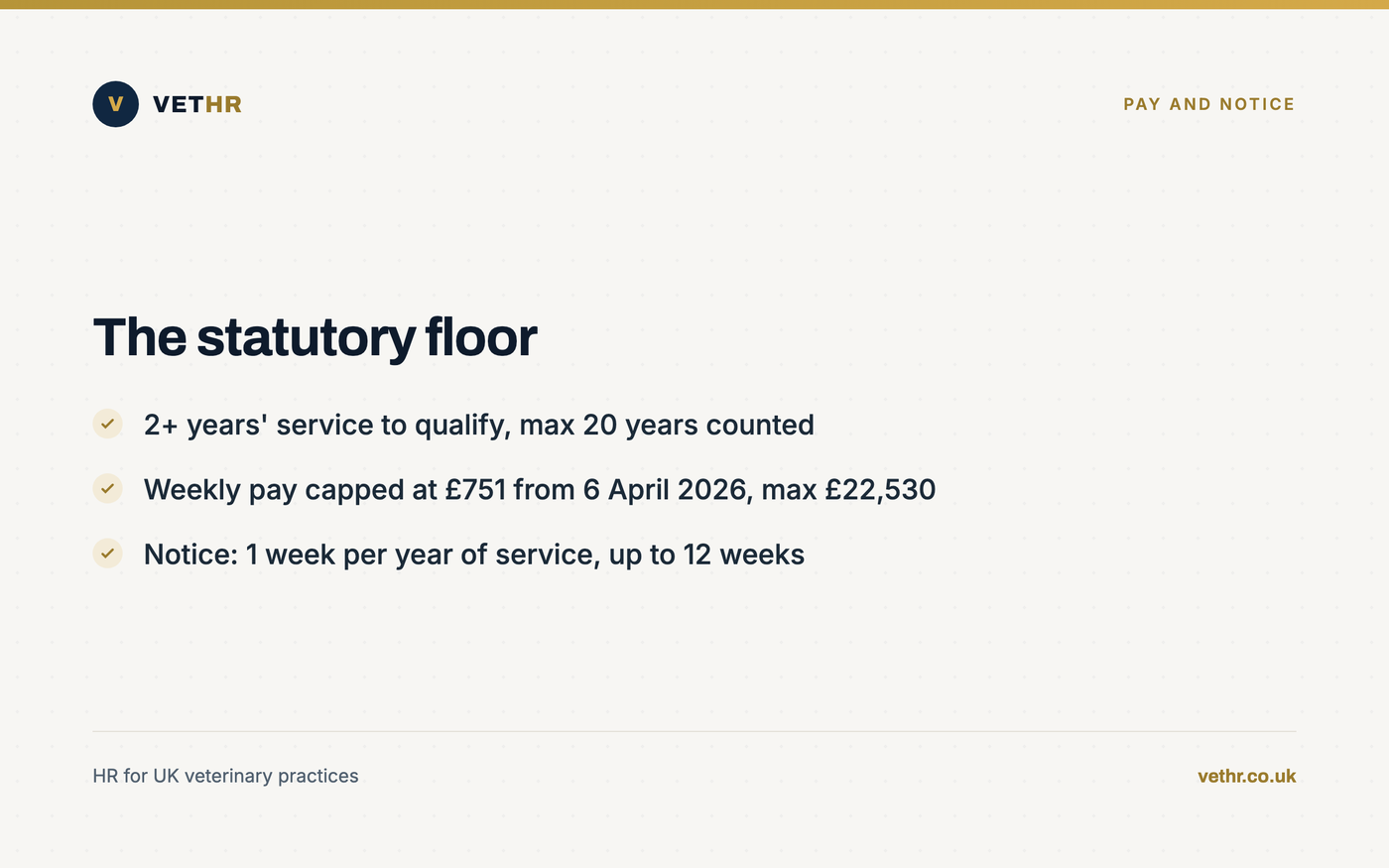
Statutory redundancy pay depends on age and length of service, and only employees with two or more years’ continuous service qualify. GOV.UK sets the formula at “half a week’s pay for each full year you were under 22”, one week’s pay for each full year aged 22 to 40, and “one and half week’s pay for each full year you were 41 or older”.
Two caps apply. Service counts for a maximum of “20 years”, and weekly pay is capped: GOV.UK gives the statutory cap as “£751” a week from 6 April 2026, making the maximum statutory redundancy payment “£22,530”. Always confirm the current cap on GOV.UK on the day, since it changes each April, and pay any better contractual terms you have promised.
Notice is separate from the redundancy payment and stacks on length of service. GOV.UK requires “at least one week’s notice” for one month to two years’ service, then “one week’s notice for each year” from two to twelve years, capped at “12 weeks’ notice” for twelve years or more. Your contract may offer more, never less.
Vet HR is HR consultancy and documentation support, not a law firm and not your accountant, so treat these figures as the statutory floor and run the actual sums against each person’s real service, pay and contract. Where freelance vet cover or genuinely casual help is involved, employment status affects entitlement, which is exactly the kind of detail a health check flags early.
The alternatives to redundancy are the options you should exhaust before any compulsory selection: redeployment, reduced hours, voluntary redundancy, natural turnover and cutting non-staff costs first. Showing you genuinely explored them strengthens your case and often keeps a valued colleague in the building.
Alternatives are not a box to tick; they are evidence of good faith. A practice that can show it offered redeployment and asked for volunteers before selecting anyone is in a far stronger position than one that jumped straight to a name. Document what you considered and why it did or did not work.
You avoid an unfair dismissal claim by making the redundancy genuine, the selection objective, the consultation real and the paperwork complete. Most challenges to a redundancy in a veterinary practice do not turn on the decision itself but on a process cut short, so the protection is in doing each step properly and keeping the record.
Some reasons make a dismissal automatically unfair regardless of process. GOV.UK confirms that selecting someone because of age, gender, disability or pregnancy “could be classed as an unfair dismissal”, and the same protection extends to maternity and family leave, union activity, part-time or fixed-term status, and whistleblowing. Never let any of these influence the pool or the scoring.
The practical safeguards are unglamorous and they work. Keep the written business case, the pool rationale, the scored selection matrix, dated consultation notes, the alternatives you offered, and the final letter setting out notice, pay and the right to appeal. If a colleague later questions the decision, that file is the difference between a calm reply and a costly dispute.
This is where good contracts and policies earn their place. Clear written terms and a settled redundancy procedure mean you are following your own stated process, not improvising under pressure. Our contracts and policies support and HR consultancy exist to get that groundwork right before you ever need it.
There is no fixed minimum for fewer than 20 redundancies, but it should never be a single meeting. Allow time to consult genuinely, usually one to two weeks of meetings, plus the individual’s notice period on top. Collective timetables of 30 or 45 days only apply at 20 or more redundancies in a 90-day period.
Employees with two or more years’ continuous service qualify for statutory redundancy pay. The amount is based on age and full years of service, capped at 20 years and a weekly pay limit GOV.UK gives as £751 from 6 April 2026, making the statutory maximum £22,530. Always confirm the current cap on GOV.UK on the day.
Not if the role still exists. Redundancy means the need for that work has reduced, so replacing the same job soon after suggests it was never genuinely redundant. If the issue is performance or conduct, use the proper procedure for that instead, because mislabelling it risks an unfair dismissal claim.
You should offer any suitable alternative vacancy that exists. GOV.UK lists moving into a different job among redundancy rights, and a tribunal will expect you to have considered redeployment. You are not required to invent roles, but failing to offer a genuine vacancy a person could fill weakens your case considerably.
A redundancy is unfair if it is not genuine, the selection is biased or discriminatory, consultation was inadequate, or alternatives were ignored. Selection on grounds such as age, disability, pregnancy or union activity is automatically unfair. The safeguard is an objective, well-documented process applied the same way to everyone in the pool.
Redundancy in a veterinary practice is hard, but it is not a minefield when the role is genuinely gone, the selection is objective, the consultation is real and the numbers are right. Almost every problem comes from speed, so the kindest and safest thing you can do is slow the process down and write it down.
If you are weighing a difficult decision, do not carry it alone. Get your contracts and policies in order, talk it through with our HR consultancy, or simply book a free HR health check and we will tell you honestly whether your process stands up. Practical support, no scare tactics.
The Vet HR Team provides HR consultancy and white-labelled staff systems exclusively to UK veterinary practices.
Read next: How to Restructure a Veterinary Practice Without Making Anyone Redundant.
Contracts, rotas, holiday, a difficult conversation. Tell us what you are dealing with and we will come back within one working day. Nothing to sign up to.
Got it. We will come back to you within one working day. If you do not see a reply, please check your spam folder.
