Last updated: 27 June 2026
TL;DR: Working time rules for veterinary practices come from the Working Time Regulations, and they set the limits your rota has to live inside: a 48-hour weekly average that staff can only exceed with a written opt-out, a 20-minute break once someone works over 6 hours, 11 hours of daily rest, weekly rest, and tighter caps for night and young workers. On-call and out-of-hours cover is where practices most often slip, so this guide ties each rule back to the shift patterns you actually run.

Most practice owners learn working time the hard way, in the week a tired rota collides with a quiet legal duty nobody had time to read. This is a calm, practical walk through the rules that govern shifts, breaks and cover, written for the way a clinic really runs rather than a flat office week. Every figure below is taken from current GOV.UK and Acas guidance and linked so you can check it.
The working time rules for veterinary practices are the parts of the Working Time Regulations that cap how long staff work and protect their rest. They set a 48-hour weekly average, a right to breaks during long shifts, minimum daily and weekly rest, and stricter limits for night and young workers. They apply to vets, nurses and support staff alike.
These rules exist to stop fatigue building unchecked, which matters more in a clinic than almost anywhere, because tired clinicians make clinical errors. The regulations do not care that your week has consults running late, branch cover and out-of-hours on top. They set the outer edges, and your rota has to plan inside them.
One reassurance before the detail. None of this requires a law degree, only knowing six or seven numbers and building your rota so they are never breached by accident. Vet HR provides HR documentation and consultancy support, not legal advice, but the rules are public and we link each one to its source.
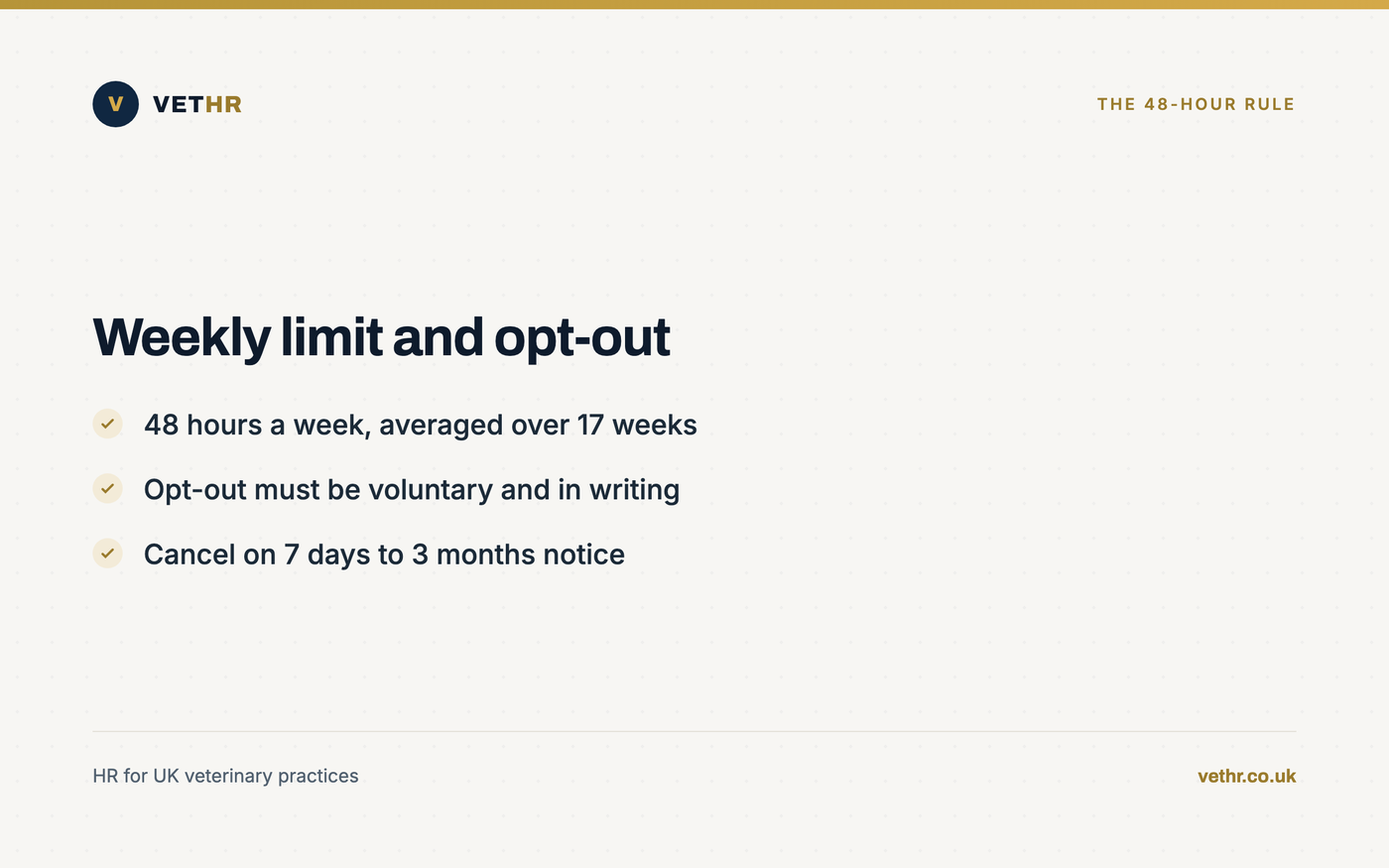
Staff cannot work more than 48 hours a week on average, normally averaged over 17 weeks, according to GOV.UK. Because it is an average, a busy fortnight is fine as long as quieter weeks balance it out across the reference period. A worker can choose to do more only by signing a voluntary written opt-out.
The averaging is the part practices misread most. You are not capped at 48 hours every single week. The cap is on the 17-week rolling average, which is why an out-of-hours-heavy stretch can be lawful if the surrounding weeks are lighter, as set out in the GOV.UK guidance on maximum weekly working hours. A clear rota that tracks rolling hours is how you prove you stayed inside it.
The opt-out has firm conditions. GOV.UK states it “must be voluntary and in writing”, and that a worker “can cancel your opt-out agreement whenever you want”, giving at least 7 days’ notice, or up to 3 months if the agreement says so. Crucially, an employer “cannot force” anyone to opt out or to cancel. Pressuring a nurse to sign is the trap that turns a paperwork detail into a dispute.
A reliable veterinary rota system that shows rolling weekly hours per person turns the 48-hour average from a worry into a number you can see. When the figure creeps up, you spot it and act before it becomes a breach rather than after.
A worker over 18 is entitled to “one uninterrupted 20 minute rest break during their working day, if they work more than 6 hours a day”, according to GOV.UK. It is a single unbroken break, not two ten-minute snatches, and it does not have to be paid unless the contract says so. The break should be away from the workstation.
In a busy practice the risk is not refusing breaks, it is breaks dissolving into the day. A nurse who eats lunch between holding for radiographs has not had an uninterrupted 20 minutes, even if 40 minutes passed on paper. The duty, set out in the GOV.UK guidance on rest breaks at work, is that the break is genuinely free of work.
The practical answer is rota design, not goodwill. Build cover so each person can step away, and record that the break was taken. A clock in and out system that captures break times gives you evidence the rest happened, which protects both the member of staff and the practice if it is ever questioned.
Workers are entitled to “11 hours rest between working days” and, each week, either “an uninterrupted 24 hours without any work each week” or “an uninterrupted 48 hours without any work each fortnight”, according to GOV.UK. So a 9pm finish means no start before 8am, and you cannot run someone day after day without a proper weekly break.
Daily rest is the one that catches out-of-hours rotas. If a vet finishes a late emergency at 11pm, the 11-hour rule means they should not be back on shift until 10am the next morning, as set out in the GOV.UK rest breaks guidance. Rotas that ignore this quietly accumulate fatigue across a team, which is exactly what the rule exists to prevent.
Weekly rest gives you a useful choice. You can give 24 uninterrupted hours every week, or bundle it into 48 hours across a fortnight, which suits practices running longer rotational patterns. Either way it must be genuinely work-free. Planning these blocks deliberately, rather than hoping they fall out of the rota, is what keeps you compliant on your busiest months.
Not sure your current rota stays inside these limits? A 30-minute conversation usually makes it clear. Book a free HR health check and we will look at how you plan hours, breaks and cover today, then tell you honestly where you are compliant and where a small change would close a gap. No jargon, nothing sold for the sake of it.
Night work rules add a tighter layer for staff who regularly work nights. GOV.UK defines the night period as “11pm to 6am” unless you agree otherwise, and a night worker as someone who “regularly work at least 3 hours during the night period”. Night workers must not average more than 8 hours’ work in each 24-hour period.
That 8-hour average is normally calculated over 17 weeks, though it can run up to 52 weeks by agreement, according to the GOV.UK guidance on night working hours. Where the work involves special hazards or heavy physical or mental strain, the limit is harder: staff “cannot work longer than 8 hours in any 24-hour period”, with no averaging. Emergency and critical-care work can fall into that category.
There is also a health duty. Employers “must offer workers a free health assessment before they become a night worker”, and repeat it as needed. If a health professional confirms night work has harmed someone’s health, the practice “must find them other suitable work, where possible”. Offering the assessment and logging that you did is a simple, often-missed step.
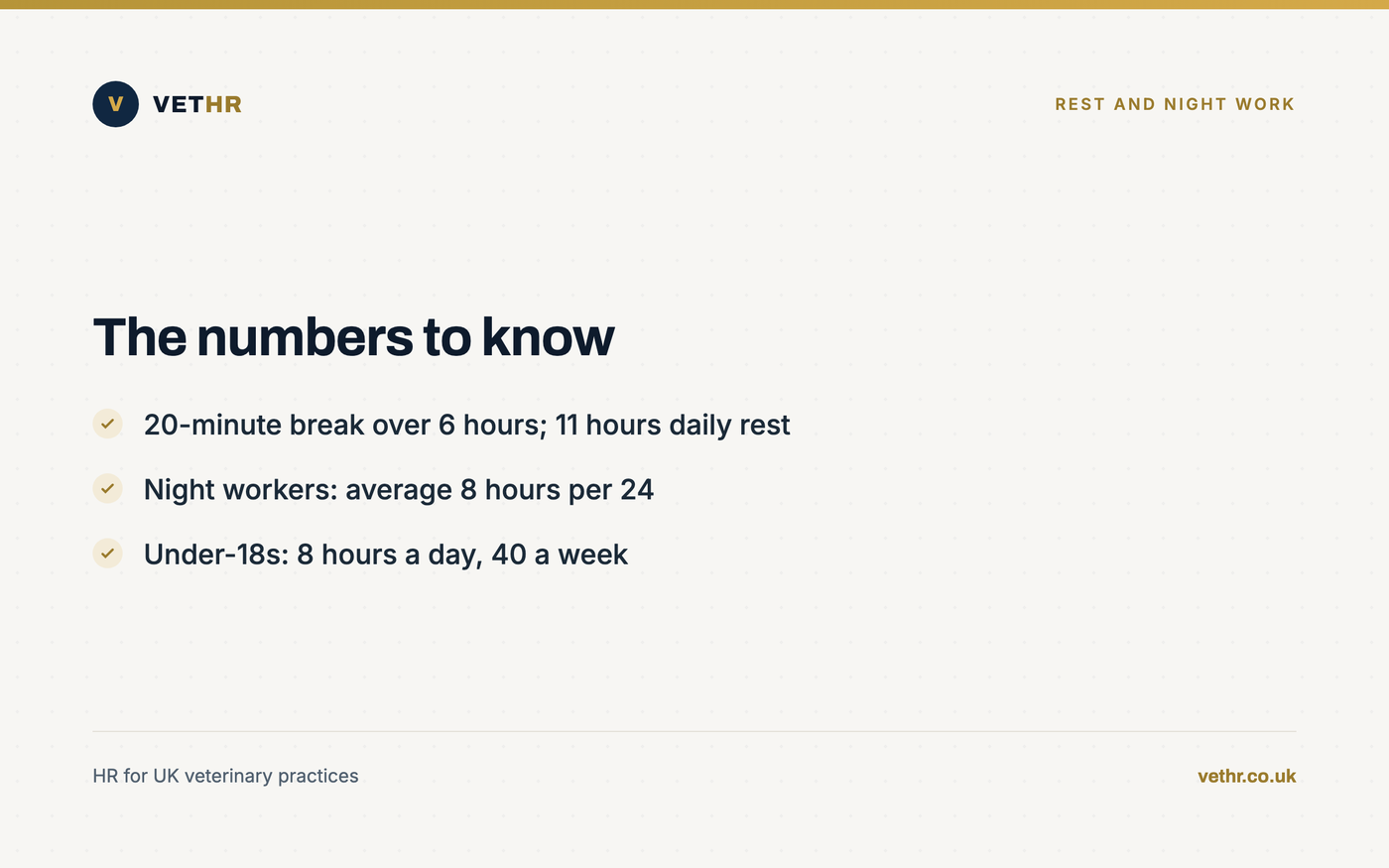
Workers above school leaving age but under 18 get stronger protection. GOV.UK states they “cannot work more than 8 hours a day or 40 hours a week”, with no opt-out available. Their breaks and rest are longer too, which matters if your practice takes on younger animal care assistants or apprentices.
The detail is worth pinning up. A young worker gets “a 30 minute rest break if they work more than 4.5 hours”, “daily rest of 12 hours” and “weekly rest of 48 hours”, according to GOV.UK guidance on rest breaks for young workers. These are firmer than the adult limits, so a rota that works for your nurses will not automatically be lawful for a 17-year-old.
This is the question that catches practices out. The short answer is that time on-call counts as working time when the worker has to be at the workplace, and the position is more nuanced when they are on-call from home. Either way, on-call working time feeds into the same 48-hour average and rest rules as everything else.
Time spent actually responding to a call, travelling in and treating a patient, is plainly working time and must be counted toward the weekly average and against daily rest. If an on-call vet is called in at 2am, that work eats into the 11-hour rest they were owed, and your rota needs to recover it. Acas notes employers “must keep” records that show staff are not exceeding the 48-hour maximum, in its guidance on the working time rules.
The practical move is to record on-call activations, not just the rota slot. A planned on-call shift and the actual hours worked during it are different numbers, and only the second tells you whether someone breached their rest. Capturing both is far easier with a system.
Because freelance vet cover and rotational out-of-hours stretch a small team thin, this is where fatigue and unfairness creep in. Treat on-call as real working time, build recovery rest around activations, and the other rules largely take care of themselves. For the operational side, see our rota system.
You must keep records showing your staff stay inside the working time limits, and Acas states “employers must keep these records for 2 years from the date they were made”. You do not have to log every daily hour, but you must be able to show compliance with the weekly maximum, night limits and young-worker rules.
According to Acas, an employer “does not need to keep records of all daily working hours”, but does need to document the 48-hour weekly position, night-work limits, health assessments for night workers and young workers’ restricted hours. Holiday is the related trap, since accurate leave depends on accurate hours, and our holiday calculations work from the same data.
The honest takeaway is that compliance lives or dies on records. If you could not produce, on request, evidence that a named worker stayed inside the 48-hour average over the last two years, the rule is breached the moment someone asks. A system that timestamps hours, breaks and opt-outs turns that demand from a panic into a two-minute export.
No. GOV.UK is clear that the opt-out “must be voluntary and in writing”, and that an employer “cannot force” a worker to sign or to cancel one. You also cannot make signing a condition of the job. Staff can withdraw at any time on at least 7 days’ notice, or up to 3 months if the agreement specifies it.
Time on-call counts as working time when a worker must be at the workplace, and the hours actually worked when called in always count. Those hours feed the 48-hour weekly average and reduce the daily and weekly rest owed. Record on-call activations as well as the rota slot, so you can prove staff stayed within the limits.
A worker over 18 is entitled to one uninterrupted 20-minute break once they work more than 6 hours, according to GOV.UK. It must be a single unbroken break away from work, and it does not have to be paid unless the contract says so. Young workers under 18 get a 30-minute break once they work more than 4.5 hours.
GOV.UK sets daily rest at 11 hours between working days for adults. So a vet finishing an emergency at 11pm should not start again before 10am. For young workers under 18 the figure is 12 hours. After an out-of-hours call-in, you need to build that recovery rest back into the rota rather than ignore it.
Acas states employers must keep working time records for 2 years from the date they were made. You do not need to log every daily hour, but you must be able to show staff stayed inside the 48-hour weekly maximum, night-work limits and young-worker rules. A system that timestamps and stores this makes producing it on request straightforward.
Working time rules for veterinary practices are not complicated, but they are unforgiving when a rota drifts. Know the seven numbers, plan on-call and out-of-hours as real working time, and keep records that prove it, and most of the risk disappears. The rest is rota discipline rather than legal expertise.
If you want a straight read on where your practice stands, browse how we build fair shift patterns in the rota system, see how clock in and out captures breaks and on-call activations, or simply book a free HR health check and we will tell you honestly where you are compliant and where a small change would help.
The Vet HR Team provides HR consultancy and white-labelled staff systems exclusively to UK veterinary practices.
Read next: Holiday Entitlement for Part-Time Staff.
Contracts, rotas, holiday, a difficult conversation. Tell us what you are dealing with and we will come back within one working day. Nothing to sign up to.
Got it. We will come back to you within one working day. If you do not see a reply, please check your spam folder.
