Last updated: 27 June 2026
TL;DR: Probation periods in a veterinary practice usually run three to six months and give both sides a fair window to confirm the hire is right. Done properly, you set clear objectives, hold regular check-ins, support training, and confirm everything in writing. You can extend probation only if the contract allows it, and you must still give statutory notice. The work is mostly in the planning, not the parting.
A new starter is a big commitment for a small clinic. Probation periods in a veterinary practice are the calm, structured way to make sure the fit is real, on both sides, before it becomes permanent. Get it right and you rarely need the difficult conversation at the end, because the work happened along the way.
Probation periods in a veterinary practice are set windows at the start of employment, usually three to six months, when you and the new starter confirm the role is the right fit. They are not a separate legal status, so the employee has most of their normal rights from day one. They are a management tool, not a loophole.
That last point matters more than people expect. Probation does not switch off employment law. It is best thought of as a clearly defined runway with closer support, more frequent reviews and an agreed standard to reach. The contract sets the runway; your management during it decides whether the hire lands well.
It also has to be written down. GOV.UK confirms that the principal statement an employee receives on their first day must include “how long any probation period is and what its conditions are”, as set out in its guidance on the written statement of employment particulars. If your contracts skip this, the probation has no firm footing.
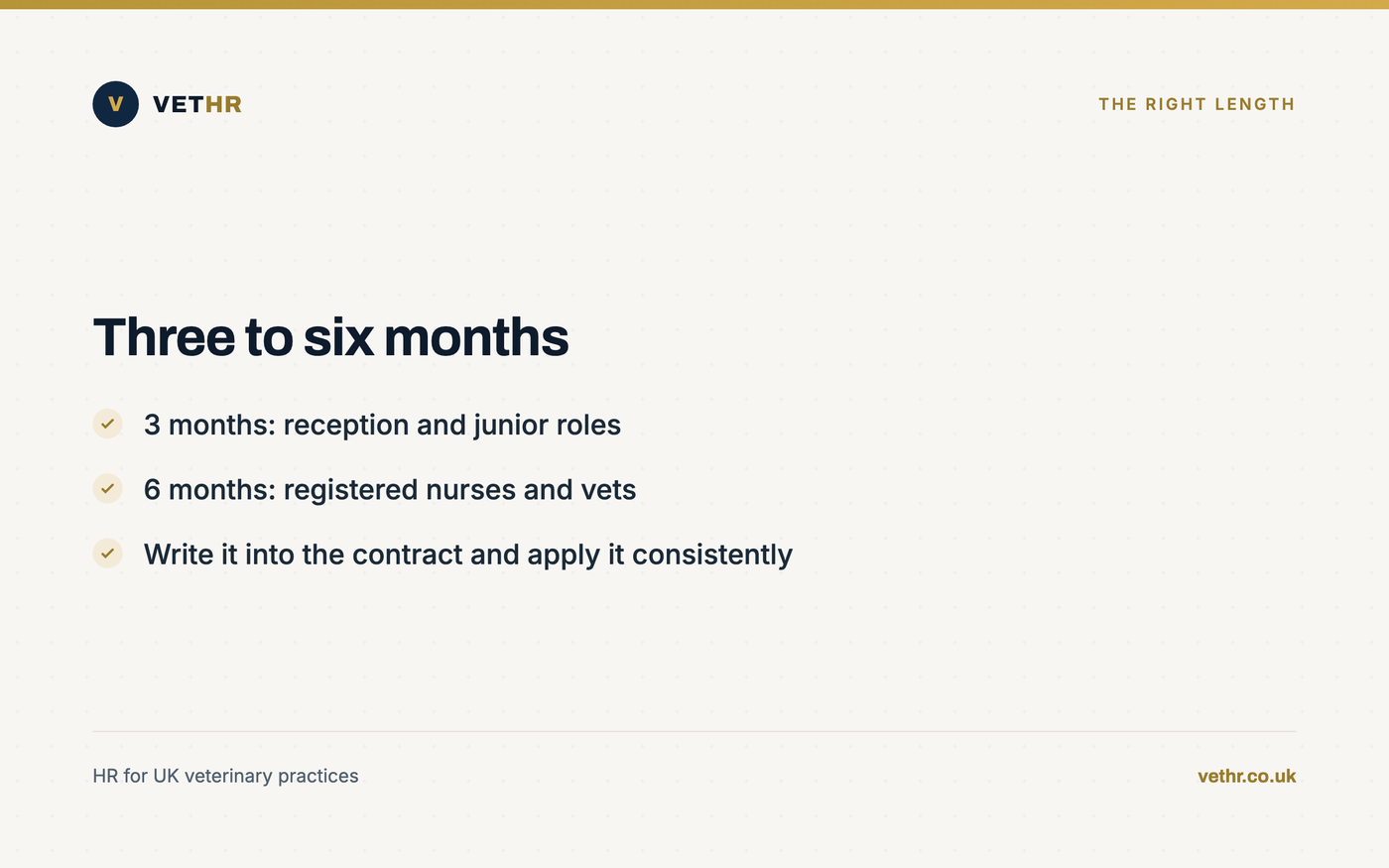
Most probation periods run between three and six months. Three months suits a junior or reception role where competence shows quickly. Six months fits a registered nurse or vet, where out-of-hours cover, clinical judgement and team fit take longer to assess across a full pattern of work. Match the length to the role, not a habit.
Be deliberate rather than generous. An over-long probation is not kinder; it just delays a decision you could make sooner, and it leaves the new starter unsure where they stand. A tight, well-run three months often tells you more than a vague six, because the closer attention forces real conversations early.
Whatever length you choose, write it into the contract and apply it consistently. Two nurses hired the same month should sit on the same terms. Inconsistency is where fairness complaints start, and a clinic where everyone knows everyone notices quickly. Our veterinary employment contracts set the period and its conditions clearly from the first day.
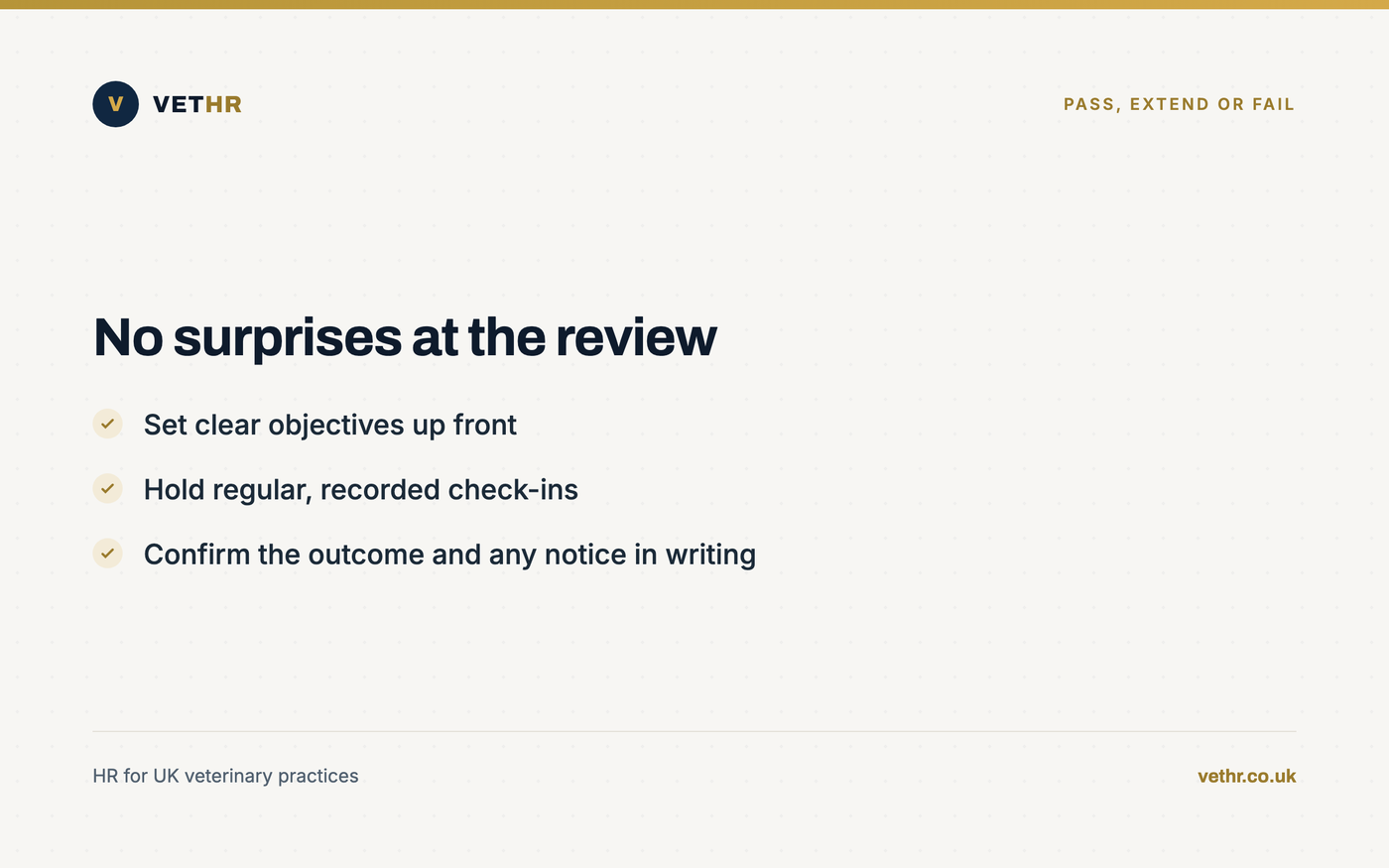
During probation you should set clear objectives, hold regular check-ins, provide training and keep a short record of each conversation. The aim is no surprises. By the final review the outcome should already be obvious to both of you, because you have been talking about progress the whole way through rather than saving it for the end.
This mirrors how Acas advises managing performance generally. Its guidance on problems with an employee’s performance recommends setting “specific objectives for the employee”, a “reasonable timeline to meet them” and “any further support or training they need”, and stresses that “it’s important for employers to keep a record of any conversations they have with employees about performance”.
In a practice, that looks practical and humane:
Acas also notes that, where capability is the issue, “dismissal should be a last resort”, with support offered first. In probation terms, that means the early months are for coaching and clarity, so a fair decision at the end rests on evidence rather than a gut feeling formed in week two.
Not sure your probation process would hold up if a new starter challenged it? A 30-minute conversation usually settles it. Book a free HR health check and we will look at your contracts, your review routine and your policy wording, then tell you honestly where you are solid and where a small change would protect the practice. No jargon, nothing sold for the sake of it.
Yes, you can extend a probation period, but only if the contract or policy gives you the right to do so. An extension is the fair move when someone is close but not quite there, or when significant absence meant they never had a clean run at the objectives. It buys a defined stretch of time, not an open one.
Keep extending a probation period transparent. Confirm it in writing before the original period ends, say plainly why you are extending, restate the specific objectives, and name the new end date. An extension is usually a further one to three months. Vague extensions, decided after the deadline has passed, are exactly where things unravel.
The reason the contract clause matters is simple. Without a written right to extend, you are changing the deal partway through, which the employee can reasonably resist. With it, an extension is a normal, agreed step. Our veterinary HR policies include probation wording that makes extensions clean rather than contested.
You pass or fail probation fairly by holding a clear final review against the objectives you set, then confirming the outcome in writing. Passing should be the warm, simple part: confirm it, thank them, and move them onto full terms. Failing should never be a shock, because the earlier check-ins flagged the concerns in good time.
The probation review meeting is the anchor. Go in with your notes from each check-in, talk through what was asked and what was delivered, and give the new starter a genuine chance to respond. A short, evidence-led conversation protects everyone, and it is far easier when the record already exists rather than being assembled the night before.
If the answer is no, fairness still applies. Even though most ordinary unfair dismissal claims need two years’ service, as Acas explains on its unfair dismissal page, that protection does not cover “automatically unfair” reasons such as pregnancy, whistleblowing or asserting a statutory right, which apply from day one. So failing probation must rest on the role, never on a protected reason.
One change to plan for. Acas notes that “protection from unfair dismissal will become a right after 6 months of being in a job” under the Employment Rights Act 2025, expected in January 2027 and “not yet law”. That shortens the runway considerably, so practices that run probation well now will be far better placed when it lands.
Statutory notice still applies during probation. Once an employee has worked for one month, they are entitled to at least one week’s notice, the same minimum that runs from one month up to two years’ service. A short contractual probation notice can sit on top, but it cannot drop below the statutory floor.
GOV.UK sets the floor out plainly: an employer must give “at least one week’s notice if employed between one month and 2 years”, on its notice periods guidance. Many practices write a one-week probation notice for both sides into the contract, which is tidy, provided it never undercuts that statutory minimum once the one-month point is passed.
So the honest position is this: probation lets you make a quicker decision, but it does not let you skip notice or process. Treat the new starter with the same courtesy you would want, give the proper notice, and confirm it in writing. That is both fairer and far safer than an abrupt exit.
The wording that protects a practice spells out four things: the length of probation, the right to extend it, the notice that applies during it, and the standard expected. Put those in the contract and a matching policy, and your probation process stops resting on memory and good intentions. It rests on the document instead.
The contract and the policy should agree with each other and with what managers actually do. Where those three drift apart, fairness gets harder to defend. If you would like the wording handled properly for your team, our HR consultancy drafts contracts and probation policies built for how a clinic really runs.
Most run three to six months. Three months suits reception and junior roles where competence shows quickly. Six months fits registered nurses and vets, where clinical judgement, out-of-hours cover and team fit take a full pattern of work to assess. Match the length to the role, write it into the contract, and apply it consistently across the team.
No. Once an employee has worked for one month, statutory notice of at least one week applies, including during probation. Your contract may set a longer probation notice, but it cannot fall below that minimum. Failing probation should also follow a fair review against agreed objectives, with the outcome and the notice confirmed in writing.
Yes, but only if the contract or policy gives you the right to extend. Confirm the extension in writing before the original period ends, explain why, restate the objectives and set a new end date. Extensions usually add one to three months. Without a written right to extend, you are changing the agreed terms partway through, which the employee can resist.
It should cover the objectives set at the start, the evidence from each check-in, and a clear outcome: pass, extend or end. Give the new starter a real chance to respond, and confirm the decision in writing afterwards. Because the concerns were raised along the way, the meeting confirms a shared picture rather than springing a surprise.
Yes. Probation is not a separate legal status, so most rights apply from day one, including statutory notice after one month and protection from “automatically unfair” dismissal such as pregnancy or whistleblowing. Ordinary unfair dismissal currently needs two years’ service, though that is set to fall to six months in January 2027 under the Employment Rights Act 2025.
Probation done properly is reassuring, not adversarial. Set a sensible length, agree clear objectives, hold honest check-ins, keep a light record, and confirm everything in writing. Do that and the final review is mostly a formality, whichever way it goes, because both sides have known where they stand the whole time.
If your contracts or policies need tightening before your next hire, start there. Browse our staff systems, see how we draft employment contracts, or simply book a free HR health check and we will give you a straight view of where your probation process stands today. Nothing sold that you do not need.
The Vet HR Team provides HR consultancy and white-labelled staff systems exclusively to UK veterinary practices.
Contracts, rotas, holiday, a difficult conversation. Tell us what you are dealing with and we will come back within one working day. Nothing to sign up to.
Got it. We will come back to you within one working day. If you do not see a reply, please check your spam folder.
