Last updated: 14 June 2026 · By The Vet HR Team
TL;DR: Freelance vet cover is a useful safety net, but heavy reliance on it quietly drains your margin and unsettles your team. The durable fix is retention. Practices that build fair rotas, clear contracts and real wellbeing support hold on to their permanent vets and RVNs, so they need fewer expensive cover days. This guide shows how to swap a costly cover habit for a stable rota you can budget with confidence.
Every practice needs the occasional freelance vet cover day. A sudden illness, parental leave, a busy bank holiday. The problem starts when those days become the way you run the rota. At that point you are paying a premium to paper over a gap that better retention would close. This guide makes the case for fixing the root, not renting the patch.
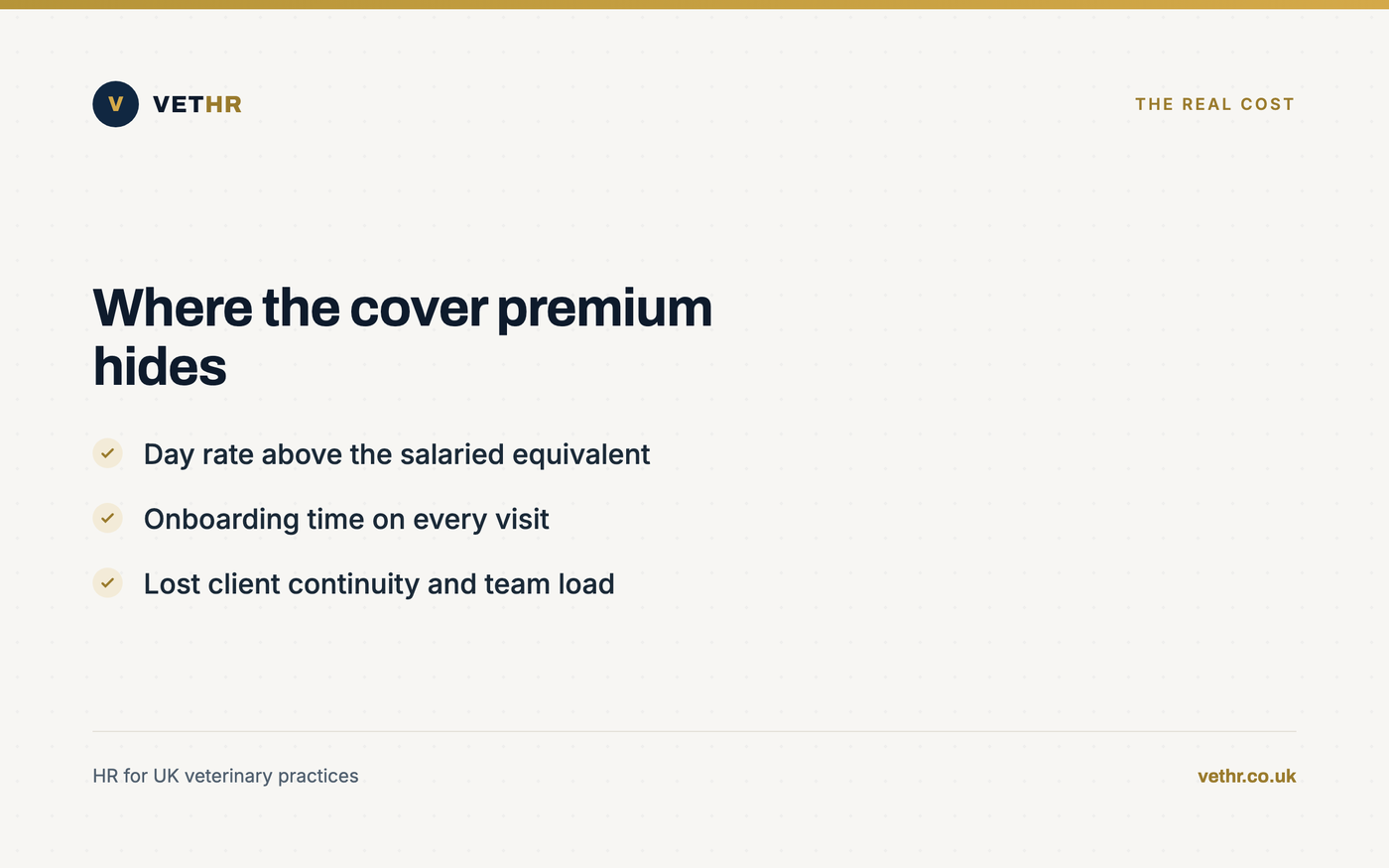
Freelance vet cover costs more than a permanent salary day for day because you are paying for flexibility, short notice and scarcity all at once. A cover vet usually charges a day rate well above the salaried equivalent, and you carry the admin, the onboarding and the lost continuity on top. When cover becomes a habit rather than a fallback, those premiums stack up into a line item that eats real margin.
The market makes it worse. Recruitment firms report that cover vets are in high demand and hard to source at short notice, which pushes day rates up and leaves you exposed when you need someone fast. A staffing model that depends on a scarce, premium-priced resource is fragile by design.
Then there are the hidden costs. A cover vet does not know your clients, your protocols or your practice management system. Continuity of care suffers, because owners would rather see the vet who knows their animal. Recruitment specialists note that regular staff changes disrupt client relationships and team dynamics, and that someone on a short booking has little reason to invest in your practice.
None of this means cover is bad. It means cover is expensive insurance, and like any insurance it should be sized to the real risk, not used as the engine of your rota.
It is usually a retention problem wearing a staffing costume. Most practices reach for cover because a permanent role is empty or a tired team needs relief. Fix why people leave, and the gap you keep renting cover to fill starts to close. The data points squarely at how the working week feels, not at pay alone.
The RCVS Surveys of the Professions 2024, carried out by the Institute for Employment Studies, gathered 6,987 responses from veterinary surgeons. It found that 91 per cent of vets and 93 per cent of vet nurses describe their work as stressful (RCVS, 2024). That is the backdrop against which people decide whether to stay.
The same survey shows the strain in hours. Full-time vets work on average five hours above their contracted hours every week, rising to seven in equine practice and veterinary schools (RCVS, 2024). Hours that creep past the contract are exactly the kind of pressure that pushes a good vet towards the door, and a leaver towards your cover budget.
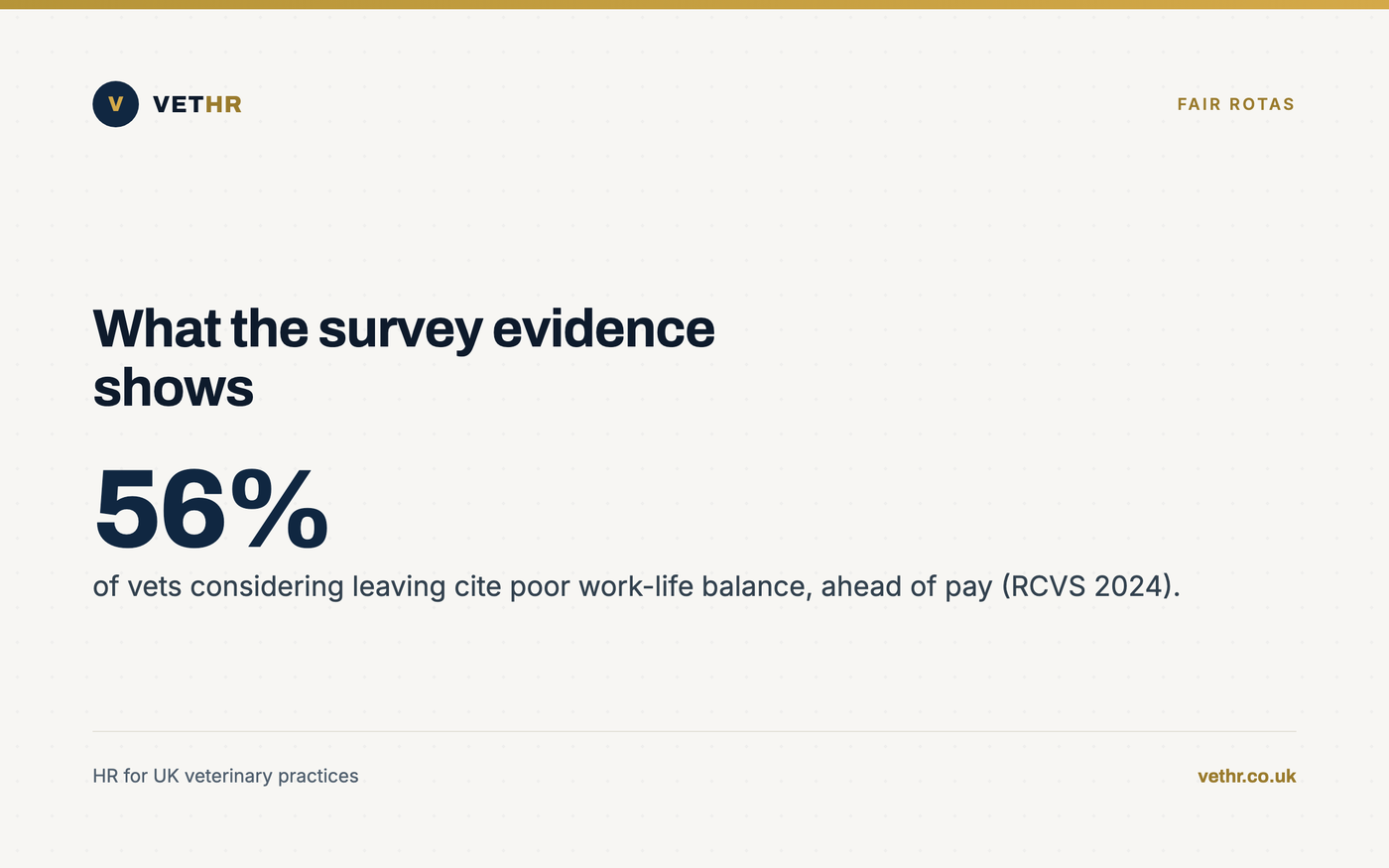
Crucially, money is not the headline reason people go. Among those intending to leave, the RCVS found the top drivers were poor work-life balance, cited by 56 per cent, and chronic stress, cited by 54 per cent, ahead of not feeling rewarded or valued (RCVS, 2024). These are rota and culture problems, and they are within your control as an employer.
If your cover bill is rising, treat it as a smoke alarm for retention, not just a fact of modern practice. The cheapest cover day is the one you never needed to book.
Fair rotas reduce freelance vet cover by removing the burnout and resentment that make people leave in the first place. A rota that protects rest, shares unsocial shifts evenly and respects the contracted week keeps your permanent team well and willing. Healthy teams take fewer sick days and resign less often, which shrinks the gaps you would fill at a premium.
Out-of-hours and on-call are where rotas quietly break trust. The RCVS reported that 35 per cent of vets and 16 per cent of vet nurses work on-call hours (RCVS, 2024). If that load lands on the same few people, they leave, and the rota you could not staff becomes the cover you cannot afford.
A fair rota is also a transparent one. When everyone can see the pattern weeks ahead, swap shifts cleanly and trust that leave requests are handled consistently, the team stops feeling at the mercy of the diary. That predictability is retention in practice. A clear veterinary rota system makes the pattern visible and the swaps simple, so fairness is something people can see rather than hope for.
Get holiday accrual right while you are at it. For irregular hours and bank staff, leave now builds up at 12.07 per cent of the hours worked in each pay period under rules that took effect on 1 April 2024 (ACAS). Calculating that correctly avoids disputes that sour the relationships you are trying to keep.
Clear contracts keep people because they remove the small uncertainties that grow into resentment. When hours, pay, leave, on-call and notice are written down in plain language, your team knows where it stands and so do you. Ambiguity is what erodes trust over time, and a vet who feels short-changed by a vague arrangement is a vet who starts taking cover bookings elsewhere.
Start with the legal floor and be generous about clarity. Almost all workers are entitled to 5.6 weeks of paid holiday a year, which is 28 days for someone on a five-day week (GOV.UK). Spelling out how that entitlement is calculated for part-time and variable-hours roles stops the most common payroll arguments before they begin.
Contracts also set expectations for the bits people feel most keenly: how on-call is paid, how overtime is recognised, how flexible working requests are handled. Putting these in writing signals that the practice is run fairly and predictably. That perception is a retention tool in its own right, because it tells your team the goalposts will not move. Well-drafted veterinary employment contracts turn good intentions into something your team can rely on.
One caution. Vet HR provides HR consultancy and documentation support, not legal advice. We build clear, compliant contracts grounded in current GOV.UK and ACAS guidance, and we tell you plainly when a question needs a solicitor. The aim is paperwork your team trusts and your managers can use.
Yes, because the survey evidence puts wellbeing at the heart of why people stay or go. With work-life balance and chronic stress sitting above pay in the reasons vets give for leaving, the practices that take wellbeing seriously are protecting their headcount and their margin at the same time. Wellbeing is not a perk here. It is workforce planning.
The trend is moving the wrong way, which is why this matters now. The RCVS found that intention to stay in the profession fell to 75 per cent in 2024, down from 79 per cent in 2019 (RCVS, 2024). Each percentage point that drifts away from your practice is another gap you are likely to fill with cover.
Wellbeing in practice is mostly unglamorous. Workable caseloads, breaks people actually take, a manager who notices when someone is struggling, and a simple route to flag problems before they boil over. Giving your team an easy way to report incidents and near-misses, through a clear See It Report It process, signals that concerns are heard and acted on rather than absorbed in silence.
It also helps to widen the lens beyond clinical staff. The affordability of veterinary care now sits among the top concerns in the profession, rising from 30 per cent in 2019 to 46 per cent in 2024 (RCVS, 2024). That external pressure lands on your front desk and your nurses, so supporting the whole team, not just the vets, is part of keeping anyone.
You move from cover-dependent to retention-led by treating your cover spend as a signal and acting on what it tells you. Start by measuring the habit, then fix the rota, the contracts and the wellbeing gaps that keep recreating it. This is steady work, not a grand gesture, and it pays back as a smaller, more predictable cover bill.
One of our clients, an independent veterinary practice, was leaning on freelance cover to plug recurring rota gaps. Working through the rota, the contracts and a clearer leave process gave the permanent team a fairer week and steadier expectations, which is the ground on which people choose to stay. The point is not a headline number. It is that the costly gap was a retention problem, and retention is where it was solved.
This is the work an outside HR partner can take off your plate. A monthly veterinary HR subscription gives you ongoing support to keep rotas fair, contracts current and wellbeing on the agenda, so retention becomes a steady habit rather than a project that slips. You can see how practices use that support on our customer stories page.
Want to know what your cover habit is really costing you? Book a free 30-minute HR health check and we will look at your rota, contracts and retention risks together. Arrange your free HR health check.
Day for day, yes. Cover vets typically charge a day rate above the salaried equivalent, and you add onboarding, lost continuity and extra load on your permanent team. Occasional cover is sensible insurance. Constant cover usually costs more than fixing the retention gap that created the need.
Mostly because a permanent role is unfilled or a stretched team needs relief. The RCVS Surveys of the Professions 2024 found stress and poor work-life balance are leading reasons vets consider leaving, ahead of pay, so the cover gap is usually a symptom of retention strain rather than a standalone staffing issue.
There is no single lever, but a fair rota is the highest-impact place to start. Sharing unsocial shifts and on-call evenly, protecting rest and honouring contracted hours directly addresses the work-life balance and stress that the RCVS identifies as the top reasons people leave.
Almost all workers are entitled to 5.6 weeks of paid holiday a year, which is 28 days for a five-day week, according to GOV.UK. For irregular hours and bank staff, leave accrues at 12.07 per cent of the hours worked in each pay period under rules effective from 1 April 2024, per ACAS guidance.
No. Cover is valuable for genuine peaks, sickness and leave. The goal is to right-size it. Keep a small, trusted bank for real gaps and stop relying on cover as your everyday rota engine by fixing the retention issues underneath.
Indirectly, yes. By helping you build fair rotas, clear contracts and stronger wellbeing, an HR partner improves retention, which shrinks the gaps you fill with premium cover. Vet HR offers a free HR health check to find the biggest retention risks in your practice first.
Freelance vet cover earns its place as a safety net, but it makes a poor business model. When it becomes the default, you pay a premium to mask a retention problem you could fix at the source. Fair rotas, clear contracts and genuine wellbeing keep your vets and RVNs in post, which is the only thing that durably shrinks your cover bill. The survey evidence is clear that how the week feels, not pay alone, decides who stays.
Vet HR helps independent and small-group UK practices do exactly this work. Start with a free HR health check, then keep the momentum with a monthly HR subscription or a focused project on the area that hurts most. See how other practices have done it on our customers page, or book your free HR health check today.
The Vet HR Team provides HR consultancy and white-labelled staff systems exclusively to UK veterinary practices. We are an HR and documentation partner, not a law firm.
Read next: Veterinary Practice HR Policies.
Contracts, rotas, holiday, a difficult conversation. Tell us what you are dealing with and we will come back within one working day. Nothing to sign up to.
Got it. We will come back to you within one working day. If you do not see a reply, please check your spam folder.
