Last updated: 14 June 2026 · By The Vet HR Team
TL;DR: A veterinary new starter checklist keeps day one legal and calm. Before the first shift, complete a right to work check, issue the contract and written statement, and confirm RCVS registration for any RVN. On day one, run a structured induction, get key policies acknowledged, and set clear probation review dates. Do this and the practice meets its duties and the new hire settles fast.
A veterinary new starter checklist matters because the first week sets the tone for everything that follows, and because several day-one steps are legal duties, not nice-to-haves. Miss a right to work check or a written statement and the practice carries real risk. Get the sequence right and a new nurse or receptionist feels confident on the floor by the end of week one.
Most staff turnover happens early. ACAS notes that a well organised induction helps a new employee “settle into a new job or organisation, get the information they need to do their job, understand what’s expected of them” (ACAS, Inductions). In a busy practice, a vague first day means a flustered receptionist on a ringing phone and an RVN unsure which consult room is theirs.
This guide walks through the checklist in the order you actually use it: before the first shift, on day one, through the induction, and into probation. It is written for owners and practice managers of independent and small-group practices, and it ties every step back to a calmer, safer floor.
Before the first shift, the veterinary new starter checklist is mostly compliance and admin: a right to work check, a signed contract and written statement, RCVS confirmation for nurses, payroll setup, and a workstation that is ready to use. Finish these before day one and the new hire spends their morning meeting the team, not filling in forms at reception.
The single most important pre-start task is the right to work check. You must check that a person is allowed to work in the UK before you employ them, and you can do this online with a share code, by checking original documents, or through a certified identity service provider using IDVT (GOV.UK, Check a job applicant’s right to work). Run the check, keep a dated copy, and you have a statutory excuse against a penalty.
This is not box-ticking. Employing someone who does not have the right to work can mean a civil penalty of up to £60,000 for each illegal worker (GOV.UK, Penalties for employing illegal workers). For an independent practice, one missed check is an existential number, so it sits at the very top of the list for every hire, qualified or not.
You also need a contract and the principal written statement ready to sign. We cover what belongs in a veterinary contract in our guide to veterinary employment contracts, including hours, pay, and out of hours expectations. The contract is the anchor of the whole veterinary new starter checklist, because so much else points back to it. The statement is a legal document in its own right, which is the next section.
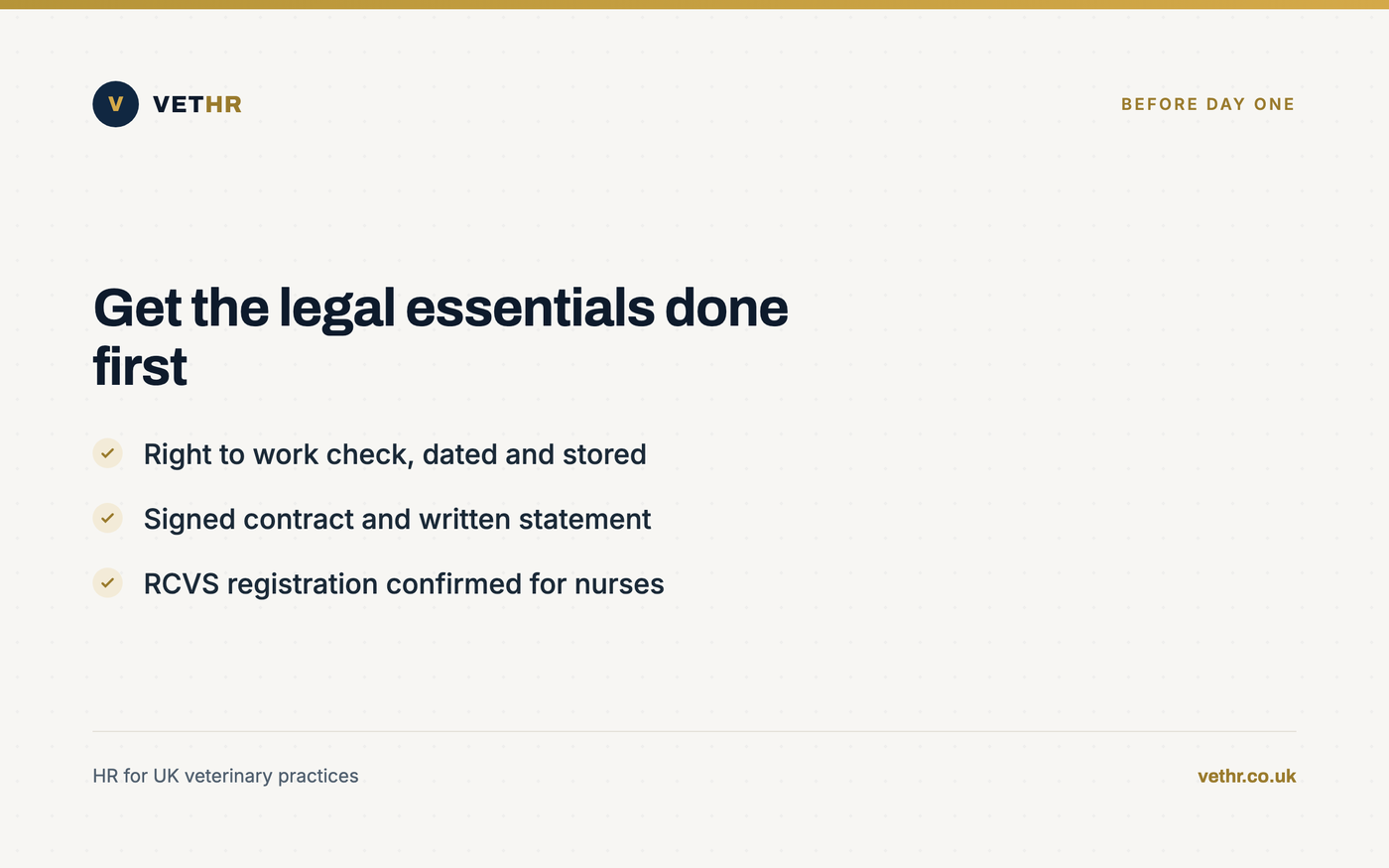
The principal written statement of employment particulars must be given on or before the first day of employment. It is a legal right for employees and workers, so it applies to your RVNs, receptionists, and part-time weekend staff alike. The wider written statement, covering items such as pensions and disciplinary procedures, can follow within two months.
GOV.UK sets out exactly what the principal statement must include: the employer and employee names, the job title or description, the start date, pay and frequency, hours and days of work and how they may vary, holiday entitlement, place of work, any probation period and its conditions, and details of obligatory training (GOV.UK, Written statement of employment particulars). For a practice, the hours and out of hours clauses deserve particular care.
This is where veterinary detail belongs. If a role carries any out of hours rota, weekend cover, or on-call expectation, write it into the statement clearly rather than leaving it as a corridor conversation. The same applies to how holiday accrues for part-time or irregular-hours staff, which is a frequent source of disputes that a precise contract prevents.
A clear written statement also protects the new starter. They know their pay, their hours, and their holiday from day one, which removes the low-level anxiety that drives early leavers. If your current template predates the 2020 day-one rule, treat this checklist as the prompt to refresh it before your next hire.
Confirm RCVS registration by searching the RCVS register before the nurse starts clinical work, and record their registration number on file. Only RCVS-registered veterinary surgeons and veterinary nurses can practise in the UK, and the public register lets you verify status, qualifications, and registration number in minutes (RCVS, Check our registers).
This step is unique to clinical onboarding and easy to skip when an offer feels settled. The title Registered Veterinary Nurse is protected, and the register confirms the person in front of you is current, not lapsed. Save a dated screenshot or note of the registration number alongside the right to work copy so your records are complete in one place.
For receptionists and unregistered support staff, RCVS registration does not apply, but role clarity still does. Be precise in adverts and contracts about whether a post requires a qualified RVN, so expectations match the register. Where a Schedule 3 task is involved, only a registered nurse may carry it out, which makes the check a clinical-governance safeguard as well as an HR one.
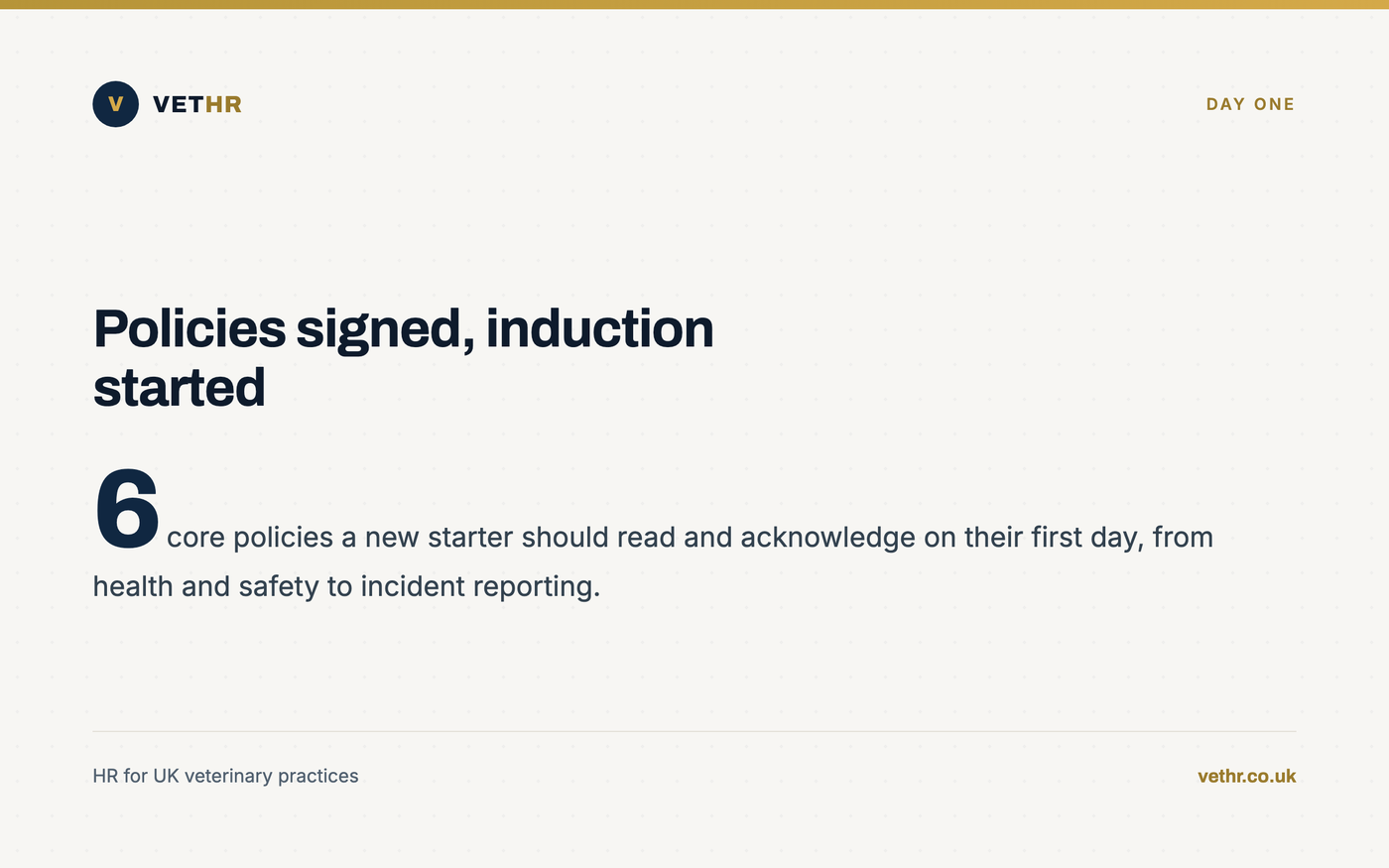
On day one, a new starter should read and sign for the core policies that govern conduct and safety: health and safety, including sharps and zoonosis handling, an employee handbook, data protection, and the practice grievance and disciplinary procedures. A signed acknowledgement proves they received and understood the rules, which is exactly what you want on file if anything is ever queried.
Practice life carries hazards a generic office never sees. Needlestick risk, zoonotic disease, manual handling of large patients, and controlled drugs all need a clear, acknowledged policy from the first shift. Keeping these documents current and signed is the everyday work behind our veterinary HR policies system, which timestamps each acknowledgement so nothing slips.
Incident reporting belongs here too. New starters are statistically the most likely to have an early mishap, so show them how to raise a concern from day one. A simple, visible route, such as a See It Report It log, normalises reporting and gives the practice manager a real-time picture rather than a story told weeks later. The point is a safer floor, not a thicker file.
Book a free 30-minute HR health check. If your policy pack is out of date or unsigned, we will tell you what to fix first. Arrange your free HR health check and start the next hire on solid ground.
A veterinary induction in week one should cover the practical and the human: a tour, the team, emergency and fire procedures, the practice management software, and the daily rhythm of consults, ops lists, and out of hours arrangements. Spread it across the first days so it lands, and pair the new starter with a named buddy who answers the small questions.
Remember that an induction is not the same as probation, though they overlap. ACAS describes induction as the process of welcoming someone and giving them what they need to do the job, and confirms there is no fixed legal length (ACAS, Inductions). For an RVN that means kennels, theatre, and the controlled-drugs cupboard; for a receptionist it means the phone system, triage basics, and how to handle a distressed owner.
Systems training is the part most often rushed. Booking, clinical notes, payments, and the rota all sit in software the new starter must trust quickly. Walking them through the staff rota system early shows exactly when they work, when out of hours falls, and how to request leave, which removes a whole category of week-one confusion.
Pay attention to the human layer. Introduce the new starter by name and role at the morning huddle, show them where to take a break, and tell them who covers what. A practice that does this well turns a nervous first day into a confident first week, and confident new hires are the ones who stay.
Set up probation by stating its length and conditions in the written statement, then booking the review dates before the new starter begins. A probationary period is commonly three to six months, with check-ins along the way and a clear final review, so nobody reaches the end date surprised. Diarise the meetings on day one and they will actually happen.
Crucially, probation does not pause statutory rights. From day one the new starter is entitled to the National Minimum Wage, paid holiday, statutory sick pay, and protection from discrimination (GOV.UK, Written statement of employment particulars, sets out the day-one particulars these rights sit beside). Probation is a structured support and assessment window, not a rights-free zone, and treating it that way keeps the practice safe.
Make the reviews genuine. Short, honest one-to-ones at roughly four to six weeks and again near the end give the new starter a chance to improve and give you a documented basis for any decision. For an RVN this might mean signing off specific clinical competencies; for a receptionist, confidence on triage and payments.
In one anonymous case, an independent veterinary practice we support replaced ad-hoc “how’s it going” chats with three diarised probation reviews and a simple competency list. Early concerns surfaced in week five rather than month five, the new nurse got targeted support, and she passed probation comfortably. Structure did not slow anyone down; it removed guesswork.
A signed contract and principal written statement, evidence used for the right to work check, and payroll details such as a P45 or HMRC starter checklist, bank details, and an emergency contact. For a Registered Veterinary Nurse, also confirm and record their RCVS registration. The written statement is due on or before day one under GOV.UK rules.
Yes. To obtain a statutory excuse against a civil penalty, you should carry out a compliant right to work check on every new employee before they start, regardless of nationality. Checking everyone the same way also helps you avoid discrimination. Acceptable methods are listed on GOV.UK.
Keep a clear copy of the evidence for the whole of the person’s employment and for two years after they leave, stored securely. A dated record is what gives you a statutory excuse if the check is ever questioned, so file it alongside the contract and, for nurses, the RCVS registration note.
No. ACAS confirms there is no legal duty to run an induction and no fixed length, but a structured one helps new staff settle and reduces early turnover. The legal must-dos around it are the right to work check, the written statement, and paying the new starter for every hour worked, including induction time.
Most practices use three to six months, with the exact length and conditions stated in the written statement. What matters more than the number is genuine review: diarised check-ins, a short competency list, and an honest final meeting. Probation does not remove statutory rights such as holiday, sick pay, and protection from discrimination.
A good veterinary new starter checklist is simply the right steps in the right order: right to work and contract before the first shift, RCVS confirmed for nurses, policies signed on day one, a structured induction across week one, and probation reviews already in the diary. None of it is heavy. Skipping any of it is where the cost lands.
If you would rather not hold all of this in your head for every hire, that is exactly what we do. Our policies system keeps acknowledgements current and timestamped, our contract templates carry the day-one particulars built in, and a quick conversation tells you where your current process leaks.
Start your next hire on solid ground. Book a free 30-minute HR health check and we will review your onboarding, contracts, and policies, then tell you the first thing to fix. No jargon, no pressure, just a calmer first day for the next nurse or receptionist who walks through your door.
The Vet HR Team provides HR consultancy and white-labelled staff systems exclusively to UK veterinary practices. Vet HR offers documentation and HR support and is not a law firm.
Read next: Work Experience in a Veterinary Practice and The Clinical Coach: Why Student Veterinary Nurses Leave.
Contracts, rotas, holiday, a difficult conversation. Tell us what you are dealing with and we will come back within one working day. Nothing to sign up to.
Got it. We will come back to you within one working day. If you do not see a reply, please check your spam folder.
