Last updated: 14 June 2026 by The Vet HR Team
TL;DR: A fair out of hours rota in a small veterinary practice rests on four things: an equal share of unsocial shifts, a cycle people can see weeks ahead, legal rest between shifts, and a clear way to swap. Get those right and the rota stops being the reason good vets and RVNs leave. This guide gives the principles, the law on rest and night work, and a workable cycle you can run from Monday.
In most small practices the out of hours rota is the single most resented document in the building. It decides who misses bedtimes, who works the bank holiday, and who never quite gets a clean weekend. When it feels arbitrary, people do not argue. They quietly start reading job adverts. This article shows how to build an out of hours rota that shares the load fairly, stays inside the law, and gives your team a reason to stay.
A fair rota distributes unsocial shifts as evenly as the team allows, publishes the cycle far enough ahead that people can plan their lives, and applies the same rules to everyone including the owner. Fairness is not everyone doing exactly the same thing. It is everyone being able to see why their share looks the way it does.
Three principles make the difference in practice. First, equity over equality: a four-day part-timer carries a smaller absolute share than a full-timer, but the proportion should track contracted hours, not personality. Second, transparency: the count of nights, weekends and bank holidays each person has done should be visible, not held in the manager’s head. Third, consent on the edges: people accept a heavy month far better when they helped shape the cycle.
The British Veterinary Association puts this plainly in its good-workplaces guidance. It asks practices to provide “fair and anticipated working hours, recognising and rewarding work above contracted hours,” and notes that unexpected long hours “should be infrequent and genuinely unforeseen” rather than the normal way the rota runs (BVA, Good workplaces: workload and flexibility). Anticipated is the operative word. A surprise is not a rota.
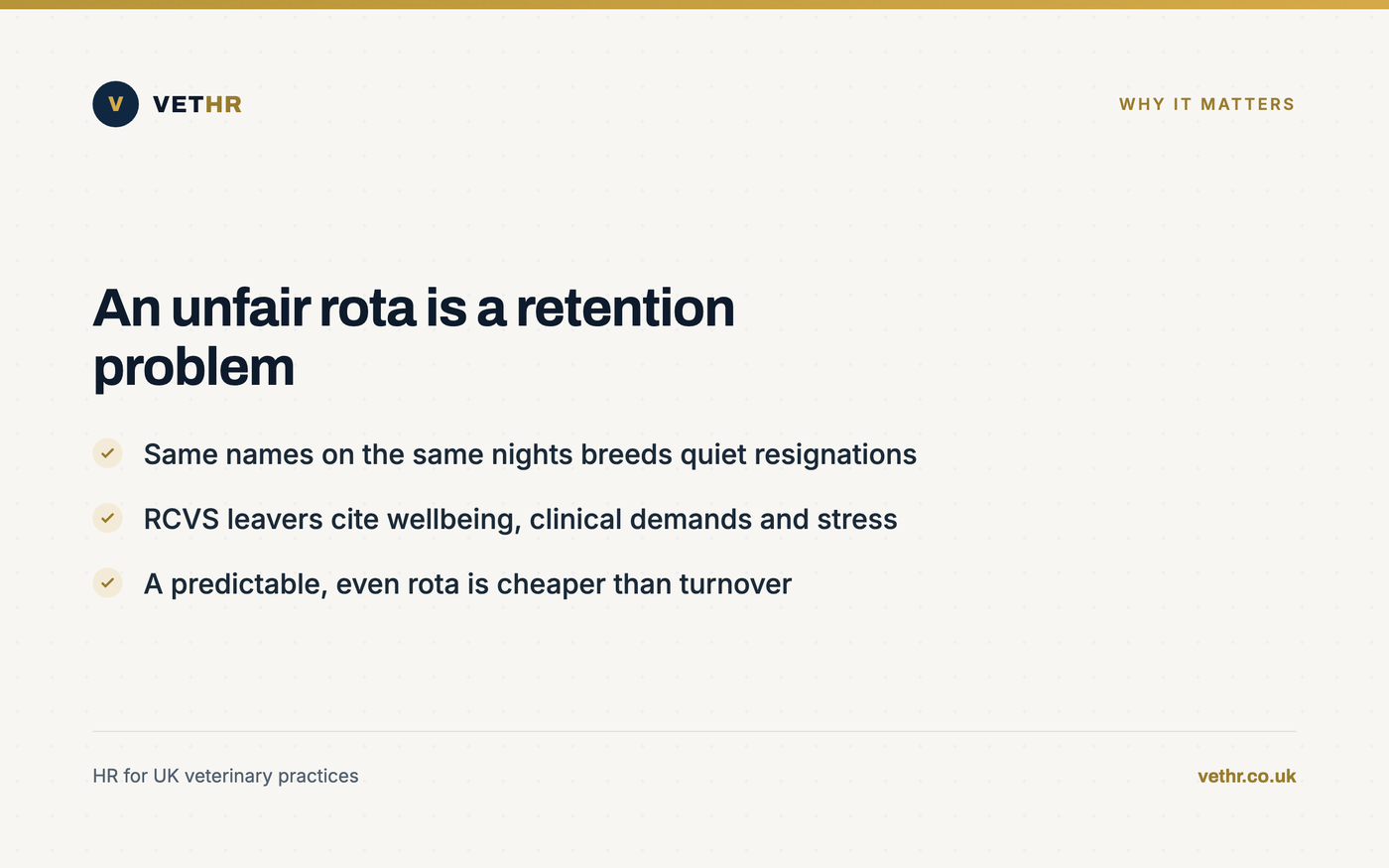
The rota affects retention because unsocial hours and the feeling of being treated unfairly are exactly what pushes clinical staff out of the door. People rarely resign over one bad weekend. They resign over a pattern: the same names on the same nights, changes sprung at short notice, and no sense that anyone is keeping score.
The most recent RCVS Exit Survey, covering leavers across 2022 to 2024, found that among vets giving up the UK-practising category the most commonly mentioned reasons in free-text answers were health and wellbeing, closely followed by the demands of working in clinical practice. For veterinary nurses, the survey reports the leading themes as pay and stress, with specific mentions of burnout and the weight of responsibility (RCVS, Exit Survey 2022 to 2024). A rota is not the whole story, but it is the part of the working day a practice can change this month.
Here is the retention logic in one line. Recruiting a replacement vet or RVN costs months of advertising, lost continuity for clients, and the strain on the people left covering the gap. A fair, predictable rota is far cheaper than the turnover it prevents.
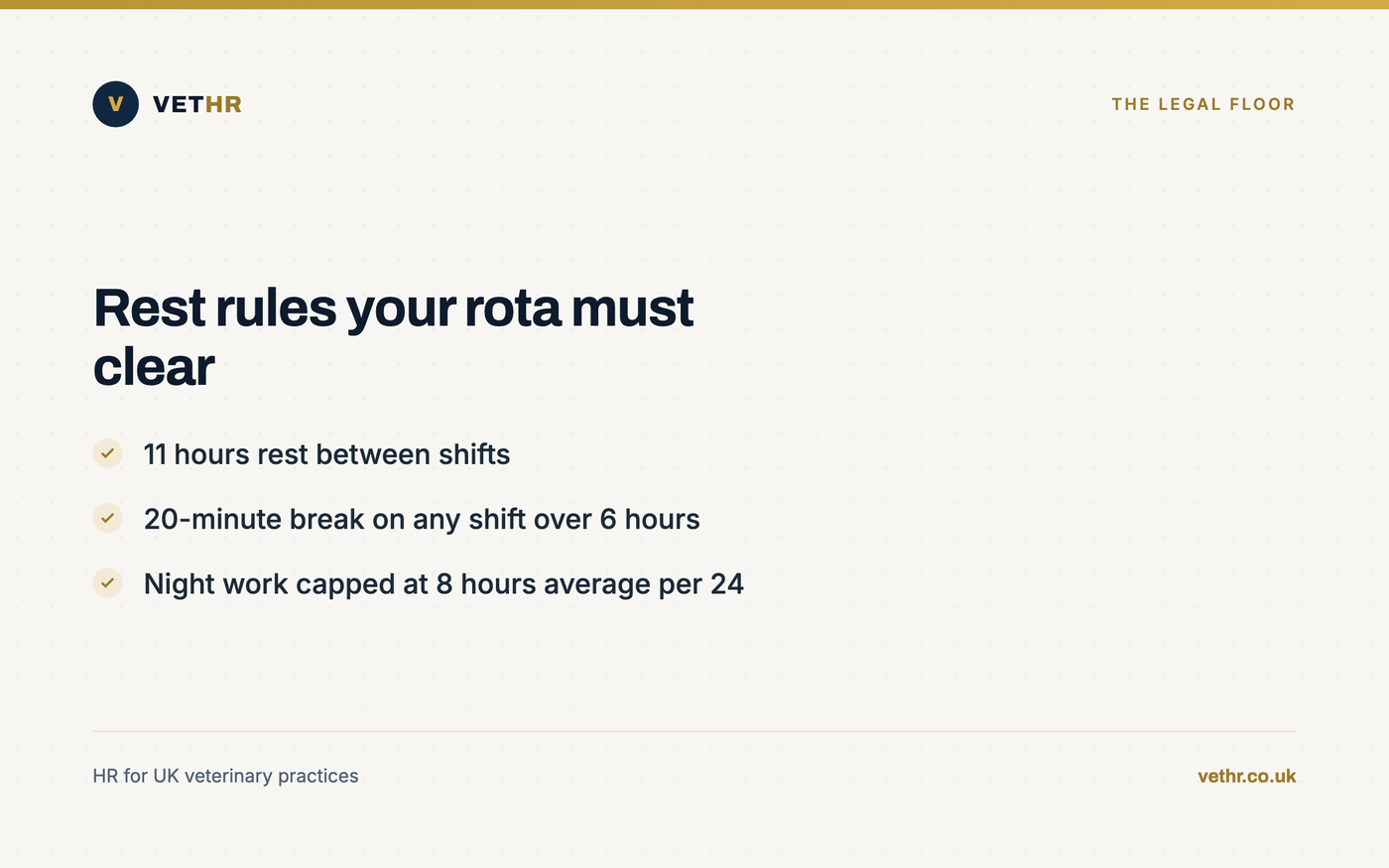
UK working-time law sets the floor your rota must clear. Workers over 18 are entitled to one uninterrupted 20-minute rest break during any day longer than six hours, at least 11 hours of rest between working days, and either 24 hours off each week or 48 hours off each fortnight (GOV.UK, Rest breaks at work). These are minimums, not targets.
The 11-hour rule is the one rotas trip over most often. If a vet finishes a late consult or an emergency at 11pm, they should not be rostered to start again until 10am the next morning. The same page gives the worked example: stop at 8pm, do not start before 7am (GOV.UK, Rest breaks at work). Build the gap into the cycle and you will not have to police it case by case.
There is also an overall ceiling. Staff cannot be required to work more than 48 hours a week on average, normally calculated over a 17-week reference period, although an individual can choose to opt out of that limit in writing (GOV.UK, Maximum weekly working hours). An opt-out is the worker’s choice to make and to withdraw. It is not a box you add to a contract and forget.
If your practice runs its own overnight cover, the night-work rules apply on top of the ordinary rest rules. A night worker is someone who regularly works at least three hours during the night period, which GOV.UK defines as 11pm to 6am unless you agree a different seven-hour window in writing that includes midnight to 5am (GOV.UK, Night working hours and rules).
Night workers must not work more than an average of eight hours in any 24-hour period, normally averaged over 17 weeks, and this limit cannot be opted out of (GOV.UK, Night working hours and rules). That is a hard constraint on how heavily you can load one person with overnight emergency duty, and a good reason to spread it.
One duty is easy to miss. Employers must offer a free health assessment before someone becomes a night worker, then regular assessments after, at a frequency that depends on the results. The worker does not have to accept, but if a health professional confirms night work is affecting their health, the employer must try to find suitable alternative work (GOV.UK, Night workers and health assessments). Put the offer in your onboarding so it is documented, not improvised.
Vet HR is an HR consultancy and documentation service, not a law firm, so use these GOV.UK pages as your source of truth and take legal advice on anything contentious. Our job is to turn the rules into a rota and a policy your team can actually follow.
There is no statutory frequency for on-call, so the honest answer is: as rarely as your team size and cover model allow, with the same share for everyone of equal contract. In a small practice the maths is simply the number of people in the OOH pool divided into the calendar. The aim is a rhythm people can predict and survive, not a number borrowed from a larger group.
Work it backwards from the people you have. If five vets share weekend on-call, each takes one weekend in five, which most people can plan around. If only two are eligible, one in two is unsustainable and you have a structural problem, not a rota problem. That is the point to consider freelance vet cover, a shared OOH arrangement with a neighbouring practice, or an external provider rather than grinding two people down.
Whatever the frequency, protect the recovery. The BVA guidance is explicit that breaks should be “structured, protected, and adhered to,” not the first thing sacrificed on a busy day (BVA, Good workplaces: workload and flexibility). A post-night day off is part of the rota, not a favour.
Build the cycle in five steps, then run it on repeat so everyone can see their share coming. The goal is a pattern that survives contact with a normal week of sickness and swaps, not a perfect spreadsheet that breaks the first time someone is off.
A worked example. Five vets, a five-week repeating cycle: each takes one full weekend on-call per cycle, one Friday night, and the bank-holiday list rotates so position one this year is position five next year. Each finishes the count one slot ahead or behind the others at most, and everyone can point to the page and see it. That visibility is what turns “the rota is unfair” into “the rota is tight, but I can see it is even.”
The mechanics matter less than the discipline of running them consistently. A shared digital rota that records who did what, flags rest-gap breaches, and lets staff request swaps in one place removes the suspicion that the manager is freelancing the allocation. Our veterinary rota system is built for exactly this: visible counts, rest-rule prompts, and a clean swap trail.
If the pool is too small, stop trying to squeeze fairness out of a rota that cannot hold it and change the cover model instead. Two or three eligible clinicians cannot carry 365 nights between them without breaching rest rules or burning out, and no clever spreadsheet fixes a staffing shortfall.
Practical options include a shared OOH rota with a nearby independent practice, a dedicated out-of-hours provider for nights and bank holidays, or freelance vet cover for the heaviest weekends. Each keeps your core team inside the legal rest limits and protects the daytime service that pays the bills. Spreading load across more shoulders is not a luxury. It is how small practices keep the people they have.
Whichever route you choose, write it down. A short OOH policy that states the cycle, the rest rules, the swap process and the escalation route stops the rota living in one person’s memory, where it always drifts toward whoever complains least.
Workers over 18 are entitled to at least 11 hours of rest between the end of one working day and the start of the next, plus a 20-minute break on any shift over six hours, and 24 hours off each week or 48 hours each fortnight (GOV.UK). Build the 11-hour gap into the cycle after every late or overnight duty.
Night duty usually follows the contract and the agreed rota, but the law caps it. Night workers must not average more than eight hours of work in any 24-hour period over the reference period, and this cannot be opted out of (GOV.UK). Employers must also offer a free health assessment before night work starts.
Share unsocial slots in proportion to contracted hours, rotate the worst dates so nobody owns every bank holiday, keep a visible count of nights and weekends per person, and apply the same rules to the owner. Publish the cycle weeks ahead and give one recorded way to swap.
It addresses two of the main drivers leavers report. The RCVS Exit Survey 2022 to 2024 highlights health, wellbeing and the demands of clinical practice for vets, and stress and burnout for nurses (RCVS). Predictable, evenly shared hours directly ease the parts of that a practice can control.
There is no fixed legal notice period, but the BVA calls for “fair and anticipated working hours” (BVA). In practice, publishing a repeating cycle four to six weeks ahead lets staff plan childcare and rest, and makes any change visible rather than sprung.
A fair rota is not a kindness you grant when things are quiet. It is the operational backbone of retention in a small practice: an even share, a visible count, legal rest built in, and a cycle people can see coming. The rules are not complicated. The discipline of running them consistently is what separates practices that keep their teams from those that keep recruiting.
If your rota currently lives in one head or one fragile spreadsheet, that is the place to start. A purpose-built rota system makes the share visible and the rest rules automatic, and a monthly HR subscription keeps the policy behind it current as your team changes.
Not sure where the unfairness is hiding? Book a free 30-minute HR health check and we will look at your OOH rota and policies with you, no charge and no obligation.
The Vet HR Team provides HR consultancy, documentation and white-labelled staff systems exclusively to UK veterinary practices.
Read next: The Veterinary Rota: 7 Mistakes That Burn Out Your Team and The Christmas Rota in a Veterinary Practice.
Contracts, rotas, holiday, a difficult conversation. Tell us what you are dealing with and we will come back within one working day. Nothing to sign up to.
Got it. We will come back to you within one working day. If you do not see a reply, please check your spam folder.
