Last updated: 14 June 2026
TL;DR: A clock in and out system for vet practices is rarely the first thing on a busy rota, yet it quietly decides how accurate your payroll is and how easily you prove compliance. Paper is cheap but fragile. A spreadsheet is flexible but manual. A proper system records hours automatically and links to your rota. For most independent practices, the honest answer depends on team size, not fashion. This guide compares all three fairly.
Recording staff hours feels like admin until the month it goes wrong. A missed half hour here, a forgotten break there, and suddenly payroll is a guessing game. This is a calm look at the three real options, with the UK rules that sit behind them and no sales theatre.
How you record hours feeds three things at once: pay, compliance and trust. Get it right and payroll is fast and uncontested. Get it loose and you carry a slow leak of unpaid minutes, padded shifts and arguments that nobody can settle with evidence. The method is not bureaucracy. It is the source of truth for what you owe your team.
Veterinary work makes this harder than the average office. Consults run late, a crash case eats the lunch break, and out of hours cover blurs the line between rostered and actual time. An RVN who stays forty minutes past close to monitor a recovery is owed those minutes, but only if something captured them.
There is a payroll cost to vagueness, too. If your timekeeping rounds in the team’s favour by ten minutes a day across eight people, that is over six hours of paid time a week with no work behind it. Round against them and you risk underpaying the minimum wage, which is a separate legal problem we will come to.
So the question is not whether to record hours. It is which method gives you accurate numbers without stealing time from clinical work. That is the lens for everything below.
UK law does not mandate a clocking machine, but it does require records that prove compliance. Two rule sets matter for a vet practice: the Working Time Regulations and National Minimum Wage law. You can satisfy both on paper, in a spreadsheet or in software, as long as the records are accurate and you can produce them on request.
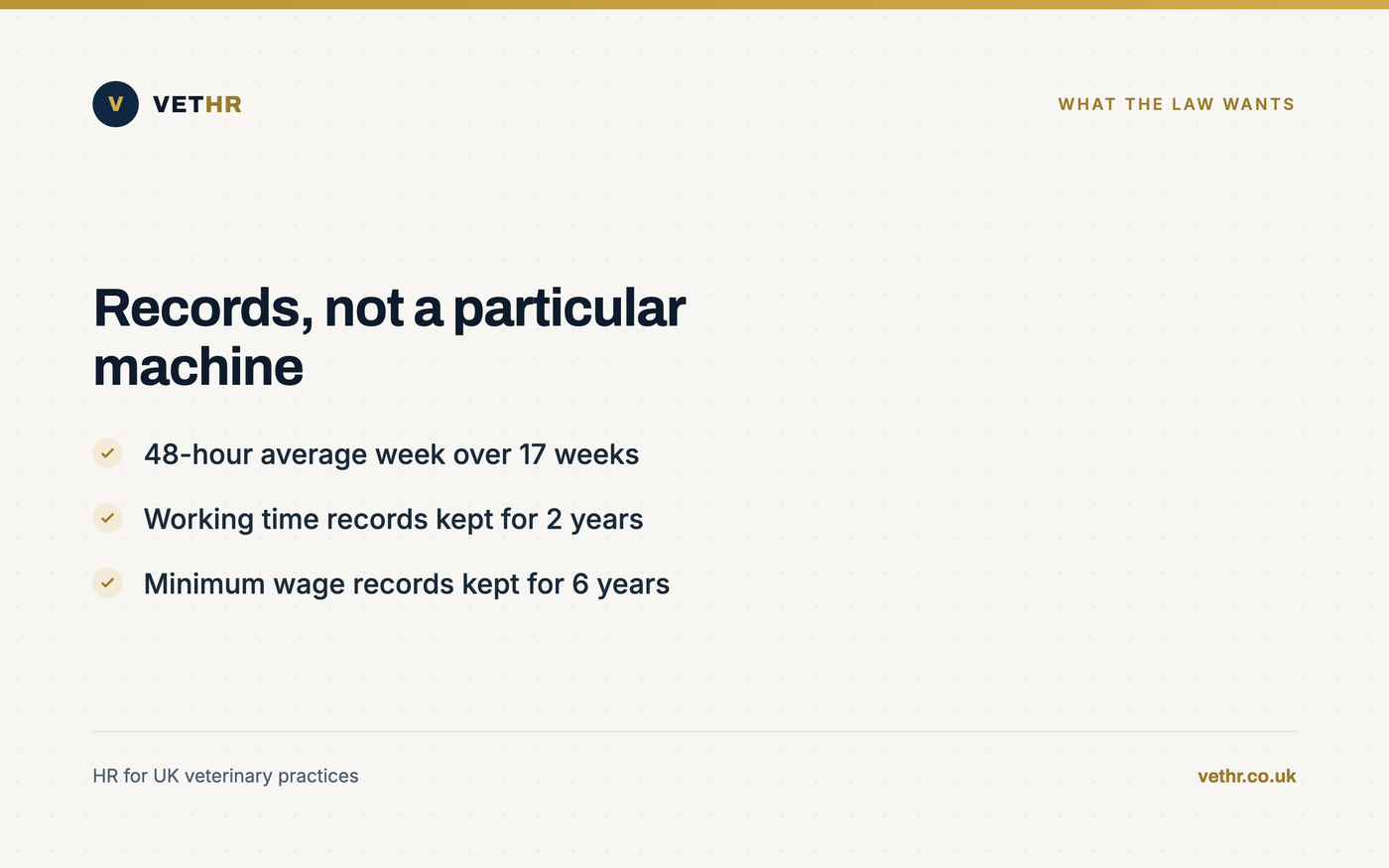
Under the Working Time Regulations, staff cannot work more than 48 hours a week on average, normally averaged over 17 weeks, although individuals can choose to opt out of the 48-hour week in writing, according to GOV.UK. You need enough record-keeping to show you are inside that limit.
The same regulations set rest entitlements. GOV.UK confirms workers are entitled to one uninterrupted 20 minute rest break during the working day if they work more than 6 hours, 11 hours rest between working days, and an uninterrupted 24 hours without work each week, as set out on the rest breaks at work guidance.
How long must you keep this? Acas states that employers must keep working time records for 2 years from the date they were made, in its guidance on the working time rules. That is the floor for the Working Time Regulations, and it applies whatever format you use.
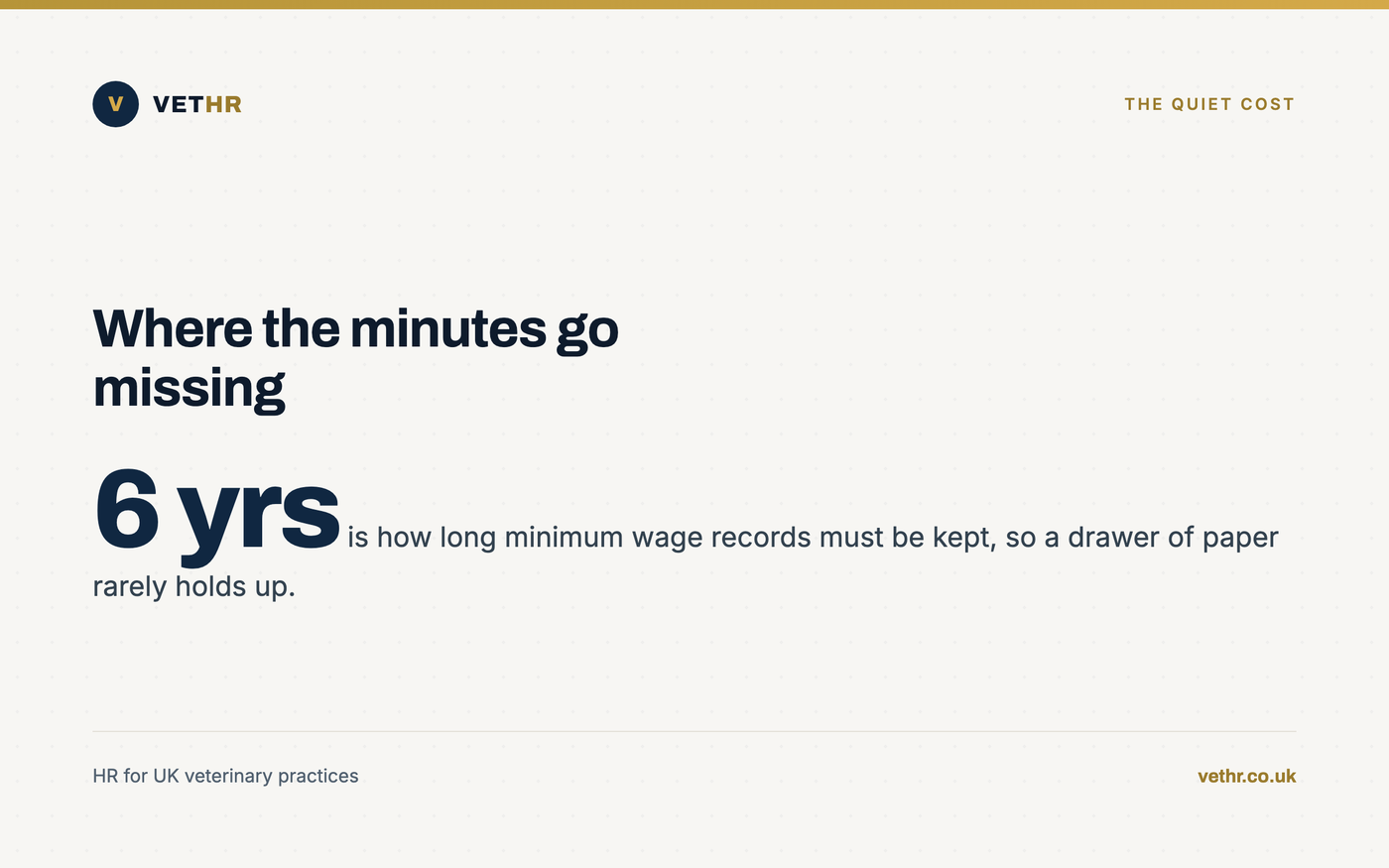
National Minimum Wage law sets a tougher bar. GOV.UK guidance on enforcing the minimum wage states that, from 1 April 2021, employers must keep records for a minimum of 6 years, must be able to produce them for a worker in a single document on request, and that it is a criminal offence not to keep records for the required period.
Read those two together and a pattern appears. The law cares less about the tool and more about whether your hours are accurate, complete and retrievable for years. Any method that cannot do that quietly fails the test, however cheap it looks today.
Paper can be good enough for a very small, stable team, and it has real virtues: no cost, no training, no screens. A sign-in sheet by the kettle works on day one. The problem is not that paper cannot record time. It is that paper cannot protect, total or retrieve that time when you need it under pressure.
Start with the strengths. Paper is instant and universal. A new starter understands a column of times without an account or a password. There is nothing to crash, no licence to renew, and an inspector can read it without a login. For a two or three person branch, that simplicity is genuinely valuable.
Now the weaknesses, because they bite. Paper is fragile. A coffee spill, a lost sheet or an illegible scrawl, and a fortnight of hours is gone. Totalling it is manual, so payroll becomes someone squinting at a clipboard and adding up by hand, which is exactly where quiet errors creep in.
It is also hard to audit. Times written in pencil after the fact are not evidence anyone trusts, and you cannot prove who wrote what or when. Against a 6-year minimum wage retention rule, a drawer of curling sheets is a liability, not a record. Paper suits the smallest, calmest practices and almost nobody else.
A shared spreadsheet is the natural step up from paper, and for many small practices it is a sensible middle ground. It totals hours for you, lives in the cloud where it cannot be spilled on, and costs nothing beyond the software you already own. The catch is that a spreadsheet is only ever as honest as the person typing into it.
The upsides are real. Formulas add up the week automatically, so payroll stops being mental arithmetic. A cloud sheet keeps a version history, which is a form of audit trail. You can colour-code overtime, flag missed breaks and export a tidy document, which goes a long way toward that single-document requirement for minimum wage checks.
The downsides are about discipline and time. Someone has to type every clock in, usually from memory at the end of a long shift, which is where the half hours vanish. There is no live record of when a person actually arrived, only when they later said they did. One wrong formula can quietly skew a whole month of pay.
Spreadsheets also strain as the team grows. Two people sharing a tab is fine. Twelve people, freelance vet cover and three branches turn one file into a tangle of tabs that only the practice manager understands. It works, but it leans hard on one person’s care and never captures time at the moment it happens.
A clock in and out system for vet practices earns its place when accuracy, scale or compliance start costing you real time. Instead of someone recalling hours later, staff tap in and out on a tablet or phone, and the system timestamps the moment. Those timestamps then total themselves, flag exceptions and sit ready for payroll and any audit.
The first benefit is captured time. A clock in and out system records the real moment, not a tired guess at five past close. That closes the gap where unpaid overtime and rounding errors live. When an RVN stays late for a recovery, the minutes are logged without anyone having to remember them.
The second is the link to the rota. The strongest setups connect clocking to scheduling, so planned and actual hours sit side by side. You can see at a glance who ran over, who left early and where cover gaps appeared. That connection is why we keep our clock in and out and rota tools in the same place.
The third is compliance you do not have to think about. A system holds years of timestamped records and produces a clean export per person on request, which maps neatly onto the 2-year working time floor and the 6-year minimum wage rule. The honest trade-off is cost and a short setup, which is why this is a question of fit, not status.
No method wins on every axis. Paper wins on simplicity and cost. A spreadsheet wins on flexibility. A system wins on accuracy, scale and audit. The table below lays the trade-offs out plainly so you can match the method to your practice rather than to a sales pitch.
| Factor | Paper | Spreadsheet | System |
|---|---|---|---|
| Upfront cost | None | None to low | Monthly fee per practice |
| Records real clock-in time | Only if written live | Rarely, usually recalled | Yes, timestamped |
| Totals hours automatically | No, manual | Yes, via formulas | Yes, automatic |
| Audit trail | Weak | Some version history | Strong, per person |
| Scales past 10 to 15 staff | No | With effort | Yes |
| Links to the rota | No | No | Yes |
| Risk of quiet error | High | Medium | Low |
| Best for | 2 to 3 staff, stable | Small, organised teams | Growing or multi-branch |
The pattern is steady. As the team grows and hours get messier, the manual options get riskier and the system gets more valuable. There is no universally right row, only the row that matches where your practice is now and where it is heading.
Not sure which row is yours? A 30-minute conversation usually settles it. Book a free HR health check and we will look at your current timekeeping, your team size and your payroll process, then tell you honestly whether paper, a spreadsheet or a system fits best. No pressure, no jargon.
Choose by team size, payroll pain and how often hours go wrong, not by what looks modern. If payroll is quick and uncontested and you have a handful of steady staff, your current method may be fine. If you spend the last week of each month chasing hours, that friction is your answer. Start with the symptom, not the software.
Three honest questions cut through it. First, how many people do you pay, and is that number rising? Second, how often does a hours dispute or a payroll correction actually happen? Third, could you produce a clean, accurate record for one person across the last few years if an inspector asked tomorrow?
Whatever you choose, the rule is the same: record real hours, keep them long enough, and be able to produce them per person. Timekeeping sits alongside your contracts and rota as part of one tidy system, not a standalone chore. Get those joined up and the month-end scramble fades.
No. UK law requires accurate, retrievable records of working time, not a specific device. You can use paper, a spreadsheet or software. What matters is that you can show compliance with the Working Time Regulations and produce minimum wage records for each worker on request, as GOV.UK and Acas set out.
It depends on the rule. Acas states working time records must be kept for 2 years from the date they were made. National Minimum Wage records, under GOV.UK guidance, must be kept for a minimum of 6 years from 1 April 2021. The safe planning figure for a practice is the longer one, six years.
Yes, provided it is accurate and you can produce a single document per worker on request. A cloud spreadsheet with version history can meet that bar for a small team. The legal risk is not the format but inaccuracy, so a sheet that relies on hours recalled days later is weaker evidence than live timestamps.
GOV.UK confirms a worker is entitled to one uninterrupted 20 minute rest break during the working day if they work more than 6 hours. They are also entitled to 11 hours rest between working days. In a busy practice, recording whether breaks are actually taken is as important as recording start and finish times.
A good one does. Freelance vet cover often means irregular, short-notice shifts that are exactly where manual records slip. A system that timestamps arrivals and links to the rota keeps planned and actual hours together, so you pay the right amount and keep a clean record without chasing anyone for their times after the fact.
There is no shame in paper if you are a calm three-person branch, and a tidy spreadsheet serves many small practices well for years. A dedicated system is not a status symbol; it is the answer when timekeeping starts costing you time, accuracy or sleep. That moment usually arrives as the team grows, the rota gets complicated, or payroll corrections become a monthly habit.
If you are weighing it up, start with the symptom and let it point to the method. To go deeper on the tools, see our clock in and out and rota pages, or simply book a free HR health check and we will give you a straight recommendation for your practice. No system sold for the sake of it.
The Vet HR Team provides HR consultancy and white-labelled staff systems exclusively to UK veterinary practices.
Contracts, rotas, holiday, a difficult conversation. Tell us what you are dealing with and we will come back within one working day. Nothing to sign up to.
Got it. We will come back to you within one working day. If you do not see a reply, please check your spam folder.
