Last updated: 14 June 2026. Written by The Vet HR Team. Position stated as at the publication date.
TL;DR: Holiday entitlement for part-time staff is the same 5.6 weeks granted to full-time colleagues, worked out pro rata to the days or hours they actually do. An RVN on three days a week gets 16.8 days a year (3 x 5.6). For staff on genuinely variable weekend or freelance vet cover, you instead accrue leave at 12.07% of the hours worked each pay period, the rule that applies to leave years starting on or after 1 April 2024.

Few HR jobs in a veterinary practice cause as much quiet friction as leave. A practice manager juggling RVNs on school-run hours, weekend receptionists and freelance vet cover can end up with a different rule in their head for every contract. This guide sets out the current UK rules in plain English, with worked examples sized to a small practice, so your rota and your payroll finally agree.
Holiday entitlement for part-time staff is the legal right to the same 5.6 weeks of paid annual leave as a full-time worker, scaled to the part-timer’s working pattern. Almost everyone classed as a worker is legally entitled to 5.6 weeks’ paid holiday a year, and part-timers are not an exception. They simply earn the same proportionate share, expressed in their own days or hours.
That 5.6 weeks is the statutory floor set out by GOV.UK in its holiday entitlement guidance. A full-time member of staff on a five-day week receives at least 28 days’ paid leave a year, the equivalent of 5.6 weeks. You can offer more in a contract, but you can never offer less.
The principle that protects part-timers is fairness. Under the Part-Time Workers (Prevention of Less Favourable Treatment) Regulations 2000, part-time workers cannot be treated less favourably than comparable full-time colleagues. ACAS states the rule plainly in its guidance on checking holiday entitlement: part-time workers cannot be treated less favourably than full-time workers. In a practice, that means a 20-hour RVN earns leave on exactly the same basis as a 40-hour one, just less of it in absolute terms.
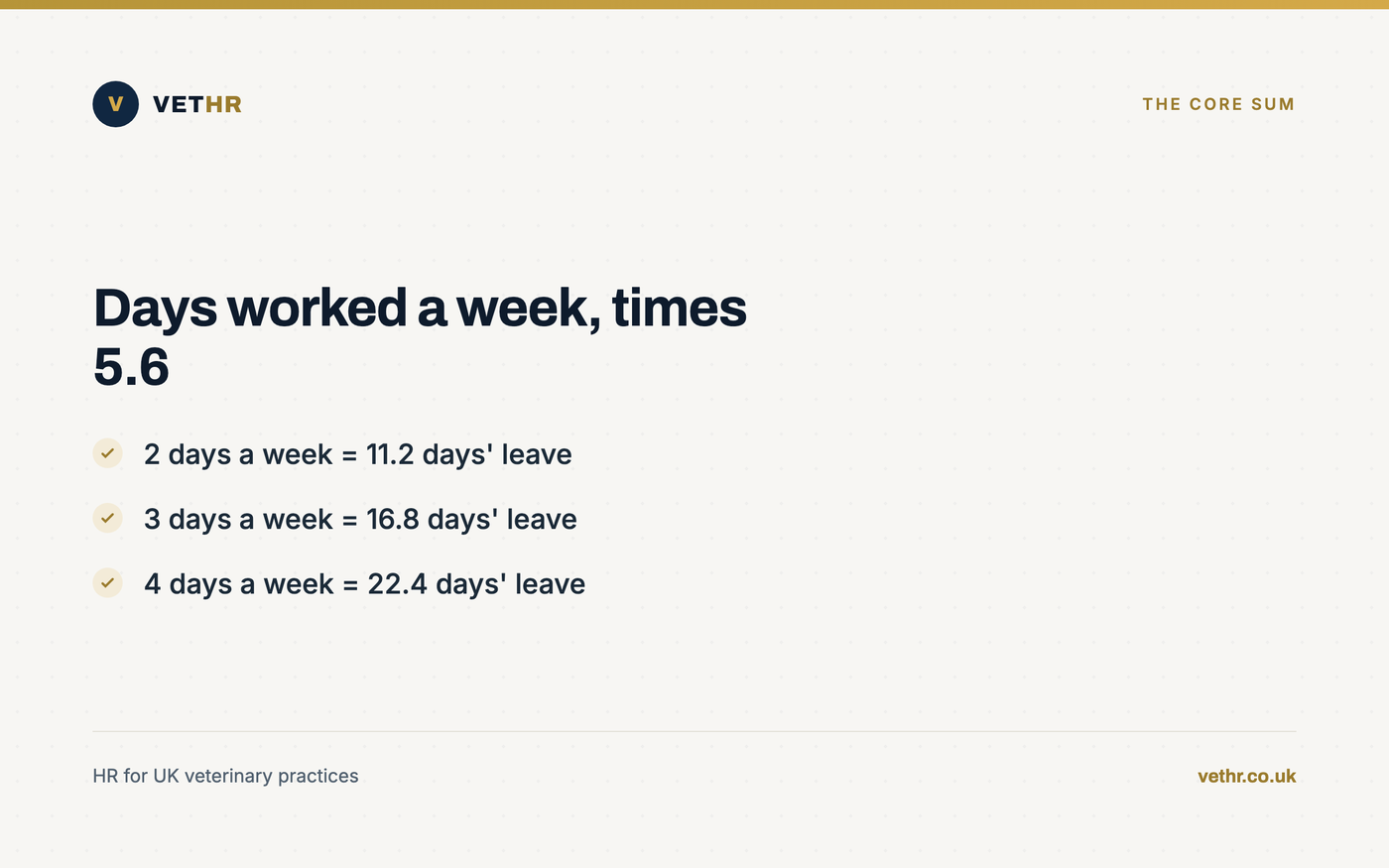
For someone who works the same days every week, multiply the number of days they work by 5.6. ACAS gives the worked example directly: if someone works three days a week, they are entitled to 16.8 days of paid holiday a year (3 x 5.6). That single sum covers most of the regular part-time contracts in a small practice.
Picture a typical team. A receptionist on two fixed days earns 11.2 days (2 x 5.6). A nurse on four days earns 22.4 days (4 x 5.6). A full-time vet on five days earns the full 28. Each figure is the statutory minimum for that pattern, and you are free to round up to whole or half days as a goodwill gesture, though you can never round below the legal figure.
There is a ceiling worth knowing. Statutory paid holiday is capped at 28 days, and ACAS confirms this rule applies regardless of how many days a week someone works. So a part-timer who works six short days a week does not earn 33.6 days; they are capped at 28. In practice this rarely bites for a part-timer, but it matters for staff who spread few hours across many days.
When a contract is set in hours rather than days, the cleanest method is to express the year’s leave in hours too. A nurse contracted for 22.5 hours a week earns 22.5 x 5.6 = 126 hours of paid leave a year. Booking leave in hours, and clocking it the same way, stops the slow drift between rota and payslip that audits so often expose. Our holiday calculations system does this arithmetic for every contract type automatically.
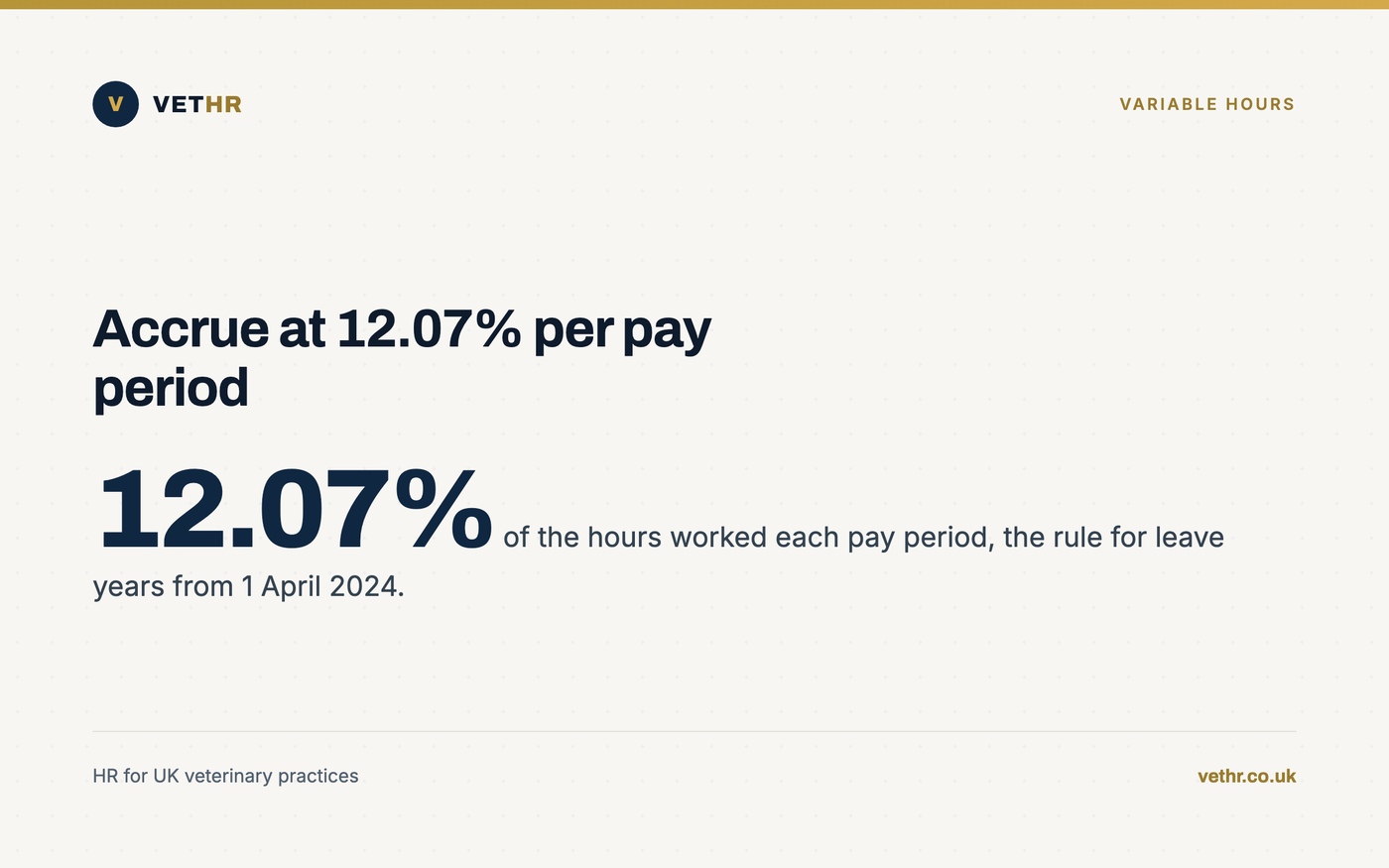
For staff whose hours genuinely vary week to week, you do not set a fixed annual figure. Instead, holiday builds up as they work, at 12.07% of the hours worked in each pay period. This is the method that applies to leave years beginning on or after 1 April 2024 for irregular hours workers and part-year workers, and it has reshaped how practices handle weekend and bank-holiday cover.
ACAS defines an irregular hours worker as someone whose paid hours in each pay period are, under their contract, wholly or mostly variable. Its guidance for irregular hours and part-year workers explains that these staff accrue holiday at 12.07% of the hours they work in a pay period, applied on the last day of that period. The figure comes from the statutory 5.6 weeks expressed as a share of the working year.
ACAS gives a clean example. In June, a worker called Jamie does 70 hours. Their entitlement for June is 12.07% of 70 hours, which works out as 8 hours after rounding down the part hour that is less than 30 minutes. GOV.UK shows the same sum a slightly different way in its holiday pay reforms guidance: 68 hours divided by 100 gives 0.68, multiplied by 12.07 gives 8.2076, which rounds to 8 hours.
For an irregular-hours weekend receptionist who worked 70 hours in a month, the practice banks roughly 8 hours of paid leave for that month, calculated and recorded as the month closes.
There is also a lawful shortcut for paying it. For leave years from 1 April 2024, rolled-up holiday pay is permitted for these workers. GOV.UK explains it as 12.07% of the worker’s total pay in each pay period, shown as a separate line on the payslip. Its worked figure: a worker earning £364.70 in a week accrues £364.70 divided by 100, times 12.07, which is £44.06 of rolled-up holiday pay. If you use this route, label it clearly and keep the rate consistent.
One more point your payroll will thank you for. When an irregular hours or part-year worker is off on maternity, another form of family leave, or sick leave, you cannot simply record zero accrual. GOV.UK directs you to use a 52-week relevant period to work out their average weekly hours, then apply the 12.07% calculation to each week of absence, so leave keeps building during protected time off.
There is no automatic legal right to bank holidays off, paid or otherwise. GOV.UK is explicit that bank or public holidays do not have to be given as paid leave, and that an employer can choose to include bank holidays as part of a worker’s statutory annual leave. What you cannot do is hand them to full-timers and quietly withhold the equivalent from part-timers.
The fairness rule does the work here. If full-time staff get the eight standard bank holidays as paid time off, part-timers must receive a pro rata share of that benefit, even when several of those dates never fall on their working days. Practices that close on bank holidays, or that run a reduced bank-holiday rota, are exactly where this gets missed.
The contract wording decides the mechanics. A contract that says “28 days inclusive of bank holidays” folds those dates into the total. One that says “20 days plus bank holidays” treats them as extra, and you must then convert the bank-holiday element to a pro rata figure for part-timers. Many practices avoid the whole tangle by quoting one all-in leave figure in hours and letting staff book bank holidays from it like any other day. Getting this language right in your employment contracts prevents the most common part-time dispute we see.
An independent veterinary practice we supported ran a fixed bank-holiday closure but had only ever credited part-timers who happened to be rostered on those Mondays. Reframing every contract to a single hours-based allowance, with bank holidays drawn from the pot, removed the inconsistency in one pay run and ended a long-running grievance. No figures were invented; the maths simply followed the rules above.
Some practice staff are contracted to work only part of the year, with unpaid gaps of a week or more, while remaining employed throughout. GOV.UK and ACAS class these as part-year workers, and since the 1 April 2024 reforms they accrue leave the same way as irregular hours staff, at 12.07% of the hours worked in each pay period rather than receiving a full year’s entitlement up front.
This matters because of a 2022 Supreme Court case, Harpur Trust v Brazel, which had briefly entitled some part-year staff to a more generous calculation. The reforms from April 2024 replaced that approach with the 12.07% accrual method for new leave years, restoring a single, simpler rule. For your practice, the takeaway is that genuine part-year and irregular-hours contracts now share one accrual method, which makes payroll considerably easier to run.
Carry-over also flexes for these workers, and the detail turns on why the leave went untaken. Always check the individual’s circumstances against the current GOV.UK and ACAS pages before agreeing any carry-over.
The errors are predictable, and every one is avoidable. They tend to surface during a resignation, a grievance, or the first proper payroll audit a practice has run in years.
None of this needs a law degree, but it does need one consistent method applied across every contract and matched by your clock-in records. That is precisely the join most small practices lack, and it is where a short review pays for itself.
If reading this surfaced a contract you are no longer sure about, that is reason enough to talk. Book a free 30-minute HR health check and we will pressure-test how you calculate leave for your part-time and variable-hours staff, against the current rules, with no jargon and no obligation. Arrange it on our contact page.
The same 5.6 weeks as a full-timer, pro rata to their days. ACAS confirms that someone working three days a week gets 16.8 days a year (3 x 5.6). A two-day worker gets 11.2 days, a four-day worker gets 22.4 days. Statutory leave is capped at 28 days regardless of how many days a week someone works.
It is the accrual method for irregular hours and part-year workers in leave years beginning on or after 1 April 2024. GOV.UK and ACAS state that these workers build up holiday at 12.07% of the hours they work in each pay period. For example, ACAS shows 70 hours worked accruing 8 hours of leave for that period.
There is no automatic right to paid bank holidays. GOV.UK states bank or public holidays do not have to be given as paid leave. However, if full-time staff receive them paid, part-time staff must get a pro rata equivalent under the part-time workers fairness rules, even for dates outside their normal working days.
Yes, for irregular hours and part-year workers in leave years from 1 April 2024. GOV.UK permits rolled-up holiday pay calculated at 12.07% of the worker’s total pay in each pay period, shown as a separate payslip item. It must be clearly labelled, not hidden inside the basic hourly rate.
Yes. For irregular hours and part-year workers, GOV.UK directs employers to use a 52-week relevant period to work out average weekly hours during maternity, other family leave, or sick leave, then apply the 12.07% calculation to each week of absence so entitlement keeps accruing during protected time off.
No. Vet HR provides HR consultancy and documentation support to UK veterinary practices, not legal advice. We help you apply the current GOV.UK and ACAS rules correctly across contracts, rotas and payroll. For a definitive legal ruling on a disputed case, we will tell you when to involve a solicitor.
Holiday entitlement for part-time staff comes down to one method per contract, written into the agreement and matched by your clock-in data. Fixed-pattern part-timers earn 5.6 weeks pro rata; genuinely variable staff accrue at 12.07%; bank holidays follow the contract wording and the fairness rule. That is the whole framework, and it is enough to run a fair, defensible leave policy.
If you would rather not own the spreadsheet, our holiday calculations system applies the right rule to every contract type, and we can tidy the underlying contract wording at the same time. When you are ready, book a free HR health check on our contact page.
The Vet HR Team provides HR consultancy and white-labelled staff systems exclusively to UK veterinary practices, available 12 hours a day, every day of the year. This article is general guidance, not legal advice, and reflects the position as at 14 June 2026.
Free tool: Try the free veterinary holiday entitlement calculator
Contracts, rotas, holiday, a difficult conversation. Tell us what you are dealing with and we will come back within one working day. Nothing to sign up to.
Got it. We will come back to you within one working day. If you do not see a reply, please check your spam folder.
