Last updated: 26 June 2026
TL;DR: HR for a growing veterinary practice gets harder with every hire, because the informal arrangements that worked for five people quietly fail at fifteen. Contracts drift, rotas tangle, and one person ends up holding it all in their head. This guide sets out six smart moves, from proper contracts to systems and a clear process, that let a practice scale its people operations without the chaos, and without losing the local feel.
Growth is the good problem. More patients, more staff, more capacity. The catch is that the people admin grows faster than the team, and the casual approach that felt fine at five staff starts to crack. This is how to scale the HR side calmly, before it starts costing you.
HR for a growing veterinary practice is different because informality stops scaling. With five people, the owner knows everyone’s hours, holiday and quirks by heart. Add a few more, a second site or freelance vet cover, and that mental model breaks. What was flexibility becomes inconsistency, and inconsistency is where disputes and errors begin.
Scale also raises the stakes on getting it wrong. One missed contract across a team of twenty is far easier to overlook than across a team of five, yet far more likely to surface. The same is true of holiday miscalculations, unrecorded hours and an undocumented disciplinary process. Volume turns small gaps into recurring ones.
There is a retention dimension too, and it bites hardest while growing. In the RCVS Surveys of the Professions 2024, the share of vets intending to stay in the profession for five or more years fell to 75 percent, from 79 percent in 2019, according to the RCVS. A growing practice that feels chaotic loses people exactly when it can least afford to.
The signals are practical, not theoretical. If two or more of the following sound like your week, the informal approach has already started to cost you, usually in the owner’s evenings and the occasional avoidable mistake. They are the cue to put proper foundations in.
None of these means anything has gone badly wrong yet. They mean the practice has grown past the method, which is normal and fixable. The point is to act on the signals while they are still mild, rather than after one becomes a formal problem with a deadline.
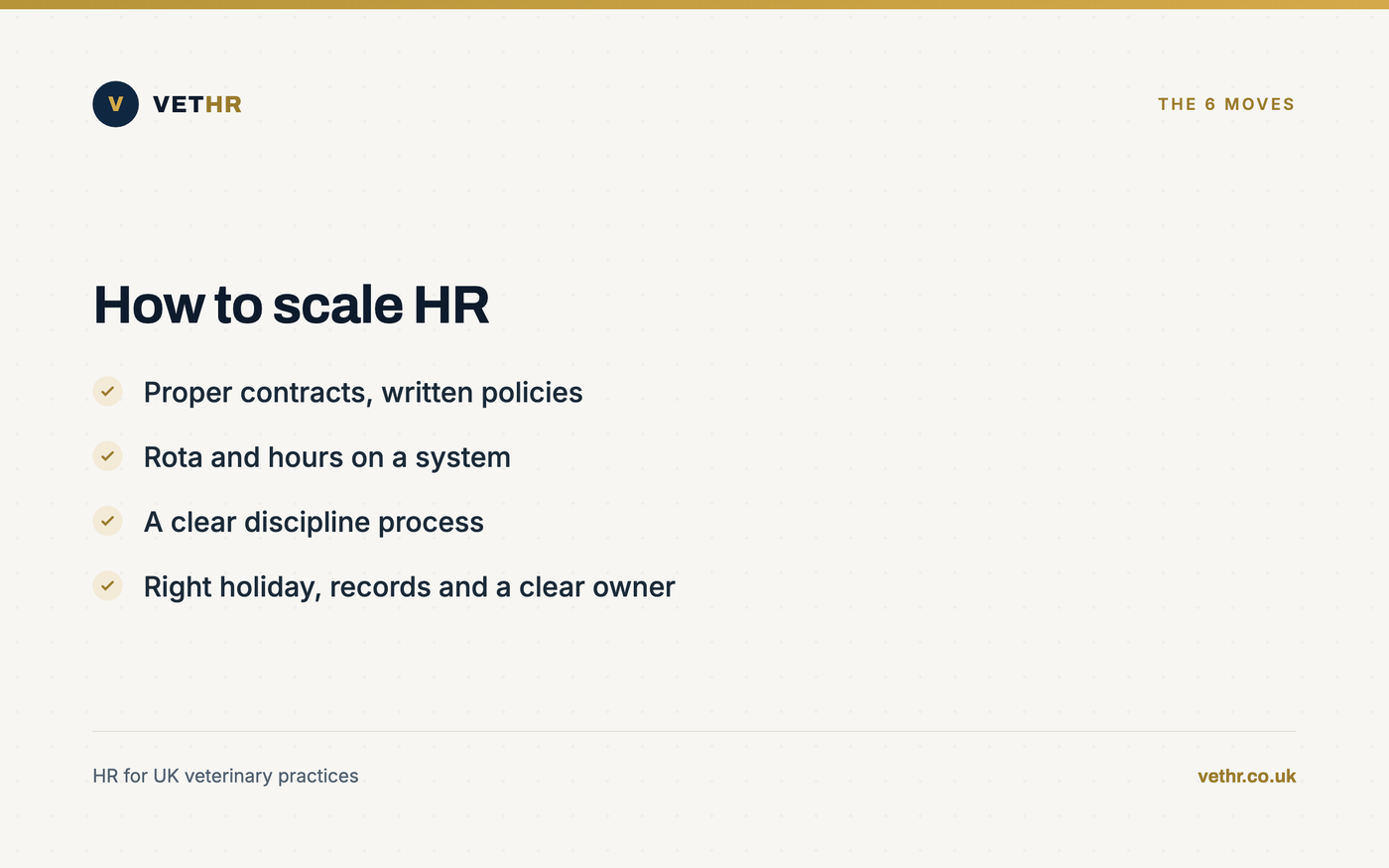
Scaling HR well comes down to six moves: proper contracts, written policies, systems for rota and hours, a clear process for the hard cases, correct holiday and records, and a decision on who owns HR. Done in roughly that order, they turn a fragile setup into one that holds as the team grows.
Two of these carry hard duties as you scale. A written statement of employment particulars is a day-one right, so the principal statement must be given on the first day, according to GOV.UK. And the Acas Code on discipline and grievance is the minimum a tribunal expects, with how you handled a case taken into account if it ever reaches one, as Acas sets out.
Not sure which move to make first? Book a free HR health check and we will look at where your practice is now and what growth is about to demand, then give you a ranked, honest plan. No pressure, no jargon, nothing sold for the sake of it.
A second site is where informal HR finally runs out of road. Suddenly you are coordinating rotas across locations, applying policies consistently in two places, and managing people you do not see every day. What one person held in their head no longer travels, and the gaps show quickly.
The fix is standardising without flattening. Contracts, policies and the rota should work the same way across sites, so fairness is visible and payroll is clean, while each location keeps the local feel that made it work. Shared staff systems are what make that possible, because they give every site one source of truth.
This is also the point where outside help usually pays for itself. Standardising people operations across two sites is a project, and doing it while running both is hard. A specialist who has done it before can set the foundations once, so the third site is a copy-paste rather than a fresh scramble.
Standardising people operations does not mean making every site identical in character. The aim is consistency where it protects people and the practice, in contracts, pay, holiday and the disciplinary process, while leaving room for each location to keep what makes it work. Fair and consistent is not the same as uniform and cold.
The way to hold both is to systematise the rules and personalise the relationships. Let the contracts, policies and rota run the same way everywhere, so nobody feels treated differently, then let each site lead, hire and care for its own team in its own way. The system carries the fairness, and the people carry the culture.
Done well, this is what lets a practice grow without feeling swallowed by process. Staff get the security of clear, even-handed treatment, owners get a practice that scales, and the local feel that made the first site special survives into the second and the third. It is also a recruitment advantage, because a practice that is clearly fair yet still personal is one people want to join and stay at.
A growing practice rarely needs a full-time HR manager, but it does need expertise on tap. A team of fifteen to forty does not generate full-time HR work, so a full salary is poor value, yet doing it all yourself stops being realistic. The answer is usually support sized to the workload.
Outsourced support gives you senior expertise without a senior salary, plus continuity that does not vanish when one person is off. Cost depends on your size and what you need, so we quote per practice in writing after a free check rather than publishing a figure. You can take HR consultancy for the setup, ongoing monthly support, or both.
Whatever you choose, the principle is the same: put the foundations in before growth forces the issue. Contracts, policies and systems built early scale quietly. The same things bolted on mid-crisis cost more and wobble. Growth is far more enjoyable when the people side simply keeps up.
There is no single number, but the strain usually shows between roughly ten and twenty staff, or when a second site appears. The trigger is friction rather than headcount: when you cannot answer people questions quickly, or rules are applied unevenly, formal HR foundations have become worth the effort.
Usually not until it is fairly large. A team of fifteen to forty rarely generates full-time HR work, so a full salary is poor value and a single hire is a single point of failure. Most growing practices get better cover from outsourced support sized to the actual workload, then revisit as they scale further.
Standardise the contracts, policies and rota so they work the same way in both places, then run them on shared systems that give every site one source of truth. That keeps fairness visible and payroll clean while letting each location keep its own character. Setting it up once, properly, is what makes a third site easy.
Contracts, almost always. Make sure every team member has a proper, current contract issued on day one, because that is both a legal duty and the foundation everything else sits on. Policies and systems come next, but a practice that is hiring without solid contracts is carrying the most avoidable risk first.
They replace the parts that should never have been informal, the rota, the hours, the records, while leaving the human management to you. A system does not manage people; it removes the admin and the guesswork so you can. For a growing practice, that is exactly the load worth lifting off the owner.
HR for a growing veterinary practice is not about adding bureaucracy. It is about replacing the informal arrangements that quietly stop scaling with foundations that hold: proper contracts, written policies, shared systems and a clear owner. Put them in before growth forces the issue, and the people side keeps pace instead of holding you back. The practices that scale best are simply the ones that built those foundations a little before they strictly needed them.
If your practice is growing and the admin is starting to bite, start with where the strain is. Book a free HR health check, or explore our staff systems and HR consultancy built for practices doing exactly this. Nothing sold that you do not need.
The Vet HR Team provides HR consultancy and white-labelled staff systems exclusively to UK veterinary practices.
Read next: From Spreadsheet to System.
Contracts, rotas, holiday, a difficult conversation. Tell us what you are dealing with and we will come back within one working day. Nothing to sign up to.
Got it. We will come back to you within one working day. If you do not see a reply, please check your spam folder.
