Last updated: 25 June 2026
TL;DR: Employment contracts for veterinary staff must set out the core terms in writing from day one, the job, pay, hours, holiday and more. Getting them right protects your practice when something goes wrong, and getting them wrong is where most disputes start. This guide covers the eight things every contract should include, how a contract differs from the legally required written statement, the common mistakes in veterinary practices, and when to update.
A contract feels like paperwork until the day you need it to settle something. A disputed shift pattern, an exit that turns sour, a question over notice. At that point a clear, current contract is the difference between a quick resolution and a slow, expensive argument. Here is how to get yours right.
Employment contracts for veterinary staff matter because they are both a legal duty and your best protection in a dispute. They set shared expectations on pay, hours and conduct, and they give you firm ground to stand on when something is challenged. Without them, every disagreement becomes one person’s memory against another’s.
They are also a retention tool, which is easy to miss. In the RCVS Surveys of the Professions 2024, the share of vets intending to stay in the profession for five or more years fell to 75 percent, from 79 percent in 2019, according to the RCVS. Clear, fair terms signal a practice that is well run, and that is part of why people stay.
The risk of getting it wrong is concrete. A missing or out-of-date contract weakens your position the moment a claim appears, and it is exactly the gap that turns a manageable situation into a costly one. The paperwork is cheap. The absence of it rarely is.
Not quite, and the difference matters. A written statement of employment particulars is a legal minimum you must give in writing; a contract is the fuller agreement that usually contains it. GOV.UK is explicit that the written statement “is not an employment contract,” so treating one as the other leaves gaps.
The timing is a day-one duty. The principal statement must be provided on the employee’s first day, with a wider written statement following within two months, according to GOV.UK. Many practices issue contracts late or after a probation period, which already breaches that day-one requirement.
In practice, a well-drafted contract handles both jobs at once. It satisfies the written-statement duty and adds the protective detail a bare statement omits, such as restrictive terms, confidentiality and a clear link to your policies. That is why issuing a proper contract on day one is simpler than juggling two documents.
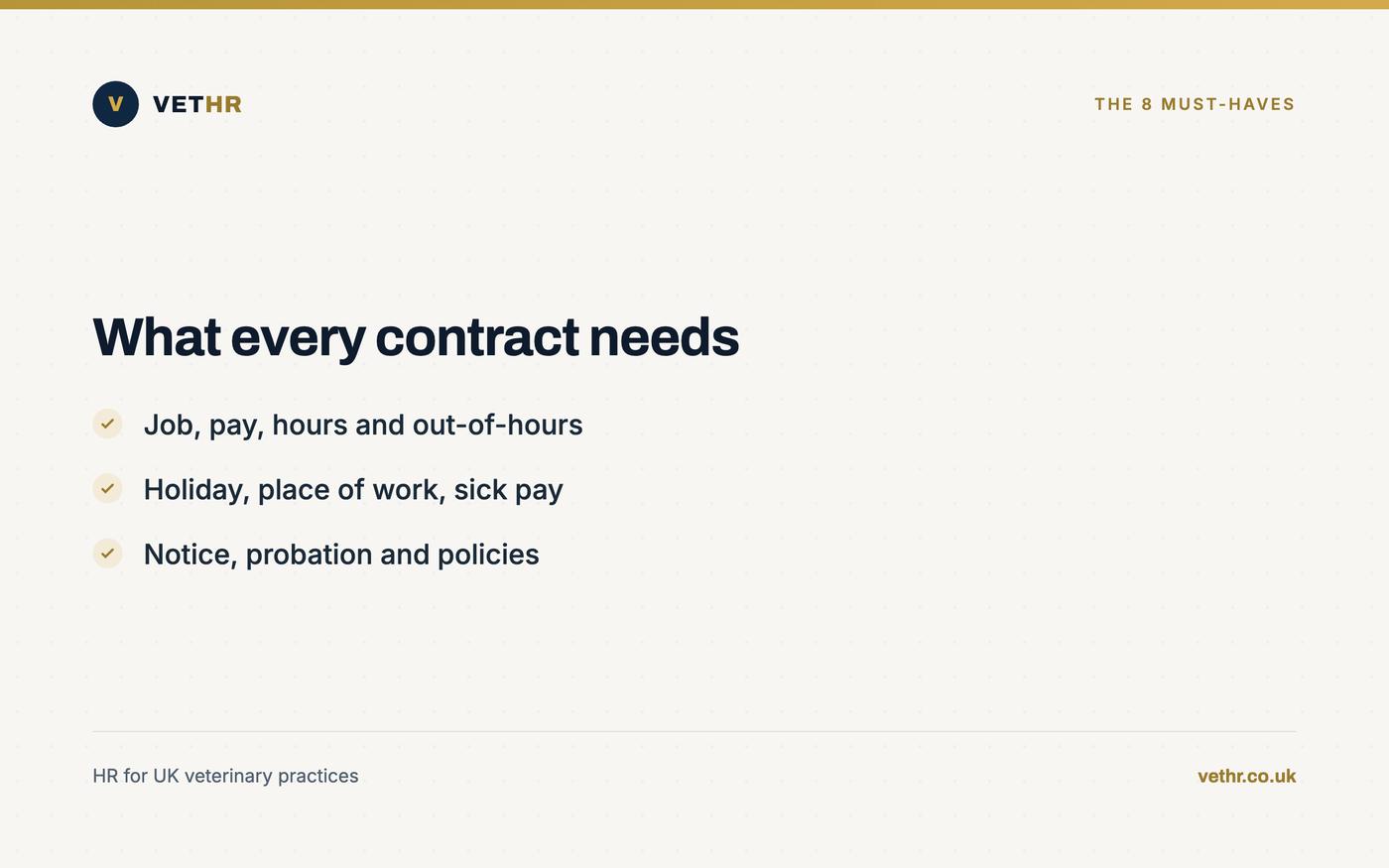
Every employment contract for veterinary staff should cover eight essentials, most of which the law requires in the day-one statement anyway. Get these right and you meet your legal duty and remove the ambiguity that fuels most disputes. Get them vague and you store up arguments for later.
Holiday deserves extra care, because the rules changed. Entitlement for irregular-hours and part-year workers now accrues based on hours worked for leave years from 1 April 2024, as set out on the GOV.UK holiday entitlement guidance. A contract that still describes the old method is out of date the day it is signed.
Not sure your contracts cover all eight? Book a free HR health check and we will review what you issue today against the current rules, then tell you plainly what is missing. You can also see how we build compliant veterinary employment contracts for each role. No pressure, no jargon.
The same handful of mistakes appear again and again, and all are avoidable. Knowing them is half the fix, because each one is a quiet gap that only shows itself under pressure. None requires a lawyer to spot; they require someone to actually read the contracts against today’s rules.
The thread through all five is drift. A contract is correct when signed, then the law moves, the role changes and the document stays still. That is why a contract is not a one-off task but something to review, which brings us to roles and timing.
Issuing a contract properly is as important as drafting it well. Provide it on or before the first day, give the employee time to read it, and keep a signed copy on file. Digital is fine, as long as it is secure and retrievable. A contract that exists but was never signed, or cannot be found when you need it, offers far less protection than most owners assume.
Storage matters more as you grow. Personal data in a contract must be held securely and kept up to date, so a shared drawer of paper is rarely the right answer past a handful of staff. Keeping contracts, signatures and any agreed changes in one place means you can produce the correct version quickly if a question ever arises.
Finally, treat issuing as a repeatable process, not a one-off. A simple checklist for every new starter, covering the contract, the written statement, the right-to-work check and policy sign-off, stops the day-one duty slipping when the practice is busy. None of this needs a lawyer; it needs a system and a habit, which is exactly what good HR support sets up once so it runs by default.
Yes. A single template stretched across the whole practice is one of the most common gaps. A vet, a registered nurse, a receptionist and someone providing freelance vet cover do genuinely different jobs, on different terms, and their contracts should reflect that rather than paper over it.
The clinical roles carry specifics an office template misses entirely. On-call and out-of-hours patterns, professional registration, indemnity expectations and continuing development all belong in the right contracts. Leaving them out does not remove the obligation; it just removes the clarity when a question arises.
Freelance vet cover is its own case again. The terms, status and pay arrangements differ from an employee’s, and using an employee contract for non-employed cover, or the reverse, creates real risk. Matching the document to the actual working relationship is the safe approach, and it is exactly what a review checks.
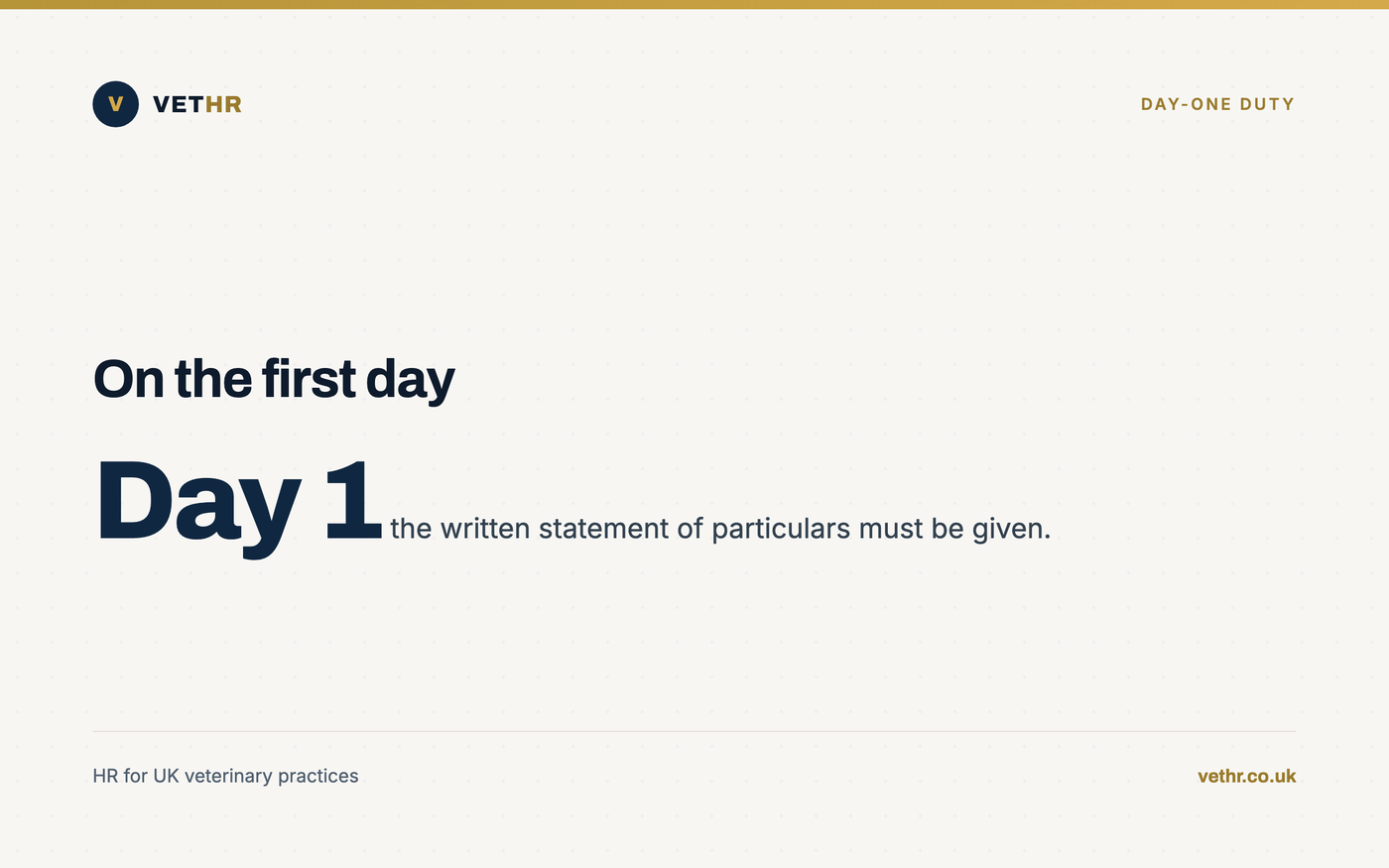
The principal written statement of particulars is a day-one right, so it must be given on the employee’s first day, with a wider statement within two months, according to GOV.UK. In practice, issuing a full contract on or before the first day is the cleanest way to meet that duty, rather than waiting until probation ends.
A written statement meets the legal minimum, but GOV.UK is clear it “is not an employment contract.” A full contract adds the protective detail a statement omits, such as confidentiality, restrictive terms and a clear link to your policies. For most practices, a single well-drafted contract that contains the statement is simpler and safer.
Yes, ideally. While the legal essentials are the same, the specifics differ: hours, on-call patterns, pay, registration and development expectations all vary by role. A contract tailored to a registered nurse, a vet or a receptionist removes ambiguity, where a single stretched template tends to create it.
Review them whenever the law changes, the role changes or pay changes, and at least once a year as a baseline. Employment rules shift most years, and a contract that still uses old wording, such as the pre-2024 holiday method for irregular hours, is already out of date. An annual check keeps them current by default.
Usually only with the employee’s agreement, since terms cannot simply be imposed. Changes are normally made through consultation and consent, and they must be confirmed in writing, with GOV.UK requiring notice of a change within one month. Handling that process properly is exactly where HR support helps you avoid a dispute.
Employment contracts for veterinary staff are not box-ticking. They are the quiet infrastructure that holds when a working relationship is tested, and the gap that costs you when they are missing or out of date. The eight must-haves above are not difficult; they simply need issuing on time and keeping current. A practice that does both has removed the single biggest source of avoidable HR disputes before one ever starts.
If you are not certain yours hold up, the quickest fix is a second pair of eyes. Book a free HR health check, or see how we build veterinary employment contracts and the HR consultancy around them. Nothing sold that you do not need.
The Vet HR Team provides HR consultancy and white-labelled staff systems exclusively to UK veterinary practices. We are HR and documentation specialists, not a law firm.
Read next: The RVN Employment Contract and Fixed Term Contracts in a Veterinary Practice.
Contracts, rotas, holiday, a difficult conversation. Tell us what you are dealing with and we will come back within one working day. Nothing to sign up to.
Got it. We will come back to you within one working day. If you do not see a reply, please check your spam folder.
